Weekend links 495

klee.jpg

Angelus Novus (1920) by Paul Klee.

• “Compared to [László] Krasznahorkai’s earlier fiction, Baron Wenckheim’s Homecoming is funnier and more stylistically accessible—despite its length and seemingly endless sentences—but it is also his most unremittingly ruthless work,” says Holly Case. Elsewhere: “Baron Wenckheim’s Homecoming may not bring joy or consolation, but reading it is a mesmerisingly strange experience: a slab of late modernist grindcore and a fiercely committed exercise in blacker-than-black absurdity,” says Sukhdev Sandhu.

Zeitraffer (“Time-lapse“) is an exhibition devoted to Tangerine Dream which opens at the Barbican, London, in January. Also coming in January is a new album, Recurring Dreams, by the current iteration of the group which will be available on CD and double vinyl. I was impressed by the last TD release, Quantum Gate, so I’m looking forward to this even if it is only a reworking of popular pieces from the Virgin years.

• RIP Gershon Kingsley, an electronic music pioneer best known for the silly but fun albums he made with Jean-Jacques Perrey, and for being the composer of that evergreen synthesizer novelty, Popcorn.

The first major study in English of ancient Greek sexuality—especially the way relationships between men were both common and celebrated as a perfect embodiment of love—A Problem in Greek Ethics helped set the stage for the modern-day gay rights movement. But it did so surreptitiously, behind closed doors, as required by the times. Symonds printed it privately in 1883; a print run of just 10 copies reduced the risk that it would fall into the wrong hands. The typesetter complained about the content. Symonds circulated it cautiously, to people he trusted or had reason to think would be discreet. Until now, researchers believed that only five copies survived.

Rachel Wallach on the discovery of a sixth copy of John Addington Symonds’ landmark study

Contagious Magick of the Super Abundance is a book of art by the late Ian Johnstone, former partner of John Balance and cover artist for some of the last releases by Coil.

Dennis Cooper‘s favourite fiction, poetry, non-fiction, film, art, and internet of 2019. Thanks again for the link here!

• At the BFI: Hannah McGill on the umbrellas of cinema, and Jasper Sharp on 10 essential films by Yasujiro Ozu.

• Bobby Krlic, aka The Haxan Cloak, talks to Claire Lobenfield about creating the soundtrack for Midsommar.

Joker and Chernobyl composer Hildur Guðnadóttir: “I’m treasure hunting”.

Joshua Rothman on how William Gibson keeps his science fiction real.

Samantha Rose Hill on Walter Benjamin’s last work.

Scientific phenomena photographs of the year.

The Dream Before (1989) by Laurie Anderson | Angel Tech (1994) by The Grid feat. Sheila Chandra | Angel Tech (1994) by Pete Namlook & Bill Laswell

Weekend links 493

gaycomix.jpg

Art by Rand Holmes for Gay Comix No. 1, September 1980.

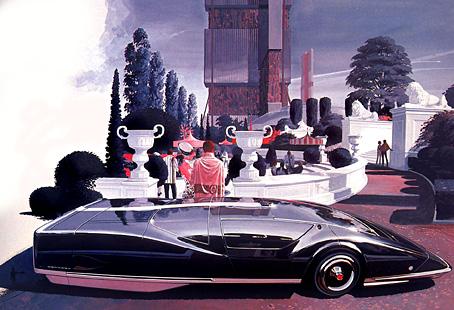
• In the universe next door, Los Angeles in November, 2019 looks like the drawings in the Blade Runner Sketchbook (1982). The book has been out of print for many years but available online for a while, although seldom in a downloadable form. A recent upload at the Internet Archive remedies this. In addition to the familiar Syd Mead designs for flying cars and street furniture there are some Moebius-like doodles by Ridley Scott, and Mead’s design for Tyrell’s cryogenic crypt, a detail that would have formed part of an unfilmed sub-plot.

• RIP Howard Cruse, comic artist and pioneering editor of the first few issues of Gay Comix in the 1980s. Cruse produced work outside the gay sphere (I first encountered his strips in Heavy Metal) but the stories that he and other artists created for Gay Comix (later Gay Comics) were some of the first by lesbians and gay men chronicling their own lives, as opposed to porn fantasies or the more recent trend of bolting a token sexuality to a superhero. John Seven talked to Cruse about his career in 2007.

• “On the eve of the First World War Stefan George had started recruiting his own twink army…” Well, if you really must have an army… Strange Flowers presents part one of a guide to the city of Vienna.

In Wild Air, 2016–2018: all 72 of Heath Killen’s requests for a list of six interesting things from artists, writers, scientists, ecologists, musicians, historians and others. My answers are at number 55.

• “Satan is a friend of mine”: Sander Bink on a forgotten occult novel, Goetia (1893) by Frits Lapidoth.

• Picturing a voice: Rob Mullender-Ross on Margaret Watts-Hughes and the Eidophone.

• “They broke the rules”: Killian Fox on the film posters of the French New Wave.

• At Dennis Cooper’s: Jan Švankmajer Day.

Ogi No Mato (1976) by Ensemble Nipponia | Rêve (1979) by Vangelis | Blade Runner Esper “Retirement” Edition, Part III (1982)

Weekend links 489

wyrding.jpg

Typhonic Neural Tantra by The Wyrding Module.

• November 2019, as many people have been noting, is the month in which Ridley Scott’s Blade Runner takes place. At Dangerous Minds Paul Gallagher writes about the unrelated William Burroughs script whose title was borrowed for Scott’s film.

• More Ridley Scott (sort of): disco was still a big thing when Alien was in the cinemas 40 years ago, so Kenny Denton reworked Jerry Goldsmith’s Alien score into a disco single which he released under the name Nostromo.

• “The Count of Monte Cristo is one of the most exciting novels ever written and on the other hand is one of the most badly written novels of all time and in any literature.” Umberto Eco on the cult of the imperfect.

• Jonathan Glazer has made a short film, The Fall, for the BBC but the corporation’s restrictions mean that (for the moment) it’s difficult to see if you live outside the UK.

• New albums at Bandcamp: Typhonic Neural Tantra by The Wyrding Module, and Emotional Freedom Techniques by Jon Brooks (aka The Advisory Circle).

• Hawkwind dancer Miss Stacia and the Barney Bubbles estate have made a line of T-shirts based on Barney Bubbles’ Space Ritual design.

Walter Murch and Midge Costin on the art of cinematic sound design.

Ivana Sekularac on the former Yugoslavia’s brutalist beauty.

• Congratulations to Strange Flowers on its 10th anniversary.

Geoff Manaugh on the witch houses of the Hudson Valley.

• At Dennis Cooper’s: 19 experimental horror films.

Fall (1968) by Miles Davis | The Fall (2011) by The Haxan Cloak | Fall (2014) by The Bug (feat. Copeland)

Weekend links 481

gaussot.jpg

L’Hamestoque (1977) by Christine Gaussot.

• Another announcement from Strange Attractor Press: Of Mud & Flame: A Penda’s Fen Sourcebook edited by Matthew Harle and James Machin will be published at the end of October. Among the contents will be the screenplay of David Rudkin’s cult television play, an item that’s always been impossible to find in print.

• A trailer for Journey to the Beginning of Time (1955), another semi-animated fantasy film by Karel Zeman which will released on disc next month by Second Run.

• “There was craziness in getting lost and dizzy.” Stereolab choose favourite songs from their back catalogue.

E=MC² (1976), an album of spacey jazz-electronica by Teddy Lasry which has never been reissued.

• “Why do so many book covers look the same? Blame Getty Images,” says Cory Matteson.

• Mix of the week: The Ephemeral Man’s Teapot by The Ephemeral Man.

Masataka Nakano has been photographing a deserted Tokyo for almost 30 years.

• Beyond the bounds of depravity: an oral history of David Cronenberg’s Crash.

Woodblocks in Wonderland: The Japanese Fairy Tale Series.

• A new novel by M. John Harrison is always a good thing.

Hamid Drake‘s favourite music.

Warm Leatherette (1980) by Grace Jones | Crash (1980) by Tuxedomoon | A Crash At Every Speed (1994) by Disco Inferno

Hawkwind: Days of the Underground

hawkwind.jpg

As mentioned at the weekend, Joe Banks’ account of the first ten years of Hawkwind will be published by Strange Attractor Press later this year with a wraparound cover of my design. I never expected to be doing anything else for Hawkwind after moving on to other things in 1985, but it was the group’s first decade of music that fuelled the drawings which brought me to their attention, so this cover design brings everything full circle. The earliest of my Hawkwind drawings dates to 1979 which means this cover is also an anniversary piece.

The design combines Barney Bubbles’ Space Ritual template with elements of the art he created before and afterwards, notably the inner and outer sleeve of Doremi Fasol Latido, and the futuristic Art Deco of his tour poster for The “1999” Party. All the Bubbles Hawk-art up to and including Space Ritual is a blend of the ancient (Egypt, tribal motifs, characters that resemble pirates or barbarians), the previous century (Art Nouveau in particular), and the far future as depicted in comics and pulp magazines. I wanted to reflect this blend without being too imitative of the details, so the cover works a variation on Space Ritual, with a similar hieratic woman as the focus, and a margin of stylised flames separating the foreground from Laurie Lewis’s photos of the band (the latter are unused shots from the same session used for Space Ritual).

haberfield.jpg

Art by Bob Haberfield, 1970.

All the background elements run across the wrap but this hasn’t been revealed yet so you’ll have to wait a while to see the full design. The flames are based on Tibetan designs in a nod to the ancient side of the equation, as well as Bob Haberfield’s covers for the Moorcock novels published by Mayflower in the early 70s, many of which featured art derived from Tibetan Buddhism. (And one of the Mayflower Moorcocks, The Black Corridor, is the origin of the monologue of the same name on Space Ritual.) The full wrap shows a futuristic city whose Frank R. Paul-derived architecture is either on fire or menaced by a wall of encroaching flames. Many of Hawkwind’s songs of the period concern flight from cities or from the Earth itself—Born To Go, Time We Left (This World Today)—so the back cover also has a number of vehicles fleeing the scene: the radical escapism of the book’s subtitle in literal form. “Sign my release from this planet’s erosion,” as Nik Turner sings in Brainstorm.

Continue reading “Hawkwind: Days of the Underground”