Bosch details

bosch01.jpg

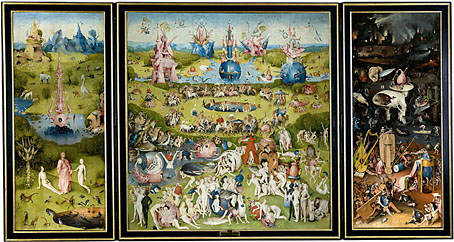
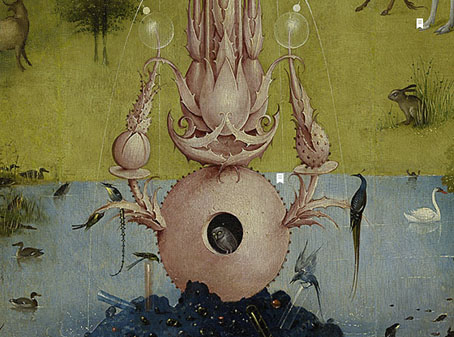
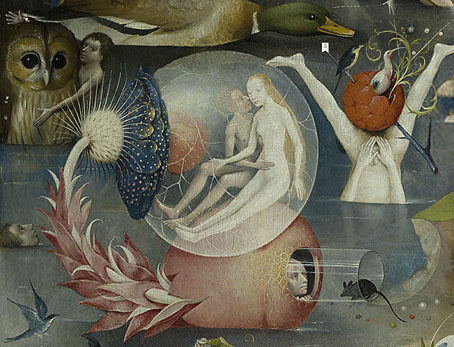
In which the indelible strangeness of Hieronymus Bosch’s triptych, The Garden of Earthly Delights (c. 1490–1510), is presented to us in the highest resolution. (I should say presented again since Google’s Art Project/Cultural Institute/whatever-it’s-called-this-week had a browsable version of their own in 2009 but this seems to have vanished. So much for the primacy of the Googleverse, etc, etc.) I’d always encourage people to see paintings in situ when possible but it remains a fact that very old and well-known works of art are difficult to study for any length of time in a crowded gallery. The more valuable works are also closely guarded by attendants who dissuade anyone from getting too close to those fragile surfaces, so it’s left to books or websites such as this one to give us the details. Not all paintings warrant this kind of attention, of course, but the crowded panels of Bosch and Brueghel the Elder certainly do. In addition to wandering among the figures you can also opt for a guided tour although bear in mind that the meaning (if any) of many of these details has never been resolved. Via MetaFilter.

bosch02.jpg

bosch03.jpg

Continue reading “Bosch details”

Paul Laffoley, 1940–2015

laffoley1.jpg

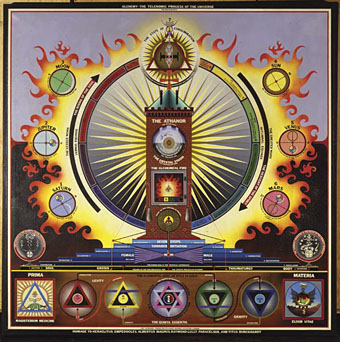
Alchemy: The Telnomic Process of the Universe (1973).

Another week, another incomparable artist gone. This small selection of Laffoley’s unique art and sculpture manages to combine references to (among other things) alchemy, William Blake, Charles Baudelaire, Oscar Wilde, HP Lovecraft, Mark of the Vampire, and Night of the Demon. And this is only a fraction of his work. Richard Metzger has a memorial post at Dangerous Minds together with more paintings and some video links. There’s more at the official website and Kent Fine Art. It’s good to read that the University of Chicago Press will be publishing The Essential Paul Laffoley in March, 2016.

laffoley2.jpg

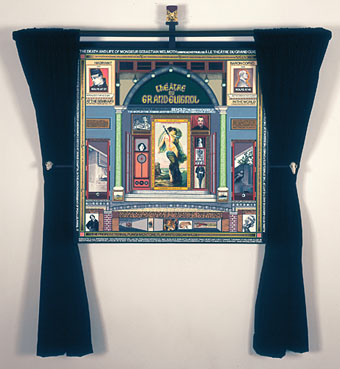
The Death and Life of Monsieur Sebastian Melmoth: Au Théâtre du Grand Guignol (2001–2003).

laffoley3.jpg

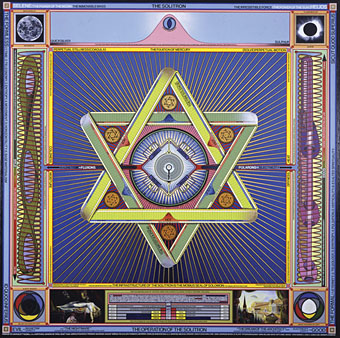
The Solitron (1997).

Continue reading “Paul Laffoley, 1940–2015”

Weekend links 284

molinier.jpg

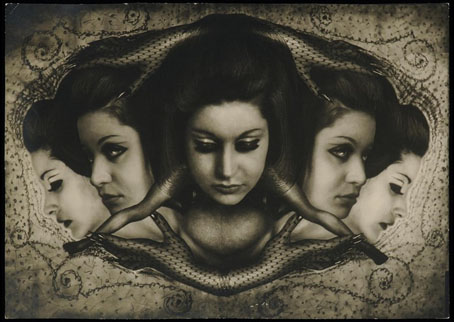
Les Hanel I by Pierre Molinier. There’s more at The Forbidden Photo-Collages of Pierre Molinier.

• Western anti-hero Josiah Hedges, better known as Edge, was the creation of prolific British author Terry Harknett. The famously violent Edge novels, credited to “George G. Gilman”, were ubiquitous on bookstalls in the 1970s. They were Harknett’s most successful works, and are still collectible today; if you’re interested there are 61 of them to search for. Amazon Originals have just launched Edge as a new TV series although anything for a mass audience is unlikely to retain the exploitative qualities of novels that often sound like pulp precursors of Blood Meridian.

Related: Terry Harknett discusses the creation of the Edge series at Drifter’s Wind; Ben Bridges on Harknett’s career, including a look at the writer’s many other Western and thriller novels; Bill Crider on Edge, Harknett and the British group of Western novelists known as “The Piccadilly Cowboys”.

• Boyd McDonald’s queer-eye film guide, Cruising the Movies: A Sexual Guide to Oldies on TV (1985), has been republished by Semiotext(e) in an expanded edition. Related: True Homosexual Experiences: Boyd McDonald and Straight to Hell by William E. Jones.

• “…a film that plumbs the dark recesses of all our imaginations: dangerous, glorious, absurd, vivid and terrifying by turns.” Charlotte Higgins on her favourite film, The Red Shoes (1948).

Art Forms from the Abyss, a new collection of illustrations by Ernst Haeckel for the report of the HMS Challenger expedition (1872–76). Related: Silentplankton.com

• “The biggest kick I ever get is to find myself pursuing some group of images without knowing why,” says M. John Harrison in conversation with Tim Franklin.

• “Plots didn’t interest him much. They were just pegs on which to hang characters and language.” Barry Day on Raymond Chandler.

• “Zdeněk Liška’s music thrived in unrealities,” says David Herter in a lengthy appraisal of the great Czech film composer.

• At Dirge Magazine: S. Elizabeth delights in the dark decor of Dellamorte & Co.

• Nabokov scholar Brian Boyd selects his ten favourite Nabokov books.

• Mix of the week: The Ivy-Strangled Path Vol. XIII by David Colohan.

Take me to the cosmic vagina: inside Tibet’s secret tantric temple.

• Pour Un Pianiste (1974) by Michèle Bokanowski | 13’05” (1976) by Michèle Bokanowski | Tabou (1992) by Michèle Bokanowski

Bruegel’s sins

heyden01.jpg

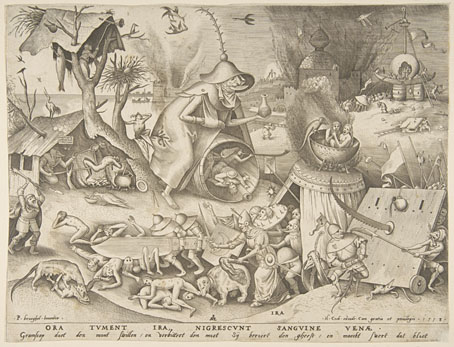
Anger (Ira).

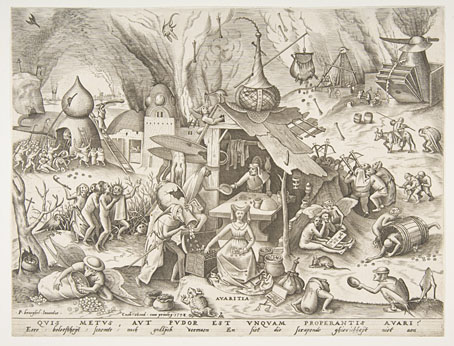
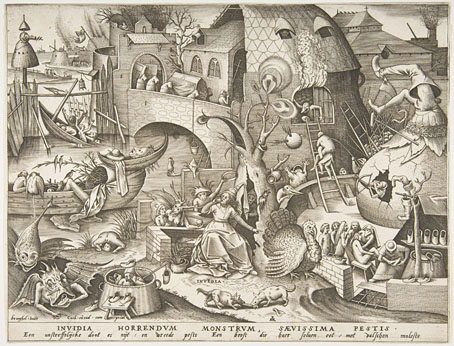
The sins are those that Christians used to regard as the seven deadly ones, presented as a series of bizarre phantasmagorias. The prints were engraved by Pieter van der Heyden in 1558 working from drawings made the year before by Bruegel the Elder. All the pictures here link to pages at the Metropolitan Museum of Art, NYC, and much bigger images which are essential if you want to scrutinise the wealth of strange detail.

heyden02.jpg

Avarice (Avaritia).

heyden03.jpg

Envy (Invidia).

Continue reading “Bruegel’s sins”

Weekend links 267

morgan.jpg

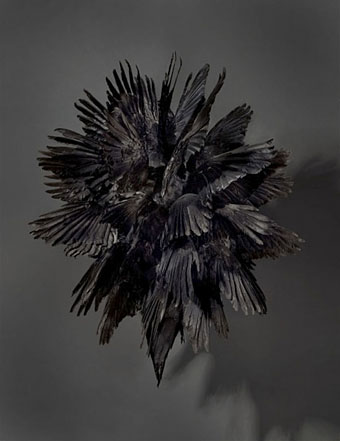
Black Fever (2010) by Polly Morgan.

• “She was something of an Auntie Mame figure for me. We spent years haunting secondhand bookstores in Berkeley, Los Angeles, and New York, talking for hours over ever more bizarre dishes of Chinese Hakka cuisine in a hole-in-the-wall eatery at Stockton and Broadway in San Francisco, watching Kenneth Anger flicks and the surrealistic stop-motion puppet masterpieces of Ladislas Starevich, which Tom Luddy would screen for us at the Pacific Film Archive, over and over again until our eyeballs nearly fell out.” Steve Wasserman remembers Susan Sontag.

California Dreams is “the first career-spanning compendium of Mouse’s work; it includes his recent landscapes and figurative paintings. Taken as a whole, the work is a weird, gilded, space-age, flame-licked way to chart the rise of late-twentieth-century youth culture”. Jeffery Gleaves on the psychedelic art of Stanley Mouse.

• “Not only does moral preoccupation corrupt the artfulness of fiction, but fiction is an inefficient and insincere vehicle for moralizing,” says Alice Gregory, joining Pankaj Mishra to address the question: “Do Moralists Make Bad Novelists?”

Nabokov’s posthumously published Lectures on Literature reprints a corny magazine ad that Nabokov liked to show to his students at Cornell, as an example of a certain kind of sunny American materialism and kitsch (or poshlost, in Russian): it’s an ad for flatware featuring a young housewife, hands clasped, eyes brimming as she contemplates a place setting. Nabokov titled it “Adoration of Spoons,” and it undoubtedly played a significant role in his creation of the suburban widow Charlotte Haze. From such strangely endearing trash was a masterpiece born.

John Colapinto reviewing Nabokov in America by Robert Roper

• “How many typefaces is too many typefaces?” asks Adrian Shaughnessy. “What happens to our ability to discriminate and exercise good judgment when we have a near-infinite number of possibilities?”

• At BUTT: a clip from one of the more dreamlike scenes in Wakefield Poole’s gay porn film, Bijou (1972). Poole’s “sensual memoir”, Dirty Poole, is published by Lethe Press.

John Banville reviews The Prince of Minor Writers, selected essays of Max Beerbohm edited by Phillip Lopate.

• My thanks once again to Dennis Cooper for featuring this blog on his list of cultural favourites.

• More Moogery: Sarah Angliss, Gazelle Twin and Free School in the Moog Sound Lab.

• Mix of the week: XLR8R Podcast 394 by Francesca Lombardo.

Atlas Obscura gets to grips with the enormous Devil’s Bible.

Feel You, a new song by Julia Holter.

Spoonful (1960) by Howlin’ Wolf | Spoon (1972) by Can | Spoon (2013) by Mazzy Star