Bruegel’s sins

heyden01.jpg

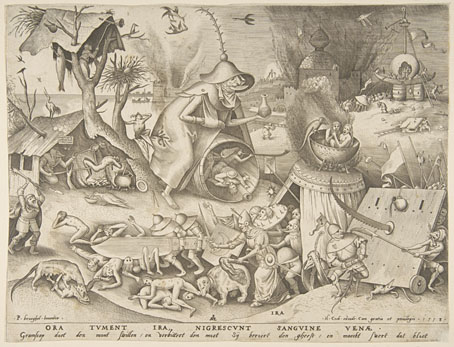
Anger (Ira).

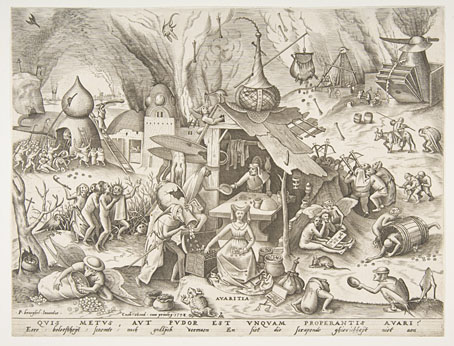
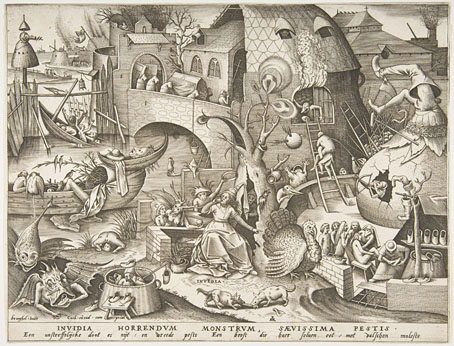
The sins are those that Christians used to regard as the seven deadly ones, presented as a series of bizarre phantasmagorias. The prints were engraved by Pieter van der Heyden in 1558 working from drawings made the year before by Bruegel the Elder. All the pictures here link to pages at the Metropolitan Museum of Art, NYC, and much bigger images which are essential if you want to scrutinise the wealth of strange detail.

heyden02.jpg

Avarice (Avaritia).

heyden03.jpg

Envy (Invidia).

Continue reading “Bruegel’s sins”

Weekend links 267

morgan.jpg

Black Fever (2010) by Polly Morgan.

• “She was something of an Auntie Mame figure for me. We spent years haunting secondhand bookstores in Berkeley, Los Angeles, and New York, talking for hours over ever more bizarre dishes of Chinese Hakka cuisine in a hole-in-the-wall eatery at Stockton and Broadway in San Francisco, watching Kenneth Anger flicks and the surrealistic stop-motion puppet masterpieces of Ladislas Starevich, which Tom Luddy would screen for us at the Pacific Film Archive, over and over again until our eyeballs nearly fell out.” Steve Wasserman remembers Susan Sontag.

California Dreams is “the first career-spanning compendium of Mouse’s work; it includes his recent landscapes and figurative paintings. Taken as a whole, the work is a weird, gilded, space-age, flame-licked way to chart the rise of late-twentieth-century youth culture”. Jeffery Gleaves on the psychedelic art of Stanley Mouse.

• “Not only does moral preoccupation corrupt the artfulness of fiction, but fiction is an inefficient and insincere vehicle for moralizing,” says Alice Gregory, joining Pankaj Mishra to address the question: “Do Moralists Make Bad Novelists?”

Nabokov’s posthumously published Lectures on Literature reprints a corny magazine ad that Nabokov liked to show to his students at Cornell, as an example of a certain kind of sunny American materialism and kitsch (or poshlost, in Russian): it’s an ad for flatware featuring a young housewife, hands clasped, eyes brimming as she contemplates a place setting. Nabokov titled it “Adoration of Spoons,” and it undoubtedly played a significant role in his creation of the suburban widow Charlotte Haze. From such strangely endearing trash was a masterpiece born.

John Colapinto reviewing Nabokov in America by Robert Roper

• “How many typefaces is too many typefaces?” asks Adrian Shaughnessy. “What happens to our ability to discriminate and exercise good judgment when we have a near-infinite number of possibilities?”

• At BUTT: a clip from one of the more dreamlike scenes in Wakefield Poole’s gay porn film, Bijou (1972). Poole’s “sensual memoir”, Dirty Poole, is published by Lethe Press.

John Banville reviews The Prince of Minor Writers, selected essays of Max Beerbohm edited by Phillip Lopate.

• My thanks once again to Dennis Cooper for featuring this blog on his list of cultural favourites.

• More Moogery: Sarah Angliss, Gazelle Twin and Free School in the Moog Sound Lab.

• Mix of the week: XLR8R Podcast 394 by Francesca Lombardo.

Atlas Obscura gets to grips with the enormous Devil’s Bible.

Feel You, a new song by Julia Holter.

Spoonful (1960) by Howlin’ Wolf | Spoon (1972) by Can | Spoon (2013) by Mazzy Star

LVCIFER

lucifer1.jpg

An engraving of Dante’s encounter with Lucifer/Satan at the end of the Inferno. Illustrators of Dante have given us a number of depictions of Dante’s fallen angel—a monstrous beast with multiple wings and three heads; icy blasts from the wings travel through the circles of Hell—but this is one I’d not seen before. The engraving is by Cornelis Galle the Elder after a drawing by Lodovico Cardi (also known as Cigoli), and it’s unusual for showing Lucifer in full rather than the more common partial view of the monster imprisoned in the ice.

lucifer2.jpg

The engraving is another of those that depict several events in one image, with the figures of Virgil and Dante shown crossing the plain of ice then climbing down Lucifer’s body; passing the centre of the world Virgil (now carrying Dante) changes direction to account for the reversal of gravity. Climbing a rocky path, they emerge at the foot of Mount Purgatory to find Lucifer’s legs protruding from the stone. The reversal of gravity is one of the more advanced ideas in The Divine Comedy, as is the general idea of a spherical Earth. What Dante doesn’t mention, and few artists show, is Lucifer’s sexless groin positioned at the Centrum Mundi, a detail accounted for here. (Larger version.)

lucifer3.jpg

Elsewhere on { feuilleton }
The etching and engraving archive

Previously on { feuilleton }
Lachman’s Inferno
Hell, a film by Rein Raamat
Inferni
Mirko Racki’s Inferno
Albert Goodwin’s fantasies
Harry Lachman’s Inferno
Melancholy Lucifers
Maps of the Inferno
A TV Dante by Tom Phillips and Peter Greenaway
The last circle of the Inferno
Angels 4: Fallen angels

Weekend links 264

dakin.jpg

Stonehenge Suite, No.10 (1977) by Malcolm Dakin.

• “Part of me always wanted to write a teatime drama. That’s something that I wanted to get out of my system,” says director Peter Strickland. The results may be heard here. In the same interview there’s news that Strickland will be adapting Nigel Kneale’s The Stone Tape for radio later this year.

• “He was, as one obituary stated in terms unusually blunt for the time, ‘not as other men’.” Strange Flowers on the eccentric and profligate Henry Cyril Paget (1875–1905) aka The Dancing Marquess.

• “Please tell Mr Jagger I am not Maurits to him.” MC Escher rebuking The Rolling Stones. The artist is the subject of a major exhibition at the National Galleries of Scotland from June 27th.

Often mentioned in the same breath as works of James Joyce and Samuel Beckett, Ó Cadhain’s novel is, in some ways, even more radically experimental. For starters, all the characters are dead and speaking from inside their coffins, which are interred in a graveyard in Connemara, on Ireland’s west coast. The novel has no physical action or plot, but rather some 300 pages of cascading dialogue without narration, description, stage direction, or any indication of who’s speaking when.

Niamh Ní Mhaoileoin on the newly-translated Cré na Cille (The Dirty Dust) by Máirtín Ó Cadhain

Paul Woods examines “10 Edgy Properties No Film Producer Dared To Touch
(Yet)”. No. 2 is David Britton’s Lord Horror.

Mallory Ortberg ranks paintings of Saint Sebastian “in ascending order of sexiness and descending order of actual martyring”.

The Sign of Satan (1964): Christopher Lee in a story by Robert Bloch for The Alfred Hitchcock Hour.

Sympathy For The Devil – The True Story of The Process Church of the Final Judgment.

• At Dangerous Minds: Paul Gallagher on the seedy malevolence of Get Carter (1971).

• Mix of the week: Sonic Attack Special – Earth by Bob’s Podcasts.

Sanctuary Stone (1973) by Midwinter | The Litanies Of Satan (1982) by Diamanda Galás | Sola Stone (2006) by Boris

Lachman’s Inferno

lachman.jpg

I’ve written already about Harry Lachman’s remarkable melodrama, Dante’s Inferno (1935), but the links to the Inferno sequence are now defunct so here’s an updated one. Lachman was an artist before he became a production designer for Rex Ingram, and later a director in his own right. The French government awarded him the Légion d’Honneur for his painting but it’s this short piece of film for which he’s remembered today, a dreamlike journey through the circles of Dante’s Hell intended as a warning to the crooked fairground owner played by Spencer Tracy. The sequence is notable for closely following Gustave Doré’s illustrations, and also for the surprising amount of naked flesh given that this was made when the Hays Code was in operation.

Previously on { feuilleton }
Hell, a film by Rein Raamat
Inferni
Mirko Racki’s Inferno
Albert Goodwin’s fantasies
Harry Lachman’s Inferno
Maps of the Inferno
A TV Dante by Tom Phillips and Peter Greenaway
The last circle of the Inferno