Weekend links 114

bowie.jpg

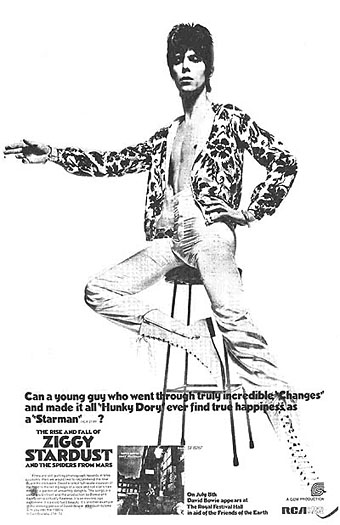
David Bowie’s cigaretted fingers and bulging silver crotch point the way to the future. This summer sees the fortieth anniversary of the Ziggy Stardust album’s release. The Melody Maker ad above can be found with a wealth of other Ziggy-related material at the very thorough Ziggy Stardust Companion site. For me the definitive artefact isn’t the album itself but DA Pennebaker’s film of the final concert from the 1973 tour; the songs really come alive and Bowie’s performance is overwhelmingly electric. Related: Cracked Actor, the BBC documentary from 1975 about Bowie’s post-Ziggy life on and off the stage.

• The week in books: Amanda Katz described the remarkable history of a single copy of The War of the Worlds by HG Wells then asked “Will Your Children Inherit Your E-Books?” | Bosnian novelist Aleksandar Hemon in The Browser’s FiveBooks interview put Blood Meridian on his list. | “Call me the greatest American novel”: Christopher Buckley on Moby-Dick. | The Brit Lit Map.

• For another anniversary, the Alan Turing centenary, there’s The Strange Life and Death of Dr Turing (part two here) and Breaking the Code (1996), Derek Jacobi playing the tragic genius in a biographical drama.

Commissioner of Sewers (1991) a William Burroughs documentary by Klaus Maeck in which the author reads some of his work and endures a Q&A session with surprising equanimity.

• Music, flesh and fantasy: When Mati Klarwein’s hyperactive paintings stole the psychedelic show.

• Move Over Casio: Teenage Engineering’s OP-1 Portable Synth Looks Cool, Does Everything.

• A retrospective of art by Madge Gill (1882–1961) at The Nunnery, London.

• “Art is unavoidably work”: Terre Thaemlitz interviewed.

• A trailer for Document: Keiji Haino.

WB Yeats, Magus

Pathétique 1 (1994) by Fushitsusha | Pathétique 2 (1994) by Fushitsusha.

Weekend links 113

leonard.jpg

Wunderkammer (2011) by Emma Leonard.

As someone who was eight years old at the time of the Apollo moon landing, I remember calculating that I would be thirty-nine in the magic year 2000 and wondering what the world would be like. Did I expect I would be living in such a world of wonders? Of course. Everyone did. Do I feel cheated now? It seemed unlikely that I’d live to see all the things I was reading about in science fiction, but it never occurred to me that I wouldn’t see any of them.

A quote from Of Flying Cars and the Declining Rate of Profit, an essay by David Graeber. Related: Another World: David Graeber interviewed by Michelle Kuo at Artforum.

Constellation, a series of portraits by Kumi Yamashita: “This body of work consists of three simple materials that, when combined, produce the portraits: a wooden panel painted a solid white, thousands of small galvanized nails, and a single, unbroken, common sewing thread.”

Nicole Rudick at The Paris Review on the history of psychedelic art. Related: The psychedelic art and design of Keiichi Tanaami. Also Manifesting the Mind: Footprints of the Shaman, a two-hour documentary about psychedelic drugs.

• Already mentioned here, The Lost Tapes, a 3-CD collection of previously unreleased recording by the mighty Can, is out on Monday. There’s a preview of ten of the tracks here.

• “I can’t think of anybody who would have a good word to say for centipedes…” Duncan Fallowell (a Can associate for many years) interviewed William Burroughs in 1982.

Herb Lubalin: American Graphic Designer and the Herb Lubalin Study Center’s Flickr sets.

Strange Flowers goes to the movies with everyone’s favourite Bavarian king, Ludwig II.

The Sphinx’s Riddle: The Art of Leonor Fini at the Weinstein Gallery, San Francisco.

• More Teutonica: A Spacemusic Primer by Dave Maier.

Van Dyke Parks: return of a musical maverick.

Forty Posters for Forty Years at Pentagram.

Donovan’s Colours (1968) by Van Dyke Parks | Sailin’ Shoes (1972) by Van Dyke Parks | Clang Of The Yankee Reaper (1975) by Van Dyke Parks.

Weekend links 109

magritte.jpg

Dreams before Surrealism: a sheet music cover from 1926 by René Magritte.

• The week in music: Listen to compositions by Annea Lockwood. | At the Free Music Archive: Uncomfortable Music, a tribute to David Lynch’s Eraserhead (and, it should be said, to Alan Splet’s unique soundtrack). | Alan Licht plays a track from Trout Mask Replica then loops some Donna Summer and improvises guitar noise over it. | Music Experiments with Terror: The Spooky Isles presents Joseph Stannard‘s list of recent eldritch sounds from British musicians.

Great art, or, let’s just say, more modestly, original art is never created in the safe middle ground, but always at the edge. Originality is dangerous. It challenges, questions, overturns assumptions, unsettles moral codes, disrespects sacred cows or other such entities. It can be shocking, or ugly, or, to use the catch-all term so beloved of the tabloid press, controversial. And if we believe in liberty, if we want the air we breathe to remain plentiful and breathable, this is the art whose right to exist we must not only defend, but celebrate. Art is not entertainment. At its very best, it’s a revolution.

Salman Rushdie on the censorship of art

• All Diamond, No Rough” says the School Library Journal about the first volume of The Graphic Canon. Volume two should be out in August.

Scientific American asks: Do Psychedelics Expand the Mind by Reducing Brain Activity?

• From 2010: A Dandy in Aspic – A letter from Derek Marlowe.

Tom Phillips and A Humument: how a novel became an oracle.

Timeline Maps at the David Rumsey Map Collection.

• Happy 50th birthday, A Clockwork Orange.

Jim Dandy (1956) by LaVern Baker | Larks’ Tongues in Aspic, part one (1972) by King Crimson, live on Beat Club.

Weekend links 107

schwabe.jpg

Le Faune (1923) by Carlos Schwabe.

• “When I recently attended a conference in China, many of the presenters left their papers on the cloud—Google Docs, to be specific. You know how this story ends: they got to China and there was no Google. Shit out of luck. Their cloud-based Gmail was also unavailable, as were the cloud lockers on which they had stored their rich media presentations.” Ubuweb’s Kenneth Goldsmith on why he doesn’t trust the Cloud.

• “I’m a poet and Britain is not a land for poets anymore.” A marvellous interview with the great Lindsay Kemp at Dangerous Minds. Subjects include all that you’d hope for: Genet, Salomé, David Bowie, Ken Russell, Derek Jarman, The Wicker Man and “papier maché giant cocks”.

• “As early as the 1950s, Maurice Richardson wrote a Freudian analysis which concluded that Dracula was ‘a kind of incestuous-necrophilious, oral-anal-sadistic all-in wrestling match’.” Christopher Frayling on the Bram Stoker centenary.

Björk gets enthused by (among other things) Leonora Carrington, The Hourglass Sanatorium and Alejandro Jodorowsky’s YouTube lectures.

• Before Fritz Lang’s Metropolis there was Algol – Tragödie der Macht (1920). Strange Flowers investigates.

marsh.jpg

David Marsh recreates famous album covers using Adobe Illustrator’s Pantone swatches.

• New titles forthcoming from Strange Attractor Press. Related: an interview with SAP allies Cyclobe.

• 960 individual slabs of vinyl make an animated waveform for Benga’s I Will Never Change.

• An exhibition of works by Stanislav Szukalksi at Varnish Fine Art, San Francisco,

Keith Haring‘s erotic mural for the NYC LGBT Community Center is restored.

The Situationist Times (1962–1967) is resurrected at Boo-Hooray.

• Doors Closing Slowly: Derek Raymond‘s Factory Novels.

Will Wilkinson insists that fiction isn’t good for you.

• More bookplates at BibliOdyssey and 50 Watts.

The Top 25 Psychedelic Videos of All Time.

Flannery O’Connor: cartoonist.

• RIP Adam Yauch.

• Their finest moment: Sabotage (1994) by Beastie Boys.

David Chestnutt’s psychedelic fairy tales

pretend10.jpg

A post for Record Store Day. “Psychedelic” is stretching things here but it’s a word that always grabs the attention. Let’s Pretend was a series of fairy tale recordings released in the US in 1970 on the Stereo Dimension Records label. Each of the 25 recordings employs a radio show format, possibly because these were all radio recordings originally (there’s an older series of Let’s Pretend radio shows at the Internet Archive). Anyone desperate to experience one of them can listen to The Little Mermaid here. The sleeves are all illustrated by David Chestnutt in that post-Heinz Edelmann style that really ought to have a name of its own. Nice to see The Tinderbox turn up again, Chestnutt’s magical hound is a distinctly benevolent creature.

These sleeves were hoovered up from Discogs.com where some of them are only available in small images. If anyone finds a gallery of all 25 designs in decent quality then please leave a comment.

pretend09.jpg

pretend01.jpg

pretend02.jpg

Continue reading “David Chestnutt’s psychedelic fairy tales”