Weekend links 443

gorey.jpg

• Yet more Gorey: Mark Dery’s biography of the artist prompted The New Yorker to unearth a piece of cover art that Edward Gorey submitted 25 years ago. In the same magazine Joan Acocella reviews Dery’s book and examines Gorey’s life and art. At Expanding Mind, Erik Davis talks with Mark Dery about Surrealism, the gay voice, Penny Dreadfuls, and the occult and Taoist influences in Gorey’s work.

Moving Through Old Daylight: Mark Fisher, Jim Jupp & Julian House of Ghost Box Recordings, and Iain Sinclair in conversation at the Roundhouse, Camden, London, 5 June 2010. Topics under discussion included Nigel Kneale, TC Lethbridge, John Foxx, BBC Radiophonic Workshop, alchemies of sound, the homogenisation of culture, imagining space and the impersistence of memory.

• “A radical retelling of our relationship with the cosmos, reinventing the history of astronomy as a new form of astrological calendar.” The Space Oracle by Ken Hollings.

There was a deliberate, almost prickly quality to Fisher’s writing and thinking that is rare nowadays, when criticism is more likely to involve open-minded rationalizing than steadfast refusal. He was not one to frolic in ambiguity or irony. “Just because something is current doesn’t mean it is new,” he writes in K-Punk, as he wonders if a time traveller from the nineties would find any contemporary music as radical as post-punk or jungle had once seemed to him. When everything is cheerfully “retro,” Fisher argued, we lose our grasp on history—and, without a sense of why the past happened the way it did, our anything-goes embrace of “happy hybridities” is an empty gesture. “What pop lacks now is the capacity for nihilation, for producing new potentials through the negation of what already exists,” he writes.

Hua Hsu on Mark Fisher’s K-Punk

• At Wormwoodiana: Mark Valentine on The Wind Protect You (1946), a novel by Pat Murphy which Mark describes as a forgotten precursor of Watership Down.

• “At once tiny and huge: what is this feeling we call ‘sublime’?” Sandra Shapshay explores the Romantic aesthetic.

Dennis Cooper‘s favourite fiction, poetry, non-fiction, film, art, and internet of 2018. Thanks again for the link here!

• Mixes of the week: XLR8R Podcast 572 by Nastia, and FACT Mix 683 by Casino Versus Japan.

A Child’s Voice (1978) by David Thomson, an overlooked ghost story starring TP McKenna.

• Jean Cocteau’s Orphée returns from the underworld via BFI blu-ray next month.

Rated SAVX: The Savage Pencil Scratchbook

Orpheus (1967) by The Walker Brothers | Orpheus (1987) by David Sylvian | Overture To Orpheus (2003) by Colin Booth

Borges in the Firing Line

borges.jpg

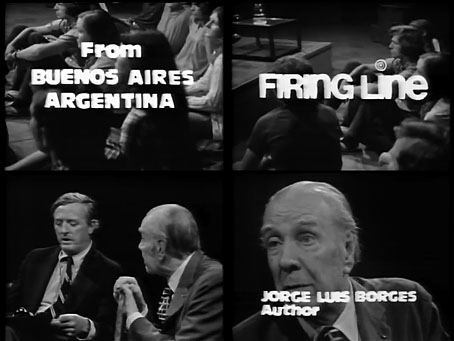
Jorge Luis Borges was interviewed on TV a number of times in later life but most of the available appearances are in un-subtitled Spanish. His 1977 meeting with William F Buckley on Buckley’s long-running debate and discussion show, Firing Line, is an exception, and a welcome one for being almost a whole hour of serious discussion. Buckley’s reputation has been reappraised in recent years. Gore Vidal famously accused him on live TV of being a “crypto-Nazi”, a barb that prompted Buckley to momentarily lose his usual composure. With American politics currently beset by actual Nazis, crypto- or otherwise, as well as people who wouldn’t crack open the spine of a book even if you offered them another tax break, Buckley now looks like an impossible figure: an American conservative who was also a genuine intellectual with a passion for literature.

The discussion on this occasion is less about Borges’ works than about language and literature. If you’ve read any Borges interviews then this is familiar territory, but Borges elaborates here on subjects that were only touched on elsewhere, especially the strengths of English over Spanish as a literary language, and the pros and cons of translation. This latter subject is a sore point for Borges readers such as myself who believe that the current translations (made after Borges’ death) are inferior to the earlier ones, many of which were prepared with the approval of the author. It’s painful to hear him say he thought his stories worked better in English, and it makes me wonder again what he might make of the present state of affairs.

Elsewhere, Buckley tries to lead Borges into a discussion of politics, a subject that he generally avoided because it didn’t interest him, and whenever he did mention the subject he’d usually get into trouble by saying something that would annoy one side of the political spectrum or the other. I was pleased to note a fleeting reference to Arthur Machen, mentioned in relation to the Julio Cortázar short story, Casa Tomada (House Taken Over), which Borges, Adolfo Bioy Casares and Silvina Ocampo reprinted in their Antología de la Literatura Fantástica (1977).

Previously on { feuilleton }
La Bibliothèque de Babel
Borges and the cats
Invasion, a film by Hugo Santiago
Spiderweb, a film by Paul Miller
The Library of Babel by Érik Desmazières
Books Borges never wrote
Borges and I
Borges documentary
Borges in Performance

Weekend links 438

awazu.jpg

Seishu Hanaoka’s Wife (1970) by Awazu Kiyoshi.

Hoodoo, Conjuration, Witchcraft & Rootwork: a colossal new addition to the Internet Archive, being a 5-volume, 4766-page collection of folkloric material gathered by Harry Middleton Hyatt in Alabama, Arkansas, Florida, Georgia, Illinois, Louisiana, Maryland, Mississippi, North Carolina, South Carolina, Tennessee, and Virginia between 1936 and 1940.

• Edward Gorey is the theme du jour, so here’s some more: Gorey’s 1977 appearance on The Dick Cavett Show is revelatory, especially if you’ve never seen him talking before. Meanwhile, Laughing Squid has a previously unpublished interview in which Gorey discusses his love for his disruptive cats.

• Jeff Nuttall’s mid-century survey of the aesthetic underground, Bomb Culture, receives a fiftieth anniversary republication by Strange Attractor. The new edition is edited by Douglas Field and Jay Jeff Jones, with a foreword by Iain Sinclair and an afterword by Maria Fusco.

I have always questioned identity politics with my work. I often have characters that engage in homosexual sex but do not identify as gay (hustlers, neo-Nazi skinheads, extreme left wing revolutionaries, gerontophiles, etc.). But my films have also always been inclusive in terms of race, class, and gender. I find that the new emphasis on identity politics has really narrowed creative expression. It demonstrates a profound ignorance about sexuality, history, and human experience.

My sexual identity is pretty much fixed—I’m a Kinsey 6, if not a 7—but I acknowledge that this means I’m sexually repressed. I believe, after Freud, that everyone has some bisexual potential, and the tendency to increasingly entrench gender identity as innate and immutable is really preposterous. It also leads to strict rules about sexual representation—how gays, lesbians and transgender people “must” be portrayed, the policing of representation, a kind of proprietary stance about who is allowed to portray these characters.

It really boils down to a naivety about sexuality, and a complete failure of the imagination. It discourages people who may have the potential for some kind of sexual fluidity to express themselves. I’ve always been a “bad gay,” but now this political correctness has made me feel even more alienated from the notion of “gay identity”—particularly since the new assimilationist model is so conservative and dull.

Filmmaker Bruce LaBruce discussing art, porn and politics with Hoçâ Cové Mbede

• “Who is Barbara Baranowska? Despite the so-called Polish Poster School’s fame, certain people were seemingly forgotten. Perhaps they even wanted it that way…” Daniel Bird on an elusive artist. Related: Selected works by Barbara Baranowska.

• “I don’t think I’m ever mean-spirited and I try to understand human behaviour even though it’s impossible,” says John Waters.

Nine Dimensional Synod Of Oblique Pleasures is a very welcome new release by The Wyrding Module.

Galerie Dennis Cooper presents…The Resplendent Illegibility of Extreme Metal Logos.

Apocalypse Burlesque — Tales of Doomsday Eros: a new book by Supervert.

Rare booksellers rallied against an Amazon-owned company and won.

B. Alexandra Szerlip on the 80-year history of the ballpoint pen.

Anjelica Huston: how we made The Addams Family.

• Mix of the week: Secret Thirteen Mix 270 by Okkre.

The Cabinet of the Quay Brothers

Hoodoo Man Blues (1965) by Junior Wells’ Chicago Blues Band | Evil Hoodoo (1966) by The Seeds | I Been Hoodood (1973) by Dr John

Weekend links 437

watson.jpg

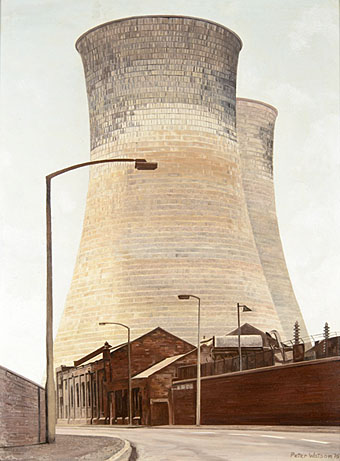
Rawmarsh Road, Rotherham, 1975 by Peter Watson.

Steel Cathedrals (1985), a composition by David Sylvian (with Ryuichi Sakamoto, Kenny Wheeler, Robert Fripp & others) was originally available only on the cassette release of Sylvian’s Alchemy: An Index Of Possibilities, and a video cassette where the music accompanied views of Japanese industry by Yasuyuki Yamaguchi. The video hasn’t been reissued since but may be viewed here.

• “If, as Arthur C Clarke famously observed, any sufficiently advanced technology is indistinguishable from magic, then can we accept that any sufficiently advanced magic is also indistinguishable from technology?” asks Mark Pilkington.

• “I didn’t like the idea of cartoons as just funny jokes, they had to have some relevant piece of observation in them to do with the society we are living in,” says Ralph Steadman.

I listen to music all the time, and I’ll often seek connections across quite disparate genres of that whatever I’m looking for. Sometimes it’s an aesthetic or a feeling, sometimes a pattern or structure, but it tends to cut across genres. The thing I liked about black metal and doom metal is the slowness and weightiness of it, it’s like deep time but in music. Sunn O))), Xasthur, and other bands captured this black gravity of sound. And they also tend to eschew the traditional vocal-lead guitar set-up, and everything is in the slow-moving wash and texture of sound.

I found that in other genres like noise music (especially Keiji Haino), the European avant-garde with composers like Ligeti, Scelsi, and Dumitrescu, dark ambient artists such as Lustmord or vidnaObmana, and contemporary works like Chihei Hatakeyama’s Too Much Sadness, Rafael Anton Irisarri’s A Fragile Geography, or Christina Vantzou’s No.4. There’s a lot to talk about in terms of music and forms of sorrow or grief, certainly every musical tradition has that—the funeral dirge, requiem, lamentation, or whatever.

Eugene Thacker listing a few favourite musicians and composers during a discussion with Michael Brooks about Thacker’s new book, Infinite Resignation

• The fourth edition of Wyrd Daze—”The multimedia zine of speculative fiction + extra-ordinary music, art & writing”—is out now.

• The Library of Congress has opened its National Screening Room, an online service for viewing films in the library’s collection.

The London Library discovered some of the books that Bram Stoker used for research when he was writing Dracula.

• “Oscar Wilde’s stock has never been higher,” says John Mullan, reviewing Oscar: A Life by Matthew Sturgis.

• Mixes of the week: RA Podcast 648 by Sarah Davachi, and Secret Thirteen Mix 269 by Sstrom.

• David Lynch directs a video for A Real Indication by Thought Gang.

• “Edward Gorey lived at the ballet,” says his biographer, Mark Dery.

• A new version of Blue Velvet Blues by Acid Mothers Temple.

• Photos of cooling-tower interiors by Reginald Van de Velde.

Aaron Worth on Arthur Machen: “the HG Wells of horror”.

• The Strange World of…Barry Adamson.

Glass And Steel No. 1 (1983) by Marc Barreca | Death Is The Beginning (1996) by Steel | Painless Steel (2000) by Bohren & Der Club Of Gore

Weekend links 430

fiochi.jpg

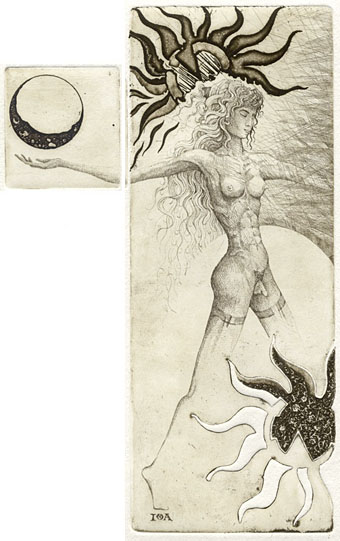
Il Mago from the IONA Tarot by Giona Fiochi.

• “Russia’s answer to James Bond: did he trigger Putin’s rise to power?” Andrew Male on Max Otto von Stierlitz and Seventeen Moments of Spring. The whole series is on YouTube (with subtitles).

Geeta Dayal reviews High Static, Dead Lines: Sonic Spectres and the Object Hereafter by Kristen Gallerneaux, a new book about the eeriness of sound technology.

• Published next month: Strange Frequencies: The Extraordinary Story of the Technological Quest for the Supernatural by Peter Bebergal.

Let me first introduce an aside: I hate the word “queer” and all its new iterations. “Gay” was awful enough. “‘Gays’ makes us sound like bliss ninnies,” Christopher Isherwood said once. “Queer” will always be for men of my generation a word of violence and hatred, and it separates generations. And while I’m digressing, let me commit blasphemy: the over-emphasis on the Stonewall riots depletes and distorts our history of resistance and the art produced, which is determinedly referred to as “pre-Stonewall.” Resistance occurred years before Stonewall (but there were lots of writers in New York at the time to write about those riots), in San Francisco, Los Angeles, other cities, powerful confrontations with the police, powerful demonstrations. “Pre-Stonewall” writers include William Burroughs, Allen Ginsberg, strong radical voices confronting the grave dangers of the time, violence, prison.

John Rechy talking to Eric Newman about his latest novel, Pablo!, written in 1948 but only now seeing publication

Tangerine Dream performing Identity Proven Matrix, one of the standout pieces from recent album Quantum Gate, live in the studio.

Beloved is the debut solo album by Randall Dunn, record producer and member of the masterful Master Musicians of Bukkake.

• “How will police solve murders on Mars?” Geoff Manaugh on the new frontier of interplanetary law enforcement.

Milly Burroughs on how Verner Panton changed the way the world sees furniture design.

Tim Martin on the new science of psychedelics.

Werner’s Nomenclature of Colours

Next Stop Mars (1966) by Sun Ra & His Arkestra | Mars, The Bringer Of War (1976) by Isao Tomita | Mars Garden (2013) by Juan Atkins & Moritz Von Oswald