Mati Klarwein, peintre Américain, a film by Fabienne Strouvé

mati1.jpg

And speaking of the 1970s and Ernst Fuchs and Mati Klarwein… Fabienne Strouvé’s Mati Klarwein, peintre Américain is a 25-minute portrait of Mati Klarwein and family made in 1979. Despite being filmed in New York City most of the conversation is in French—the Klarweins being fluent speakers—but if you like Klarwein’s art this is still a wonderfully insightful film. I always wonder about the size of paintings and other technical details so it’s good to see that, yes, many of Klarwein’s later works are larger than you might expect from reproductions, and it’s also instructive to see him at work with a portion of his painting covered by masking tape. Ernst Fuchs makes a couple of appearances (speaking French—“psychédélique!”), and you get a brief Mati guide to some of the paintings that comprise the incredible Aleph Sanctuary.

mati2.jpg

(Video link updated.)

Elsewhere on { feuilleton }
The fantastic art archive

Previously on { feuilleton }
Ernst Fuchs, 1977
The art of Mati Klarwein, 1932–2002

Weekend links 285

graphic.jpg

Some of the art from my collage adaptation of The Picture of Dorian Gray appears on the cover of The Graphic Canon: Volume 2, published this month in a German edition by Verlag Galiani. Out next month (although possibly available now) is the same book in a Brazilian edition from Boitempo Editorial. One of the disappointments this year was having to abandon plans to contribute to Russ Kick’s forthcoming graphic canon of crime fiction. I was overstretched during the summer, and what with projects slipping their deadlines and the trip to Providence there wasn’t any time left for other things.

• For those who missed the first edition, a second and final expanded edition of the Penda’s Fen study/celebration The Edge Is Where The Centre Is.

• Whipping up a storm: how Robert Mapplethorpe shocked America; Kevin Moore on the photographer’s Perfect Moment exhibition.

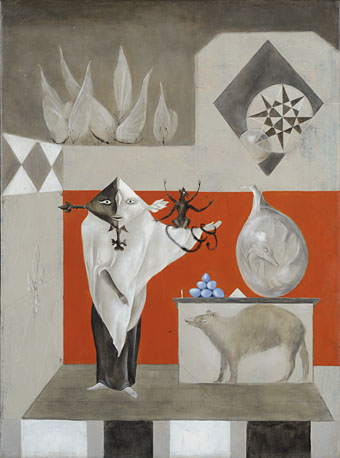
In the best scenario, metaphysical art distributes the work of understanding among cultural traditions and symbolic systems, and it is along these lines that Carrington’s work has been described as a productive combination of Mexican, Egyptian, Hebrew, Celtic, Greek, and Mesopotamian elements. Her paintings, plays, and stories mix the symbols of alchemy, astrology, Tarot, herbalism, magic, witchcraft, and a personal iconography.

Leif Schenstead-Harris on the life, art and fiction of Leonora Carrington

• Mixes of the week: Hieroglyphic Being collects favourite cosmic jazz of the 1970s; NTS Radio presents an hour of Annette Peacock.

• At Kill Your Darlings: Alexandra Heller-Nicholas enthuses about Dario Argento’s delirious masterwork, Suspiria.

Pye Corner Audio releases a new album (only limited vinyl at the moment—boooo!) and remixes Stealing Sheep.

• The Trip Planners: Emily Witt meets the founders behind Erowid, the online drug encyclopedia.

Woven Processional (1985), music on the Long String Instrument by Ellen Fullman.

• “The Paris attacks prove Charlie Hebdo’s critics wrong,” says Dorian Lynskey.

• Photographs by Danila Tkachenko of abandoned Soviet technology.

Come Wander With Me / Deliverance by Anna von Hausswolff.

• The collages of Guy Maddin.

CAN HALEN

Let’s Take A Trip (1965) by Godfrey | Trip On An Orange Bicycle (1968) by The Orange Bicycle | Last Trip (1968) by We Who Are

Paul Laffoley, 1940–2015

laffoley1.jpg

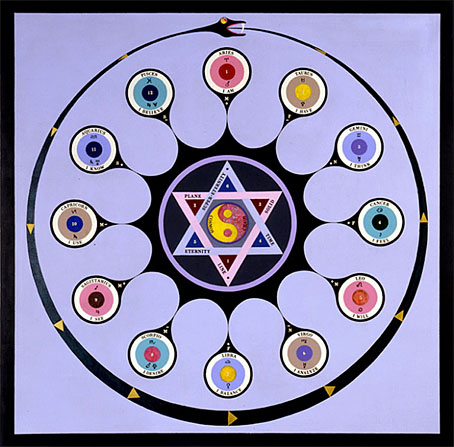
Alchemy: The Telnomic Process of the Universe (1973).

Another week, another incomparable artist gone. This small selection of Laffoley’s unique art and sculpture manages to combine references to (among other things) alchemy, William Blake, Charles Baudelaire, Oscar Wilde, HP Lovecraft, Mark of the Vampire, and Night of the Demon. And this is only a fraction of his work. Richard Metzger has a memorial post at Dangerous Minds together with more paintings and some video links. There’s more at the official website and Kent Fine Art. It’s good to read that the University of Chicago Press will be publishing The Essential Paul Laffoley in March, 2016.

laffoley2.jpg

The Death and Life of Monsieur Sebastian Melmoth: Au Théâtre du Grand Guignol (2001–2003).

laffoley3.jpg

The Solitron (1997).

Continue reading “Paul Laffoley, 1940–2015”

The art of Neil Dallas Brown, 1938–2003

brown3.jpg

Apocalypse (Homage to Tangerine Dream) (1981).

It’s not every day you find a painting dedicated to the doyens of German electronica. This and other works by Scottish artist Neil Douglas Brown are in public galleries in Britain which means they’re also online at the BBC’s Your Paintings site. The pictures that combine nebulous figures, blank backgrounds and lines/arrows show an obvious Francis Bacon influence but that’s no bad thing, and Brown isn’t the only artist to explore this territory. There’s more of his work at the official website.

brown1.jpg

The Indictment (1976–77).

brown2.jpg

Fallen Man (1977).

Ernst Fuchs, 1930–2015

fuchs6.jpg

It was a surprise to see the death of Austrian artist Ernst Fuchs mentioned on the BBC website since I’d never seen him mentioned in the British media during his lifetime. Fuchs was one of those artists who would have been a natural Surrealist if he’d been born a few years earlier, and his work does occasionally receive a mention in the more comprehensive guides to Surrealism. The first place I saw any of his paintings was in the pages of Omni magazine when it was launched in the late 1970s. As well as providing a high-profile showcase to science-fiction writers, Omni in its early days avoided generic SF art in favour of the living practitioners of Fantastic Realism: Fuchs, HR Giger, Mati Klarwein, Robert Venosa, Rudolf Hausner, De Es Schwertberger and many others. Fuchs was often seen as the figurehead of this loose movement as a result of founding the Vienna School of Fantastic Realism in the 1940s, but Fantastic Realism as it’s generally applied is an umbrella term used to connect a generation of artists who were using hyper-real techniques to explore their obsessions. Fuchs’ obsessions often concern spirituality of one kind or another but he could be erotic as well, something you can’t always say about his many imitators in the current Visionary Art world. At his best his paintings seem caught midway between the Max Ernst style of the late 40s and Gustave Moreau’s more hieratic moments, with human figures or inhuman creatures emerging from (or melting into) mineral forms.

Official site
Fuchs at Wikiart
Fuchs pages at Fantastic Visions
360-degree panorama of the Apocalypse Chapel, Klagenfurt

fuchs2.jpg

Battle of the Gods that have been Transformed (1952).

fuchs1.jpg

The Spirit of Mercury (1954).

Continue reading “Ernst Fuchs, 1930–2015”