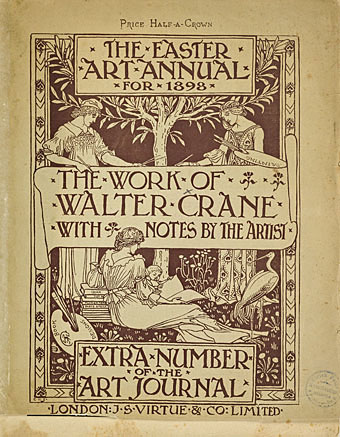
The Work of Walter Crane

crane01.jpg

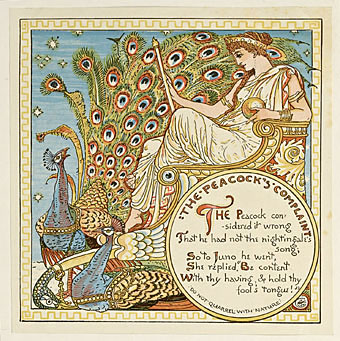
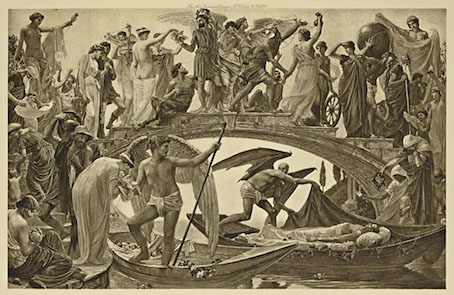
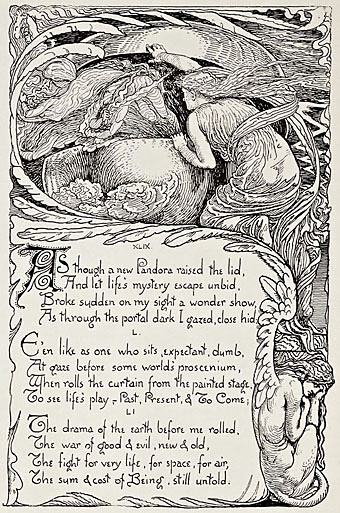
Not the first time Walter Crane has been featured here but this slim volume (62 pages) is a useful overview of the artist’s work which covers all aspects of his career: fine art, book illustration, political design (Crane was a lifelong Socialist), textiles for William Morris, and interior design. There’s more Walter Crane at Wikimedia Commons.

crane02.jpg

crane03.jpg

crane04.jpg

Continue reading “The Work of Walter Crane”

Weekend links 363

sommers.jpg

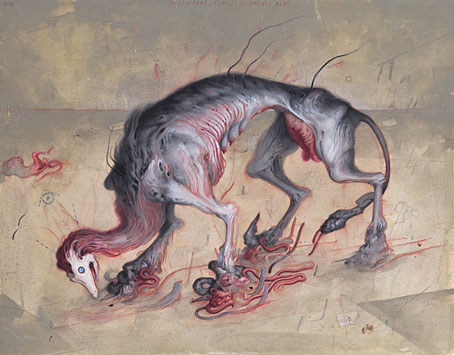
The Constant Drumbeat of Terrible News (no date) by Allison Sommers.

• Nadia Khomami on Gay UK: Love, Law and Liberty, an exhibition at the British Library. Related: Simon McCallum‘s potted history of LGB characters on British screens. Elsewhere: writer and philanthropist Chuck Forester on gay sex in the 1970s.

The Panic Fables: Mystic Teachings and Initiatory Tales by Alejandro Jodorowsky. Finally available in English, a collection of all the comic strips written and illustrated by Jodorowsky when he was living in Mexico in the 1960s.

• A trailer for the restored print of The Fabulous Baron Munchausen (1961) by Karel Zeman. Related: collage designs by Graphic Manipulator for a Japanese collection of Zeman’s films.

• “Whether divining ancient wisdoms or elevating the art of cold reading, Tarot is a form of therapy, much like psychoanalysis,” says James McConnachie.

James Reith on “the Icelandic publisher that only prints books during a full moon – then burns them”.

• Mixes of the week: Wire 400 Mix #6 by Emptyset, and Secret Thirteen Mix 223 by Constantine.

• Mud And Flame: Penda’s Fen re-examined by Matthew Harle and James Machin.

Tilda Swinton in a Leonora Carrington-inspired fashion shoot for i-D magazine.

• At Dennis Cooper’s: Spotlight on William Burroughs’ The Wild Boys.

Applied Ballardianism: A Theory of Nothing by Simon Sellars.

• At Dangerous Minds: The Dark Rift by Jim Jarmusch’s Sqürl.

French Underground Rock: 1967–1980; a Discogs list.

Suzanne Ciani‘s favourite albums.

Infinite artwork: Untitled, 2017

Rip, Rig And Panic (1965) by The Roland Kirk Quartet | Panic (1984) by Coil | Flash Of Panic (1994) by Axiom Ambient

Weekend links 362

yoshi47.jpg

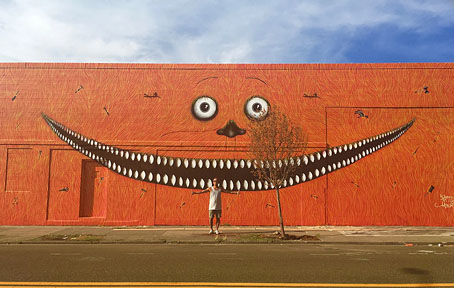
A mural for Forest For The Trees, 2016, by Yoshi47.

• “Who’s the real cunt?” Andrew O’Hagan on the Daily Mail‘s hypocrisies, Little England bigotries and omni-outrage in a review of Mail Men: The Unauthorised Story of the ‘Daily Mail’, the Paper that Divided and Conquered Britain by Adrian Addison.

Deutschlandspiegel 198/1971: a short film at the German Federal Archive which includes footage of Popol Vuh (still in their electronic phase) six minutes in.

• A meeting of remarkable minds: a live radio discussion between Annea Lockwood and Pauline Oliveros from December 1972.

The House In The Woods (aka Martin Jenkins of Pye Corner Audio) at Rare Air, Seattle, 14th May 2017.

• “Peaceful but not to be messed with.” Tony Naylor on how the bee came to symbolise Manchester.

• Mixes of the week: FACT Mix 602 by Deathprod, and Secret Thirteen Mix 222 by Yuji Kondo.

Emptyset and Mouse On Mars’s Jan St Werner on space, time and the evolution of sound.

• At Indiegogo, a funding call for Subotnick: Portrait of an Electronic Music Pioneer.

Shannon Taggart’s Camera Fantastica: an interview by Peter Bebergal.

Study finds mushrooms are the safest recreational drug.

Mary Anne Hobbs‘ favourite albums.

Bumble Bee Bolero (1957) by Harry Breuer | Bee Stings (1998) by Coil | The Bees Made Honey In The Lion’s Skull (2008) by Earth

Weekend links 360

sasaki.jpg

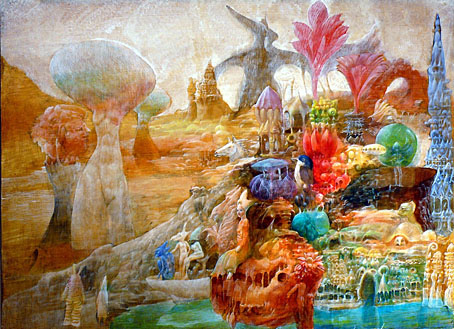
Threshold (2008) by Roku Sasaki.

• A previously unseen interview with Angela Carter from 1979 in which she talks to David Pringle about her evolution as a writer, literary influences and genre fiction.

• Among the highlights in the latest edition of Wormwood there’s Doug Anderson on Panacea by Robert Aickman, a “vast unpublished philosophical work”.

• The London Review Bookshop podcast: Marina Warner and Chloe Aridjis discuss Leonora Carrington.

The prose works, conversely, read like surrealist poetry. They were written according to a compositional method Roussel called le procédé (the procedure), in which a complicated system of puns rather than traditional narrative logic determines the progression of the story. In Locus Solus, the mad scientist Martial Canterel takes his colleagues on a tour of his country estate—“the lonely place” of the title—to show them the bizarre inventions generated by Roussel’s procédé. These include a device that constructs a mosaic made out of human teeth; a water-filled diamond in which a dancer, a hairless cat, and the head of Danton are suspended; and a series of corpses Cantarel has brought back to life with the fluid “ressurectine,” which compels them to act out the most important event of their former lives, to the scientists’ astonishment.

Ryan Ruby on Raymond Roussel, The Accidental Avant-Gardist

• The latest manifestation of paranormal electronica by The Electric Pentacle is entitled Black Ectoplasm.

Sergey Bessmertny‘s account of working as a camera technician on Andrei Tarkovsky’s Stalker.

• City Of Fallen Angels: The Bug vs. Earth. In conversation with Kevin Martin and Dylan Carlson.

• Sex and art by the Grand Canal: Judith Mackrell on Peggy Guggenheim in Venice.

• A Guide Through the Darkened Passages of Dungeon Synth.

• Mix of the week: XLR8R Podcast 489 by Samuel Rohrer.

• The late Mika Vainio/Panasonic live in 1996.

Xan Brooks on Cary Grant’s 100 acid trips.

Resurrection (1968) by Steppenwolf | Resurrection (1975) by Master Wilburn Burchette | Resurrection (1987) by Demons Of Negativity

Weekend links 359

azuma.jpg

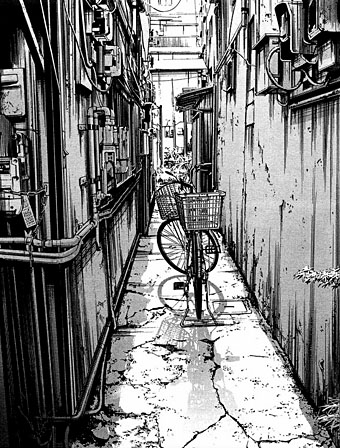
An urban scene from Yotsuba&! by manga artist Kiyohiko Azuma.

• The resurgence of interest in Alice Coltrane’s music is very welcome even if she joins for the moment the list of those artists (usually women: see Leonora Carrington) tagged by editors as “lost”, “forgotten”, “unrecognised”, etc. Alice Coltrane was only ever lost if you weren’t paying attention, and was notable enough fifteen years ago to be given the cover of The Wire magazine. Articles appearing this week have been prompted by a compilation of the devotional music that Coltrane recorded for a series of self-released cassettes in the 1980s. Geeta Dayal writes about the creation of the ashram recordings, while Stewart Smith suggests starting points for new listeners.

• Mentioned here before, but there’s now a page for the book: a new edition of Hashish (1902) by Oscar Schmitz will be published by Wakefield Press in November. “A collection of decadent, interweaving tales of Satanism, eroticism, sadism, cannibalism, necrophilia, and death”, illustrated by Alfred Kubin.

• Mixes of the week: A Dark Entries mix for the 400th issue of The Wire, Procedure, LA, April 25, 2017 by Pinkcourtesyphone, and Secret Thirteen Mix 220, a 4-hour epic by Ricardo Gomez Y De Buck.

• More off-the-beaten-path film lists: Sarah Lyons for Dirge Magazine on three occult documentaries, and Terry Ratchett for Dennis Cooper on 18 needlessly obscured avant-garde films.

• An Island of Peace: James Conway on Amanda DeMarco’s new translation of Walking in Berlin: A Flâneur in the Capital by Franz Hessel.

Ryuichi Sakamoto talks to Aaron Coultate about overcoming cancer, The Revenant and his new album, async.

Ingrid D. Rowland on Caravaggio: The Virtuoso of Compassion.

• “I think I am weirdly politically correct,” says John Waters.

Mnemonic Generator

• Berliner Nächte Part 1 (1990) by Seigen Ono | Berlinerstrasse (1995) by Coco, Steel & Lovebomb | Berlin (1998) by Pole