Le Voyage dans la Lune

melies.jpg

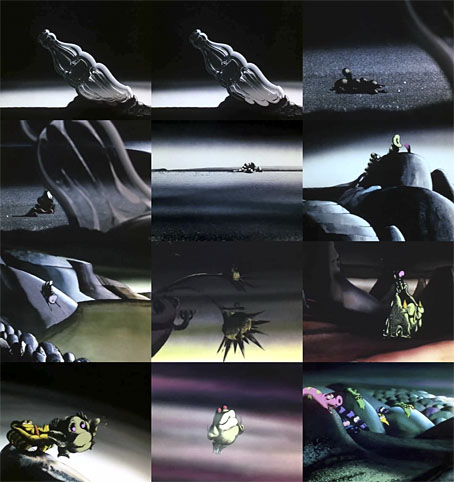
The title of Georges Méliès’Le Voyage dans la Lune (1902) is usually given the English translation of A Trip to the Moon, the word “trip” being an apt one when the lunar voyagers discover a landscape of giant mushrooms and crab-clawed inhabitants similar to the Selenites in HG Wells’ The First Men in the Moon (1901). I linked to a copy of this film years ago but these shots are from the recently reissued colour version, a print of which was discovered in 2002. The new version also includes a previously lost scene at the end. The soundtrack is by the French group Air. The more time elapses, the stranger these films seem. Queen Victoria had only been dead a year when this one was made; some of the young women here may have lived long enough to see the Apollo missions.

Previously on { feuilleton }
A Trip to Mars
Lunation: Art on the Moon
Somnium by Steve Moore
Blood on the Moon
Mushrooms on the Moon
Filippo Morghen’s Voyage to the Moon

Jean Delville album covers

delville12.jpg

Scriabin: Symphony no 3; Arensky: Silhouettes (1992) by Neeme Järvi.

The Delville painting from yesterday’s post seems popular with classical recordings, this is only one example of its use, chosen here because some of the music is Scriabin for whom Delville created a sheet music illustration in 1912. Delville’s other work is understandably popular in the metal world among whose adherents there’s now a kind of tradition for using interesting paintings as album art. Examples of some of these follow.

delville3.jpg

The Treasures of Satan (1895).

Morbid Angel beat everyone to Delville’s masterwork. I wrote something about using the same painting on a book cover design here.

delville4.jpg

Blessed Are The Sick (1991) by Morbid Angel.

parsifal.jpg

Parsifal (1890).

Another very popular Delville image, that face was used by Stanley Mouse in a poster design in 1991, and even crept into my adaptation of The Call of Cthulhu.

delville6.jpg

Into The Flames (2004) by Pseudostratified Epithelium.

Pseudostratified Epithelium are a death metal band from Costa Rica. A shame they stretched Delville’s drawing; The Everdawn make a better fist of it.

delville7.jpg

Poems – Burn The Past (2012) by The Everdawn.

Continue reading “Jean Delville album covers”

L’amour des âmes

delville1.jpg

L’amour des âmes (1900) by Jean Delville.

Another of the many connections between the Symbolism and psychedelic poster art, the mystically-inclined Jean Delville (1867–1953) may at least have approved of the addition of a yin-yang symbol to his painting of drifting souls. I was originally going to post Delville’s Pour L’art poster design since I’ve not seen a copy on the web as good as the one below which is scanned from a book. (The principal Delville site has many of his works but in variable quality.) Delville’s pair of floating lovers happen coincidentally to suit the preoccupations of February 14th.

grimshaw.jpg

MC5 at the Grande Ballroom, Detroit (1967) by Gary Grimshaw.

Pour L’art was a Belgian circle of artists formed in Brussels in 1892 to stage exhibitions promoting their work. Delville was the most notable of the group as well as being one of its prime movers. Looking on the Delville website it’s good to see there’s a major study of the artist’s life and work in progress, with publication scheduled for later this year. Too many artists from the late 19th century have been neglected for far too long but attitudes are slowly changing. Anyone interested in Jean Delville is advised to also look at this site which is dedicated to that apostle of androgyny, Joséphin Péladan. One of the strangest characters in the Symbolist menagerie (and the competition for that label is fierce), Péladan’s occult theories inspired Delville and a number of other artists in Belgium and France. It’s good to see he’s also gaining some serious study at last.

delville2.jpg

Pour L’art (1892) by Jean Delville.

Previously on { feuilleton }
Philippe Jullian, connoisseur of the exotic
Delville, Scriabin and Prometheus
The faces of Parsifal
Masonic fonts and the designer’s dark materials
Angels 4: Fallen angels

Seven

love.jpg

Seven and Seven Is (1967), a single by Love.

Celebrating seven years of this here blawg with a bunch of sevens. But first, the stats which (according to WordPress’s own meter) say “This blog was viewed about 2,300,000 times in 2012”. The caveat there is that many people visit these pages simply to see a picture, not because there’s anything further of interest, hence the persistent popularity of the Naked furniture post in the top five listing below:

1: The weekend artists, December 2011
2: Naked furniture, April 2009
3: The art of Takato Yamamoto, June 2007
4: Alex in the Chelsea Drug Store, April 2006
5: Hysterical Literature, August 2012

Not listed there because it’s on a standalone page is the gay artists archive which remains the most popular thing on the site. The equally persistent popularity of the Clockwork Orange post at no. 4 is a good demonstration of the fickleness of the blog hordes; things done on a whim often have more staying power. As always, thanks for reading and commenting! And now the music…

Seven By Seven (1971) by Hawkwind
Seven Days (1972) by Annette Peacock
Seven Years (1986) by Watermelon Men
Seven Souls (1989) by Material feat. William Burroughs
Seven Laws of Woo (1992) by Praxis
Seven, Seven, Seven (1995) by Money Mark

Weekend links 146

snake.jpg

A Chinese postage stamp celebrating the Year of the Snake.

Cyclopean is a collaboration from Burnt Friedman, Jono Podmore and Can founding members Jaki Liebezeit, and Irmin Schmidt. The Quietus has a preview of all the tracks from their forthcoming EP. Great stuff.

Ten Things You (Possibly) Don’t Know About Kraftwerk. Related: a Speak & Spell emulator, and Atomium, a new single by Karl Bartos.

• In 1975 Barney Bubbles designed an inner sleeve for Hawkwind’s Warrior on the Edge of Time album, and this scarce recipe booklet.

• “We should all use language carefully. That is an obligation on the literate. But carefully doesn’t mean fearfully,” says Jenny Diski.

• Faber’s car-crash of a cover design for the 50th anniversary edition of The Bell Jar by Sylvia Plath caused an outbreak of parodies.

• At Strange Flowers: Ancient dreams and antique corruptions, Salomé via Gustave Moreau and Huysmans.

• FACT Mix 368 is a very varied collection of recent music and older pieces curated by Holly Herndon.

• At Ubuweb: eleven out-of-print recordings of Harry Bertoia’s sound sculptures.

Laurie Anderson and Brian Eno in conversation at Interview magazine.

Michael Chabon on Wes Anderson’s Worlds.

Snake Rag (1923) by King Oliver’s Creole Jazz Band | Rattlesnake Shake (1969) by Fleetwood Mac | Snakes Crawl (1980) by Bush Tetras | Ananta Snake Dance (1980) by Suns of Arqa | Snakeblood (2000) by Leftfield