Huszti Horvath’s Three Dragons

horvath01.jpg

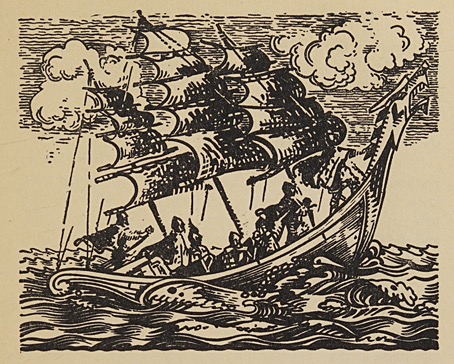
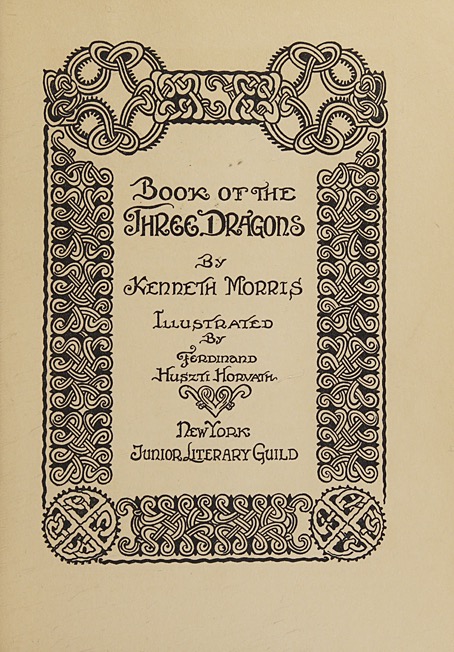
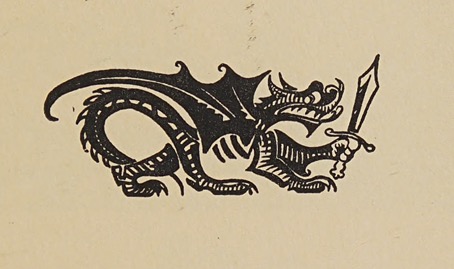
Book of the Three Dragons is an unusual illustrated volume, being an American edition of a retelling of Welsh myths by a Welsh writer, Kenneth Morris, with illustrations by a Hungarian artist, Ferdinand Huszti Horvath (1891–1973). Morris was, among other things, a Theosophist who was living in California when he wrote Book of the Three Dragons which no doubt explains the American publication. There doesn’t appear to be any Theosophy in this book at least. Dragons are an important symbol for the Welsh, with a red dragon being a prominent emblem on the flag of Wales. Morris’s book opens with a guide to the pronunciation of the Welsh names and words that appear in the text.
horvath02.jpg

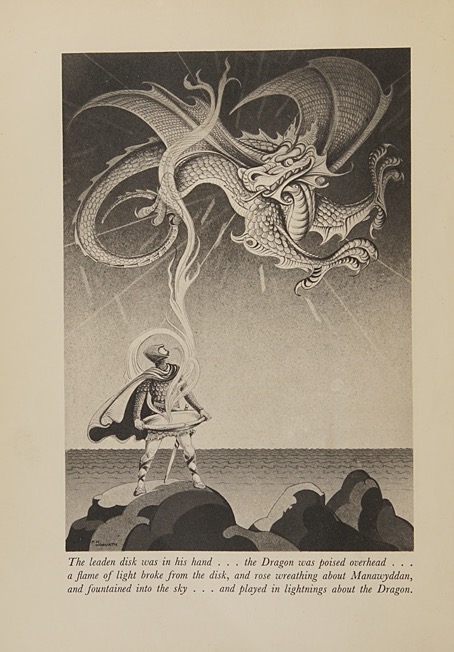
Ferdinand Horvath, meanwhile, moved to the USA in the 1920s where he eventually found employment as an illustrator before working (without credit) for Disney. It’s at Disney-related websites that you’ll find most of the information about his life and work, where the discussion inevitably concerns his designs for animated films. A list of his other book productions would be welcome. There’s a very nice edition of The Raven that was published in the same year as Book of the Three Dragons but with art in much more of an Expressionist style.

I often wonder what Disney’s animations might have been like if the studio had given artists like Horvath and Kay Nielsen a freer rein. Disney only began to change its style in the late 1950s as a result of competition from other animation studios, and even then the results were compromised. Sleeping Beauty used the designs of Eyvind Earle to distinguish the film from the studio’s previous fairy tales but Earle was dissatisfied with the treatment his work received and he left the project before it was finished; the art direction for One Hundred and One Dalmatians was based on the cartoons of Ronald Searle but Walt Disney hated the results and refused to try anything similar again.
horvath03.jpg

horvath04.jpg

horvath05.jpg

Continue reading “Huszti Horvath’s Three Dragons”

Allegro Non Troppo

allegro1.jpg

Having watched Disney’s Fantasia (1940) recently, I had to search out this as a palliative. There’s a lot I like about the Disney film but the explanatory interludes for the Great Unwashed are tiresome, I’ve always loathed Mickey Mouse’s voice (although the Sorceror’s Apprentice sequence is fine), and, for a film that aspired to artistic seriousness, the Pastoral Symphony episode has all the aesthetic gravitas of a packet of fizzy sweets.

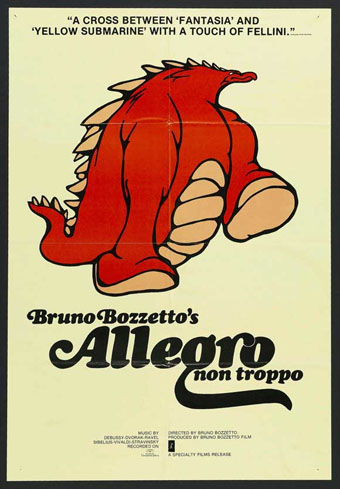
Bruno Bozzetto’s Allegro Non Troppo (1976) was a feature-length animated riposte to Disney’s pretensions. The concept is identical—well-known pieces of classical music illustrated by animation—but in place of inadvertent vulgarity there’s a heavy helping of deliberately crude behaviour. Bozzetto replaces the coyness of the Pastoral Symphony with the erotic melancholy of an ageing satyr set to Debussy’s Prélude à l’après-midi d’un faune. The laboured explanations of Fantasia become a series of live-action slapstick moments supposedly featuring the animator, conductor, and members of the orchestra, all of which explain nothing at all.

allegro2.jpg

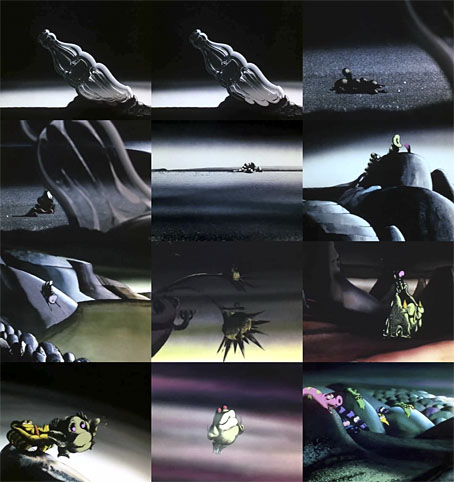
The one thing everyone remembers from Allegro Non Troppo is the Bolero sequence in which Bozzetto satirises Fantasia‘s evolutionary Rite of Spring. A departing spacecraft leaves a Coke bottle on the surface of a planet. The dregs left in the bottle give birth to a slime creature which crawls away and evolves along with Ravel’s music into a train of animals marching (and eating each other) across a treacherous landscape. The animation may lack Disney’s technical finesse but it’s a lot more memorable than his cartoon dinosaurs. Watch the whole sequence here.

Schloss Falkenstein

falkenstein.jpg

Proposal for Schloss Falkenstein (c. 1883).

A slight return to Ludwig II. Schloss Falkenstein would have been another beetling edifice in the manner of Schloss Neuschwanstein had it ever been built, and judging by this view it might have been even more grandiose. The painting is one of the proposals by stage designer Christian Jank whose plans had already been used for Neuschwanstein. Philippe Jullian makes some scathing remarks about the Gothic interior of the earlier castle but he may have had more patience for the Byzantine interiors planned for Falkenstein. I’m not sure how these would be reconciled with Jank’s exterior, however, the style being Gothic enough to satisfy Viollet-le-Duc. Ludwig’s untimely death in 1886 drew a line under his architectural schemes but Bavaria’s loss eventually became Walt Disney’s gain as Jank’s fantasias provided the inspiration for the castle in Sleeping Beauty (1959) and all of the Disney theme park castles. What Ludwig would have made of this we can only guess. I suspect he’d be entranced by the fantasy but appalled by the vulgarisation. He was an elitist, after all, and the castles were always for him alone, not hordes of T-shirted proles.

Previously on { feuilleton }
Schloss Linderhof
Schloss Neuschwanstein
Pite’s West End folly
Viollet-le-Duc

Krazy Kat animations

krazy.jpg

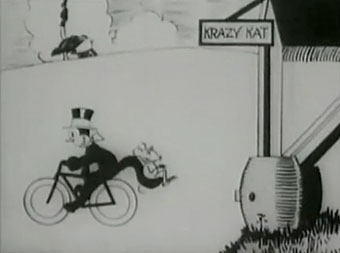
Krazy Kat – Bugologist (1916).

Among the films at the Library of Congress YouTube channel are a number of shorts from the early days of animation including several of the first Krazy Kat films. George Herriman apparently had nothing to do with these, they were Hearst corporation spin-offs, which perhaps explains their lack of Herriman’s eccentricities. They’re necessarily crude, of course; cartoon animation had barely begun in 1916 and Walt Disney was yet to make a film. It’s curious watching a cartoon which transcribes the comic strip conventions so literally, with speech balloons growing from the characters mouths. Also at the LoC channel is one of the later Gertie the Dinosaur films and the very strange The Centaurs, both by Winsor McCay and son.

Autobahn animated

autobahn.jpg

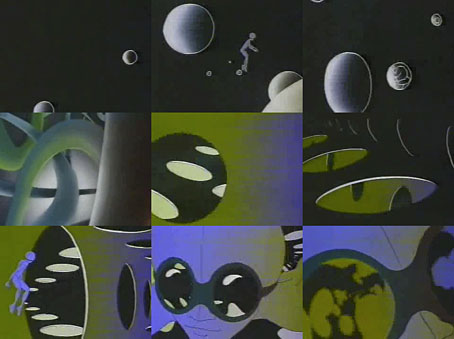
The Düsseldorf maestros are treated to some animated illustration in this 1979 film by Roger Mainwood which takes Kraftwerk’s Autobahn as its soundtrack. Mark at Strange Attractor provided the tip and he compares the animation style to René Laloux and Roland Topor’s Fantastic Planet (1973). The purple humanoid floating through surreal landscapes is certainly reminiscent of Laloux’s film, but Autobahn also reminds me of Bruno Bozzetto’s Allegro non troppo (1977) and, given that Mainwood’s animation comes a couple of years later, it may well have been inspired by it. Bozzetto’s film is a feature-length “adult” response to Walt Disney’s Fantasia which takes the Fantasia format—well-known classical themes illustrated by animated sequences—but does so in a slightly more grotesque or risqué fashion. Much of Bozzetto’s film seems less daring today than it was in 1977 but the best sequence still works well and happens to be as science fictional as Mainwood’s Autobahn, an entire cycle of planetary evolution set to Ravel’s Bolero. Follow the links below.

• Roger Mainwood’s Autobahn pt. 1 | pt. 2
Ravel’s Bolero from Allegro non troppo

Previously on { feuilleton }
Sleeve craft
Who designed Vertigo #6360 620?
Old music and old technology
Aerodynamik by Kraftwerk
The genius of Kraftwerk