Into the Vortex

radiosoulwax1.jpg

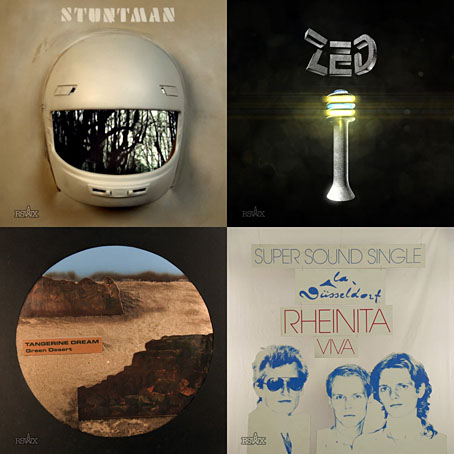
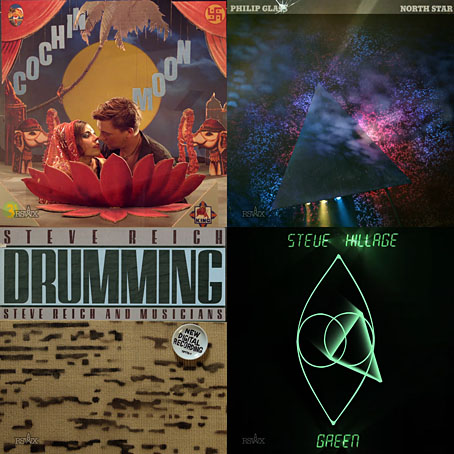
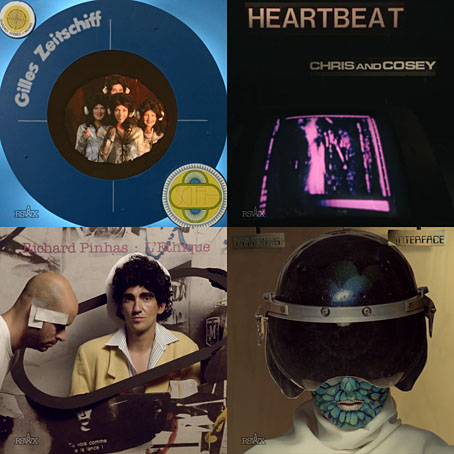
I’m surprised this has managed to evade my attention for the past eight years but better late than never. Into the Vortex is an hour-long music mix by Radio Soulwax whose visuals are one answer to the question of how best to illustrate a diverse playlist, if illustrate you must. The solution, directed by Wim Reygaert, is to recreate with sets, props and a cast of performers every single cover from every record in the mix, with each cover recreation lasting the duration of the piece. Many of the recreations are simple affairs using paint and cardboard but the time and effort involved still boggles the mind. No surprise that the Radio Soulwax motto is “Why do things the easy way?”

radiosoulwax2.jpg

The best part for this viewer and listener is that much of the music is drawn from very familiar albums: German electronica or Kosmische music, its French equivalents, and so on. It’s a lot more satisfying (and surprising) seeing the alien head from Interface by Heldon being recreated instead of yet another Beatles cover design. On the musical side, one of the users at Discogs very conveniently put together an almost complete listing of the mix, together with links to the records. Collect the set.

radiosoulwax3.jpg

Elsewhere on { feuilleton }
The album covers archive

Weekend links 465

palladini.jpg

The Star (1970) from The Aquarian Tarot by David Palladini.

• Artist David Palladini died in March but I only heard the news this week. His poster for Werner Herzog’s Nosferatu has been a favourite of mine ever since the film’s release, while some of his other works have featured here in the past. Still popular among Tarot users is the Aquarian Tarot (1970), a deck published a few years after Palladini had helped with the production of the Linweave Tarot. From the same period as the Aquarian deck is a set of Zodiac posters, all of which exhibit Palladini’s distinctive blend of Art Nouveau and Deco stylings. In addition to posters, Palladini produced book covers and illustrations, and even a few record covers. A book collecting all of this work would be very welcome.

Erotikus: A History of the Gay Movies (1974? 75? 78?): Fred Halsted presents a 90-minute history of American gay porn, from the earliest beefcake films to the hardcore of the 1970s, some of which Halsted also helped create. Related: Centurians of Rome [sic]: Ashley West and April Hall on the bank robber who made the most expensive gay porno of all time.

Peter Bradshaw reviews Too Old to Die Young, a Nicolas Winding Refn TV series described as “a supernatural noir”. Sign me up.

Naomi Wolf’s Outrages establishes the context for [John Addington] Symonds’s desperate efforts to justify his own sexual feelings. Since he was born in 1840, he was 15 when the first edition of Walt Whitman’s Leaves of Grass appeared, the same year that legislation in Britain streamlined the laws against sodomy and ensured that men found guilty of it served long prison sentences. With intelligence and flair, Wolf uses the various responses to Whitman to show the levels of intense need in the decades after the publication of Leaves of Grass for images and books that would rescue homosexuality from increasing public disapproval.

Colm Tóibín reviews Outrages: Sex, Censorship and the Criminalisation of Love by Naomi Wolf

• Record label Dark Entries has discovered 40 more reels (!) of music by Patrick Cowley dating from 1974 to 1979.

• “Is Stockhausen’s Licht the most bonkers operatic spectacle ever?” asks Robert Barry.

• Sex, Spunk, Shoes and Sweet Satisfaction: A Q&A with artist Cary Kwok.

• Tripping his brains out: Eric Bulson on Michel Foucault and LSD.

• Paul O’Callaghan chooses 10 best Dennis Hopper performances.

• “More obscene than De Sade.” Luc Sante on the fotonovela.

• Karl Blossfeldt’s Urformen der Kunst (1928).

• The Strange World of…Gong

Neonlicht (1978) by Kraftwerk | Brüder Des Schattens, Söhne Des Lichtes (1978) by Popol Vuh | Lichtfest (2017) by ToiToiToi

The Watchers

watchers.jpg

The latest release from A Year In The Country is The Watchers, a compilation album which takes as its theme the ancient trees of the British Isles. The slow time of a tree’s life becomes centuries in the case of the oldest specimens. Some of Britain’s yew trees are so old you imagine that if trees perceive human beings at all it would be as fleeting blurs, continually changing the landscape (and destroying the trees) before being replaced. It’s fitting that yew trees are often found growing in graveyards.

Some of them have lived through invasions of their island home undertaken by wooden ships, sword and arrow, the final days and passing of the old ways and the times of magic and witchcraft, the coming of the industrial revolution and the dawning of the digital era.

Track list:
1) Grey Frequency—In A Clearing
2) Field Lines Cartographer—A Thousand Autumns
3) Widow’s Weeds ft Kitchen Cynics—The Brave Old Oak
4) Depatterning—Ook/Dair
5) A Year In The Country—Radicle Ether
6) Phonofiction—Xylem Flow
7) Pulselovers—Circles Within Circles
8) Sproatly Smith—Watching You
9) Vic Mars—The Test Of Time
10) The Heartwood Institute—The Trees That Watch The Stones
11) Howlround—The Winter Dream of Novel’s Oak

The theme may be a pastoral one but, as with earlier compilations, several of the pieces here are very much products of the digital era; many of the pieces are also instrumentals which might pose a problem in illustrating the theme but each artist provides a note describing their intentions: Grey Frequency investigate a rooky wood; Widow’s Weeds provide the folkiest offering with The Brave Old Oak, a song about the ancient Scottish woodland of Dalkeith Oakwood; Depatterning attempt to convey in sound the shared genetic history of English and Irish Oaks.

I’m often resistant to music (or art) that relies on text for support but it’s difficult to avoid with an album like this. It’s also no different to the old “programme” tradition of illustrative instrumental music, a form whose most familiar example is Vivaldi’s Four Seasons. The listener may ignore the notes, of course, but doing so would mean missing details such as Phonofiction’s referring to their “drumkit of tree hits”. The best piece is Watching You by Sproatly Smith, a group who always seem to stand out on these compilations. Watching You delivers the theme with sympathy and economy, and since this is a song no notes are required. Many of the other pieces are less distinct, and without textual support they risk blurring into an undifferentiated electronic fuzz. Given the theme, this may be appropriate, the artists themselves becoming the fleeting blurs that the ancient trees perceive.

The Watchers will be released on 7th June, and is available for pre-order now.

Previously on { feuilleton }
The Corn Mother
The Quietened Mechanisms
The Shildam Hall Tapes
Audio Albion
A Year In The Country: the book
All The Merry Year Round
The Quietened Cosmologists
Undercurrents
From The Furthest Signals
The Restless Field
The Marks Upon The Land
The Forest / The Wald
The Quietened Bunker
Fractures

Weekend links 464

picaud.jpg

13 Circles by Julien Picaud.

• The 50th anniversary of the Apollo Moon landing is only two months away so it’s no surprise that Brian Eno’s Apollo: Atmospheres And Soundtracks is being reissued. The latest release will include an additional disc of new music by Eno with his collaborators from the original sessions, Daniel Lanois and Roger Eno. Related: the Apollo 11 Command Module as an explorable (and printable) 3D model.

• From the real Moon to the presence of the satellite in myth and history, the next book from Strange Attractor will be Selene: The Moon Goddess & The Cave Oracle, a volume which is also the final work by the late Steve Moore. With a foreword by Bob Rickard, and an afterword by Alan Moore.

• Guitar-noise maestro Caspar Brötzmann released a handful of thrilling albums in the 1990s then disappeared from view. Spyros Stasis talked to Brötzmann about his hiatus and his recent resurfacing on the Southern Lord label.

• A year late, but I didn’t know Paul Schrader had written an updated introduction to his 1972 study of Ozu, Bresson and Dreyer, Transcendental Style in Film. I love the idea of “The Tarkovsky Ring” as a directorial event horizon.

• “Nothing written is utterly without value, as I proved to myself by reading two random works.” Theodore Dalrymple on the lasting worth of “worthless” books.

Cinemagician: Conversations with Kenneth Anger, a documentary by Carl Abrahamsson about the director/writer/magus.

• Mirror, Mirror: When Movie Characters Look Back at Themselves by Sheila O’Malley.

• From Susan Sontag to the Met Gala: Jon Savage on the evolution of camp.

• Mix of the week: Secret Thirteen Mix 289 by Mondkopf.

• Portrait of the Artist as a Consumer: Anne Billson.

• A video by IMPATV for Religion by Teleplasmiste.

Obscure Sound ~ Cosmic: a list.

Mira Calix‘s favourite records.

Transcendental Overdrive (1980) by Harald Grosskopf | Transcendental Moonshine (1991) by Steroid Maximus | The Transcendent (1999) by Jah Wobble

Synapse: The Electronic Music Magazine, 1976–1979

synapse01.jpg

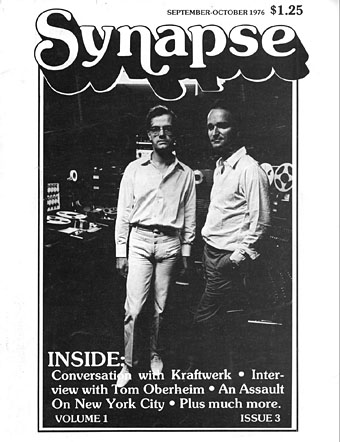
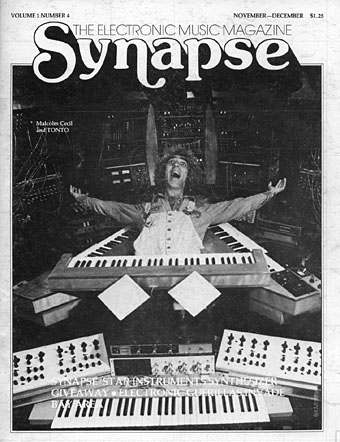
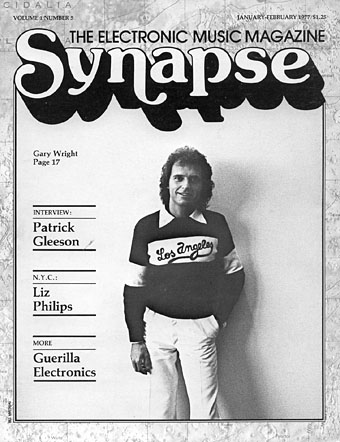
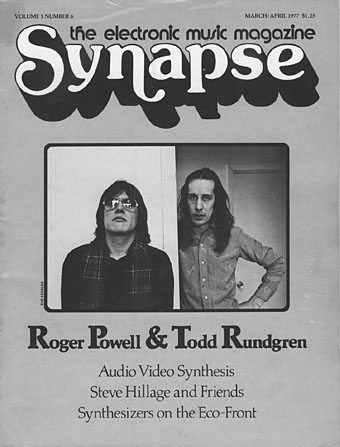
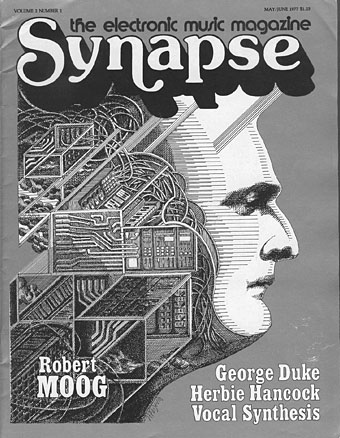
Synapse magazine has been mentioned here before, but only briefly in a weekend post. Looking last week for one of the back issues revealed that the scans of the magazine placed online by the publishers in 2012 have now vanished so this post links to an archive of PDFs at Monoskop. The publishers didn’t have copies of the first two issues so the run begins with issue 3.

synapse02.jpg

Synapse wasn’t around for very long but it’s of great interest for people like myself who have an enthusiasm for the analogue synthesizer music of the 1970s. The magazine was small but managed to secure interviews with major synthesists of the period (and Stockhausen!), as well as lesser-known figures who you wouldn’t expect to see in the general music press. Tangerine Dream and Brian Eno have never been starved of attention but the interviews with Isao Tomita and Michael Hoenig are valuable ones; the latter discusses his earlier career in the Kosmische band Agitation Free as well as his new album, the very Tangerine Dream-like Departure From The Northern Wasteland.

synapse03.jpg

Elsewhere in the magazine there are the usual technical articles that were common in journals of this type (the border between art and engineering in the early synthesizer world used to be as permeable as it was in the first decades of science fiction); and the latest synth-related albums receive reviews, many of which are more equivocal than you might expect. It’s a surprise seeing an album such as Ricochet by Tangerine Dream being treated with scepticism but then the reviewer evidently preferred the recordings of the group’s pre-Virgin period. Likewise, Kraftwerk were featured in the third issue but their Man-Machine album is given the same “Is this the future we really want?” appraisal they used to receive from the rock press.

synapse04.jpg

As always with old magazines, the ads are often as interesting as the editorial, and Synapse is filled with promotional material for a wide range of synth gear, from the major keyboard manufacturers to tiny electronic companies. It’s not every magazine where you can see a full-page command to “Trade in your Mellotron”.

Synapse contents list at Wikipedia

synapse05.jpg

Continue reading “Synapse: The Electronic Music Magazine, 1976–1979”