Weekend links 619

schulze.jpg

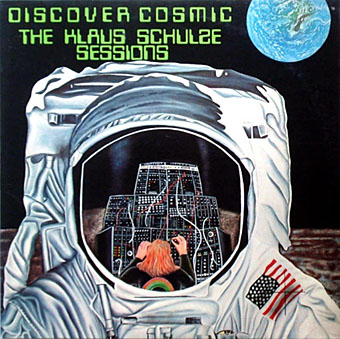
A Moog on the Moon by P. Praquin, 1977. And a space helmet reflection to add to the list being accumulated by 70s Sci-Fi Art.

• RIP Klaus “Quadro” Schulze. I’ve owned many of his solo albums over the years, and while they’re historically important for the part they played in developing the kosmische sound in the 1970s I’ve never been very enthusiastic about the music. The albums I prefer are the ones where he was working with others, whether as a drummer in Ash Ra Tempel, an inadvertent member of the fake Cosmic Jokers supergroup, or part of the genuine Cosmic Couriers supergroup that made Tarot. The Tonwelle album credited to “Richard Wahnfried” benefits considerably from the presence of Manuel Göttsching and Michael Schrieve (also a rumoured Carlos Santana); I recommend it. For a taste of the synth-doodling Schulze, here he is in analogue heaven.

• Next month, Luminous Procuress, a film by Steven Arnold (previously), is released for the first time on blu-ray by Second Run: “Exploding out of San Francisco’s vibrant late-60s counter-culture, Luminous Procuress is a psychedelic odyssey of unabashed hedonism. The only feature film by artist, mystic and polymath Steven Arnold, the film celebrates gender-fluidity and pan-sexuality in a voyeuristic phantasmagorical journey towards spiritual ecstasy.”

• “Whereas [Bernard] Herrmann worked predominantly with strings and [John] Carpenter with synths, Anderson wanted to evoke a similar atmosphere with guitars.” Greg “The Lord” Anderson talks to Dan Franklin about making an album of night music.

I am troubled by how often people talk about likability when they talk about art.

I am troubled by how often our protagonists are supposed to live impeccable, sin-free lives, extolling the right virtues in the right order—when we, the audience, do not and never have, no matter what we perform for those around us.

I am troubled by the word “problematic,” mostly because of how fundamentally undescriptive it is. Tell me that something is xenophobic, condescending, clichéd, unspeakably stupid, or some other constellation of descriptors. Then I will decide whether I agree, based on the intersection of that thing with my particular set of values and aesthetics. But by saying it is problematic you are saying that it constitutes or presents a problem, to which my first instinct is to reply: I hope so.

Art is the realm of the problem. Art chews on problems, turns them over, examines them, breaks them open, breaks us open against them. Art contains a myriad of problems, dislocations, uncertainties. Doesn’t it? If not, then what?

Jen Silverman on the new moralisers

• “The website is colorful and anarchic, evoking the chaotic sensory experience of exploring a crammed, dusty shop.” Geeta Dayal explores the Syrian Cassette Archives.

• New music: The Last One, 1970 by Les Rallizes Dénudés; Untitled 3 by Final; Blinking In Time (full version) by Scanner.

• Why was erotic art so popular in ancient Pompeii? Meilan Solly investigates.

• You’ve been reframed: Anne Billson explores the history of split-screen cinema.

• At Spoon & Tamago: Japanese era names illustrated as logos.

• Mix of the week: XLR8R Podcast 745 by Wilted Woman.

Fun type

Split, Pt. 4 (1971) by The Groundhogs | Split Second Feeling (1981) by Cabaret Voltaire | Splitting The Atom (2010) by Massive Attack

Weekend links 617

parent.jpg

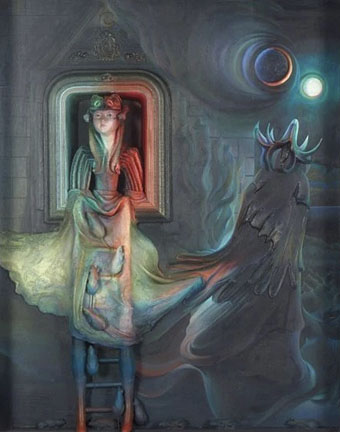
Diane (1977) by Mimi Parent.

Richard Pinhas expounds upon his favourite musical choices for Warren Hatter. The influence of Robert Fripp has always been to the fore in the Pinhas oeuvre—an early track by Heldon is titled In The Wake Of King Fripp—so there was bound to be a King Crimson album on the list. But which one? Click through the selections to find out.

• Vinyl is the product of a toxic manufacturing process, as well as being difficult to recycle without releasing yet more toxins, but you seldom see these issues discussed by today’s quality-conscious vinyl fetishists. Jono Podmore talks to some of the people trying to create an eco-friendly disc.

• “…these Renaissance images shock us because they are so frequently ithyphallic: Christ has risen, but not in the way we have come to expect.” Hunter Dukes on ostentatio genitalium in Renaissance art.

• At Wormwoodiana: Mark Valentine on those music projects that used to be described as “hauntological”, with an emphasis on The Machinery of the Moment, a new release from The British Space Group.

• “Like Delia Derbyshire jamming with This Heat.” Jesse Locke tours the Broadcast discography.

• 50 Watts announces the birth of 50 Watts Books, a publisher of strange and/or unusual art books.

• “Black lights turn this North Carolina mine into a psychedelic wonderland.”

• At Dennis Cooper’s: Bill Morrison Day.

Black Lightening Light (1968) by The Shy Guys | Black Light (1994) by Material | Transmission Nine: Black Light (2013) by Pye Corner Audio

Weekend links 616

finlay.jpg

Illustration by Virgil Finlay for The Face in the Abyss by A. Merritt; Famous Fantastic Mysteries, October 1940.

• “The pier was completely outside of the gallery system, which David loved of course. People were just working on the walls, nothing was for sale, nothing could really be bought, although people were coming in and trying to chip things off the walls.” Cynthia Carr on the love letters and legacy of David Wojnarowicz.

• “In pursuit of Pure Form, the Polish artist known as “Witkacy” would consume peyote, cocaine, and other intoxicants before creating pastel portraits.” Juliette Bretan on the artful intoxications of Stanisław Ignacy Witkiewicz.

• Kino Kyiv: Christopher Silvester compiles a list of notable Ukrainian films. I’ve not seen all of these but Shadows of Our Forgotten Ancestors is a great favourite.

Onscreen for nearly the entire runtime, [Laura Dern] pulls off the remarkable feat of being in total control of a scenario organized by undermining her identity, obliterating her characterization, and so scrambling the distinction between Nikki and Susan that one eventually comes to view Inland Empire not as a maze to exit, a puzzle to solve, an ouroboros to gawk at, but rather as both a generalized treatise on the enigma of acting and a very specific, exquisitely perverse mash note to one of Lynch’s most formidable collaborators.

Nathan Lee on Laura Dern, David Lynch and Inland Empire. I’ve always thought Dern’s exceptional performance might have been recognised more widely if Lynch hadn’t filmed most of it on low-grade video.

• New music: Golden Air by Sun’s Signature, a new project from Elizabeth Fraser and Damon Reece.

• Miranda Remington explores The Strange World of…Stomu Yamash’ta.

• Steven Heller’s font of the month is Boucan.

• At Dennis Cooper’s: Labyrinthine.

Labyrinth (2010) by Chrome Hoof | Labyrinths (2018) by Jonathan Fitoussi / Clemens Hourrière | The Seventh Labyrinth (2019) by Pye Corner Audio

Through The Gates Of Yesterday

broadcast1.jpg

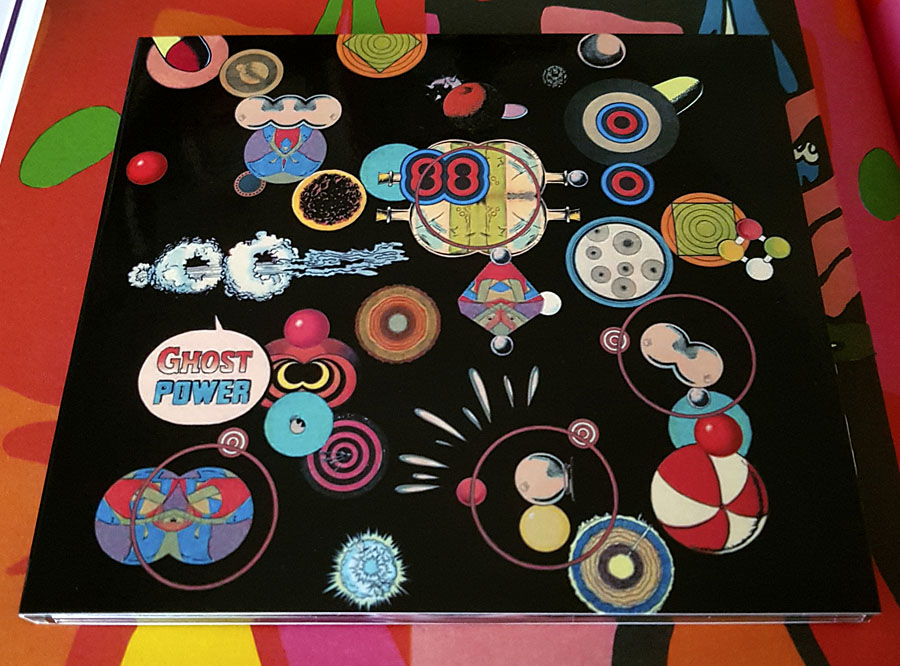
Here at last, the two Broadcast reissues and the album of officially released radio sessions. I already had much of the music so these purchases are mostly for reasons of cult completism and the Julian House cover designs. Mr House had already designed the rest of the Broadcast discography, as well as collaborating with them in his Focus Group guise, so this continuity was essential.

broadcast2.jpg

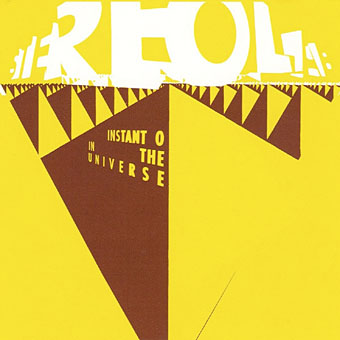
Also essential, music-wise, is the Mother Is The Milky Way EP even though it’s only 20 minutes long. This was originally limited to 750 copies sold during the 2009 tour so it’s always been hard to find. Musically, it’s of a piece with the Witch Cults Of The Radio Age album, and just as beguiling, a dreamy mélange of song fragments and sound samples—Kurt Schwitters’ Ursonate colliding with Jonathan Miller’s Alice in Wonderland—that’s more genuinely “psychedelic” than many attempts to conjure these qualities by mimicing old musical styles. The overlaid images on the cover may be alluding to the layered sounds…and are those magic mushrooms in one of the squares? Answers on a lysergic sugarcube.

broadcast3.jpg

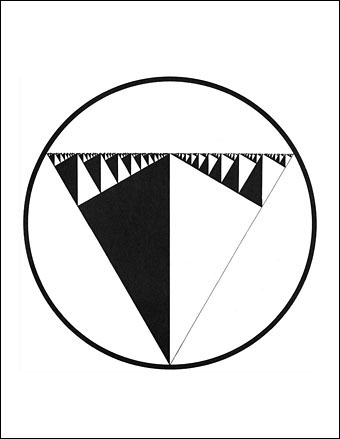
The two Microtronics EPs were intended to be functional works rather than entertainments, “Music for links and bridges”, although I don’t know if they’ve ever been used as such outside Broadcast mixes. These were also sold on separate tours as mini CDs but they now come packaged together, including a first-time release on vinyl which will keep the fetishists happy despite the format seeming like overkill for a collection of 21 very short squawks and drum loops.

broadcast4.jpg

Maida Vale Sessions will also be essential for some listeners, comprising the group’s three sessions for John Peel’s show (1996, 2000, 2003) plus one from 1997 for Steve Lamacq’s Evening Session, 54 minutes in total. Being a collector of Broadcast bootlegs I already had most of these but they sound so much better coming from the original recordings. The final session, which I hadn’t heard before, is a fantastic set, and includes one of their few covers, a version of Sixty Forty by Nico. John Peel was an enthusiast, unsurprisingly, who may be heard on a bootleg of a Birmingham concert introducing the group as “one of the nation’s great bands”.

And if any of the above has stimulated your interest, Warp Records wisely commissioned The Gaslamp Killer to create an hour-long mix from the new records which may be heard here.

Previously on { feuilleton }
Esoterica 49
Peter Strickland’s Stone Tape
Valerie and Her Week of Wonders
The Ghost Box Study Series

Weekend links 611

ltpf.jpg

Let The Power Fall (1981) by Robert Fripp. A postcard included with the original vinyl release of the Let The Power Fall album.

Exposures 1977–1983 is the title of another wallet-busting CD/DVD/blu-ray box which will be released by DGM at the end of May. Unlike the previous King Crimson sets this one will be devoted to Robert Fripp’s first run of solo releases, covering the albums that emerged from the artistic campaign he described at the time as “The Drive to 1981”: Exposure (1979), God Save The Queen/Under Heavy Manners (1980), The League Of Gentlemen (1981), and Let The Power Fall (1981). If you’re as interested as I am in this period of Fripp’s career then this is all very exciting. Exposure has been reissued several times over the years, and exists in three different “editions” featuring alternate mixes and song variations, but the other albums have been unavailable in any form for decades, possibly as a result of the turmoil caused by the mismanagement and eventual collapse of the EG label. In addition to the reissues the box will include live recordings, a League Of Gentlemen Peel session plus a substantial quantity of Frippertronics material, including the loops that were recorded for Eno & Byrne’s My Life In The Bush Of Ghosts. Fripp retained a credit for his contribution to Regiment but the results are so far down in the mix that they’re easy to miss. Related: The Drive to 1981: Robert Fripp’s Art-Rock Classic Exposure.

• Galerie Georges-Philippe & Nathalie Valloisin, Paris, is currently creeping out visitors to Strange Aeons—We will meet you there, an exhibition by Peybak (Peyman Barabadi and Babak Alebrahim Dehkordi) that borrows its title from HP Lovecraft and includes a number of creatures, “neither embryos nor chimeras”, which may be found prostrate and breathing on the gallery floor.

• New music: Sub Zero, in which Kevin Richard Martin returns to the subterranean/subaqueous/subarctic zones he charted on his Isolationism and Driftworks compilations in the 1990s; plus The Carrier by Large Plants, an album of “psych rock belters” coming soon on the Ghost Box label.

• Science fiction as revolution: Joe Banks talks to Iain McIntyre, co-editor of Dangerous Visions and New Worlds—Radical Science Fiction, 1950–1985, about the flourishing of the New Wave of SF in the 1960s and 70s.

• “We know from his letters that Joyce sent a Greek flag to Nutting for him to colour-match. So, he was aiming for ‘Greek’ blue.” It’s that book again. Cleo Hanaway-Oakley on Ulysses, blindness and blue.

• Intermittent Eyeball Fodder: More visual delights gathered by S. Elizabeth.

• Steven Heller’s font of the month is Nicholas.

• Galerie Dennis Cooper presents…Liz Larner.

Let The Power Fall (1971) by Max Romeo | Minor Man (1981) by The League Of Gentlemen ft. Danielle Dax | Heptaparapashinokh (1981) by The League Of Gentlemen