Weekend links 199

cordal.jpg

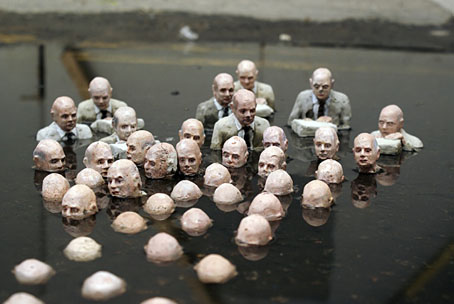
Follow the Leader (London, 2011) by Isaac Cordal.

• “Brutalism is the decor of dystopian films, literature and comics, just as gothic is for horror.” Jonathan Meades‘ A-Z of brutalism.

Vitaly Shevchenko on the urban explorers of the ex-USSR. Related: Photos by Vitaliy Raskalov from the top of the Shanghai Tower.

Joe Banks reviews the throbbing, hissing, minatory pulses of the Black Mill Tapes 1–4 by Pye Corner Audio.

Walter Benjamin is the only one among the commentators who attempts to pin down the anonymous, evanescent quality of Walser’s characters. They come, he says, “from insanity and nowhere else. They are figures who have left madness behind them, and this is why they are marked by such a consistently heartrending, inhuman superficiality. If we were to attempt to sum up in a single phrase the delightful yet also uncanny element in them, we would have to say: they have all been healed.” Nabokov surely had something similar in mind when he said of the fickle souls who roam Nikolai Gogol’s books that here we have to do with a tribe of harmless madmen, who will not be prevented by anything in the world from plowing their own eccentric furrow.

Le Promeneur Solitaire: WG Sebald on Robert Walser

Drink The New Wine, an album by Kris Force, Anni Hogan, Jarboe, Zoe Keating and Meredith Yayanos.

• At 50 Watts: Illustrations by Fortuné Méaulle for Alphabet des Insectes by Leon Becker.

Lawrence Gordon Clark, Master of Ghostly Horror. An interview by John D’Amico.

• Chapel Perilous: Notes From The New York Occult Revival by Don Jolly.

• Mix of the week: Secret Thirteen Mix 107 by Ernestas Sadau.

• An Occult History of the Television Set by Geoff Manaugh.

• Was Ist Das? The Krautrock Album Database.

• First dérive of the year by Christina Scholz.

John Waters’ Youth Manifesto.

Gardens of Earthly Delights

Psychedelic Folkloristic

Water Music I / Here Comes The Flood / Water Music II (1979) by Robert Fripp & Peter Gabriel | After The Flood (1991) by Talk Talk | Flood (1997) by Jocelyn Pook
School Daze by Patrick Cowley

cowley.jpg

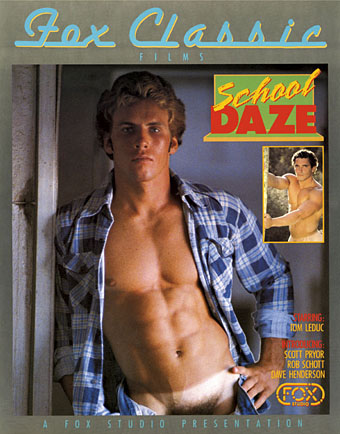
School Daze sleeve designed by Eloise Leigh.

Music made for porn films is nothing if not derivative and unmemorable, assuming it’s been specially made at all and isn’t merely a cheap library track, the aural equivalent of stock footage. This wasn’t necessarily the case when porn cinema was getting established in the America of the 1970s but a huge turnover of anonymous product combined with simple expediency—hours of footage that needed to be soundtracked by something—made falling standards inevitable. The cliché of the cheesy porn soundtrack is such a given that it’s a surprise to encounter anything which is even halfway listenable away from the screen. In the case of this album by Patrick Cowley it’s even more of a surprise to find that such exceptional music has been hiding for years on a couple of gay porn films, School Daze and Muscle Up, from 1980.

foxclassic.jpg

Gay porn would seem the perfect thing to be soundtracked by the creator of an unashamed anthem like Menergy (1981) but the music on School Daze bears little resemblance to Cowley’s Hi-NRG disco hits, not least because some of the tracks were composed as far back as 1973 when Cowley was still in college. The tapes were unreleased until John Coletti, the owner of Fox Studios, asked Cowley for some music which is how these early experiments ended up as porn scores. Experiments they may be, in differing moods and styles, but they’re also very successful ones. Jorge Socarras’s album notes describe Cowley’s wide-ranging musical (and sexual) tastes which would explain why one of the longer tracks, Journey Home, features a didgeridoo of all things. The didgeridoo sound became a considerable dance music cliché in the early 90s but prior to this you’d only find it outside Indigenous Australian music on pastiche numbers such as Flying Doctor by Hawklords or The Dreaming by Kate Bush; Cowley uses the instrument as simply another sound source. Socarras also mentions Cowley listening to Tomita and Wendy Carlos while in college but none of the music here sounds anything like the earlier generation of Moog composers. It also doesn’t sound much like Tangerine Dream or anything that was happening in Europe during the 1970s. If anything, the subdued and often dark atmosphere is a better fit with the post-punk music being produced in Britain around the time the films were released, sombre albums like The Bridge by Thomas Leer & Robert Rental, or instrumental tracks by The Human League. Didgeridoo or not, some of the tracks are pretty gloomy for porn music.

In the autumn of 1982 I was in the process of moving from Blackpool to Manchester, and spent a lot of time shuttling back and forth on coaches listening to tapes on a cheap Walkman clone. A couple of those journeys were soundtracked by Patrick Cowley’s extended remix of I Feel Love by Donna Summer and Industrial Muzac by Throbbing Gristle, a piece of subdued electronica which has been out of circulation for far too long. The music on School Daze fills an unlikely space between the two, there’s even a synth solo like the one that erupts into the Donna Summer remix. Patrick Cowley died in November of that year, one of the earliest casualties of a disease which at that time wasn’t even called AIDS. Listening to School Daze, and to the last album released while he was alive, Mind Warp, you can’t help but wonder what he might have done with the sampling technology that became widespread a couple of years later.

School Daze is available on double-vinyl and CD from Dark Entries who say all proceeds from the album will be donated to Project Open Hand and the AIDS Housing Alliance.

Nightcrawler from School Daze
Mockingbird Dream from School Daze
Dark Entries interviews John Coletti of Fox Studio
Five Things You Need to Know about Gay Electronic Wizard Patrick Cowley

Previously on { feuilleton }
William E. Jones on Fred Halsted
Summer of Love
A Clockwork Orange: The Complete Original Score

Weekend links 198

boty.jpg

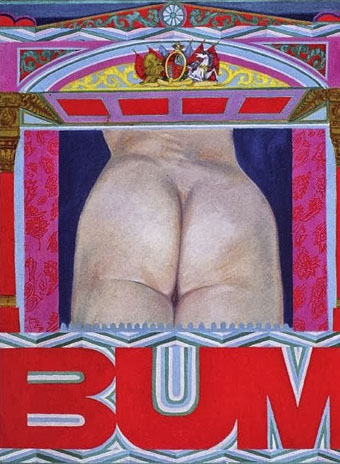
Bum (1966) by Pauline Boty.

Eleanor Birne on Pauline Boty, “the only prominent female Pop artist among a generation of famous men”. Ken Russell’s Pop Art documentary, Pop Goes the Easel (1962), which features Boty, may be seen here. Two years later Boty was back with Ken Russell playing the part of the prostitute from The Miraculous Mandarin in a film about Béla Bartók. That’s something I’d love to see. There’s more about her painting, and the work of other female Pop artists, here.

• Why Are We Sleeping? Mark Pilkington on the music world’s recurrent interest in the philosophy of GI Gurdjieff. Pilkington’s most recent Raagnagrok release with Zali Krishna, Man Woman Birth Death Infinity, was reviewed by Peter Bebergal.

• Cinematic details: Frames-within-frames in The Ipcress File (1966), and the typography of 2001: A Space Odyssey (1968).

highrise.jpg

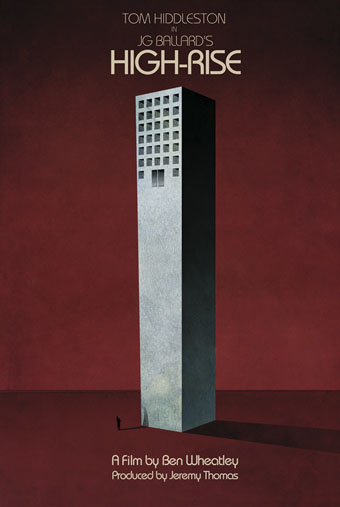
A Jay Shaw poster for Ben Wheatley’s forthcoming film of High-Rise.

• “…a large cavity must be dug in the bird’s shoulder and filled with ball bearings.” Christine Baumgarthuber on the dubious delights of The Futurist Cookbook.

• Why Tatlin Can Never Go Home Again: Rick Poynor on the difficulties of finding a definitive representation of an artwork online.

Jay Parini reviews Inside a Pearl: My Years in Paris by Edmund White. At AnOther Donatien Grau talks to White about fashion.

• At Bajo el Signo de Libra (in Spanish): the homoerotic and occasionally Surrealist art of Pavel Tchelitchew.

• At 50 Watts: Kling Klang Gloria: Vintage Children’s Books from Austria.

• The motorbike girl gangs of Morocco photographed by Hassan Hajjaj.

Geoff Manaugh on how LED streetlights will change cinema.

Stylus “is an experiment in sound, music and listening”.

• Mix of the week: Secret Thirteen mix 106 by Senking.

• At Pinterest: JG Ballard

This Is Pop? (1978) by XTC | Pop Muzik (1979) by M | Pop Quiz (1995) by Stereolab

Decoder, a film by Jürgen Muschalek

decoder1.jpg

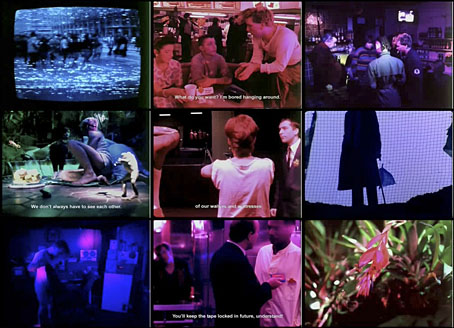
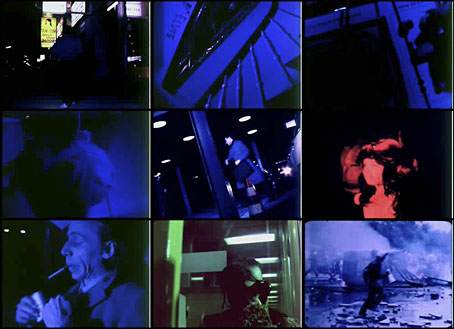
The Burroughs Centenary approaches, and this month sees the 30th anniversary of this Burroughs-related item. Decoder is a low-budget feature film from 1984 written by Klaus Maeck, and directed by Jürgen Muschalek (aka Muscha). Despite the constraints of budget and casting—many of the actors are amateurs—Decoder is truer to the techno-anarchist strand of Burroughs’ fiction than anything attempted before or since, and it’s arguably truer to the spirit of his works as a whole than David Cronenberg’s Naked Lunch.

decoder2.jpg

Decoder was shot in Hamburg in the early 1980s although the city is never properly identified in order to maximise the film’s near-future qualities. The narrative concerns attempts by FM (played by FM Einheit from Einstürzende Neubauten) to combat the insidious effects of muzak in burger restaurants using tapes created with his home-made electronics. William Burroughs makes a couple of brief appearances as the “Old Man” with a shop full of electronic components. Among the rest of the cast there’s Christiane Felscherinow, dividing her time between peep-show sex-work and languishing in a room filled with her pet frogs; and Genesis P-Orridge in his Psychic TV gear as the head of an underground pirate cult who encourage FM to launch an offensive against the muzak signals. Original music is provided by Dave Ball (from Soft Cell) and FM Einheit. The complete score is very good, featuring additional tracks by Soft Cell, Einstürzende Neubauten and Matt Johnson. Watched today, the narrative seems very much a product of its time, and somewhat outmoded. In 1984 home computing was increasingly prevalent, and cheap sound-sampling was just around the corner; Decoder is the last hurrah of an analogue struggle against the agents of the Control Virus.

decoder3.jpg

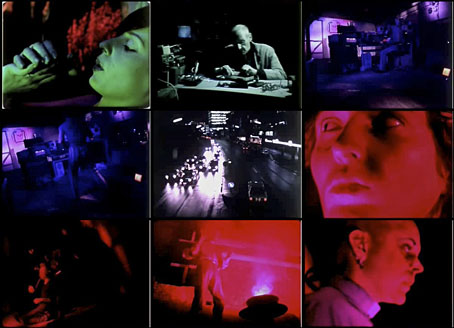
It’s a shame Jürgen Muschalek didn’t get to make anything else when he was obviously trying for some kind of cross between Burroughs’s The Electronic Revolution (1970) and Godard’s Alphaville (1965). Low-budget films often suffer visually but this one makes impressive use of vivid lighting and plenty of shadow which helps alleviate some of the weaknesses elsewhere. David Cronenberg has often acknowledged the influence of avant-garde types such as Burroughs and Warhol but his own films tend to be very conservative in their presentation. Muschalek at least tries to parallel some of Burroughs’ fragmented narrative techniques with an abrupt and disjunctive editing style. The film as a whole is much more in tune with the early Industrial Culture ethos than Peter Care’s noir pastiche, Johnny YesNo, but suffered from being more read about than seen in the 1980s. A few copies can be found online. In 2010 it finally appeared on DVD with extra material and a soundtrack disc.

Elsewhere on { feuilleton }
The William Burroughs archive

Weekend links 197

field.jpg

Posters by Jay Shaw for Ben Wheatley’s A Field in England which receives a US release this month.

Alvin Baltrop’s Gay New York: “the clandestine activities taking place under New York piers between 1975 and 1986”. AnOther samples some of the work on display at the Open Eye Gallery, Liverpool. Meanwhile, BUTT has some shots from Texas Porno Road Trip, a photo series by Mike McLeod. Related: HBO will show you anything but a male erection, says Justin Moyer.

• “[Robert] Desnos quickly proved himself to be one of the most gifted in these experiments – eventually known as ‘the period of sleeping fits’. He was capable of writing, speaking, drawing and composing entire fantastical narratives.” Eugene Thacker on the Surrealist séances of the 1920s.

• “It’s history, not a viral feed,” says Sarah Werner. A complaint about the way the ongoing decontextualisation of images is both pernicious and potentially lucrative.

His prose is a palimpsest of echoes, ranging from Eliot’s Preludes and Rhapsody on a Windy Night (lines like “Midnight shakes the memory / As a madman shakes a dead geranium” are Burroughsian before the fact) to Raymond Chandler’s marmoreal wisecracks and Herbert Huncke’s jive. I suspect that few readers have made it all the way through the cut-up novels, but anyone dipping into them may come away humming phrases. His palpable influence on JG Ballard, William Gibson, and Kathy Acker is only the most obvious effect of the kind of inspiration that makes a young writer drop a book and grab a pen, wishing to emulate so sensational a sound. It’s a cold thrill.

Peter Schjeldahl reviews Call Me Burroughs by Barry Miles.

• “Dance music was born in LGBT communities, but has this been forgotten?” Luis-Manuel Garcia on an alternate history of sexuality in club culture.

• Avant-Grade Hallucinogens: the Poetics of Psychedelic Perception in Moving Image Art by Stuart Heaney.

No Condition Is Permanent: weekly radio shows from Count Reeshard at LuxuriaMusic and iTunes.

The Golem: where fact and fiction collide. David Barnett on 100 years of Gustav Meyrink’s novel.

• Don’t Let Harlan Ellison Hear This: Nick Mamatas on a great writer.

• Mix of the week: the Ela Orleans Mix at A Sound Awareness.

Amon Düül II playing live on French TV, 1971 & 1973.

• A soundmap of London canals and minor rivers.

The Peculiar Underworld of Rare-Book Thieves.

• At Pinterest: William Burroughs and Phalluses.

Architecture of Doom

Hallucinations (1967) by Tim Buckley | Phallus Dei (1969) by Amon Düül II | Hallucinations (In Memory of Reinaldo Arenas) (1994) by Paul Schütze