Recent signals

signals1.jpg

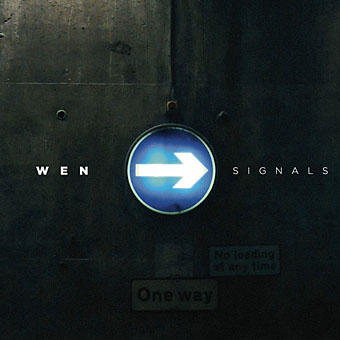
Signals (2014): vinyl front cover. Photo by Nico Hogg.

Seeing as my design for the recent Signals album by Wen has been deemed one of the best covers of the year so far I thought I ought to mention some of the other albums I’ve worked on over the past few months. I tend to give the most attention here to my book designs and illustrations but I’m still working on music releases, albeit with less regularity.

One reason the book work receives more attention is that there’s more of my input involved. Almost all these recent releases have begun as picture selections from the artist which it’s been my job to work into a printable form then place the relevant information in a suitable typeface. This isn’t to downplay the work involved: the careful placing of type becomes more critical the more the design tends to minimalism, and even the best photo can be ruined by clumsy typesetting or an unsympathetic typeface. The challenge of working in a more minimal direction can be a refreshing one when much of the work I do tends to visual excess.

signals2.jpg

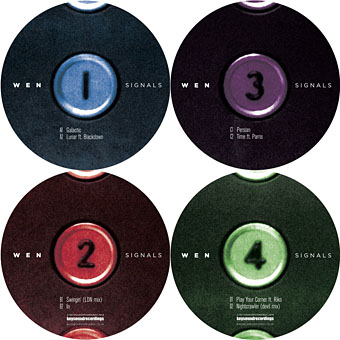
Signals (2014): vinyl labels. Photos by Nico Hogg.

Wen’s album for Keysound Recordings is a collection of dark urban rhythms for which Nico Hogg provided some suitable views of nighttime London. The numbers on the vinyl labels are lift buttons from a high-rise block, while the abstract scene below is a photo of the Thamesmead housing estate.

signals3.jpg

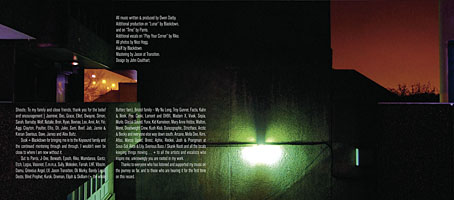
Signals (2014): CD interior. Photo by Nico Hogg.

Continue reading “Recent signals”

Weekend links 211

shau.jpg

Secret Bloom (2014) by Natalie Shau.

Bloomsday approachs. “Reading Ulysses changed everything I thought about language, and everything I understood about what a book could do,” says Eimear McBride whose debut novel, A Girl Is a Half-formed Thing, recently won the first Bailey’s women’s prize for fiction. McBride was interviewed by Susanna Rustin last month, shortly before the award was announced, and her novel has now become one of those minor causes célèbres for being rejected so often it was eventually published by a new imprint set up by a bookseller. “If the publishing industry doesn’t take a risk then who will?” asks Henry Layte, the bookseller in question.

Speaking of risk, David Hebblethwaite coincidentally wrote a post earlier this week asking where the formal challenge has gone in science-fiction writing. (He mentions McBride in passing.) Nina Allen followed up with a post of her own. I suspect the books are still being written but they’re no longer being accepted by editors and publishers who want even more adventure stories, “sympathetic” characters, and easy reads. Novels that only aspire to be written equivalents of action films or computer games are doomed to be less exciting than their more kinetic competitors. The struggle between the values of art and the values of entertainment is an old one but it shouldn’t be an either/or proposition. “Difficulty is subjective,” says Eimear McBride, “the demands a writer makes on a reader can be perceived as a compliment.”

Related: the following from Geoffrey Hill on “difficulty”:

We are difficult. Human beings are difficult. We’re difficult to ourselves, we’re difficult to each other. And we are mysteries to ourselves, we are mysteries to each other. One encounters in any ordinary day far more real difficulty than one confronts in the most “intellectual” piece of work.

• The Quietus pulled out all the stops this week, interviewing Annette Peacock, Iain Sinclair (again), Alan Moore (again), and asking Peter Strickland, the director of Berberian Sound Studio, for a list of his favourite albums. Given the above, it’s worth noting that all those people have produced challenging work of their own in different media.

• “The Satyrs Motorcycle Club was founded in 1954 with seven members, but little did anyone know it would become the oldest running LGBT organization (and oldest gay motorcycle club) in the world.”

Trunk TV posted another great selection of television title sequences. The previous selection has been taken down for the usual tiresome copyright reasons so watch this one while you can.

• “Detroit techno and black metal have so much in common,” say Wolves In The Throne Room whose new album, Celestite, is predominantly a product of synthesizer technology.

• “Houghton Library’s copy of Arsène Houssaye’s Des destinées de l’ame (FC8.H8177.879dc) is without a doubt bound in human skin.”

• The secret of Nabokov’s sexual style: David Lodge reviews Nabokov’s Eros and the Poetics of Desire by Maurice Couturier.

• How long can you hold your breath? 2 models, 7 divers in an underwater shipwreck by photographer Von Wong.

• At Dangerous Minds: Paul Gallagher on The fantastic world of Sharmanka Kinetic Theatre.

• Wizards of the Coast: Benjamin Breen on John Dee and the occult in California.

• More photography: Peter Guenzel captures strange lights in forests.

• Mix of the week: Bleep podcast 121 presented by Margot Didsbury.

I’m The One (1972) by Annette Peacock | Eros Arriving (1982) by Bill Nelson | The Dire And Ever Circling Wolves (2005) by Earth

Weekend links 209

soundcarriers.jpg

Soundcarriers poster by Julian House.

A new release on the Ghost Box label is always a welcome thing but Entropicalia by The Soundcarriers, out on May 20th, is one I’m especially looking forward to. Julian House has made a video for new song Boiling Point, and there’s also the poster above which can be downloaded at larger size here. The Ghost Box Guest Shop has a couple of new additions including the recent Man Woman Birth Death Infinity album by Raagnagrok.

• “It’s a funny time to be making music, because we’re a generation of people who make music with screens instead of with ears.” Ben Frost talking to Tristan Bath.

• At Dangerous Minds: You Gotta Say Yes to Another Excess, a rare glimpse of Yello live in concert, 1983.

Our movements about London are closely circumscribed, and while we may imagine ourselves to be free, the truth is that the vast majority of our journeys are undertaken for commercial imperatives: we travel either to work or to spend. All about us during our daily existence we are presented with buildings we cannot enter, fences we cannot climb and thoroughfares it would be foolhardy to cross. We are disbarred from some places because we don’t have the money — and from others because we don’t have the power. The city promises us everything, but it will deliver only a bit.

The place-hackers draw our attention to how physically and commercially circumscribed our urban existence really is. […] As more and more international capital flows into London, so public space is increasingly eroded — it’s just too valuable for us ordinary folk to paddle about in any more.

Give the freedom of the city to our urban explorers, says Will Self. Related: Robert Macfarlane accompanied urbexer Bradley Garrett on a night-time jaunt.

Black Sabbeth: Metal band Gonga covering a classic with Portishead’s Beth Gibbons on vocals.

• Pelican books take flight again; Paul Laity on the resurrection of the non-fiction imprint.

• Finland’s homoerotic stamps are an ocular feast for women, too, says Nell Frizzell.

• “I guess you could say I am a Pagan.” Kenneth Anger on the occult.

• “How much gay sex should a novel have?” asks Caleb Crain.

• Mix of the week: Secret Thirteen Mix 112 by Kyoka.

The Gibraltar Encyclopedia of Progressive Rock

Zombi’s Guide to Goblin

Decadence Comics

Zombie Warfare (1979) by Chrome | Escape From The Flesheaters (Zombie) (1979) by Fabio Frizzi | Zombie’ites (1993) by Transglobal Underground

Weekend links 208

sungwon.jpg

The Blue Girl (2013) by Sungwon.

• “Meanwhile, in her parents’ room [Max] Ernst painted aardvarks eating ants and big human hands around the windows. ‘Sexual connotations, I think,’ she says shyly.” Agnès Poirier talks to Cécile Eluard about her childhood among the Surrealists.

• “Thrilling and prophetic”: why film-maker Chris Marker‘s radical images influenced so many artists. Sukhdev Sandhu, William Gibson, Mark Romanek and Joanna Hogg on the elusive director.

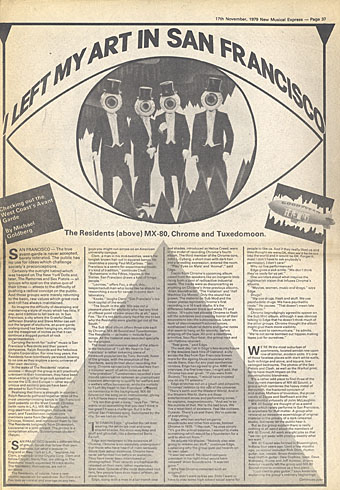
• At Dangerous Minds: Throbbing Gristle live in Manchester in 1980, and Brian Butler talks about the rediscovered early print of Kenneth Anger’s Lucifer Rising. There’s a trailer!

• From 1981: The Art of Fiction No. 69 at The Paris Review, an interview with Gabriel García Márquez. Related: Thomas Pynchon reviewed Love in the Time of Cholera in 1988.

• “Seven years ago, a stolen first edition of Borges’s early poems was returned to Argentina’s National Library. But was it the right copy?” Graciela Mochkofsky investigates.

• “What was Walter Benjamin doing with his shirt off in Ibiza?” Peter E. Gordon reviews Walter Benjamin: A Critical Life by Howard Eiland & Michael W. Jennings.

• A video by Marcel Weber for Måtinden, a track from Eric Holm’s Andøya album. Another album on the Subtext label that I helped design.

• More Ian Miller: Boing Boing has pages from his new book, The Art of Ian Miller, and there’s an interview at Sci-Fi-O-Rama.

Outrun Europa, a free compilation of 80s-style electronic music. There’s a lot more along those lines here.

• Praise Be! Favourite religious and spiritual records chose by writers at The Quietus.

Ralph Steadman illustrated Alice’s Adventures in Wonderland in 1973.

British Pathé is uploading 85,000 of its newsreel films to YouTube.

• Drawings by Lebbeus Woods at The Drawing Center, New York.

• At Pinterest: Ian Miller and Kenneth Anger.

Lucifer Sam (1967) by Pink Floyd | The Surrealist Waltz (1967) by Pearls Before Swine | Which Dreamed It (1968) by Boeing Duveen And The Beautiful Soup

Weekend links 207

barker.jpg

Chthonic Cities by David Chatton Barker. One of a series of Folklore Tapes screenprints available from Bleep.

• The original version of Kenneth Anger’s Lucifer Rising, the one with the Jimmy Page soundtrack that was completed in 1973, has always been described as lost/stolen/buried or otherwise gone forever. So you’d think the news that a print had been discovered recently by Brian Butler would have received greater attention. There’s a screening in Los Angeles this Thursday. When do the rest of us get to see it?

Chris Marker: A Grin Without a Cat, an exhibition and series of Marker-related events at the Whitechapel Gallery, London. Related: The Encounter of M. Chat & Chris Marker as Told By Louise Traon.

• The trailer for The Gospel According to St Derek, a forthcoming documentary about Derek Jarman. Related: Carl Swanson on why Tilda Swinton is not quite of this world.

Maybe there’s just something conservative at the bedrock of American fiction. […] Or maybe it’s just another symptom of the creeping conservatism that’s infected so many aspects of the culture.

Eric Obenauf talks to author Jeff Jackson whose comments about cultural conservatism could equally be applied to the UK.

• Primitive graphics, inventive graphics, budget Surrealism, and some great theme tunes; it’s Trunk TV, Episode 1: Title Sequences.

• Mixes of the week: Secret Thirteen Mix 110 by Black To Comm, and Intro To Drone For Debcon 1, almost 7 hours of music!

Joseph Burnett reviews Ett, an album of electronic music by Klara Lewis.

The Delian Mode (2009), a film about Delia Derbyshire by Kara Blake.

• Extracts from Tokyo Reverse by Simon Bouisson and Ludovic Zuili.

Dan Piepenbring on The Haunting Illustrations of Alfred Kubin.

• At Strange Flowers: Photos of arcades by Germaine Krull.

• Fish, Fiends, and Fantasy: The Gothic Art of Ian Miller.

• At 50 Watts: Richard Teschner and His Puppets.

• Sonic Foam: Ian Penman on Kate Bush and Coil.

Bits and Pieces

Lucifer (1968) by The Salt | Experiment IV (1986) by Kate Bush | Methoxy-N, N-Dimethyl (5-MeO-DMT) (1998) by Coil