Weekend links 331

jacobsen.jpg

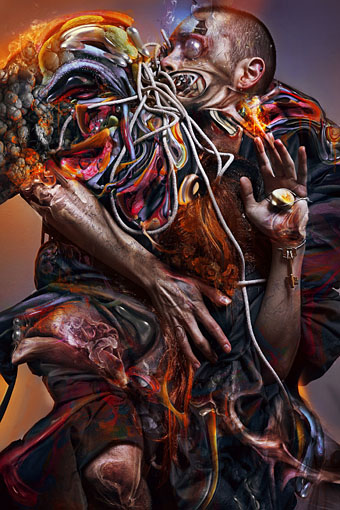
Ekeko (2016) by Jon Jacobsen.

Outer Space (1999), a short film by Peter Tscherkassky using reprocessed footage taken from The Entity (1982).

Pye Corner Audio playing live for 77 minutes at New Forms Festival, Vancouver 2016.

Salvador Dalí‘s rare Surrealist cookbook republished for the first time in over 40 years.

Keeping On Keeping On by Alan Bennett; extracts from the writer’s most recent diaries.

The Hagströmer Medico-Historical Library is a new source for free antique images.

• The shopfronts of independent Paris photographed by Sebastian Erras.

The Edge of the Ceiling (1980) is a short film about writer Alan Garner.

• Mix of the week: Secret Thirteen Mix 198 by Bestial Mouths.

Brenda S G Walter on eviscerating the body of Black Metal.

• “When did new age music become cool?” asks Geeta Dayal.

Barok Main, a new piece from Mica Levi & Oliver Coates.

• American gay magazine XY has been relaunched.

• Confessions of a vinyl junkie by David Bowie.

Touch Radio archive at the British Library.

Harvard’s collection of glass flowers.

Michelle Stuart‘s Magical Land Art.

Dali’s Car (1969) by Captain Beefheart & His Magic Band | Save Me From Dali (1980) by Snakefinger | Salvador Dali’s Garden Party (1989) by Television Personalities

Weekend links 329

vyletal.jpg

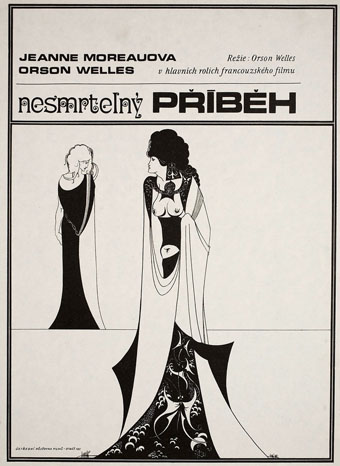
Josef Vyletal borrows figures from Aubrey Beardsley’s Salomé for a Czech poster promoting The Immortal Story (1969) by Orson Welles. Vyletal’s own paintings were often strange and surreal.

Pale Fire is Nabokov’s “great gay comic novel,” says Edmund White. A surprising but not inappropriate reappraisal. White has noted in the past that Nabokov “hated homosexuality” despite having a gay brother and uncle. The portrayal of Charles Kinbote in Pale Fire isn’t unsympathetic if you overlook his being delusional, and possibly insane…

• At Folk Horror Revival: details of the charity donations raised by sales of the Folk Horror Revival books, the first of which featured my David Rudkin essay. A one-day Folk Horror Revival event takes place later this month at the British Museum, London.

• Mixes of the week: The Bug presents Killing Sound Chapter 2: Inner Space, a 2-hour blend of “sci-fi scores, expansive atmospheres and synthesized psychedelia”; Decoded Sundays presents Scanner; Secret Thirteen Mix 197 is by LXV.

Stars Of The Lid unveil a James Plotkin remix of their Music For Twin Peaks Episode #30 Pt. 1. Related: the hype for the new Twin Peaks series gets into gear with a teaser.

• Robert Aickman’s only novel, The Late Breakfasters (1964), is being given its first US publication by Valancourt Books.

• “Don’t dream it, bet it.” Evan J. Peterson on 40 years of The Rocky Horror Picture Show.

• Anna von Hausswolff’s sister, Maria, directs a video for Come Wander With Me / Deliverance.

• RIP Michael O’Pray, film writer and curator of many festivals of experimental cinema.

• Oli Warwick talks to electronic musicians about the influence of the late Don Buchla.

Breakfast In Bed (1969) by Dusty Springfield | Alan’s Psychedelic Breakfast (1970) by Pink Floyd | Another Breakfast With You (2001) by Ladytron

Old Weird and New Weird

savdreams.jpg

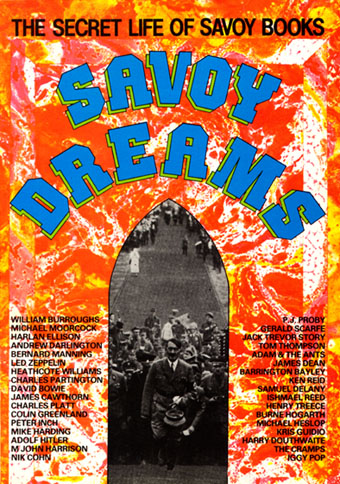
Savoy Books, 1984.

A couple more recent arrivals that feature my work. These are of minority interest but worth noting since academic articles don’t always travel beyond a small audience of subscribers.

A recent issue of Foundation (The International Review of Science Fiction), Volume 45.1, number 123, contains an article by Mark P. Williams, Underground Assemblages: Savoy Dreams and The Starry Wisdom. This examines the legacy of New Worlds magazine under the editorship of Michael Moorcock (from 1964 to 1974) via two writing collections, Savoy Dreams (Savoy Books, 1984) and The Starry Wisdom (Creation Books, 1994). The two collections are very different: Savoy Dreams, edited by David Britton and Michael Butterworth, was an eclectic overview of Savoy’s publishing endeavours up to that point. Among the original writing there’s fiction by Butterworth, M. John Harrison (the first publication of the Viriconium story, Lords of Misrule) and others, plus a reaction by Michael Moorcock to William Burroughs’ Cities of the Red Night, a book that Savoy had contracted to publish before police harassment forced the company’s bankruptcy. The rest of the book is taken up with press reviews of Savoy books.
starrywisdom.jpg

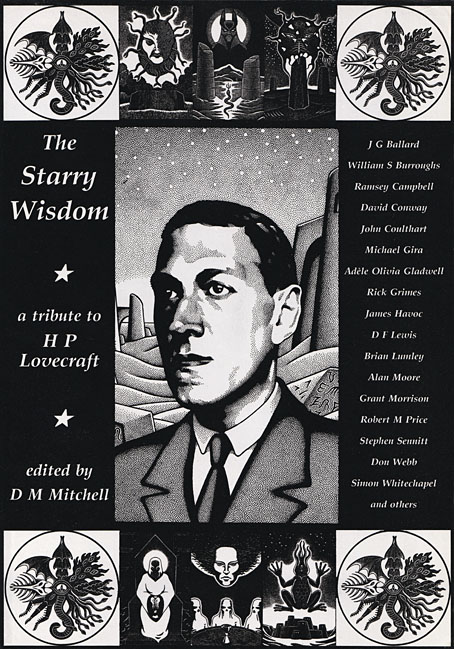
Creation Books, 1994. Cover art by Peter Smith.

The Starry Wisdom should require less of an introduction since the book has been in print since 1994, and has a small, possibly notorious, reputation among HP Lovecraft enthusiasts. Editor DM Mitchell felt that the assembling of post-Lovecraftian fiction up to that point had been too cosy and insular: too many story collections were being edited and written by groups of friends in the genre fiction “community”, with the result that the stories were often stale and complacent. The startling newness of Lovecraft’s imagination in comparison to many of his contemporaries in Weird Tales seemed to have been bled away into pastiche, a process that began soon after Lovecraft’s death. Mitchell’s solution was to commission original pieces of Lovecraft-inspired work from writers outside the genre world, notably Alan Moore, Grant Morrison, and newcomer David Conway; he also reprinted pieces that would never appear elsewhere as Lovecraftian fiction, including Wind Die. You Die. We Die. by William Burroughs, and Prisoner of the Coral Deep by JG Ballard. Burroughs and Ballard connect directly to New Worlds, of course (Ballard wrote about Burroughs for the magazine), while the pair cast a shadow over many of Savoy’s book productions. Both Savoy Dreams and The Starry Wisdom featured comic strips; Tales of the Cramps by Kris Guidio appeared in Savoy Dreams, while The Starry Wisdom contained strips by Mike Philbin & James Havoc, Rick Grimes, and the first publication of my own adaptation of The Call of Cthulhu.

I was surprised—and pleased—that my comic strip receives a fair amount of scrutiny in Williams’ piece. My Lovecraft strips have received almost no attention from the comics world, a consequence of having been printed by book publishers and distributed to book shops. (A rare exception was this recent piece by Matt Maxwell.) When you’ve been overlooked in this manner it’s a surprise to find your work receiving serious evaluation from an entirely different quarter. Mark P. Williams’ essay examines the contents of both collections, my strip included, as “assemblages”. This is a valid critique in the case of the Cthulhu strip since Lovecraft’s story is itself an assemblage of what seems at first to be unrelated data. The comic adaptation assembles a range of cultural references—some genuine, others invented—to parallel the narrator’s investigation, and even uses genuine documents in places, including columns from The New York Times. I don’t know if Williams has seen the blog post I made that points out many of the cultural references but he notes some of the more overt ones, such as Joseph Conrad appearing as the doomed Professor Angell, Arnold Böcklin’s The Isle of the Dead, and so on. While I was drawing the strip I was trying to imagine the story as an RKO production, a hybrid of two island films—The Most Dangerous Game and King Kong—and Orson Welles’ unmade Heart of Darkness. These references, many of which aren’t very obvious, were largely for my own amusement. The series I created with David Britton that followed the Lovecraft strips, Reverbstorm, puts assemblage and cultural reference at the forefront.
genre.jpg

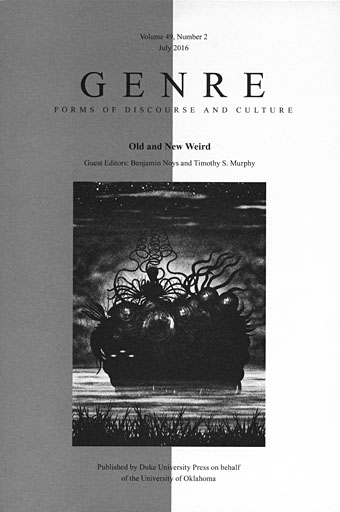
Cover art is my illustration for Remnants from Lovecraft’s Monsters, edited by Ellen Datlow.

The Cthulhu strip and the Reverbstorm series—now collected as Lord Horror: Reverbstorm—are the subject of a very perceptive piece by Benjamin Noys in the latest edition of Genre, an academic journal published by Duke University Press. This number of the journal is a kind of Weird special edited by Benjamin Noys and Timothy S. Murphy. Noys’ Full Spectrum Offence: Savoy’s Reverbstorm and the Weirding of Modernity is the final article in a publication that examines aspects of the “Old Weird” (ie: the Lovecraft-era Weird Tales) and contrasts it with the more recent “New Weird”. The latter was a short-lived label coined by M. John Harrison in 2003 for a range of fiction that was ignoring genre boundaries, and consciously developing the Weird as a project. China Miéville was one of the most visible proponents of the New Weird, and Harrison’s term emerged in part as a response to Miéville’s fiction. Miéville is interviewed in this issue of Genre where, as usual, he has some very worthwhile things to say. He prefers the term “haute Weird” for the original manifestation, possibly because it avoids the negative connotations of the word “old”.
reverbstorm.jpg

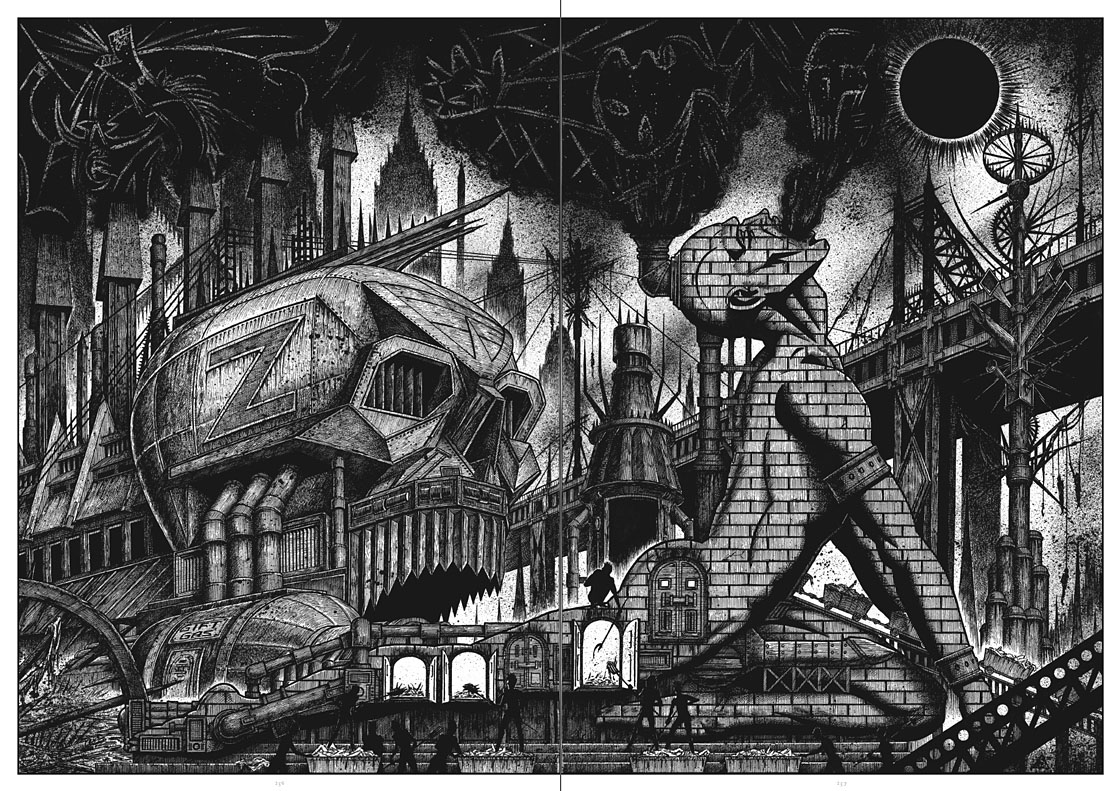
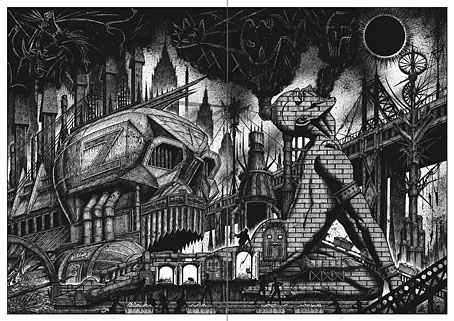
A spread from part 7 of Reverbstorm.

Benjamin Noys’ article is lengthy and resists easy summary, but it begins by investigating the way my work on the Lovecraft strips permeated the Lord Horror comics and dictated some of the imagery, in particular the architectural forms and eruptions of monstrosity. Later discussion concerns the way that Reverbstorm forces the Weird and Modernism together, a collision that I believe is still unique anywhere, never mind in the comics medium. Noys’ piece has given me a lot to think about, not least for its being the first substantial critical appraisal of Reverbstorm. The series is a difficult one, being deliberately excessive and avant-garde, and presenting the reader with a torrent of interrelating cultural references. Many of these are itemised in the appendix but the success (or not) of their working together, and the potential sparking of connections, depends very much on the prior knowledge of the individual reader. Noys is not only knowledgeable but adept at forging his own connections while situating the series in the larger context of the Weird, old (or haute) and new. Even without the inclusion of my work inside the journal and on the cover, I’d recommend this issue of Genre to anyone with an interest in the subject. One of the reasons I favour the Weird as a chosen work label is the way it evades (or ignores) generic boundaries. Years ago I realised that many of the things I liked the best in the arts were the chimeras, those works that transgress boundaries and created new hybrids. No surprise then that I enjoy a genre that refuses easy definition. There aren’t many masts I pin my colours to but the Weird is one of them.

Previously on { feuilleton }
The Weird

Bikers and witches: Psychomania

psychomania1.jpg

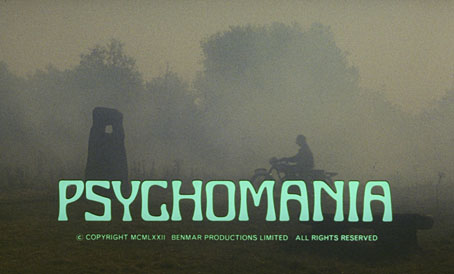
Among the film viewing this past week there was Psychomania (1973), another advance Blu-ray courtesy of the BFI. Americans may know this as The Death Wheelers, a more accurate (if clumsily literal) retitling, although Psychomania does a better job of grabbing the attention. In the micro-genres of the horror film the occult biker picture is a niche with few entries; offhand I can only think of Werewolves on Wheels (1971), a low-grade American production. Most biker films are American so Psychomania is unusual for being British (with an Australian director, Don Sharp), and with a pitch that’s memorable if nothing else: biker gang kill themselves then return from the dead so they can cause mayhem with impunity. The script was the work of Arnaud d’Usseau and Julian Zimet whose only other credit is for a curious chiller made the year before, Horror Express. This was a British/Spanish period piece with a good cast (Christopher Lee, Peter Cushing, Telly Savalas) that’s notable—and often overlooked—for being another film based on John W. Campbell’s SF story “Who Goes There?”.

psychomania2.jpg

The Seven Witches and The Living Dead.

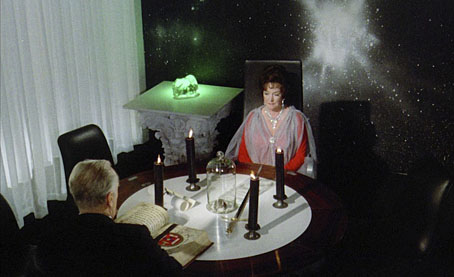
Psychomania also has a decent supporting cast despite its frequent swerves into absurdity. Since the subject is a Home Counties’ bike gang, the leader, Tom Latham (Nicky Henson), has a mother (Beryl Reid) who lives in a country house with a very modish interior: all abstract art, scatter cushions, leather furniture and Trimfones. Mrs Latham is the local table-tapper and may also be a witch, although it’s never clear whether the scene of her offering her son to the Devil is Tom’s hallucination or a replaying of past events. Tom’s father has died after some unspecified supernatural encounter in a mysterious locked room where Tom later has the vision of his being sold to the Devil. Then there’s Shadwell (George Sanders), ostensibly the butler of the household but devilish enough to shrink from a cross when it’s offered by grateful séance attendees. Reid and Sanders lend the proceedings some gravitas, even if Sanders (in his final role, and not well at the time) seems to have stooped far below his usual level. Nicky Henson makes a charismatic leader of bike gang The Living Dead, although his tight leather pants, and the shiny leather gear worn by the others, belong to an earlier decade. This is biker gear as imagined by people remembering The Wild One or The Leather Boys, and a long way from the reeking, never-washed denim “originals” favoured by Hell’s Angels and their ilk.

psychomania3.jpg

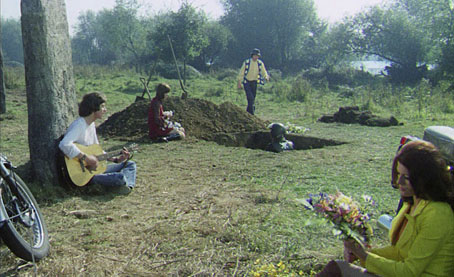
Chopped Meat (Harvey Andrews) sings Riding Free while Tom is being buried.

It’s probably too much to expect of a low-budget horror film, but watching Psychomania again had me thinking that an opportunity was missed to more accurately reflect the real bike gangs of Britain in the 1970s. Biker culture was a country-wide phenomenon at the time; boys I was at school with were too young to own motorbikes but many had brothers who did, and had picked up from them the fetishising of dying British manufacturers such as Triumph, Norton and BSA. (The Living Dead all ride Triumphs.) A few years later I was hanging around with the bikers who were always present among any group of metal-heads, many of whom were too poor to own British bikes but behaved as though they did. The bikerdom of the 70s had little to do with the bike groups of earlier decades even if the bike brands remained the same. The new model, of course, was California’s Hell’s Angels whose first British chapters appeared in London in the late 1960s, and whose legend was popularised by Hunter S. Thompson in Hell’s Angels: The Strange and Terrible Saga of the Outlaw Motorcycle Gangs (1967). Every biker seemed to have read to Thompson’s book, and the presence of Hell’s Angels on British soil led to the swift founding of many imitation groups, forbidden from using the name without Californian approval but grouping themselves under similar handles. A measure of the culture’s appeal to the popular British imagination may be found in the many biker exploitation novels published by New English Library through the mid-70s.

Given all this you’d expect biker culture to be more prevalent in British cinema of the period but the examples are so few there’s really only Psychomania and Sidney J. Furie’s The Leather Boys (1964). The latter documents the pre-Hell’s Angels biker scene via a pseudonymous gay novel that makes similar connections to Kenneth Anger’s almost contemporaneous Scorpio Rising. The gay content is diluted in the film but there’s enough there to make it seem surprisingly bold for the time. Furie’s bikers are a tame bunch compared to The Living Dead, they only want to ride their bikes, not play hogs of the road, and the film as a whole is kitchen-sink-on-wheels, with a link to A Taste of Honey (1961) via Rita Tushingham.

psychomania4.jpg

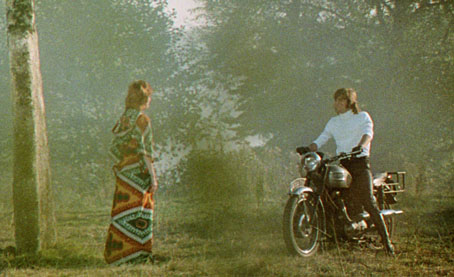
Abby meets dead Tom at the stone circle.

Psychomania is glossier—well, it’s in colour!—and aims for lurid AIP-style mayhem even if such antics seem out-of-place in leafy Surrey. When Tom’s mother inadvertently gives him the secret of bodily resurrection he goes out and kills himself; after his return from the grave (on a motorcycle!) his gang eagerly follow his example. The film runs out of steam when it becomes apparent that The Living Dead’s idea of making the most of their post-death freedom is the same harassing of pedestrians and other motorists as before. The only question is whether Tom’s girlfriend, Abby (Mary Larkin), will kill herself and join them in an eternity of trashing supermarkets. Abby’s equivocation is signalled by her being the only member of the gang who doesn’t wear leather. The film touches on folk horror with the location of “The Seven Witches”, a circle of standing stones which the gang use as their meeting place, and where they bury Tom after he plunges off a bridge. As with The Wicker Man, which was being filmed around the same time, there’s even an acoustic song interlude from one of the more hippyish bikers.

psychomania5.jpg

George Sanders and Beryl Reid indulge in some home Satanism.

Psychomania was always a welcome sight when it used to appear on late-night television. The combination of bikers and occult rites is unusual enough to sustain the attention even if the implications of the premise go unexplored. Unlike The Wicker Man, however, or the excellent Blood on Satan’s Claw (1970), Psychomania‘s disparate threads fail to cohere, and the film is held together largely by its sense of black humour. Don Sharp’s direction manages a couple of clever single-take sleights, and the soundtrack by John Cameron is very good. Cameron wrote a great deal of library music so was adept at capturing the essence of a style. Psychomania‘s soundtrack plays on the rock grooves of the period, and the theme was issued as a single credited to “Frog” (after the possibly supernatural amphibian that Tom finds in a graveyard).

The film looks excellent on Blu-ray albeit grainier in low-light scenes than other BFI transfers. The audio is also more noise-reduced than I’d prefer. The disc includes the usual wealth of BFI extras: interviews with the surviving cast members; a short interview with John Cameron; an amateur film, Roger Wonders Why (1965), about a pair of Christian (!) bikers; and a black-and-white short for Shell narrated by John Betjeman about the Avebury stone circle. George Sanders is absent from the extras since he killed himself shortly after finishing work on the film. As Michael Weldon notes with typical drollery in The Psychotronic Encyclopedia of Film, Sanders didn’t return from the dead on a motorcycle. A pity.

Psychomania is released on 19th September.

Weekend links 324

waliszewska.jpg

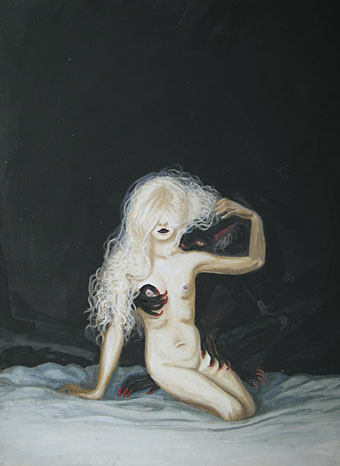
Untitled painting by Aleksandra Waliszewska. The artist is profiled by S. Elizabeth at Dirge Magazine.

• “…from my point of view, the only thing to do with any genre, any medium, is pretty much to break it, to transcend it, to find out what its limits are, and then go beyond them, and see what happens.” Alan Moore (again) talking to Heidi MacDonald about his novel, Jerusalem, which is out next month.

• A Monument to Outlast Humanity: Dana Goodyear gets the reclusive Michael Heizer to talk about his decade-spanning sculptural project, City, work on which is almost finished.

William Burroughs’ appearances in adult men’s magazines: a catalogue which includes some downloads of uncollected Burroughs essays and other writings.

• Mixes of the week: Homegirls & Handgrenades Mix by Moor Mother, Secret Thirteen Mix 194 by Kareem, and hieroglyphics #014 by Temples.

Remoteness of Light is a new album by The Stargazer’s Assistant inspired by the depths of the oceans and the vastness of space.

• RIP Gilli Smyth. “The silliness ran deep in Gong, but they could groove like mothers, too,” says Joe Muggs.

Guide to Computing: historic computers presented by James Ball as though they were new machines.

• “Oscar Wilde’s De Profundis is one of the greatest love letters ever written,” says Colm Tóibín.

• “Will You Dance With Me?” Derek Jarman films dancers in a gay club in 1984.

• Snapshots from an editor: Donald Weise on working with Edmund White.

Stupid by Wrangler (Stephen Mallinder, Phil Winter and Benge).

The Rutt-Etra-Izer

Dynamite/I Am Your Animal (1971) by Gong | Witch’s Song/I Am Your Pussy (1973) by Gong | Prostitute Poem (1973) by Gong