Schalcken the Painter

schalcken.jpg

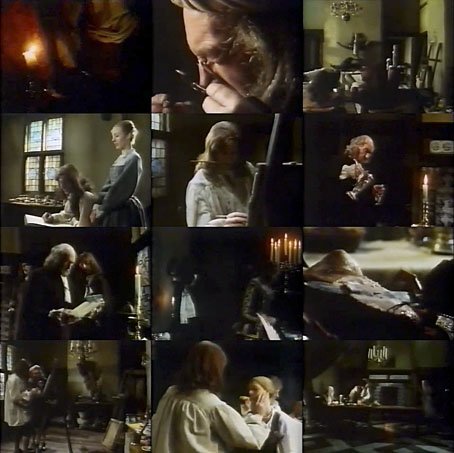
Next week the BFI releases a box set of the BBC’s Ghost Stories for Christmas, a series of hour-long TV films broadcast during the 1970s, most of which were adaptations of stories by MR James. One film that isn’t among them, unfortunately, is Leslie Megahey‘s superb Schalcken the Painter, a 70-minute drama based on Strange Event in the Life of Schalken the Painter (1839) by J. Sheridan Le Fanu. Megahey gets mentioned here more than any other TV director (see this earlier post), for years he was someone whose productions I looked out for with a kind of cult fervour.

schalcken2.jpg

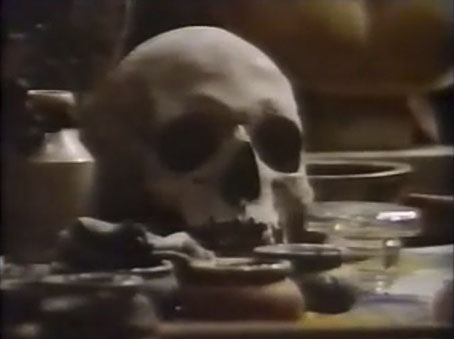
Schalcken the Painter was first screened on 23rd December, 1979, and repeated two or three times over the next decade. Megahey directed several period dramas for the BBC but this is his only supernatural piece. Its story of real-life Dutch painters Godfried Schalcken (1643–1706) and Gerrit Dou (1613–1675) is beautifully produced, with great attention to period detail, lighting and photography. The BBC used 16mm film for everything at this time but lighting cameraman John Hooper does an excellent job of creating shots that resemble Schalcken’s celebrated chiaroscuro paintings, still life tableaux or scenes from Vermeer. Many of the shots appear, Barry Lyndon-like, to be illuminated with nothing but candles. The acting is equally good, with Jeremy Clyde as Schalcken, Maurice Denham as the heartless Dou, and Cheryl Kennedy as Dou’s daughter, Rose. The narrator is the splendid Charles Gray.

schalcken3.jpg

Self-portrait of Godfried Schalcken (1694).

Given all of this it’s surprising the BFI haven’t included the film in their DVD series, it’s a superior work compared to several of the other inclusions, not least the most recent (and terrible) Whistle and I’ll Come to You. YouTube has a couple of uploads, however, so the curious may choose from a full-length version here or the usual multi-part version here. None of these fuzzy VHS copies do John Hooper’s photography any favours at all but for now this is the only way most people will be able to see Leslie Megahey’s beautiful and chilling ghost story.

Previously on { feuilleton }
Leslie Megahey’s Bluebeard
“Who is this who is coming?”
The Watcher and Other Weird Stories by J. Sheridan Le Fanu
Chiaroscuro

Weekend links 131

thingposter.jpg

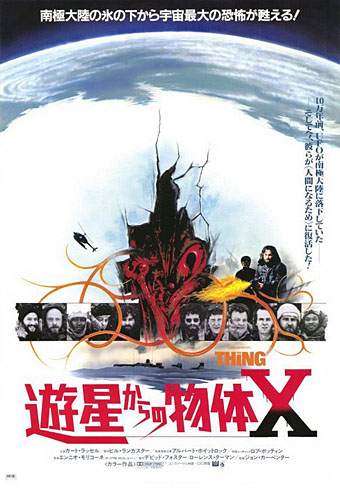
Japanese poster (1982).

At The Quietus Steve Earles looks back at John Carpenter’s visceral and uncompromising The Thing which exploded messily onto cinema screens thirty years ago. It’s always worth being reminded that this film (and Blade Runner in the same year) was considered a flop at the time following bad reviews and a poor showing at the summer box office. One reason was The Thing‘s being overshadowed by the year’s other film of human/alien encounters, something called E.T. the Extra-Terrestrial. To The Thing‘s status as the anti-E.T. you can add its reversal of the can-do heroics of Howard Hawks’ The Thing from Another World (1951), an attitude out-of-step with Reaganite America. Carpenter’s film is not only truer to the original story but from the perspective of 2012 looks like one of the last films of the long 1970s, with Hawks’ anti-Communist subtext replaced by bickering, mistrust, paranoia and an unresolved and completely pessimistic ending that most directors would have a problem getting past a studio today.

I was fortunate to see The Thing in October of 1982 knowing little about it beyond its being a John Carpenter film (whose work I’d greatly enjoyed up to that point) and a remake of the Hawks film (which I also enjoyed a great deal). One benefit of the film’s poor box office was a lack of the kind of preview overkill which made E.T. impossible to avoid, and which a couple of years earlier did much to dilute the surprise of Ridley Scott’s Alien. I went into The Thing mildly interested and came out overwhelmed and aghast. For years afterwards I was insisting that this was the closest you’d get on-screen to Lovecraft’s At the Mountains of Madness. The correspondence is more than merely Antarctica + monsters when you consider this:

Lovecraft’s story was rejected by his regular publisher Weird Tales but was accepted by Astounding Stories in 1936 >> The editor of Astounding, John W. Campbell, published his own Antarctica + monsters story (under the pen-name Don A. Stuart), “Who Goes There?”, in the same magazine two years later >> Charles Lederer wrote a loose screen adaptation of Campbell’s story which Howard Hawks and Christian Nyby filmed as The Thing from Another World.

This isn’t to say that Campbell copied Lovecraft—both stories are very different—but I’d be surprised if Lovecraft’s using Antarctica as the setting for a piece of horror-themed science fiction didn’t give Campbell the idea.

More things elsewhere: Anne Billson, author of the BFI Modern Classics study of The Thing, on the framing of Carpenter’s shots, and her piece from 2009 about the film | Mike Ploog’s storyboards | Ennio Morricone’s soundtrack music, of which only a small percentage was used in the film.

• The week in music: 22 minutes of unreleased soundtrack by Coil for Sara Dale’s Sensual Massage | Analog Ultra-Violence: Wendy Carlos and the soundtrack for A Clockwork Orange | A Halloween mixtape by The Outer Church | Herbie Hancock & The Headhunters, live in Bremen, 1974: a 66-minute set, great sound, video and performances | Giorgio Moroder’s new SoundCloud page which features rare mixes and alternate versions | A video for Collapse by Emptyset.

One of the main themes of the book, and what I found in The Arabian Nights, was this emphasis on the power of commodities. Many of the enchanted things in the book are lamps, carpets, sofas, gems, brass rings. It is a rather different landscape than the fairy tale landscape of the West. Though we have interiors and palaces, we don’t have bustling cities, and there isn’t the emphasis on the artisan making things. The ambiance from which they were written was an entirely different one. The Arabian Nights comes out of a huge world of markets and trade. Cairo, Basra, Damascus: trades and skills.

Nina Moog talks to Marina Warner

John Palatinus, “one of the last living male physique photographers of the 1950s”, is interviewed. Related: the website of Ronald Wright, British illustrator for the physique magazines.

• “A classic is a work which persists as a background noise even when a present that is totally incompatible with it holds sway.” Italo Calvino’s 14 Definitions of What Makes a Classic.

Huge Franz Kafka archive to be made public. Related: Judith Butler asks “Who owns Kafka?”

• Geoff Manaugh’s Allen Ginsberg Photos & Ephemera, 1994–Dec 1996.

Magic mushrooms and cancer: My magical mystery cure?

Clark Ashton Smith Portfolio (1976) by Curt Pardee.

Jan Toorop’s 1924 calendar.

artQueer: a Tumblr.

• All The Things You Are (1957) by Duke Ellington | Things That Go Boom In The Night (1981) by Bush Tetras | Things Happen (1991) by Coil | Dead People’s Things (2004) by Deathprod.
Long Live the New Flesh: The Films of David Cronenberg

cronenberg.jpg

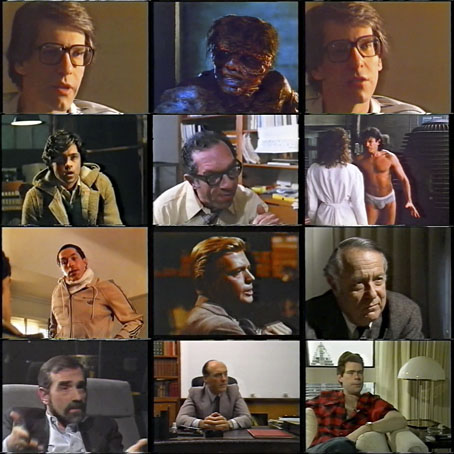
I used to have this documentary on tape but it vanished years ago so it’s good to find it again on YouTube. Long Live the New Flesh: The Films of David Cronenberg was directed by Laurens C. Postma and broadcast on British television in 1987 as a tie-in with the UK release of Cronenberg’s The Fly. The writer was Chris Rodley who subsequently directed some equally good documentaries of his own including the South Bank Show feature about the making of Naked Lunch (now present as an extra on the Naked Lunch DVD), A Very British Psycho about Michael Powell’s Peeping Tom (clips of which can be found in this film), and Donald Cammell: The Ultimate Performance.

Postma’s film captures Cronenberg when he was starting to gain visibility outside the science fiction and horror genres he’d mostly been working in up to this point. Among the interviewees are Martin Scorsese, an early champion, and Stephen King, whose The Dead Zone Cronenberg adapted in 1983. In the critical corner there’s the late film critic Robin Wood who the producers possibly chose on account of his being the voice of dissent in Piers Handling’s 1983 study of Cronenberg’s films The Shape of Rage. Wood isn’t as tiresomely ideological here as he is in Handling’s book (where you can play a drinking game if you count the times he uses the phrase “bourgeois patriarchal capitalism”) but he still seemed to find something reactionary and “unprogressive” (in a political sense) about Cronenberg’s work. Elsewhere there are clips of the films from Shivers on, and I’d forgotten about the comparisons Rodley and Postma make between Cronenberg’s work and Michael Powell’s still astonishing Peeping Tom.

Long Live the New Flesh is 67 minutes long and unfortunately chopped into chunks on the YouTube copy. Watch it here:

Part 1 | part 2 | part 3 | part 4 | part 5 | part 6 | part 7

Weekend links 130

teraoka.jpg

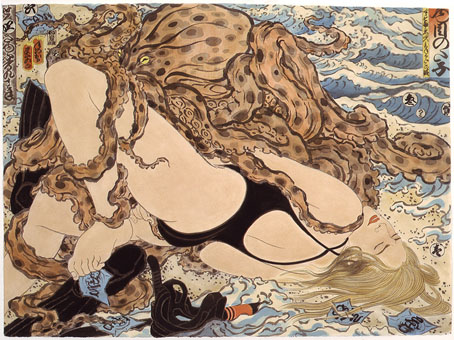
Sarah and Writhing Octopus (New Wave Series, 1992) by Masami Teraoka.

Strange Flowers continues to push all my buttons. For a while now I’d been intent on writing something about the strange (unbuilt) temples designed by German artist/obsessive naturist Fidus (Hugo Höppener) but I reckon James has done a better job than I would have managed. Also last week he wrote about Schloss Schleißheim, a palatial estate outside Munich with connections to Last Year in Marienbad and another eccentric, pseudonymous German artist: Alastair (Hans Henning Voigt).

• The circus poster that inspired John Lennon’s Sgt. Pepper song Being For The Benefit Of Mr. Kite! has been reproduced as a limited edition letterpress print. Related: Wikipedia’s page about Pablo Fanque (1796–1871), “the first black circus proprietor in Britain”.

• The first two volumes of The Graphic Canon, both edited by Russ Kick, are reviewed at Literary Kicks. I’ve not seen either of these yet but volume 2 contains my interpretation of The Picture of Dorian Gray. Related: the second book previewed at Brain Pickings.

You only have to read [Alan Bennett’s] diaries to see that, underneath the wit and humour and sandwich-filled pottering around old churches, there is a deep resentment at what has happened to England in his lifetime and an instinctive distrust, sometimes amounting to deep loathing, of most politicians. Listening, for instance, to Alan Clark and Kenneth Clarke talking on the radio about the arrest of General Pinochet in 1998, he writes: “Both have that built-in shrug characteristic of 80s Conservatism, electrodes on the testicles a small price to pay when economic recovery’s at stake.”

Michael Billington on Alan Bennett: a quiet radical

Hauntologists mine the past for music’s future: Mark Pilkington draws a Venn diagram encompassing Coil, Broadcast, the Ghost Box label, Arthur Machen, MR James, Nigel Kneale, Iain Sinclair and others.

Hell Is a City: the making of a cult classic – in pictures. The mean streets of Manchester given the thriller treatment by Hammer Films in 1959. The film is released on DVD this month.

The Function Room: The Kollection, Matt Leyshon’s debut volume of horror stories, has just been published. The cover painting is one of my pieces from the 1990s.

New Worlds magazine (now apparently known as “Michael Moorcock’s New Worlds“) has been relaunched online.

konahin.jpg

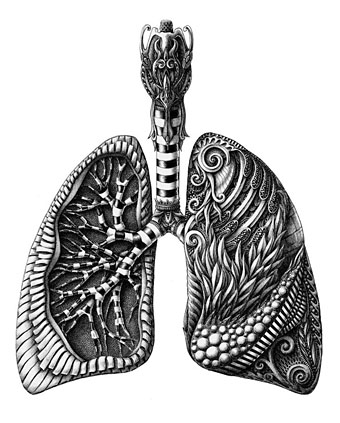
A drawing from Anatomy (part 1), a series by Alex Konahin.

• The forthcoming Scott Walker album, Bish Bosch, will be released on December 3rd. 4AD has a trailer.

Cormac McCarthy Cuts to the Bone: Noah Gallagher Shannon on the early drafts of Blood Meridian.

• The Velvet Underground of English Letters: Simon Sellars Discusses JG Ballard.

• Michelle Dean on The Comfort of Bad Books.

The typewriter repairers of Los Angeles

Cats With Famous People

Marienbad (1987) by Sonoko | Komm Nach Marienbad (2011) by Marienbad | Marienbad (2012) by Julia Holter.

(Thanks to Ian and Pedro for this week’s picture links!)

The Horse of the Invisible

carnacki1.jpg

Can Carnacki make any claim to be taken seriously as a detective? If he solves anything it is by force of will, rather than the application of deductive powers. He is no Sherlockian ironist, no high-domed mental traveller. He stands as close to Holmes as Mike Hammer does to Philip Marlowe. His methods are enthusiastic but basic: good old-fashioned head-in-the-door stuff. He is not so much a “ghostbuster” as a self-starting lightning rod for psychic phenomena that has not yet been housebroken.

Thus Iain Sinclair in a typically acerbic afterword to the 1991 Grafton paperback of Carnacki, the Ghost-Finder by William Hope Hodgson. Holmes would indeed look askance at Carnacki’s methods but that didn’t prevent the occult investigator being drafted as one of The Rivals of Sherlock Holmes in the first television series of that name in 1971. I was reminded of this dramatisation following last week’s discussion of Hodgsonian cinema; I’ve known about the episode for years—notable for having Donald Pleasence in the role of Thomas Carnacki—but hadn’t watched it until this week courtesy of YouTube.

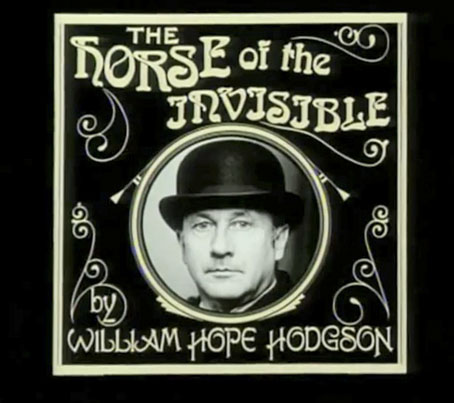
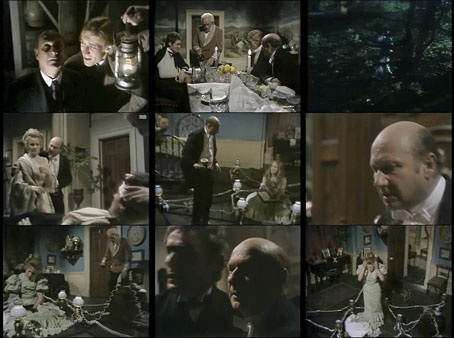
Philip Mackie wrote the script for The Horse of the Invisible, and Alan Cooke was the director. Their adaptation is interesting mostly for seeing a Hodgson story dramatised; as a piece of television the presentation is serious and well-acted but looks rather creaky today, suffering from the over-lit artificiality that always blighted studio-shot productions attempting to create any kind of atmosphere. Donald Pleasence is his typical lugubrious self which doesn’t really suit Carnacki’s bull-headed enthusiasm but I don’t mind that, Pleasence was a good actor so it’s a treat to see him play the part. And we do get to see Carnacki’s “electric pentacle” in action (Carnacki enjoys his Edwardian gadgets) in the midst of which the beleaguered Michele Dotrice is forced to spend the night. The most successful Carnacki stories are those that play to Hodgson’s strengths as a writer of supernatural dread, stories such as The Gateway of the Monster or The Hog. The Horse of the Invisible doesn’t attain the heights of those tales but then it would be a doomed venture trying to conjure Hodgson’s cosmic horrors on a limited budget. With this story you get a taste of the supernatural, which no doubt sets it apart from the other “Rivals”, whilst staying within the bounds of credibility.

carnacki2.jpg

There’s one curious detail worth mentioning: in both the story and the dramatisation the character of the fiancé is named “Charles Beaumont”. There was a real Charles Beaumont, a screenwriter responsible for many scripts for The Twilight Zone TV series, as well as for some of the superior American horror films of the 1960s, including Night of the Eagle, The Haunted Palace (Roger Corman’s adaptation of The Case of Charles Dexter Ward) and The Masque of the Red Death. In last week’s discussion I mentioned John Carpenter’s The Fog as a good example of Hodgsonian cinema on account of its ghost pirates. My memory may be playing tricks but I’m sure that Carpenter has a reference to a “Charlie Beaumont” in either The Fog or Halloween, both films being littered with significant character names. (There’s a “Mr Machen” in The Fog). Donald Pleasence was in Halloween, of course, playing a doctor with a name lifted from Psycho. I’ve searched in vain for the Beaumont reference; does this ring a bell for any Carpenter-philes?

Both series of The Rivals of Sherlock Holmes are available from Network DVD.

Previously on { feuilleton }
Tentacles #2: The Lost Continent
Tentacles #1: The Boats of the ‘Glen Carrig’
Hodgson versus Houdini
Weekend links: Hodgson edition
“The game is afoot!”
Druillet meets Hodgson