Raffles, the gentleman thief

raffles1.jpg

The Raffles that concerns us here is the television incarnation as seen in a series of adventures made by Yorkshire TV in 1977. I recently bought a cheap DVD set of the series, not for reasons of nostalgia (a wretched condition) but out of curiosity and whim. I had a vague recollection of enjoying the few episodes I’d seen, and was hoping for another decent Victorian adventure series along the lines of The Rivals of Sherlock Holmes (1971/1973). Raffles proved to be better than I expected; not quite up to the standards of Granada TV’s peerless adaptations of the Sherlock Holmes stories but thoroughly enjoyable. The production values are better than those in The Rivals of Sherlock Holmes, a well-written series with an impressive cast that was nevertheless compromised by a restricted budget. I’m not really reviewing the Raffles series here, this piece is intended to note a couple of points of interest which, for me, added to its pleasures.

raffles2.jpg

Raffles and Bunny as they were originally. An illustration by FC Yohn from Raffles: Further Adventures of the Amateur Cracksman (1901).

Arthur J. Raffles was invented by EW Hornung, a writer who was, among other things, Arthur Conan Doyle’s brother-in-law. Raffles, like Sherlock Holmes, is a resolute bachelor with a devoted friend and accomplice, but the two men share few other characteristics beyond a talent for outwitting the dogged inhabitants of Scotland Yard. Raffles’ indulgent lifestyle in the bachelor enclave of (the) Albany, Piccadilly, is financed by his burglaries which invariably target aristocrats and the homes of the wealthy. To the general public he’s known as one of the nation’s leading cricket players, a position which gives him access to upper-class social circles from which he would otherwise by excluded. His former school-friend, “Bunny” Manders, is also his partner-in-crime, a position that Bunny is happy to fill after Raffles saves him from bankruptcy and suicide. Conan Doyle disapproved of the immoral nature of the Raffles stories but they were very popular in their day, and they’ve been revived in a number of adaptations for film, TV and radio. George Orwell admired the stories, and writes about them with his usual perceptiveness here, noting the importance of cricket to Raffles’ gentlemanly philosophy of criminal behaviour. I’ve not read any of the stories myself, and I’m not sure that I want now, not when the television adaptations succeed so well on their own terms.

raffles3.jpg

Anthony Valentine and Christopher Strauli.

The TV series was preceded by a pilot episode made in 1975 which saw the first appearances of Anthony Valentine as the dashing Raffles and Christopher Strauli as the fresh-faced Bunny. Valentine and Strauli fit their roles so well it’s difficult to imagine anyone else improving on them, Valentine especially. In the series the pair are supported by many familiar faces from British drama: Graham Crowden, Charles Dance, Brian Glover, Robert Hardy, Alfred Marks, and, in a rare piece of TV acting, Bruce Robinson. Pilot and series were all written by Philip Mackie, and here we have the first noteworthy element since Mackie had earlier adapted six stories for The Rivals of Sherlock Holmes, including the one that features Donald Pleasence as William Hope Hodgson’s occult detective, Thomas Carnacki. Raffles is another rival of Sherlock Holmes, of course, albeit a criminal one, and much more of a mirror image of Holmes than the thoroughly villainous Professor Moriarty. Raffles only breaks the law to improve his bank balance, or as an occasional, daring challenge; he regards theft and evasion from the police as a form of sport, and generally deplores other types of crime. Some of his thefts are intended to punish the victim following an infraction, as with the belligerent South African diamond miner who causes a scene at Raffles’ club, and the Home Secretary who makes a speech in Parliament demanding stiffer penalties for burglary. In one conversation about the morality of their activities Bunny suggests to Raffles that his friend is a kind of Robin Hood figure; Raffles agrees before admitting that he never gives his spoils to the poor.
Continue reading “Raffles, the gentleman thief”

Saki: The Improper Stories of HH Munro

saki.jpg

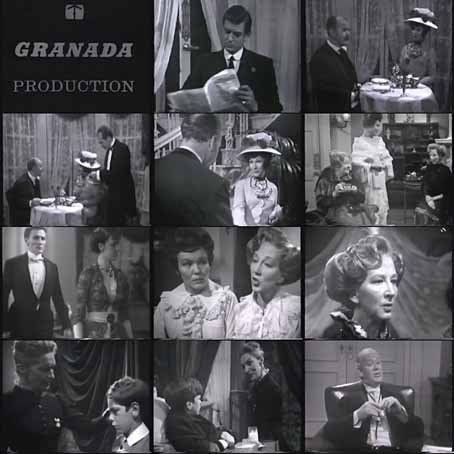
I thought I’d written about this some time ago but it appears not so the present post can serve as a way to honour the talents of the late Fenella Fielding. The obituaries this week have inevitably emphasised her roles in the Carry On films, a series of alleged comedies that I’ve never liked, and which weren’t much liked by several of the actors who appeared in them. Fenella Fielding did much more than this, of course, especially in the theatre, on radio and in television, including appearances such as the one here from a collection of adaptations of the peerless short stories of Hector Hugh Munro, better known as Saki. Granada TV made a whole series of these in 1962, broadcasting this anthology in 1985 following the death of producer Philip Mackie. Fenella appears in the second story, A Holiday Task, as the forgetful Mary Drakmanton, and she fits so well with into Saki’s world that I really wish I’d suggested to my colleagues at Savoy Books a reading or two by Fenella from Saki. She enjoyed reading Colette for Savoy, and chose the selections herself, one of which concerned Colette’s homosexual friends. Given this, I can imagine Fenella teasing out some of the sly gay humour that runs like a scarlet thread through Saki’s Clovis stories.

The other pieces in this Granada collection are The Stampeding of Lady Bastable, The Way to the Dairy, Sredni Vashtar and A Defensive Diamond. The story editor was Gerald Savory who later did such an excellent job adapting Dracula for the BBC.

Previously on { feuilleton }
Fenella Fielding reads Colette

The Horse of the Invisible

carnacki1.jpg

Can Carnacki make any claim to be taken seriously as a detective? If he solves anything it is by force of will, rather than the application of deductive powers. He is no Sherlockian ironist, no high-domed mental traveller. He stands as close to Holmes as Mike Hammer does to Philip Marlowe. His methods are enthusiastic but basic: good old-fashioned head-in-the-door stuff. He is not so much a “ghostbuster” as a self-starting lightning rod for psychic phenomena that has not yet been housebroken.

Thus Iain Sinclair in a typically acerbic afterword to the 1991 Grafton paperback of Carnacki, the Ghost-Finder by William Hope Hodgson. Holmes would indeed look askance at Carnacki’s methods but that didn’t prevent the occult investigator being drafted as one of The Rivals of Sherlock Holmes in the first television series of that name in 1971. I was reminded of this dramatisation following last week’s discussion of Hodgsonian cinema; I’ve known about the episode for years—notable for having Donald Pleasence in the role of Thomas Carnacki—but hadn’t watched it until this week courtesy of YouTube.

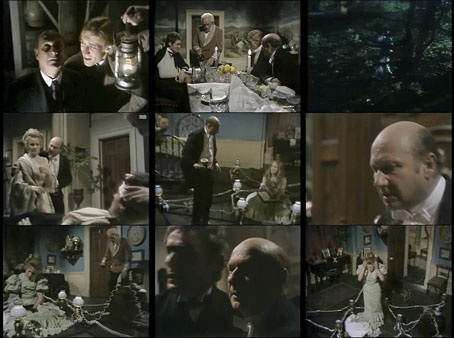
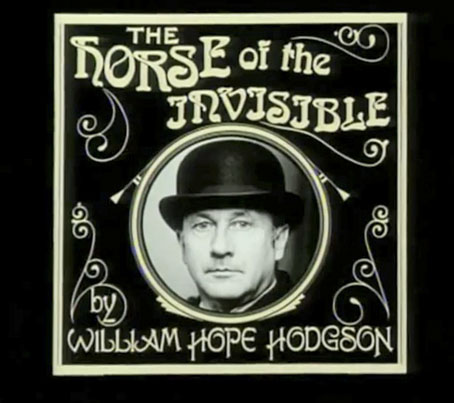
Philip Mackie wrote the script for The Horse of the Invisible, and Alan Cooke was the director. Their adaptation is interesting mostly for seeing a Hodgson story dramatised; as a piece of television the presentation is serious and well-acted but looks rather creaky today, suffering from the over-lit artificiality that always blighted studio-shot productions attempting to create any kind of atmosphere. Donald Pleasence is his typical lugubrious self which doesn’t really suit Carnacki’s bull-headed enthusiasm but I don’t mind that, Pleasence was a good actor so it’s a treat to see him play the part. And we do get to see Carnacki’s “electric pentacle” in action (Carnacki enjoys his Edwardian gadgets) in the midst of which the beleaguered Michele Dotrice is forced to spend the night. The most successful Carnacki stories are those that play to Hodgson’s strengths as a writer of supernatural dread, stories such as The Gateway of the Monster or The Hog. The Horse of the Invisible doesn’t attain the heights of those tales but then it would be a doomed venture trying to conjure Hodgson’s cosmic horrors on a limited budget. With this story you get a taste of the supernatural, which no doubt sets it apart from the other “Rivals”, whilst staying within the bounds of credibility.

carnacki2.jpg

There’s one curious detail worth mentioning: in both the story and the dramatisation the character of the fiancé is named “Charles Beaumont”. There was a real Charles Beaumont, a screenwriter responsible for many scripts for The Twilight Zone TV series, as well as for some of the superior American horror films of the 1960s, including Night of the Eagle, The Haunted Palace (Roger Corman’s adaptation of The Case of Charles Dexter Ward) and The Masque of the Red Death. In last week’s discussion I mentioned John Carpenter’s The Fog as a good example of Hodgsonian cinema on account of its ghost pirates. My memory may be playing tricks but I’m sure that Carpenter has a reference to a “Charlie Beaumont” in either The Fog or Halloween, both films being littered with significant character names. (There’s a “Mr Machen” in The Fog). Donald Pleasence was in Halloween, of course, playing a doctor with a name lifted from Psycho. I’ve searched in vain for the Beaumont reference; does this ring a bell for any Carpenter-philes?

Both series of The Rivals of Sherlock Holmes are available from Network DVD.

Previously on { feuilleton }
Tentacles #2: The Lost Continent
Tentacles #1: The Boats of the ‘Glen Carrig’
Hodgson versus Houdini
Weekend links: Hodgson edition
“The game is afoot!”
Druillet meets Hodgson