Words and pictures

ghosts.jpg

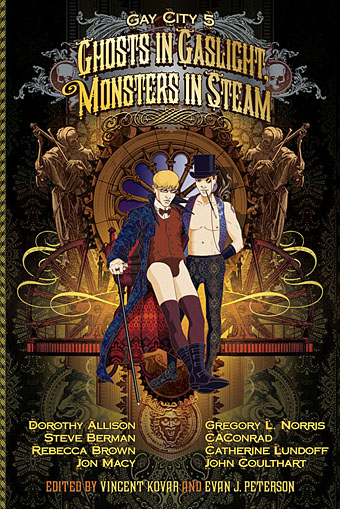
This one has been a long while gestating. Evan J. Peterson asked me late last year to contribute a cover to a new edition of Seattle’s Gay City anthology which he was editing with Vincent Kovar. In May this year the anthology successfully covered some of its production costs with a Kickstarter fund, and the anthology will have its official launch next month (although the book is on sale now). Ghosts in Gaslight, Monsters in Steam combines a loose take on steampunk themes with spectral or horror material, and adds a queer twist. The contents are as follows:

Cover art by John Coulthart
Illustrations by M S Corley and Levi Hastings
Graphic story: Paper Lantern by Jon Macy

Poetry:
from Preternatural Conversations and Oblivious Imperialism is the Worst Kind by CAConrad
Dear Dr. Frankenstein by Jericho Brown
Anaphora as Coping Mechanism and American Dreams by Ocean Vuong
Orpheus on the 74 and The Resurrection Spell by Oscar McNary
Zombie Autopsy by Janie Miller
Moon Goddess by Imani Sims

Hybrid/Flash Fiction/Prose Poetry:
Psychopomp by Lydia Swartz
Thangs by Imani Sims
The Door, Casualties of War, and The Worst is that You Can’t Even Ask Him to Use Protection by Jeremy Halinen

Short Stories:
Demon Lover by Dorothy Allison
Monster Movie by Rebecca Brown
B.E.M.s by Gregory L. Norris
Feeding Desire by Steve Berman
Medium Méchanique by Catherine Lundoff
Study in Blue, Green, and Gold by John Coulthart
A Captive Audience by Ryan Keawekane
Splinter by Ryan Crawford
The Difference Men by Kat Smalley
Alexander’s Wrath by J L Smither
Quota by Amy Shepherd
Heart of the Labyrinth by Tony Rella

This isn’t the first occasion when I’ve produced the cover for an anthology and also contributed some fiction inside—The Thackery T. Lambshead Pocket Guide to Eccentric and Discredited Diseases included a short fiction piece—but the Gay City anthology marks the first appearance in print of anything from my ongoing Axiom project. This is a long-term endeavour which I began in March 2001 but haven’t referred to much in public, mainly because the bulk of the project to date has been written fiction. There are few words more dismaying to hear than the dread phrase “I’m writing a novel”, especially today when the activity of fiction writing seems to have undergone an exponential increase. I tend to believe that unless you’re an established author there’s little to be gained by discussing your own literary labours in public until you have some results to offer. Well, now I have.

I know some people have been curious about the Axiom project so—keeping things brief—I can say it’s two novels, one finished, the second one nearly finished. Axiom was written from 2001 to 2007, and concerns a year in the life of an invented city. It’s fantasy of a sort but closer to the world of Reverbstorm than anything you’ll find on the swords-and-dragons shelves. The idea began in the late 1990s when I was working on Reverbstorm with David Britton and realised I could easily shift the city in that book a few degrees sideways to provide a setting for my own obsessions. I’d been writing a lot of fiction in the 1980s—short stories and two unfinished novels—and wanted to return to this seriously having tired of collaborations and illustrating the work of other people. Axiom marked out some territory I wanted to explore; the new novel, Vitriol, uses the territory to stage a “psychedelic apocalypse”. The project as a whole is loose enough to evolve into other media, and eventually there should be some Axiom-related art. I’ve been working on Vitriol since August 2006 (there was some overlap while finishing the first book); my contribution to the Gay City anthology, Study in Blue, Green, and Gold, is an extract from the work-in-progress which happened to function quite well as a self-contained piece. Despite the anthology theme it’s not quite a steampunk affair but there are some steam locomotives present so it has the required flavour.

Whilst working on the new book I’ve had an agent (Leslie Gardner at Artellus) trying to sell Axiom. This would have been in print by now if the London publisher who agreed to take it 18 months ago hadn’t gone bust after they’d sent us a contract. I’ve been considering putting out a limited hardback edition of the novel, although I’m busy enough as it is, and don’t relish having to self-distribute even a small number of books. For now it’s an option that remains open.

Gay City’s own site points to Amazon for sales of Ghosts in Gaslight, Monsters in Steam so on this occasion I’ll do that too. If you’re in the Seattle area there’s a launch party on September 27th. Details here.

Update: I’ve belatedly noticed that Evan is interviewed about the anthology here.

Weekend links 174

ikuma.jpg

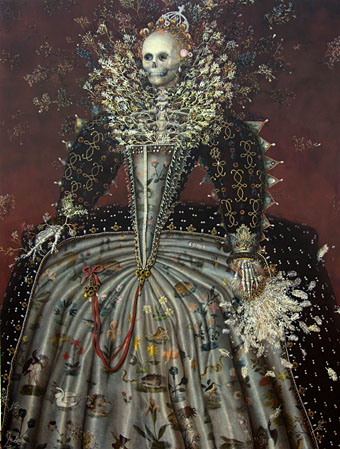
Dress (2012) by Nao Ikuma.

• Two of my Cthulhu artworks can currently be seen in the Ars Necronomica exhibition at the Cohen Gallery, Brown University, Providence, RI. The exhibition is part of NecronomiCon, and runs to September 13th. In related news, my steampunk illustration has been nominated in the Visual category of this year’s Airship Awards. Winners will be announced at Steamcon V in October.

• “…the story of how a small cabal of British jazz obsessives conducting a besotted affair with the style arcana of Europe and America somehow became an army of scooter-borne rock fans…” Ian Penman looks back at the culture of Mod for the LRB.

• “What is it about the writer in the First World that wants the Third World writer to be nakedly political, a blunt instrument bludgeoning his world’s ills?” Gina Apostol on Borges, Politics, and the Postcolonial.

If someone had designed a work regime perfectly suited to maintaining the power of finance capital, it’s hard to see how they could have done a better job. Real, productive workers are relentlessly squeezed and exploited. The remainder are divided between a terrorised stratum of the, universally reviled, unemployed and a larger stratum who are basically paid to do nothing, in positions designed to make them identify with the perspectives and sensibilities of the ruling class (managers, administrators, etc) – and particularly its financial avatars – but, at the same time, foster a simmering resentment against anyone whose work has clear and undeniable social value. Clearly, the system was never consciously designed. It emerged from almost a century of trial and error. But it is the only explanation for why, despite our technological capacities, we are not all working 3–4 hour days.

On the Phenomenon of Bullshit Jobs by David Graeber

Ron Rosenbaum talks to Al Pacino about all the usual stuff, and reveals some detail about the actor’s obsessive interest in Oscar Wilde’s Salomé.

• More queer history: The Brixton Fairies and the South London Gay Community Centre, Brixton 1974–6.

• At Dangerous Minds: Anthony Burgess and the Top Secret Code in A Clockwork Orange

• Every day for 100 days, Jessica Svendsen redesigned a Josef Müller-Brockmann poster.

LondonTypographica: Mapping the typographic landscape of London.

• Mix of the week: Secret Thirteen Mix 083 by Demdike Stare.

• At Strange Flowers: Alfred Kubin the writer.

Derek Jarman’s sketchbooks.

Rick Poynor on Collage Now.

• Thomas Leer: Private Plane (1978) | Tight As A Drum (1981) | Heartbeat (1985)

Just the ticket: Cabaret Voltaire

cv01.jpg

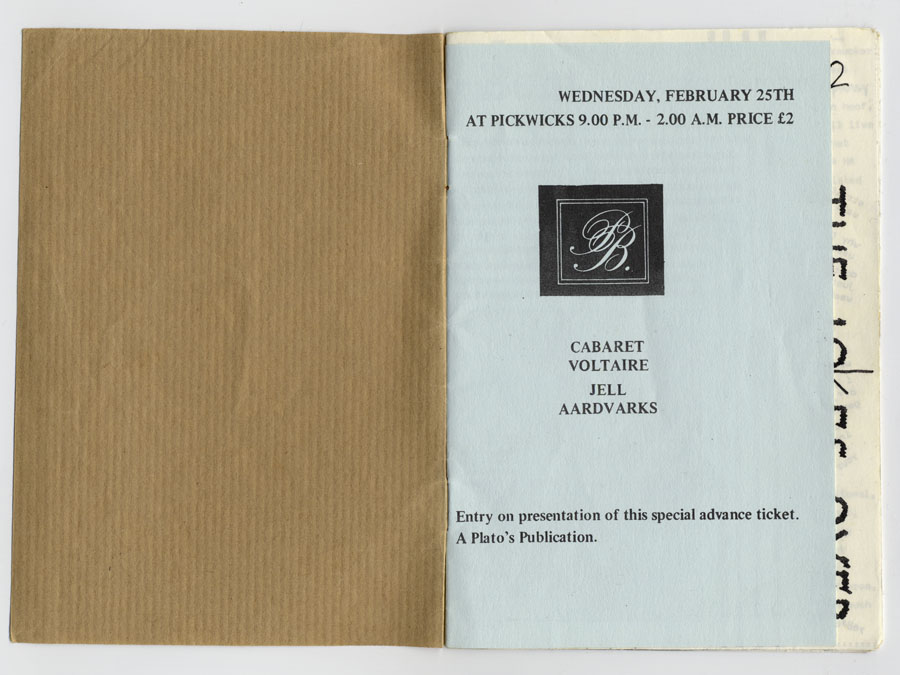
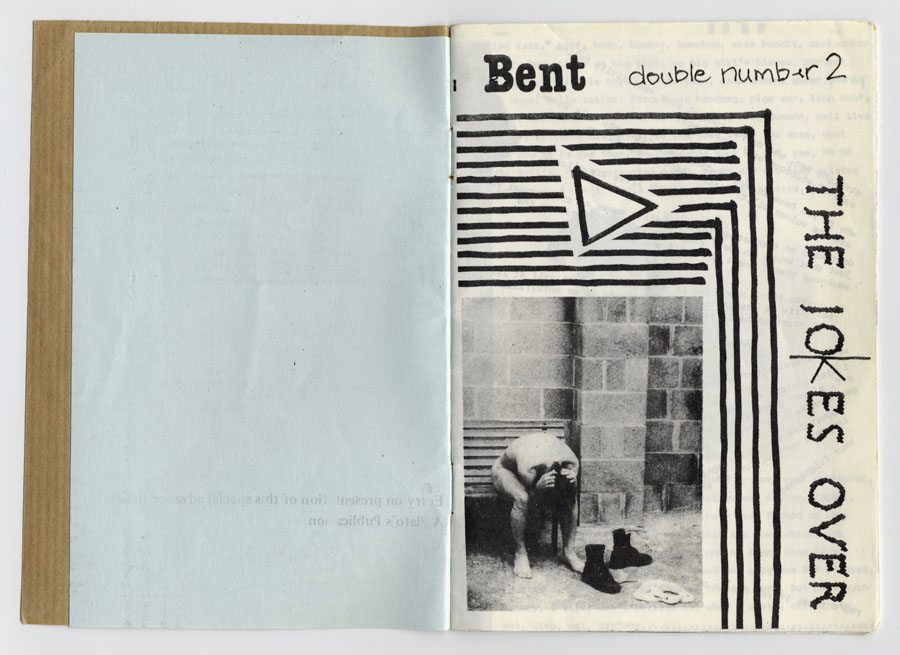
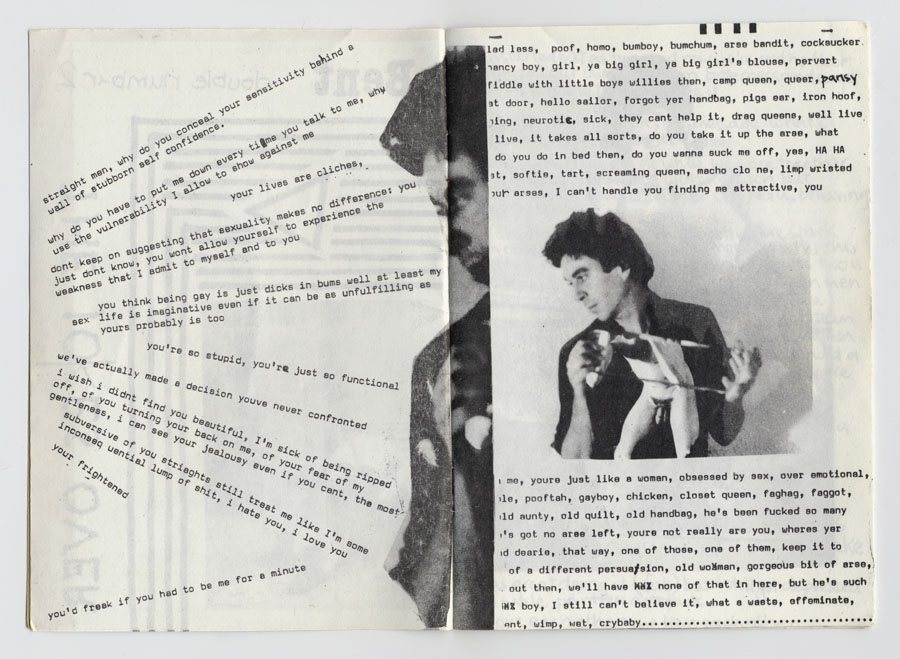
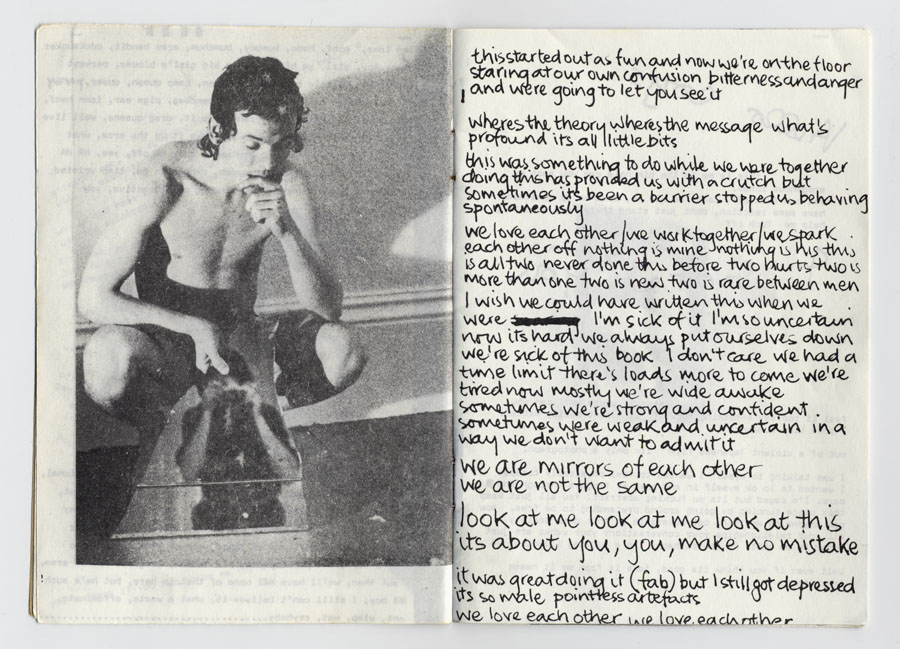
The current issue of The Wire has a great appraisal by Keith Moliné of the musical history of Cabaret Voltaire, a well-timed piece given the recent announcement of forthcoming reissues from Mute Records. Having been a Cabophile from the start I’m rather biased, but the Wire piece has had me listening to the early albums and singles this week (between bouts of Zdenek Liska), and finding the passage of time has made those early recordings seem increasingly strange. Cabaret Voltaire were one of the few groups I liked obsessively enough to collect ephemera from newspapers and magazines. Knowing this, a friend gave me this curious fanzine/ticket from a gig the group played in Liverpool in February, 1981. The venue was Plato’s Ballroom at Pickwicks, and judging by the wording inside—”A Plato’s Publication”—it seems it was the venue’s idea to make the ticket a small (10.5 x 15 cm) booklet.

cv02.jpg

What’s surprising about this is that the fanzine the ticket is bundled with has nothing at all to do with music (or that other perennial of 80s post-punk culture, left-wing politics) but is a glimpse of life as a gay man in Liverpool. I’ve always found this fascinating for the daring it took to foist the thing on a bunch of unwitting Cabs fans, most of whom would have been straight men and not especially sympathetic to the subject matter. In the context of 1981 forcing people to look at grainy shots of naked men with accompanying text (by another man) declaring them to be a turn-on was a transgressive act. The only representations of anything gay in the popular media were a few camp (and therefore safe) comedians; Derek Jarman was still an underground figure, and as late as 1984 a BBC play about gay men was prefaced with a warning about its “contentious” subject.

cv03.jpg

I’ve no idea who was responsible for the fanzine, there are no credits, and it’s possible that the people involved didn’t want to be too easily identified. If the tone of the writing seems rather dramatic then, again, it’s important to see it in context of a country which wasn’t much more amenable to gay people than Russia is today. Saying things in public that most people didn’t want to hear was a challenging act; emotions often ran high.

cv04.jpg

Looking for information about the gig turned up this newspaper ad. (Who were Jell and Aardvarks, I wonder?) By an odd coincidence only the day before I’d found this upload from the same person of a very scarce compilation tape that happens to be from the same year, and which features contributions from Cabaret Voltaire’s Chris Watson and Richard Kirk. The Men With The Deadly Dreams was compiled by Geoff Rushton, aka John Balance of Coil, and was apparently limited to 200 copies. Among the other highlights there’s a track from Eyeless in Gaza, whose early work I like a great deal, and an electronic piece by Throbbing Gristle’s Chris Carter which I think is exclusive to this collection. Two artefacts—fanzine and tape—with brown paper covers that give a snapshot of Britain’s underground culture in 1981.

cv05.jpg

Continue reading “Just the ticket: Cabaret Voltaire”

Weekend links 172

thielker.jpg

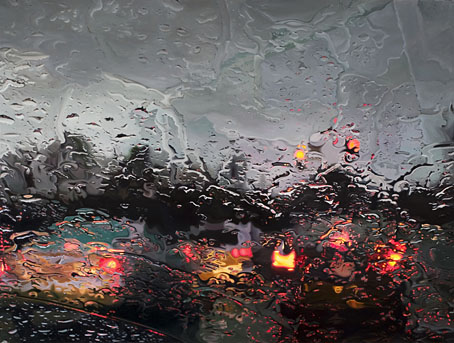
Complete Stop (2008), an oil painting by Gregory Thielker from his Under the Unminding Sky series.

• For Halloween last year I watched a very poor copy of a BBC Play For Today production, Robin Redbreast, a piece of rural horror by John Bowen which received a single screening in 1970. That poor copy—black-and-white, timecoded, multi-generation video—has been circulating for years, so it’s good to know that the BFI will be releasing Robin Redbreast on DVD in time for this year’s Halloween. This might be news enough but the following month the BFI also releases Leslie Megahey’s stunning adaptation of Schalcken the Painter in a dual DVD/Blu-ray edition. I wrote a short review of the latter film last October.

• Mixes of the week: August Sun High from The Advisory Circle, and John Wizards’ Quietus Mix “African music, R&B and chamber pop, filtered through gentle electronic arrangements that cross-pollinate with South African house, Shangaan electro and dub”.

• A trailer has surfaced for The Counselor, a film by Ridley Scott from an original screenplay by Cormac McCarthy. Trailers are too spoilerish so I’m refusing to watch it but for those interested Slate has the details.

Luckhurst makes an admirable attempt to link Lovecraft’s most frustrating writing tic to this theme of the unknown when he claims that Lovecraft’s “catachresis”—deliberate muddling of language through the use of mixed metaphors and the like—is a tool he uses to bolster the atmosphere of futility in the face of “absolute otherness.” The trauma of encountering something so far outside the realms of imagination triggers a collapse of logic in the language itself.

Cate Fricke reviews The Classic Horror Stories of HP Lovecraft, a collection from Oxford University Press edited by Roger Luckhurst.

• “Contemporary audiences found it too weird, too wonky and even borderline distasteful…” Xan Brooks goes looking for the locations from Powell & Pressburger’s 1943 film, A Canterbury Tale.

• Two songs from Julia Holter’s forthcoming album, Loud City Song: World and Maxim’s I. Also unveiled this week: Evangeline, a new track by John Foxx & Jori Hulkkonen.

• Have Ghost, Will Find: Colin Fleming on William Hope Hodgson’s Carnacki, The Ghost Finder.

• At PingMag: Urban Calligraphy: Turning the Streets into Big, Loud Canvases.

• Sex, Spirit, and Porn: Conner Habib talks to Erik Davis.

Serendip-o-matic: Let Your Sources Surprise You

The Pronunciation of European Typefaces

Twilight (2004) by Robin Guthrie & Harold Budd | Luminous (2009) by John Foxx & Robin Guthrie | Cling (2011) by Robin The Fog

Weekend links 171

bossi.jpg

Jeune moine à la Grecque (1771) by Benigno Bossi. Via Monsieur Thombeau.

Victoriana: The Art of Revival is an exhibition which will run throughout the autumn at the Guildhall Art Gallery, London. Some of my steampunk work will be included. Related: Rick Poynor on Soft Machine’s Dysfunctional Mechanism.

• “The egg glows and hovers in the middle of a field of mesmerizing color. The spell is broken when the guard finally says, “Everybody up off the floor.'” Morgan Meis on Aten Reign by the amazing James Turrell.

• Mix of the week: a “heatwave mix” of psychedelic songs compiled by Jaime Williams. Anything that includes Vacuum Cleaner by Tintern Abbey gets my vote.

Because sex is so compartmentalized — it’s often considered separate from the rest of life and hidden away — porn performers, who have sex publicly, are in a unique position to consider and talk about integrating private and public aspects of life.

Writer and porn performer Conner Habib on the issue of nomenclature in the porn business.

• Still Hopscotching: Peter Mendelsund posts some unused cover designs for Julio Cortázar.

A Hymn For Megatron, an hour-long drone work, and a free download, by The Black Dog.

• Vagrancy and drift: Sukhdev Sandhu on the rise of the roaming essay film.

• A Flickr set of Peter “Sleazy” Christopherson’s musical instruments.

mwc.jpg

“Whether flower-pressing in the garden, hallucinating in the summerhouse, fainting inside stifling sites of historical interest, pirouetting along the promenade, or even sea-cruise thalassophobia complications, barely a moment will pass that isn’t made all the sweeter by obsessively listening to Down to the Silver Sea.”

The TM Research Archive: sate yourself on Swiss graphic design.

• A Lecture on Johnson and Boswell by Jorge Luis Borges.

• Words, sounds and robots from Sarah Angliss.

Never Built Los Angeles

Nautilus (2012) by Anna Meredith | Nature Of Light (2012) by Isnaj Dui | Popcorn (Ealing Feeder Mix) (2012) by SpacedogUK (Sarah Angliss)