Weekend links 288

gourmelin.jpg

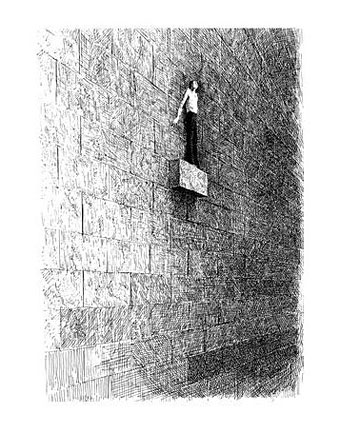
Untitled drawing by Jean Gourmelin.

• Yet another book featuring my design work (interiors this time) has been published in the past week. Leena Krohn: Collected Fiction is an 850-page selection of novels, novel extracts and short works from a prolific Finnish author of the fantastic. Many of the selections are being published in English for the first time:

From cities of giant insects to a mysterious woman claiming to be the female Don Quixote, Leena Krohn’s fiction has fascinated and intrigued readers for over forty years. Within these covers you will discover a pelican that can talk and a city of gold. You will find yourself exploring a future of intelligence both artificial and biotech, along with a mysterious plant that induces strange visions. Krohn writes eloquently, passionately, about the nature of reality, the nature of Nature, and what it means to be human. One of Finland’s most iconic writers, translated into many languages, and winner of the prestigious Finlandia Prize, Krohn has had an incredibly distinguished career. Collected Fiction provides readers with a rich, thick omnibus of the best of her work—including novels, novellas, and short stories. Appreciations of Krohn’s work are also included.

• “Not only is the nature of Rollin’s choice of images close to [Clovis] Trouille’s, the director structures his movies in a similar fashion, crowding his movies with dreamy horror iconography. Rollin has specifically cited the influence of Trouille’s paintings on his work alongside that of other Surrealist painters working in a figurative style.” Tenebrous Kate explores the influences (and influence) of Jean Rollin’s erotic horror films.

• “[Morton] Subotnick might just have been the first person to get a club full of people—including the entire Kennedy family—dancing to purely electronic music when he played his Silver Apples Of The Moon at the opening night of New York’s legendary Electric Circus.” Robert Barry interviews the pioneering composer.

• “What I actually wanted to do was make music that contained all that was new in the 20th century,” says Irmin Schmidt in an interview with Bruce Tantum. Good to read that Rob Young is writing a biography of Can.

• “…gay mainstream culture was never really about expressing individuality, for me. It always seemed very conformist,” says Bruce LaBruce in conversation with Mike Miksche.

• At Dangerous Minds: Paul Gallagher on the making of Ken Russell’s The Devils, and Martin Schneider on the return of Paul Kirchner’s wordless comic strip, The Bus.

• Two years ago a group of Russian urban explorers climbed the Pyramid of Cheops at night. They’ve just returned from South America, and have a report here.

• In the wake of their new album, Kannon, Jason Roche asks “Are drone-metal icons Sunn O))) the loudest band on the planet?”

Junji Ito returns to horror with two new titles. Related: Fuck Yeah Junji Ito.

• Mix of the week: FACT mix 527 by Jóhann Jóhannsson.

Anna von Hausswolff‘s favourite albums.

Touch (Beginning) (1969) by Morton Subotnik | Rapido De Noir (1981) by Irmin Schmidt & Bruno Spoerri | The Gates of Ballard (2003) by Sunn O)))
Fat of the Land: selected British short films, 1984–1987

fat1.jpg

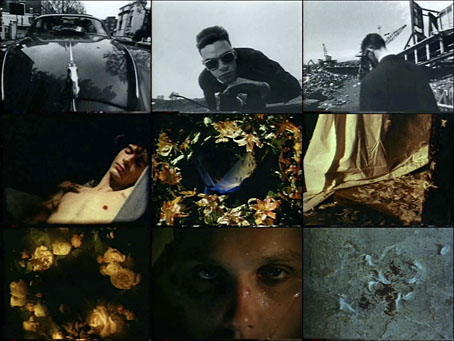
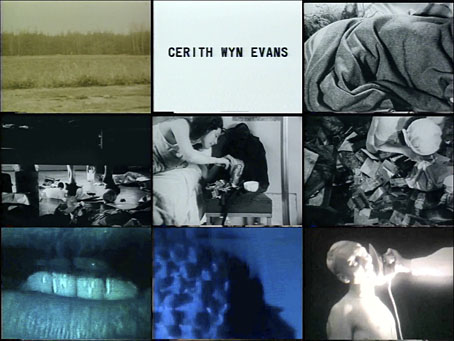
Here’s another of those film/video anthologies released on VHS in the UK in the 1980s that I never got to see at the time. Fat of the Land is a collection of student films, short video experiments and two video pieces related to the early Industrial music scene featuring 23 Skidoo and Last Few Days. The anthology appeared in 1988 as Ikon 25 on Factory Records’ video label packaged with an approving quote by Derek Jarman. Two Jarman collaborators appear within—Cerith Wyn Evans and Tilda Swinton—while director Richard Heslop (who hosts this at Vimeo) is featured in front and behind the camera in many of the pieces. Heslop is responsible for Language, the 23 Skidoo video, and dons angel wings for Maggie Jailler’s A Nosegay, a homoerotic homage to Genet and Lautréamont. Jailler’s film is my favourite but then I’m biased towards the content.

fat2.jpg

Previously on { feuilleton }
The Dream Machine
Seven Songs by 23 Skidoo

Weekend links 286

ahmed.jpg

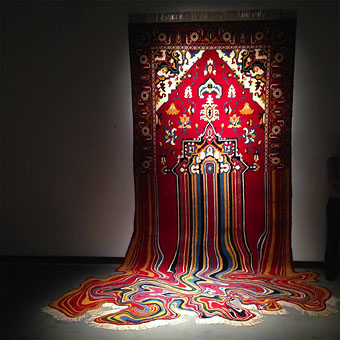
One of Faig Ahmed‘s melted Azerbaijani rugs.

• “I asked [William Burroughs] about the future of typography and he said that letterforms would go back to hieroglyphs, similar to the ancient Egyptians.” Jonathan Barnbrook discussing the thinking behind his design for blackstar, the new David Bowie album.

• “…a thick, yellow fog fills the air, sinks, crawls on the very ground; at 30 paces a house or a steam-ship look like ink-stains on blotting paper.” PD Smith review London Fog, a history of the capital’s lethal pea-soupers by Christine Corton.

• At Rue Morgue: Dejan Ognjanovic asks seven writers and editors why HP Lovecraft is still relevant. Related: big thanks to Paul Gallagher for plugging my Lovecraft calendar at Dangerous Minds.

• Some end-of-year weirdness from Moon Wiring Club: Into The Chattering Ground, a sample of the new releases available at the MWC website.

Elaine Lustig Cohen: accidental graphic designer. Related: book covers and other designs by Elaine Lustig Cohen.

• The tomb that architect John Soane built for his wife inspired the shape of Gilbert Scott’s red telephone box.

• Mix of the week: Stephen O’Malley at the controls of Stuart Maconie’s Freak Zone on BBC Radio 6.

• At Dirge Magazine: S. Elizabeth talks to Alice Rogers about art and occultism.

Simon Callow on taking 25 years to write a three-volume life of Orson Welles.

Todd Haynes on Cate Blanchett, Saul Leiter and Queer Cinema.

Le Freak (1978) by Chic | Freak (2003) by LFO | Jovan Freak (Rune Lindbaek Nomaden Mix) (2012) by Georges Vert

Weekend links 285

graphic.jpg

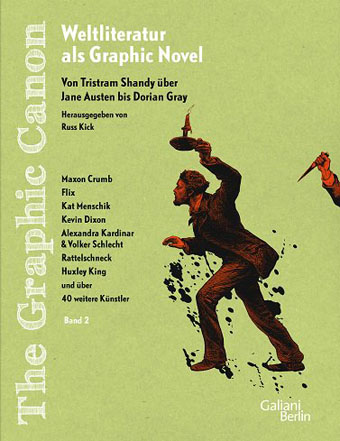
Some of the art from my collage adaptation of The Picture of Dorian Gray appears on the cover of The Graphic Canon: Volume 2, published this month in a German edition by Verlag Galiani. Out next month (although possibly available now) is the same book in a Brazilian edition from Boitempo Editorial. One of the disappointments this year was having to abandon plans to contribute to Russ Kick’s forthcoming graphic canon of crime fiction. I was overstretched during the summer, and what with projects slipping their deadlines and the trip to Providence there wasn’t any time left for other things.

• For those who missed the first edition, a second and final expanded edition of the Penda’s Fen study/celebration The Edge Is Where The Centre Is.

• Whipping up a storm: how Robert Mapplethorpe shocked America; Kevin Moore on the photographer’s Perfect Moment exhibition.

In the best scenario, metaphysical art distributes the work of understanding among cultural traditions and symbolic systems, and it is along these lines that Carrington’s work has been described as a productive combination of Mexican, Egyptian, Hebrew, Celtic, Greek, and Mesopotamian elements. Her paintings, plays, and stories mix the symbols of alchemy, astrology, Tarot, herbalism, magic, witchcraft, and a personal iconography.

Leif Schenstead-Harris on the life, art and fiction of Leonora Carrington

• Mixes of the week: Hieroglyphic Being collects favourite cosmic jazz of the 1970s; NTS Radio presents an hour of Annette Peacock.

• At Kill Your Darlings: Alexandra Heller-Nicholas enthuses about Dario Argento’s delirious masterwork, Suspiria.

Pye Corner Audio releases a new album (only limited vinyl at the moment—boooo!) and remixes Stealing Sheep.

• The Trip Planners: Emily Witt meets the founders behind Erowid, the online drug encyclopedia.

Woven Processional (1985), music on the Long String Instrument by Ellen Fullman.

• “The Paris attacks prove Charlie Hebdo’s critics wrong,” says Dorian Lynskey.

• Photographs by Danila Tkachenko of abandoned Soviet technology.

Come Wander With Me / Deliverance by Anna von Hausswolff.

• The collages of Guy Maddin.

CAN HALEN

Let’s Take A Trip (1965) by Godfrey | Trip On An Orange Bicycle (1968) by The Orange Bicycle | Last Trip (1968) by We Who Are

Weekend links 284

molinier.jpg

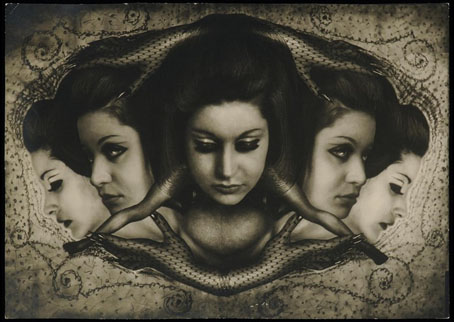
Les Hanel I by Pierre Molinier. There’s more at The Forbidden Photo-Collages of Pierre Molinier.

• Western anti-hero Josiah Hedges, better known as Edge, was the creation of prolific British author Terry Harknett. The famously violent Edge novels, credited to “George G. Gilman”, were ubiquitous on bookstalls in the 1970s. They were Harknett’s most successful works, and are still collectible today; if you’re interested there are 61 of them to search for. Amazon Originals have just launched Edge as a new TV series although anything for a mass audience is unlikely to retain the exploitative qualities of novels that often sound like pulp precursors of Blood Meridian.

Related: Terry Harknett discusses the creation of the Edge series at Drifter’s Wind; Ben Bridges on Harknett’s career, including a look at the writer’s many other Western and thriller novels; Bill Crider on Edge, Harknett and the British group of Western novelists known as “The Piccadilly Cowboys”.

• Boyd McDonald’s queer-eye film guide, Cruising the Movies: A Sexual Guide to Oldies on TV (1985), has been republished by Semiotext(e) in an expanded edition. Related: True Homosexual Experiences: Boyd McDonald and Straight to Hell by William E. Jones.

• “…a film that plumbs the dark recesses of all our imaginations: dangerous, glorious, absurd, vivid and terrifying by turns.” Charlotte Higgins on her favourite film, The Red Shoes (1948).

Art Forms from the Abyss, a new collection of illustrations by Ernst Haeckel for the report of the HMS Challenger expedition (1872–76). Related: Silentplankton.com

• “The biggest kick I ever get is to find myself pursuing some group of images without knowing why,” says M. John Harrison in conversation with Tim Franklin.

• “Plots didn’t interest him much. They were just pegs on which to hang characters and language.” Barry Day on Raymond Chandler.

• “Zdeněk Liška’s music thrived in unrealities,” says David Herter in a lengthy appraisal of the great Czech film composer.

• At Dirge Magazine: S. Elizabeth delights in the dark decor of Dellamorte & Co.

• Nabokov scholar Brian Boyd selects his ten favourite Nabokov books.

• Mix of the week: The Ivy-Strangled Path Vol. XIII by David Colohan.

Take me to the cosmic vagina: inside Tibet’s secret tantric temple.

• Pour Un Pianiste (1974) by Michèle Bokanowski | 13’05” (1976) by Michèle Bokanowski | Tabou (1992) by Michèle Bokanowski