Weekend links 604

ware.jpg

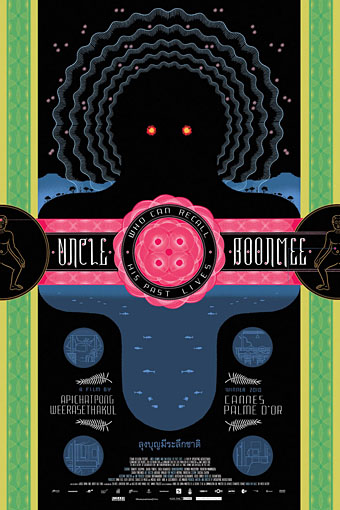
Poster by Chris Ware for Uncle Boonmee Who Can Recall His Past Lives (2010).

• “He is a proponent of “slow cinema,” which is to say, movies that inspire reflection because they are unhurried but fluid, clear but framed by mystery.” Hilton Als on the metaphysical world of Apichatpong Weerasethakul.

• “You could take off your clothes and lay in the sun, nude, with other guys looking for sex, right in Manhattan. And the police didn’t care. It was safe…” Stanley Stellar on his photographs of New York’s “Gay Piers”.

• At Wormwoodiana: An interview with RB Russell who talks about his new book, Robert Aickman: An Attempted Biography.

• New music: Mysterium by Held By Trees; A Journey by Hinako Omori; Waves by The Soundcarriers.

• Get some cosmic perspective with an updated version of Charles & Ray Eames’ Powers of Ten.

• You Cut Your Hair and Made a Friend: Richard Conway on Ladytron’s 604 and Light & Magic.

• At Unquiet Things: The Tawdry Technicolor Horrors of Vicente B. Ballestar.

• Alexis Petridis compiles a list of the late James Mtume’s greatest recordings.

• Steven Heller’s Font of the Month is Valvolina.

Slow Motion (1978) by Ultravox | Slow And Low (1995) by Tetsu Inoue | Slow Burning Ghosts (1996) by Paul Schütze
The art of Pinckney Marcius-Simons, 1867–1909

marcius-simons13.jpg

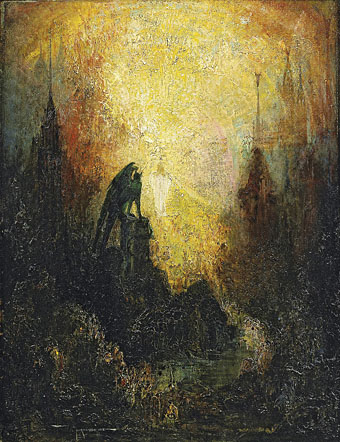
Vision of the Demon.

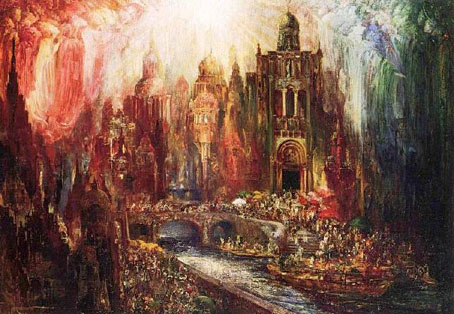
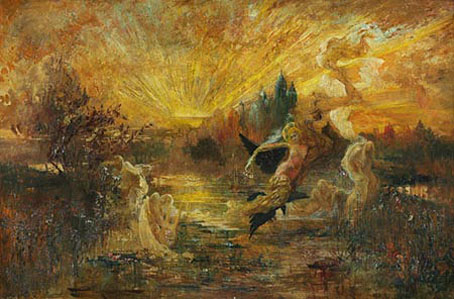
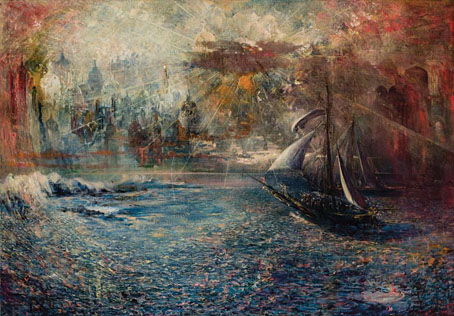
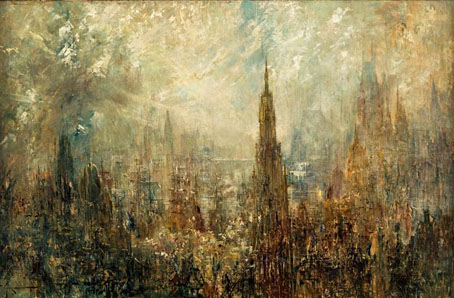
The Symbolist movement in painting never really took hold in America the way it did in Europe so it’s a surprise to find a new name to add to the very small list of American Symbolists. Pinckney Marcius-Simons painted his share of 19th-century genre pictures but these give way in his later career to canvases that show a distinct Gustave Moreau influence, or perhaps Turner in those nebulous volumes of illuminated vapour. Marcius-Simons was born in New York but lived in Europe for most of his life; he studied in Paris so he would have been able to see Moreau’s work first-hand. A few of his later pictures are rather vague fantasies but his real obsession was with Wagner’s operas, and he spent the last few years of his life working as a set designer at Bayreuth while also creating a series of paintings intended to illustrate the entire run of Wagner’s Ring Cycle. His most remarkable creation isn’t a canvas, however, but a French edition of A Midsummer Night’s Dream which he painted over entirely, even decorating the binding. I’m surprised again that such a unique work isn’t more widely known. Happily the entire book is available online at the Folger Shakespeare Library.

All the usual caveats apply here with regard to the accuracy of titles and dates. There’s even some dispute about the artist’s birth year which is occasionally given as 1865. Most of these pictures have been found on auction sites where larger reproductions may be seen.

marcius-simons03.jpg

Port City.

marcius-simons04.jpg

marcius-simons05.jpg

Sunrise.

marcius-simons12.jpg

The City of Dreams.

Continue reading “The art of Pinckney Marcius-Simons, 1867–1909”

Weekend links 603

weird.jpg

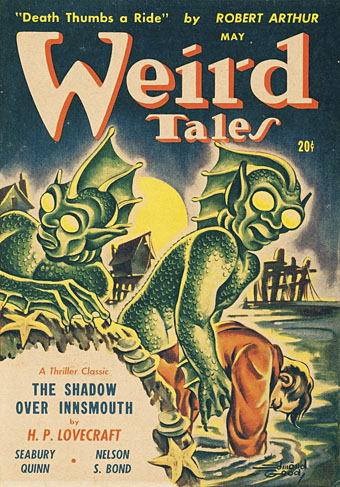
Weird Tales (Canada), May 1942. Cover art by Edmond Good.

• “…in 1968, seven years after the MOMA retrospective, Orson Welles appreciatively got in touch and suggested that Bogdanovich do a book-length set of interviews with him like the one that Bogdanovich had just done with Ford. The resulting book, This Is Orson Welles (which took a winding path to publication, in 1992, seven years after Welles’s death), is a classic of the literature of movies.” Richard Brody on the late Peter Bogdanovich. The book of Welles interviews is one of my favourite film books, as good in its way as Hitchcock/Truffaut, and like Truffaut’s book you wish it was twice as long.

• At Public Domain Review: Paloma Ruiz and Hunter Dukes on Johann Caspar Lavater’s frog-to-human physiognomies. If you reverse the sequence, as I did for one of the illustrations in Lovecraft’s Monsters, you approach The Shadow Over Innsmouth.

• The week in virtual exploration (via MetaFilter): Mini Tokyo 3D and Explore the Soane Museum, London.

• Submissions are open for the 16th issue of Dada journal Maintenant which will have the theme “Nyet Zero”.

• At Spoon & Tamago: Artists and artisans collaborate on exhibition of 144 maekake aprons.

• DJ Food unearths flyers and posters for the Million Volt Light & Sound Rave, 1967.

• Mix of the week: Isolatedmix 116 by Chris SSG.

• At Dennis Cooper’s: Stephen Dwoskin Day.

The Little Blue Frog (1970) by Miles Davis | Jail-House Frog (1972) by Amon Düül II | Tree Frog (1995) by Facil

Weekend links 602

hightimes.jpg

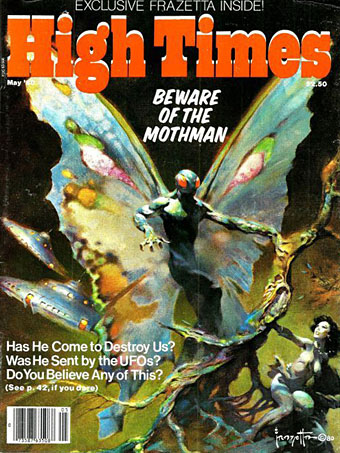
High Times, May 1980. Cover art by Frank Frazetta.

• Desperately Seeking Mothman: “The Scythian Lamb, after all, was equal parts Venus flytrap and baby lamb, a mysterious woolly gourd,” says Tara Isabella Burton, on the trail of cryptids old and new.

• “In my youth of course I indulged in such stunts as bringing forth a Boramez, or a so-called vegetable lamb.” It’s that lamb again, in a translation of pages from The Voynich Manuscript.

• “2022: Be willing to be dazzled,” says S. Elizabeth. Also, follow her blog because she’s always turning up strange and wonderful things.

• “Why do we count down to the New Year?” Alexis McCrossen explores the history of countdowns, from Fritz Lang to the present day.

• “Snow coats reality in a fresh layer of strangeness,” says Charlie Fox.

• Spending the War Without You: Laurie Anderson’s Norton Lectures.

• New music: Our Hands Against The Dusk by Rachika Nayar.

• Mix of the week: Fact Mix 840 by Time Is Away.

• Galerie Dennis Cooper presents…Piet Zwart.

Does It Matter Irene? (1979) by The Mothmen | Tardis (Sweep Is Dead, Long Live Sweep) (1981) by The Mothmen | Mothman (1981) by The Mothmen

The Late Show: Thomas Pynchon

pynchon1.jpg

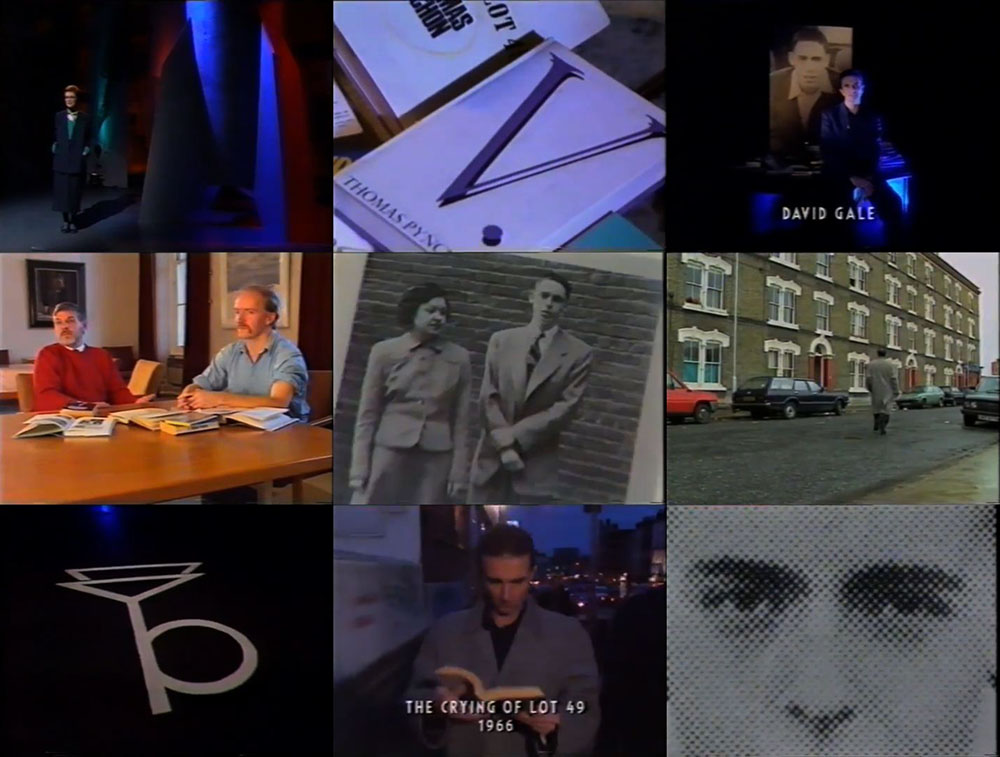
Among other things, I’ll remember 2021 as the year of Too Much Work, but it’s also been the year of reading several thousand pages of Thomas Pynchon’s prose. After finally getting through Gravity’s Rainbow back in June (having also read V. and The Crying of Lot 49) I continued with the rest of the Pynchon oeuvre, working my way through Vineland, Mason & Dixon, and Inherent Vice. And after reading the latter I watched the film adaptation again which I found to be much more enjoyable and less confusing the second time round. (Moral: read the novel first). I’m currently ploughing through Against the Day, not worrying too much about how all the various episodes are supposed to join together.

pynchon2.jpg

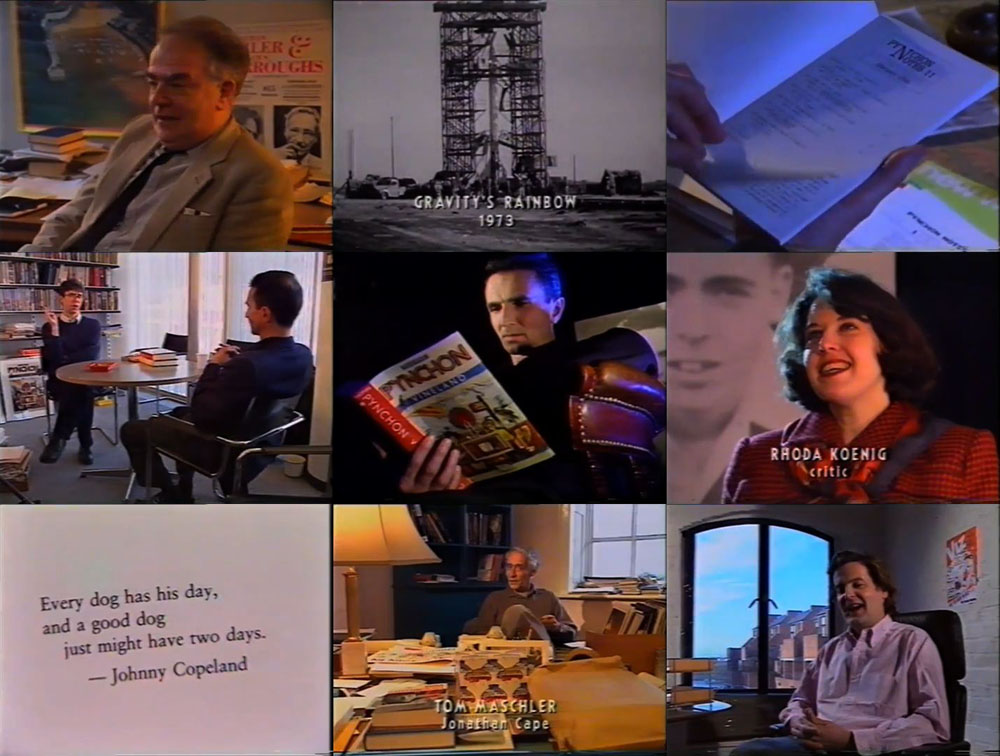
The commendable inaccessibility of Pynchon the man means that documentary features about his books are scarce. Television abhors an authorial vacuum which is why so many TV documentaries about long-dead or otherwise unavailable writers resort to the cliches of a silhouette hammering away at a typewriter, or an actor in period clothing scribbling in a dimly-lit room. The BBC, in the days when it still used to make programmes about books and writers, often evaded the absurdities of docu-drama by the simple expedient of having a suitable actor read portions of prose, which is what we have in this all-too-brief Pynchon feature from 1990. The Late Show was a nightly fixture on BBC 2 at this time, with a remit to cover anything newsworthy in the cultural sphere. Vineland was about to be published in Britain so editor David Gale was called upon to explain to viewers the lure of Pynchon’s novels and their mysterious author. It’s a fascinating piece which achieves in a mere 19 minutes what Thomas Pynchon – A Journey into the Mind of [P.] barely manages in an hour and a half. As with the Dubinis documentary, there’s some discussion of the authorial enigmas but Gale keeps the novels to the fore. It’s amusing with hindsight to hear about the critical disappointment that greeted the arrival of Vineland—Pynchon’s first novel after a silence of 17 years—knowing that the monumental Mason & Dixon would be published a few years later. Commentary is supplied by publishing heavyweights Tom Maschler, Dan Franklin and John Brown (two of whom describe their meetings with the elusive author), together with critic Rhoda Koenig and critic/poet Eric Mottram, here interviewed with a picture of one of his favourite authors, William Burroughs, peering over his shoulder.

Previously on { feuilleton }
Esoterica 49
Pynchonian cinema
Going beyond the zero
Pynchon and Varo
Thomas Pynchon – A Journey into the Mind of [P.]