Weekend links 17

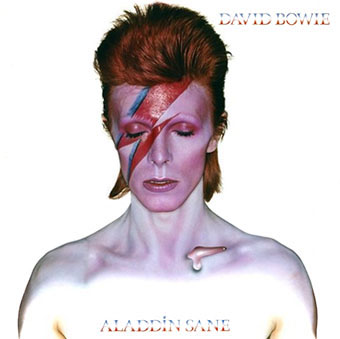
bowie.jpg

Aladdin Sane (1973). Cover photo by Brian Duffy who died this week.

• Among the obituaries this week: artist Louise Bourgeois; poet and partner of Allen Ginsberg, Peter Orlovsky; film director Joseph Strick, a man who dared to film James Joyce’s Ulysses; photographer Brian Duffy.

The dustbin of art history: “Why is so much contemporary art awful? We’re living through the death throes of the modernist project—and this isn’t the first time that greatness has collapsed into decadence.” Admirable sentiments but galleries and dealers have far too much invested in the corrupt edifice to let it collapse any time soon.

• Edinburgh film festival to screen ‘lost and forgotten’ British movies including the director’s cut of Jerry Cornelius film The Final Programme.
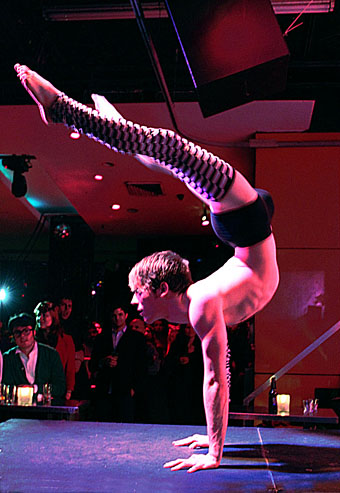
gogoharder.jpg

Delectable Bawdville burlesque boy Chris “Go-Go” Harder. Via EVB who have more pics.

Homobody by Rio Safari, “a scrappy diy zine about queerness”. Obliquely related: Lizzy the Lezzie, animations at the Sundance Channel.

• Richard Norris aka Time and Space Machine puts together a psychedelic mixtape for FACT. Fab stuff.

• Diamanda Galás has a message for critics: “Stick to reviewing plant life and leave the Witches alone.”

Brion Gysin: Dream Machine will be the first US survey of Gysin’s work in NYC next month.

• Geeta Dayal’s study of Another Green World by Brian Eno reviewed at Ballardian.

• For type-heads: font anatomy wallpaper by Sigurdur Armannsson.

If it was my home: visualising the BP oil disaster.

Antony Gormley’s Breathing Room III.

The Paris Review has a new blog.

• Bizarre juxtaposition of the week: John Martyn’s sublime Small Hours with, er… The Clangers.
The voice of Oscar Wilde

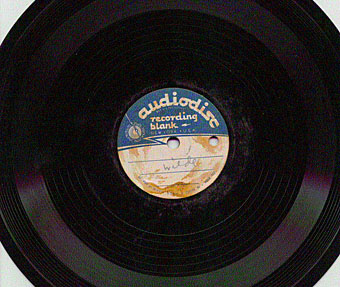
record.jpg

How to combine two recent {feuilleton} obsessions? Ask whether Oscar Wilde had his voice recorded on an Edison machine at the Exposition Universelle in Paris, 1900. It’s a tantalising question. We know from Wilde’s letters that he visited the Exposition several times; he talked with Rodin and admired a self-portrait by his old painter friend Charles Shannon in the British pavilion. Edison staff were prominent at the exposition and did us a favour by filming parts of it. Several of the Wilde biographies mention the rumoured recording, the details of which are recounted at Utterly Wilde:

According to H Montgomery Hyde’s 1975 biography of Oscar Wilde: “…It was during one of these visits to the Exhibition that Wilde was recognized in the American pavilion, where one of the stands was devoted to the inventions of Thomas Edison. One of these inventions was the ‘phonograph or speaking machine,’ and Wilde was asked to say something into the horn of the recording mechanism. He responded by reciting part VI of The Ballad Of Reading Gaol, which consists of the last three stanzas of the poem, and identifying it with his name at the end.” (More.)

The purported wax cylinder is lost but an acetate copy surfaced in the 1960s. Wilde’s son, Vyvyan Holland, identified his father’s voice then changed his mind later on. An analysis by the British Sound Archive threw further doubt on the recording so we’re left to make up our own minds which you can do for yourself here. It doesn’t sound to me like the voice one would expect from a man of Wilde’s physical size, but then I also never expected Aleister Crowley’s voice to be so highly-pitched. If anyone knows of more recent research or detail about the Wilde recording, please leave a comment.

Elsewhere on { feuilleton }
The Oscar Wilde archive

Odes and Sonnets by Clark Ashton Smith

cas.jpg

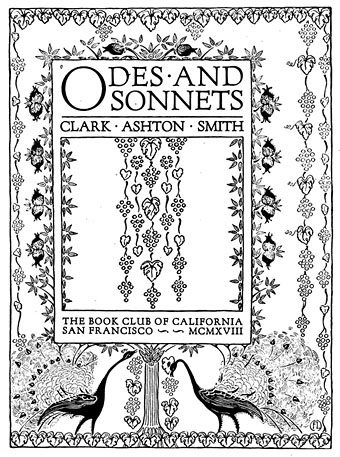
Clark Ashton Smith’s weird fiction is reprinted more often and more widely than his poetry so it’s convenient for those curious about his verse that the Internet Archive has two volumes of early work. Odes and Sonnets is from 1918 and features embellishments by illustrator Florence Lundborg whose grape-devouring peacocks nod towards the fin de siècle spirit Smith was trying to capture in his poems. The Star-Treader, and Other Poems is Smith’s first book from 1912, published when he was just 19, and is heavily indebted to the Decadents. That Decadent influence carried over into the stories he wrote for Weird Tales and augments their unique flavour and over-heated atmosphere, an atmosphere which raised his work above the often mediocre level of his contemporaries. On page 58 of The Star-Treader can be found The Eldritch Dark, the poem from which the leading Smith website takes its name.

Previously on { feuilleton }
Clark Ashton Smith book covers

Weekend links 16

clockwork.jpg

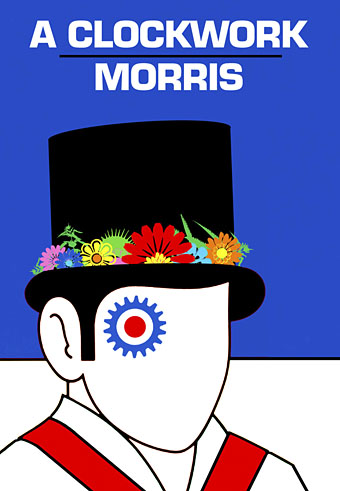
Sumer Is Icumen In but you wouldn’t have known it today, it being cold and wet, O my brothers. The picture above is the work of David Owen whose Ink Corporation does a splendid job of updating the iconography of the folk music world. Via Electric Eden.

• Biting the hand that feeds: designer Jonathan Barnbrook’s contribution to the Biennale of Sydney takes a dig at the whole enterprise. The art market is impervious to criticism (or shame) but the gesture is an amusing one.

Emanuel Schongut’s book covers of the 1960s and 1970s on the artist’s own Flickr pages. Via A Journey Round My Skull.

• Owen Freeman on illustrating William Burroughs. Related: Reality Studio interviews Victor Bockris.

• RIP Jack Birkett, Derek Jarman’s Caliban and the Pope in Caravaggio. And RIP Dennis Hopper, actor, director and photographer.

seanettle.jpg

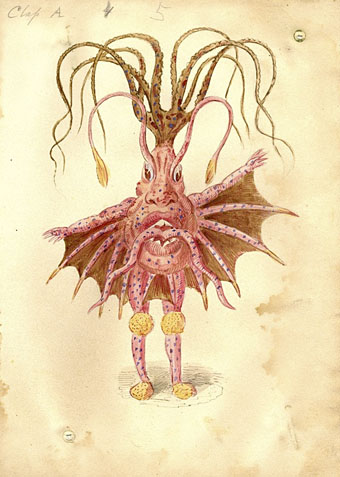
“Sea Nettle” (1873), a costume design by the Mistick Krewe of Comus. From this BibliOdyssey posting of New Orleans Mardi Gras designs.

• Chris Summerfield’s surfer boys at Lulu.

• Homotography also has a Tumblr page.

The Ghost Box Study Series Singles.

• More 3D projection on buildings.

John Foxx interviewed at FACT.

Song of the week: Ineffect (1989) by Material.

The Sapphire Museum of Magic and Occultism

colman.jpg

Cover design by Pamela Colman Smith for The Tarot of the Bohemians by “Papus” aka Gérard Encausse (1910).

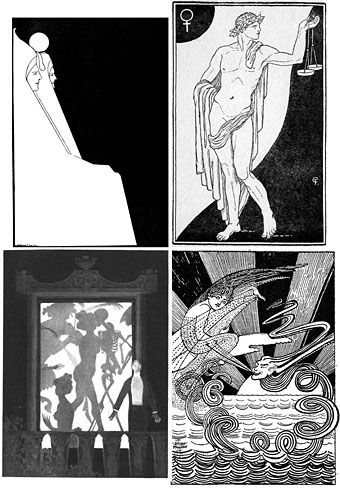
The Sapphire Museum of Magic and Occultism says it’s been around since 1999 but I don’t recall having come across it before. Among a variety of fascinating rarities is this gallery section devoted to some of the less well-known illustrators of occult or occult-related books from the late 19th and early 20th century. Included there are two substantial galleries of work by Pamela Colman Smith, artist of the world’s most popular Tarot deck. Many of the scans are high-quality and, like the pictures at Golden Age Comic Book Stories, seem to be taken from the original printings. A great site.

occult.jpg

top left: WT Horton; top right: Cecil French.
bottom left: Althea Gyles; bottom right: M Bergson MacGregor.

Elsewhere on { feuilleton }
The illustrators archive

Previously on { feuilleton }
Pamela Colman Smith’s Russian Ballet
The art of Julien Champagne, 1877–1932
The art of Pamela Colman Smith, 1878–1951
The art of Andrey Avinoff, 1884–1949
The art of Cameron, 1922–1995
Austin Osman Spare