
PlacePrints by David Rudkin

pp1.jpg

Hidden voices and haunted landscapes are conjured up in ten unique stories from the imagination of visionary writer David Rudkin. Join a stellar cast including Juliet Stevenson, Toby Jones, Josie Lawrence, Michael Pennington and Stephen Rea, among many others on an enlightening journey across the British Isles with this dramatic audio cycle that will transform your sense of the landscape around you.

PlacePrints is the umbrella title for ten new audio plays by David Rudkin, a series directed by Jack McNamara for the New Perspectives theatre company. The series has been freely available online for over a year but only came to my attention last month. One of the pleasures of recent years has been seeing David Rudkin’s dramas being reappraised after many years of neglect, although interviews suggest the writer has ambivalent feelings about the concentration on the gaudier, generic elements of his surviving TV plays. In The Edge Is Where The Centre Is, a book by Texte und Töne about Penda’s Fen, Rudkin is determined to frame the film as a political work when most of the reaction to it over the past decade has been to label it “folk horror”. I can’t complain too much when I’ve been partly responsible for giving it the horror label in the first place, having written (at the request of one of the editors) a short review of the film for Horror: the Definitive Guide to the Cinema of Fear (2006), and later contributed a lengthy piece about Rudkin’s stage and TV dramas to Folk Horror Revival: Field Studies (2015). In my defence, the latter was intended to draw attention to Rudkin’s work as a whole, and you have to start somewhere. In 2006 Penda’s Fen and Artemis 81 were mysteries to most people, not horror enough for the MR James obsessives, or, in the case of Artemis 81, too weird for the science-fiction crowd; both of them were also unavailable in any form. Grant Morrison was the only person I’d met who not only knew who Rudkin was but had read the available playscripts. Some of Rudkin’s works may touch on generic horror or science fiction but even his adaptation for the BBC of The Ash-Tree by MR James can be grouped with his own dramas via its themes of religious conflict and the presence of history in the landscape. He also changes Mothersole’s warning from James’s “There will be guests at the hall!” to the pithier “Mine shall inherit!”, a threat delivered with a playwright’s economy, and a declaration whose reference to inheritance connects the film to a persistent Rudkin theme, the legacies of people, place and history.

pp2.jpg

All of which makes the existence of the PlacePrints dramas very welcome indeed. For the most part, these are closer to Rudkin’s theatrical works than his TV films, being a collection of lone voices engaging repeatedly with the legacies of people, place and history: a British Celt watching the invading Roman army build one of their roads across the Warwickshire fields (River, Of Course); a close description of a walk along an ancient pathway in Cornwall (Nemeton); the scathing voice of an earthwork following the clumsy searches of an aged academic (Grim’s Ditch); a young student slipping in and out of visions of life in Suffolk 30,000 years ago (Cave Girl/The Stone Age). The series features an impressive range of acting talent, especially Juliet Stevenson in Grim’s Ditch, and Frances Tomelty as an elemental spirit haunting the waters of Lough Fea in To the Waters and the Wild. Sympathetic sound design and music by Adam McCready adds a hint of location atmosphere and dramatic texture without ever being obtrusive. Each piece is preceded by an authorial introduction, one of which suggests that Rudkin may not be too displeased about being tagged with the horror label when he describes Grim’s Ditch as being a contemporary equivalent of an MR James warning to unwary academics. The episode has its share of uncanny moments, with Toby Jones as the professor receiving a lesson from the landscape that he won’t forget. The final recording is an interview with David Rudkin by Gareth Evans, one of the interviewers and contributors to The Edge Is Where The Centre Is.

There’s a further parallel in some of these pieces with chapters from Voice of the Fire by Alan Moore, a novel that also deals with (among other things) ancient Britain, the Roman invasion and the patterns of history. Fitting, then, that New Perspectives have produced the audio version of Voice of the Fire with the same director and sound designer, and with Toby Jones returning as one of the characters. I generally prefer to read books rather than to hear them read but I’m looking forward to listening to this one as well. (Thanks to Jay for the tip!)

Previously on { feuilleton }
Voice of the Fire
Penda Reborn
Folk Horror Revival: Field Studies
The Edge Is Where The Centre Is
Afore Night Come by David Rudkin
White Lady by David Rudkin
Penda’s Fen by David Rudkin
David Rudkin on Carl Dreyer’s Vampyr
Weekend links 580

kausch.jpg

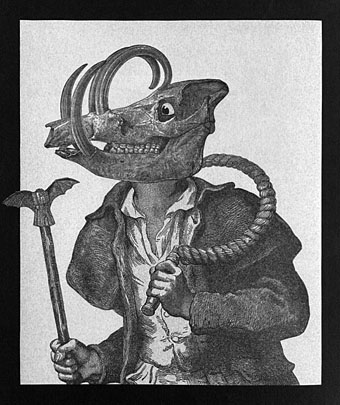
The Collective Lie We All Live By, a cut-paper collage by Allan Kausch from Maintenant 15, A Journal of Contemporary Dada Writing and Art.

• “It’s unusual that an album manages to be at once so much of its moment, yet so much outside it. Time was unmistakably a response to the electronic and synth waves that rose in the wake of punk. It was also a concept album about time travel, which couldn’t have been more pre-punk had it been focus-grouped that way.” David Bennun on Time (1981), ELO’s masterwork of science-fiction pop. The first song on the album, Twilight, is a thundering piece of synth bombast that prefigures Trevor Horn’s equally bombastic productions, and was used to memorable effect in the copyright-infringing animation made in 1983 for the opening of Daicon IV.

• New music: Disciples Of The Scorpion by The Rowan Amber Mill, and Shade by Grouper.

• “Psychedelic spirituality: Inside a growing Bay Area religious movement“.

• “It’s time to farewell this project,” says Ballardian.

• At Wormwoodiana: the seven greek vowels.

• A playlist for The Wire by Douglas Benford.

Norman Blake‘s favourite albums.

Astronomia Playing Cards.

• RIP Dusty Hill.

Time (1973) by David Bowie | Time (1976) by La Düsseldorf | Time (1992) by Lull

Man is the Animal: A Coil Zine

coil.jpg

Death is centrifugal / Solar and logical / Decadent and symmetrical / Angels are mathematical / Angels are bestial / Man is the animal —Fire Of The Mind by Coil

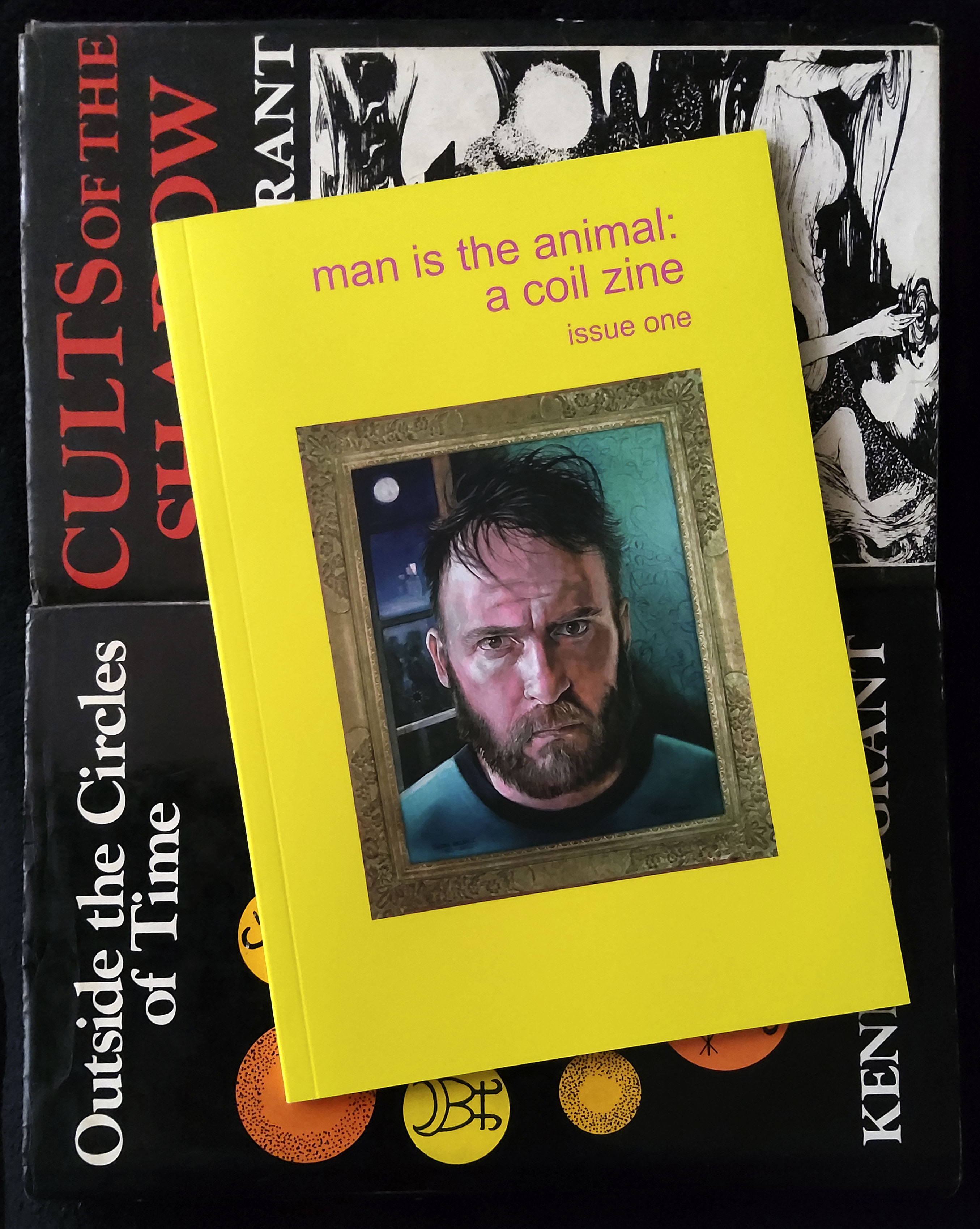
In the post this week from Temporal Boundary Press, issue 1 of Man is the Animal: A Coil Zine. A timely publication, given the persistent and increasing interest in Coil, and one whose essays are all of a quality belied by the “zine” label which usually suggests something more fannish and trivial. This is a pleasing object even before you look inside, a perfect-bound A5 booklet with full-colour printing throughout, and a cover painting by Val Denham, an artist with Coil associations that reach back through the Some Bizzare period to art for Marc Almond and Throbbing Gristle. Denham also contributes one of the written pieces, Jhonn is Unbalanced, a touching memoir of Geoff Rushton/John (Jhonn) Balance. Among the other entries is a piece by Benjamin Noys, a writer whose previous studies have included an examination of the connections between my own art for the Reverbstorm comic series and the weird fiction of HP Lovecraft. Noys takes a similar approach here, finding reflections of Coil obsessions in the symbolism of alchemical magic and the weird fiction of Arthur Machen.

grant.jpg

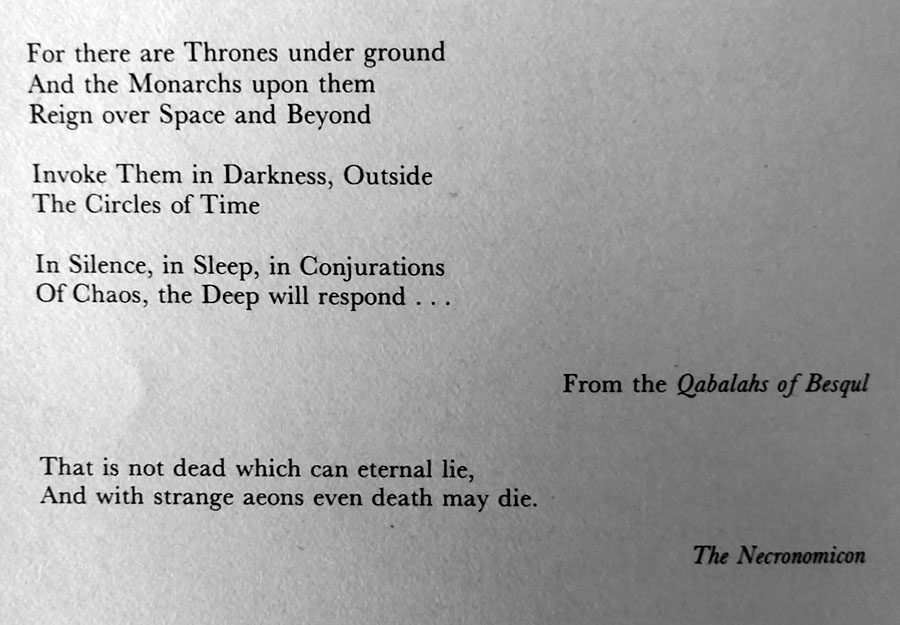
Epigraph from Outside the Circles of Time by Kenneth Grant.

The weird fiction of HP Lovecraft was a Coil obsession, and Lovecraft receives the most attention in a great piece by Andy Sharp which takes its cue from the appearance in Titan Arch of lines from the epigraph for Outside the Circles of Time, an occult study by magus and scholar Kenneth Grant. The latter was another Lovecraft obsessive—no doubt one of the first, given his age—whose books are littered with references to both Lovecraft and Machen. I spotted the Coil/Grant connection many years ago (although quite some time after Love’s Secret Domain was released), and acknowledged the link in two pages in The Haunter of the Dark, one of which reprints Grant’s epigraph, while the other is a picture with the title In Spaces Between, a line from Titan Arch which is also a reference to the Necronomicon extract in The Dunwich Horror: “The Old Ones were, the Old Ones are, and the Old Ones shall be. Not in the spaces we know, but between them, they walk serene and primal, undimensioned and to us unseen.” Sharp does more than merely acknowledge this web of connections, he delves into Grant’s dense treatise in search of further correspondences. I’ve not read Grant’s book for many years but this essay makes me think I ought to look at it again. By coincidence (or is it? etc), both Love’s Secret Domain and Outside the Circles of Time have been reissued this year, the Grant book by Starfire Publishing.

Contents:
The Vision and the Voice: Esoteric Dimensions of Coil’s Vocals by Hayes Hampton
A Hauntology of Coil by Sean Oscar
Are You Loathsome Tonight?: Coil’s Transformations by Benjamin Noys
The Horseman Betrays His Steed by Cormac Pentecost
The Spaces Between: Outside the Circles of Time and Love’s Secret Domain by Andy Sharp
Jhonn is Unbalanced by Val Denham

Previously on { feuilleton }
Dreaming Out of Space: Kenneth Grant on HP Lovecraft
Peter Christopherson Photography & The Art of John Balance Collected
The White People by Arthur Machen
Val Denham album covers
Kenneth Grant, 1924–2011
Peter Christopherson, 1955–2010
The Angelic Conversation

Weekend links 579

kresek.jpg

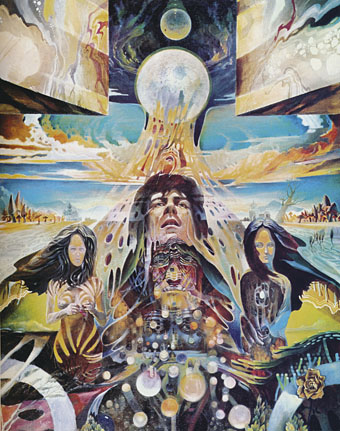
Untitled painting by Larry Kresek.

• “A good comparison might be Broken English-era Marianne Faithfull, Appalachian folk singer Hedy West, or the early-70s home recordings of German actress Sibylle Baier; spellbound female voices possessed of an uncanny emotional honesty.” Andrew Male on the songs of Karen Black. In 1989, the first issue of Psychotronic Video profiled Black’s remarkable acting career which was cultish enough for the magazine to give her the “psychotronic” label.

• Coming soon from Strange Attractor Press, In A Sound World by Victor Segalen, “a work of fantasy concerning an inventor lost in his own immersive harmonic space”.

• At Messynessychic: Inside the Imaginarium of a Solarpunk Architect, or architectural designs by Luc Schuiten, brother of comic artist and illustrator François Schuiten.

De Strijd der Werelden, 1899. The first illustrated book version of HG Wells’ The War of the Worlds was a Dutch edition with drawings by JH Speenhoff.

• New/old music: Words Disobey Me (Dennis Bovell Dub Version) by The Pop Group, part of a forthcoming Bovell remix of the group’s debut album, Y.

• Mixes of the week: A mix for The Wire by Sunik Kim, FACT Mix 817 by Malibu, and Rhythmic Asymmetrical Wyrd by The Ephemeral Man.

• “Whatever we call them, and whatever else they might be, they are, in fact, printed paintings.” Joseph Visconi on William Blake’s monoprints.

• Curious Music announces Moebius Strips, an audio installation by Tim Story from the sounds and music of Dieter Moebius.

• At Dangerous Minds: Richard Metzger‘s confessions of an analogue vinyl snob.

Strange Flowers departs from tradition by offering a summer reading list.

Moebius 256 (1977) by Zanov | Moebius (1981) by Cyrille Verdeaux | Elena’s Sound-World (2014) by Sinoia Caves

Ravi Shankar’s metempsychosis

ravi.jpg

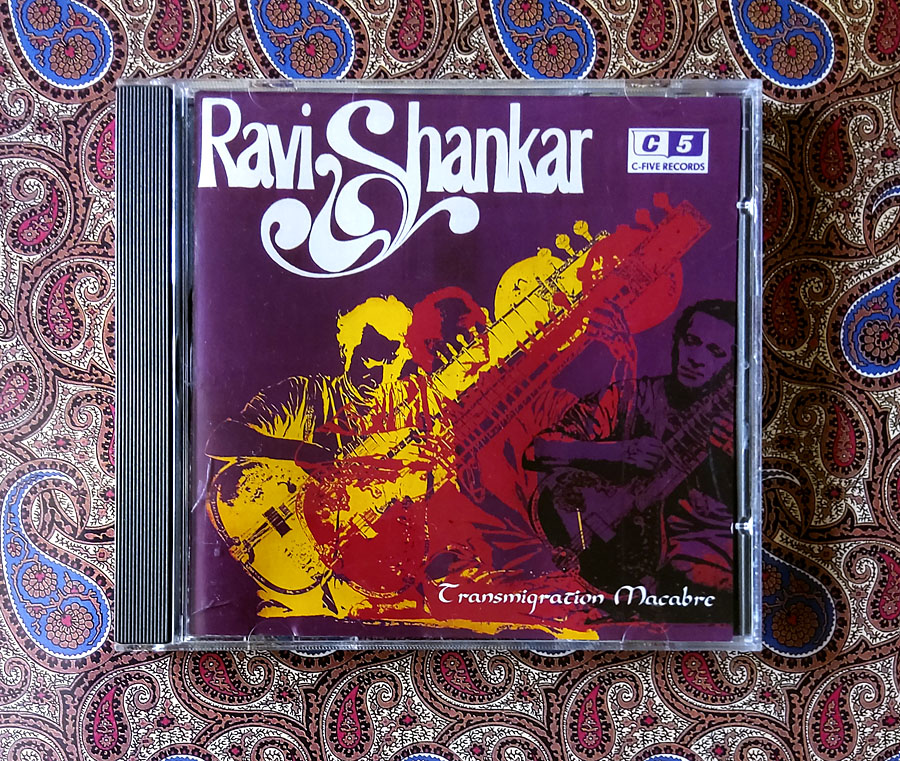
Transmigration Macabre is the curious title of a disc by Ravi Shankar that turned up in one of the local charity shops this week. The album is the score for a short British film, Viola, made in 1967 when Indian music was enjoying its fleeting novelty status in the West. Prior to this, Shankar had provided music for Jonathan Miller’s TV film of Alice in Wonderland, Conrad Rooks’ Chappaqua, and an obscure independent feature, The Psychedelics. Transmigration Macabre wasn’t released until 1973, however, when the sitar fad had long since expired, but it does does work well as an album in itself, albeit a short, monophonic one. I wrote something about the album in 2008 after it provided the key to a minor musical mystery. At the time I only had a collection of mp3s so it’s good to find a cheap disc of the music.

davis.jpg

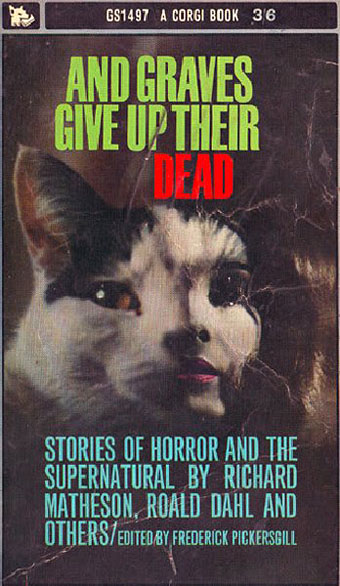
The most notable feature of the score, also the feature that solved my musical mystery, is the appearance on several tracks of the Cristal baschet, a unique instrument made of glass rods and metal cones created by Bernard and François Baschet, and played by Structures Sonores (aka Structures Sonores Lasry Baschet), the group the Baschet brothers formed with Yvonne and Jacques Lasry. The combination of the Cristal’s weird timbres with Ravi Shankar’s sitar playing works so well I wish the ensemble had recorded more together. The presence of the Cristal also makes Viola one of the few films that features the instrument at all, something I find surprising given the otherworldliness of the Cristal sound. Viola is a supernatural story directed by Dunstan Pereira in which “a man believes that his dead wife has returned in the form of a cat to haunt him”, hence the need for uncanny sounds. The film is described as being comprised of still photos, a common technique for low-budget shorts. Producer Richard Davis adapted his own short story, The Female of the Species, which was first published in And Graves Give Up Their Dead in 1964, a book that also appears to illustrate his story on its cover. The BFI has a copy of the film that’s free to watch but it wouldn’t play for me so I’ll just have to imagine the visuals while listening to the music.

Previously on { feuilleton }
Alice in Wonderland by Jonathan Miller
Cristalophonics: searching for the Cocteau sound