Weekend links 412

maroto.jpg

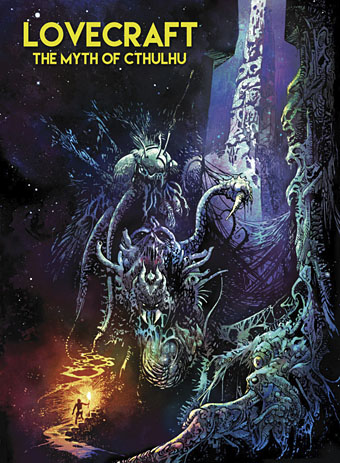
Lovecraft: The Myth of Cthulhu, an English-language edition of three comic-strip adaptations by Esteban Maroto, is now available from IDW.

The Coffin House, a short story by Robert Aickman that’s a taster for the new Aickman collection, Compulsory Games. Anwen Crawford wrote an introduction to Aickman’s world of “strange stories” for The New Yorker. Related: Victoria Nelson, editor of the new collection, chooses ten favourite horror stories.

• German music this week at The Quietus: Sean Kitching talks to Irmin Schmidt about his years with Can; and there’s an extract from Force Majeure, an autobiography by the late Edgar Froese, writing about the early days of Tangerine Dream.

• More German music at Carhartt WIP: a lengthy and revealing interview with guitarist Michael Rother about his time as one half of Neu!. There’s also a bonus Neu!-themed mix (and one of the mixes of the week) by Daniel Miller.

• From October last year, a Stereoklang interview with master synthesist Hideki Matsutake (Logic System, Yellow Magic Orchestra, et al).

• “When did you first get interested in esoteric studies?” Gary Lachman interviewed at The Astral Institute.

• At Sweet Jane: early illustrations by Wojtek Siudmak for Plexus magazine, 1969.

• 87 prints and drawings by MC Escher in zoomable high-resolution.

• Meet the Small Press: James Conway of Rixdorf Editions.

• Mix of the week: Goodbyes & Beginnings by Zach Cowie.

Derek Jarman on the trouble with shopping for clothes.

Person To Person (1981) by Logic System | Plan (1981) by Logic System | Prophet (1981) by Logic System
The Thing on the Doorstep

thing1.jpg

Workwise, this year has been a major one for interior illustration. So far I’ve completed about 80 illustrations for different titles, and I’m still not finished. The majority of the work has been for a Spanish publisher, Editorial Alma, based in Barcelona. Earlier this year they launched a line of reprints of classic works of fiction, each of which is illustrated. To date I’ve worked on three of the titles, the first of which, Narraciones extraordinarias by Edgar Allan Poe, will feature in a later post.

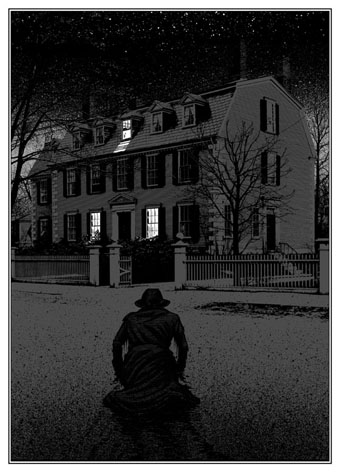
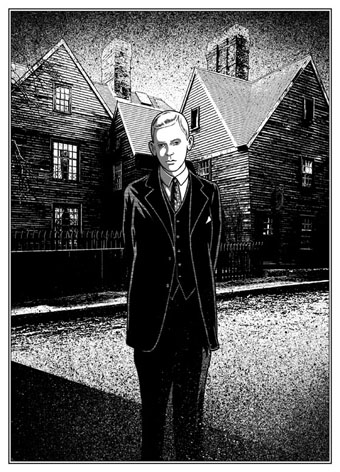
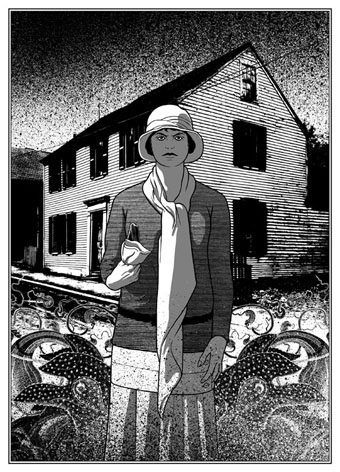
The second title, La llamada de Cthulhu by HP Lovecraft, is a small collection comprising the rather odd pairing of The Call of Cthulhu with The Thing on the Doorstep, two very different stories that you wouldn’t usually expect to see together. I provided six illustrations, three for Cthulhu which are slightly reworked pages from my comic-strip adaptation of the story, and three new ones for The Thing on the Doorstep. This is a story I’d never considered illustrating before when so much of its horror is psychological. It does, however, feature two characters who (by Lovecraft’s standards) are well-defined: the ineffectual Edward Pickman Derby and his sinister future wife, Asenath Waite. So that’s what you see here: portraits of the two main characters plus a view of the climactic scene that gives the story its title. Ideally, I would have liked to have done a fourth picture showing Derby’s surprise awakening at a nightmarish ritual but the deadlines on these books have been tight and there simply wasn’t time.

thing2.jpg

For those interested in this title, the only purchase link I have is an Amazon one. All the books are hardbacks (without dustjackets) complete with decorated endpapers—I provided a tentacle pattern for this one—and a bookmark ribbon. Deadlines aside, it’s been a very pleasant experience working for Alma. The next two books are the big ones so watch this space.

thing3.jpg

Elsewhere on { feuilleton }
The Lovecraft archive

Weekend links 387

liquidsky.jpg

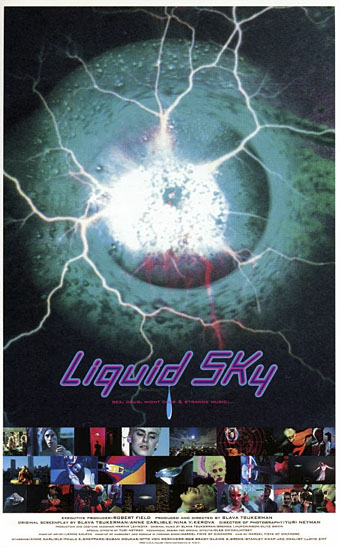
Japanese (?) poster for Liquid Sky (1982).

• The announcement this week of the death of Carl T. Ford, former editor of Dagon magazine, prompted a handful of memorial pieces. Dagon was notable for being a small British magazine devoted to Lovecraftian and other weird fiction (and the Call of Cthulhu games) at a time when the majority of such publications were American; it was also very well-produced, its later issues being typeset and filled with quality black-and-white illustration. Dagon interviewed many notable writers, including people such as Thomas Ligotti whose work at the time was still only known to a small group of enthusiasts. Mark Valentine posted a reminiscence at Wormwoodiana; Yog-Sothoth.com has an interview with Carl from 2010.

Michael “Dik Mik” Davies, manipulator of an audio generator and tape echo for Hawkwind, also died this week. Dik Mik’s primitive background electronics, augmented by Del Dettmar’s synthesizers, were an essential component of the early Hawkwind sound.

• Erik Davis talks to writer, photographer, and curator Joanna Ebenstein about Goth obsessions, memento mori, Santa Muerta, and her extraordinary new illustrated collection Death: A Graveside Companion.

• Slava Tsukerman’s cult film Liquid Sky (1982) finally gets a blu-ray release. From 2014: Punks, UFOs, and Heroin: Daniel Genis on how Liquid Sky became a cult movie.

Geeta Dayal explores the MOMA exhibition Thinking Machines: Art and Design in the Computer Age: 1959–1989.

You Should Come With Me Now is a collection of new fiction by M. John Harrison published this week.

VinylHub: “Our mission is to document every physical record shop and record event on the planet.”

Vladimir Nabokov‘s dream diary reveals experiments with “backwards timeflow”.

• Flawed Greatness: DB Jones on beauty and balance in John Ford’s The Searchers.

Irakli Kiziria on 9 synth artists who defined Eastern Europe’s post-Soviet sound.

• Edgar Allan Poe’s Hatchet Jobs: Mark Athitakis on Poe’s book reviews.

• Mix of the week: FACT mix 627 by Oneohtrix Point Never.

• At Creative Review: The design of Mute Records.

How generative music works.

Laraaji‘s favourite albums.

We Do It (1970) by Hawkwind | Adjust Me (1971) by Hawkwind | Electronic No. 1 (1973) by Hawkwind

Weekend links 366

kashiki.jpg

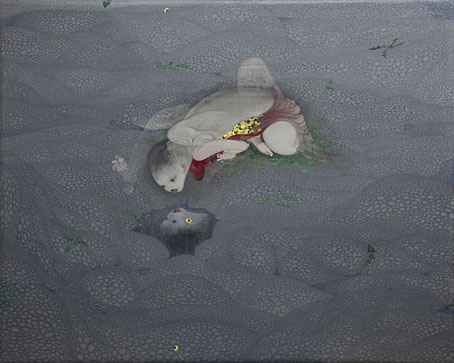
Dandelion (2009) by Tomoko Kashiki.

• “Standard Ebooks takes ebooks from sources like Project Gutenberg, formats and typesets them using a carefully designed and professional-grade style guide, lightly modernizes them, fully proofreads and corrects them, and then builds them to take advantage of state-of-the-art ereader and browser technology.”

Obscenity and the Arts, a previously unpublished essay by Anthony Burgess, will appear in book form later this year via Pariah Press.

• Mixes of the week: VF Mix 97: Talk Talk by The Last Dinosaur, and Secret Thirteen Mix 225 by Janek Schaefer.

Rub any two writers together and similarities will show. No two writers, however different, are completely different. Here’s a crucial instance: Lovecraft and Ballard both put architecture at the heart of their fiction, even though neither had the slightest formal training in the subject. And it is via this interest that the two intersect in an unexpected way. They are connected, through time and space, by that most humble of architectural events: the corner, the junction between two walls. What Lovecraft and Ballard did was to make the corner into a place of nightmares — and in doing so, they reveal its secret history.

Will Wiles in a long and rewarding essay, The Corner of Lovecraft and Ballard

• Dungeons Deep, Forests Dark – A beginner’s guide to Dungeon Synth by Daniel Pietersen.

Alex Ross on Joséphin Péladan, the Symbolists and the occult roots of Modernism.

• Cooling the Tube: engineering heat out of the [London] Underground by IanVisits.

Caroline on the mysteries of Pye Corner: Flames, poltergeists and bodysnatchers.

• The Saint of Sin City – Tony Kail Visits Las Vegas’ Santuario de la Santa Muerte.

• Photographs of Art Nouveau architecture by Keiichi Tahara.

• A stream of the new Porter Ricks album, Anguilla Electrica.

Jasper Sharp on 100 years of Japanese animation.

• At Dennis Cooper’s: 197 clocks.

On The Corner [Take 4] (1972) by Miles Davis | Corner Crew Dub (1976) by Augustus Pablo | Empty Avenues And Dark Corners (Pye Corner Audio Mix) (2013) by John Foxx and the Belbury Circle

Weekend links 351

burgkmair.jpg

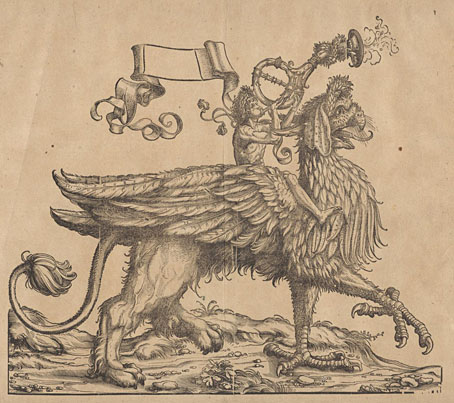
Herald on Griffin (1516-1518) from The Triumphal Procession of Emperor Maximilian I series by Hans Burgkmair the Elder.

• My design and illustration work for Pirate Utopia by Bruce Sterling continues to gain favourable comments, a novelty when reviewers often pass over the visual component of the books under their consideration. One of the most recent examples is in the latest edition of Locus Magazine; this can only be read in full by subscribers but the Tachyon Tumblr has an extract.

Paul La Farge on the complicated friendship of HP Lovecraft and Robert Barlow. Related: The Night Ocean, a short story by Barlow & Lovecraft. Meanwhile, Lovecraft enthusiasts are still raising money for a Providence statue (spot my art and design work in the photo of the Lovecraft Art and Sciences Council).

• At The Quietus this week: Children Of Alice talk to Patrick Clarke about audio collage and English Surrealism, Lottie Brazier enters The Strange World of Annette Peacock, and Manuel Göttsching tells Robert Barry how Ash Ra Tempel became the loudest band in Berlin.

• “Mind the doors!” Eight reviewers pick ten films featuring the London Underground. Not a bad list but choosing a Doctor Who film while ignoring the great Quatermass and the Pit (1967) is an error.

• Mixes of the week: Swedenborgian Hobos by acephale, Secret Thirteen Mix 214 by Fabio Perletta, and a mix for NTS by Six Organs Of Admittance.

• More Surrealism: Leonor Fini, Surrealist Sorceress, a lecture by Dr Sabina Stent, will take place at Treadwell’s Bookshop, London, on 19th May.

• “Michael Chapman’s road-weary guitar resonates with a new generation,” says Joel Rose.

A Journey Round my Room (1794), a book by Xavier de Maistre.

Lyrical Nitrate (1991), a film by Peter Delpeut.

The Sorcerer (1967) by Miles Davis | Impressions Of Sorcerer (1977) by Tangerine Dream | Venom Sorcerer (2014) by Cultural Apparati