Rebel Ready-Made

duchamp1.jpg

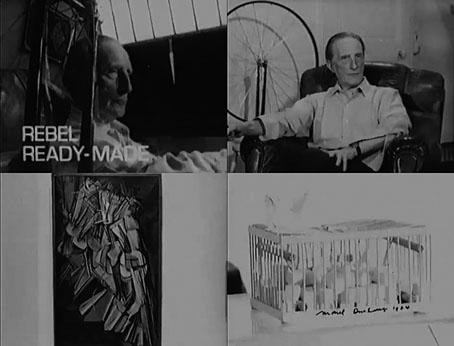
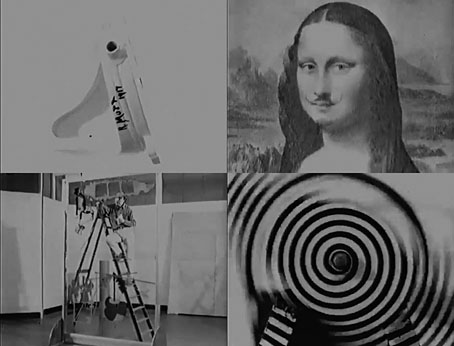
I think I spotted across this one while searching for more Robert Hughes, in which case I offer grudging thanks to the algorithms of the Great Panopticon. If you’ve ever seen Marcel Duchamp talking about his work in an arts documentary then it’s probable that the clip will have been taken from this film. (The Shock of the New is no exception.) Rebel Ready-Made was directed by Tristram Powell for a short-lived BBC arts series, New Release, and broadcast in June 1966 to coincide with a major Duchamp retrospective at the Tate Gallery, London. It’s fascinating for number of reasons, mostly the way that Duchamp is happy to talk about his sporadic art career, an occupation that in its mature phase consisted of spasms of invention followed by increasing boredom and a wandering off to do something else. The ease with which he did all this—the inventions which in other hands would have fuelled entire careers, and then the eventual abandonment of the whole art game—always made a sly mockery of the self-importance that sustained the art world in the 20th century.

duchamp2.jpg

Elsewhere in the film you get praise for Duchamp from Robert Rauschenberg and John Cage, plus the artist’s friend Richard Hamilton, seen briefly painting the replica of The Large Glass that appeared in the Tate exhibition as a substitute for the fragile original. This has been my favourite of Duchamp’s works since I saw the replica in the Tate a decade later. Having a duplicate stand in for the original isn’t such an unusual thing for Duchamp when most of his ready-made sculptures are also copies, the “originals” having been lost or destroyed shortly after their first exhibitions. From the 1930s on, Duchamp had also been making multiple copies of all his works in miniature for the various iterations of the Boîte-en-valise, or portable museum.

Tristram Powell was lucky to capture the artist being so talkative at such a late date. Two years after this Duchamp was dead, although there was one last surprise in store. Jasper Johns referred to Étant donné as “the strangest work of art in any museum”. Duchamp never acknowledged the existence of this life-size peepshow while he was alive, preferring it to be announced to the public only after his death, which is what happened in 1969. There are no replicas of this one; if you want to see it (or the parts of it the artist allows you to see) you have to go to Philadelphia and peer through the holes in the door.

Previously on { feuilleton }
Televisual art
Chance encounters on the dissecting table
The Witch’s Cradle by Maya Deren
Audio Arts
8 x 8: A Chess Sonata in 8 Movements
Anémic Cinéma
Dreams That Money Can Buy
Entr’acte by René Clair
View: The Modern Magazine

Weekend links 616

finlay.jpg

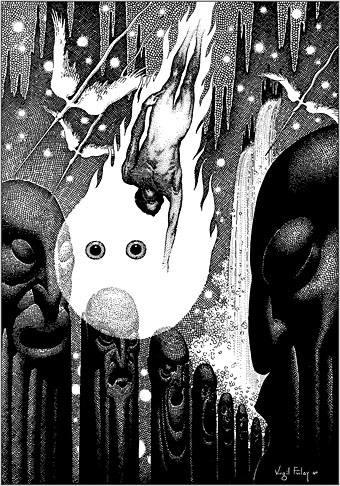
Illustration by Virgil Finlay for The Face in the Abyss by A. Merritt; Famous Fantastic Mysteries, October 1940.

• “The pier was completely outside of the gallery system, which David loved of course. People were just working on the walls, nothing was for sale, nothing could really be bought, although people were coming in and trying to chip things off the walls.” Cynthia Carr on the love letters and legacy of David Wojnarowicz.

• “In pursuit of Pure Form, the Polish artist known as “Witkacy” would consume peyote, cocaine, and other intoxicants before creating pastel portraits.” Juliette Bretan on the artful intoxications of Stanisław Ignacy Witkiewicz.

• Kino Kyiv: Christopher Silvester compiles a list of notable Ukrainian films. I’ve not seen all of these but Shadows of Our Forgotten Ancestors is a great favourite.

Onscreen for nearly the entire runtime, [Laura Dern] pulls off the remarkable feat of being in total control of a scenario organized by undermining her identity, obliterating her characterization, and so scrambling the distinction between Nikki and Susan that one eventually comes to view Inland Empire not as a maze to exit, a puzzle to solve, an ouroboros to gawk at, but rather as both a generalized treatise on the enigma of acting and a very specific, exquisitely perverse mash note to one of Lynch’s most formidable collaborators.

Nathan Lee on Laura Dern, David Lynch and Inland Empire. I’ve always thought Dern’s exceptional performance might have been recognised more widely if Lynch hadn’t filmed most of it on low-grade video.

• New music: Golden Air by Sun’s Signature, a new project from Elizabeth Fraser and Damon Reece.

• Miranda Remington explores The Strange World of…Stomu Yamash’ta.

• Steven Heller’s font of the month is Boucan.

• At Dennis Cooper’s: Labyrinthine.

Labyrinth (2010) by Chrome Hoof | Labyrinths (2018) by Jonathan Fitoussi / Clemens Hourrière | The Seventh Labyrinth (2019) by Pye Corner Audio

Televisual art

sotn1.jpg

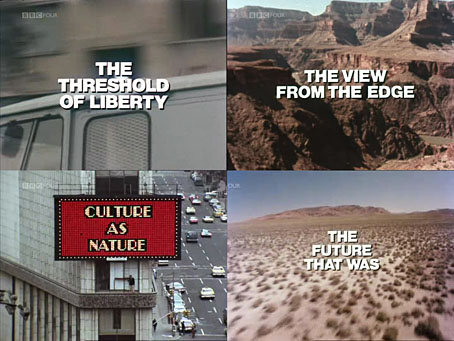
A few words of praise for The Shock of the New, Robert Hughes’ eight-part TV series about art in the 20th century. Not that it’s ever been lacking in praise—it was lauded from the outset back in 1980—but, having read the book of the series twice, then dipped back into it on regular occasions, it occurred to me recently that I’d not seen the series itself for a very long time.

If you don’t know—and is anyone today really unaware of this?—Hughes was commissioned by the BBC and his employers at TIME magazine to travel the world presenting a history of modern art from the 1880s to the end of the 1970s. The series was part of a run of costly co-productions that flattered viewers with colour television sets (still a luxury item in the UK) while engaging the intellect; Kenneth Clarke’s Civilisation, Jacob Bronowski’s The Ascent of Man and David Attenborough’s Life on Earth established the template that Hughes was required to follow. If you have the time and the money, the globetrotting is the easy part of an enterprise such as this. Much more difficult is making sense of the increasingly fragmented development of art in a century of two world wars and rapid technological change. Hughes did this by selecting a single route of evolution for each episode, often missing out significant artists or entire movements, then winding back the clock in the following episode to trace a different route that included the neglected names. Some of them, anyway. In the introduction to the book he admits the difficulty of trying to summarise a century of complex aesthetic activity and philosophy in a mere eight hours. The book is inevitably much more thorough, making the TV series seem like a sketch beside it; but there are good sketches and bad ones, and this one is exceptional.

sotn2.jpg

Hughes had an enviable talent for lucid explanation, an ability to tell you what was important about an artist or an idiom or an artistic development in a few simple, memorable sentences, free of jargon or the obfuscation that bedevils art criticism. This is best seen in his collected reviews from TIME magazine, Nothing if Not Critical (1991), which offers bite-sized appraisals of individual artists or group shows, from the Renaissance to the present day. Difficult to do well when you’re limited to a few hundred words, near impossible when you have to explain something using a minimum of words while simultaneously talking to a camera and walking down a busy Paris street. Some of his statements, like the following one, have been lodged in my memory for years:

A Rodin in a parking lot is still a misplaced Rodin, but this in a parking lot is just bricks.

“This” being Carl Andre’s oblong of 120 firebricks, Equivalent VIII, a minimalist sculpture that caused a huff of outrage from the philistine British tabloids in the 1970s. Hughes’ comment occurs when he examines the way that galleries in the same decade became frames for creations such as Andre’s, works that wouldn’t be recognised as art without the building they were situated in.

sotn3.jpg

The explication is very familiar but I’d forgotten about all the foreign travel. This seems profligate at times although it’s only the same as David Attenborough flying to a remote jungle to film a lemur or a lizard. Paintings and sculptures seen in their natural habitats, as it were, together with the locations that inspired them: van Gogh’s Arles, Matisse’s Côte d’Azur, de Chirico’s Turin, and so on. One of the axioms of Hughes’ criticism, repeated here as elsewhere, was that art has to be studied in situ, not appraised via mediated representations, whether that means halftone dots in a book, 16mm film delivered by cathode ray tube, or a gallery website. It’s an attitude I sympathise with even though I don’t visit galleries very often. Sculptures have a physical presence that doesn’t reproduce at all, while paintings are more subtle or more dramatic or more detailed or more dimensioned when you’re standing in front of them. Piranesi’s prints are big; William Blake’s paintings are very small; Max Ernst’s engraving collages are not only smaller than you expect but they’re also toned by age; Picasso’s canvases reveal the direction his brush was travelling when he painted a line in a single stroke…

sotn4.jpg

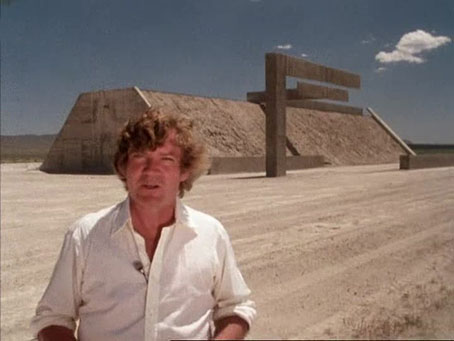
Hughes and Complex One, an artwork that few people are allowed to visit.

Something else I’d forgotten about was the artist interviews in the later programmes, especially those with land artists Michael Heizer and Walter De Maria. The final episode in the series examines the collapse of the idea of the avant-garde, with land art being presented as work that can’t be bought by wealthy collectors or appropriated by mass media. Hughes treks into the Nevada desert to see Heizer’s Complex One which at the time was all that existed of the massive site known today as City; Walter De Maria is seen walking through The Lightning Field in New Mexico accompanied by synthesizer chords from Jean-Michel Jarre’s Equinoxe. Electronic music abounds in this series, from Peter Howell’s clanging Radiophonic theme, to extracts from albums by Tangerine Dream and Brian Eno, Music For Films being a popular choice with TV producers at the time. It’s notable that the phrase “the shock of the new” only occurs once, near the very end, possibly as a capitulation to the BBC who Hughes says chose the title for him. In a later book, Things I Didn’t Know: A Memoir (2006), you’ll find another of those memorable statements:

Some new works of art have values of some kind or another. Others, the majority, have little or none. But newness as such, in art, is never a value.

I’m following this with a re-viewing of Hughes’ multi-part American Visions (1996), a history of American culture that I’ve not seen since its first broadcast. The Shock of the New is all over YouTube if you require it, also at the Internet Archive. The series took three years to create and was broadcast at 8:00pm on Sunday evenings to an audience of millions. They really don’t make them like this any more.

Previously on { feuilleton }
Robert Hughes, 1938–2012
Land art

Weekend links 611

ltpf.jpg

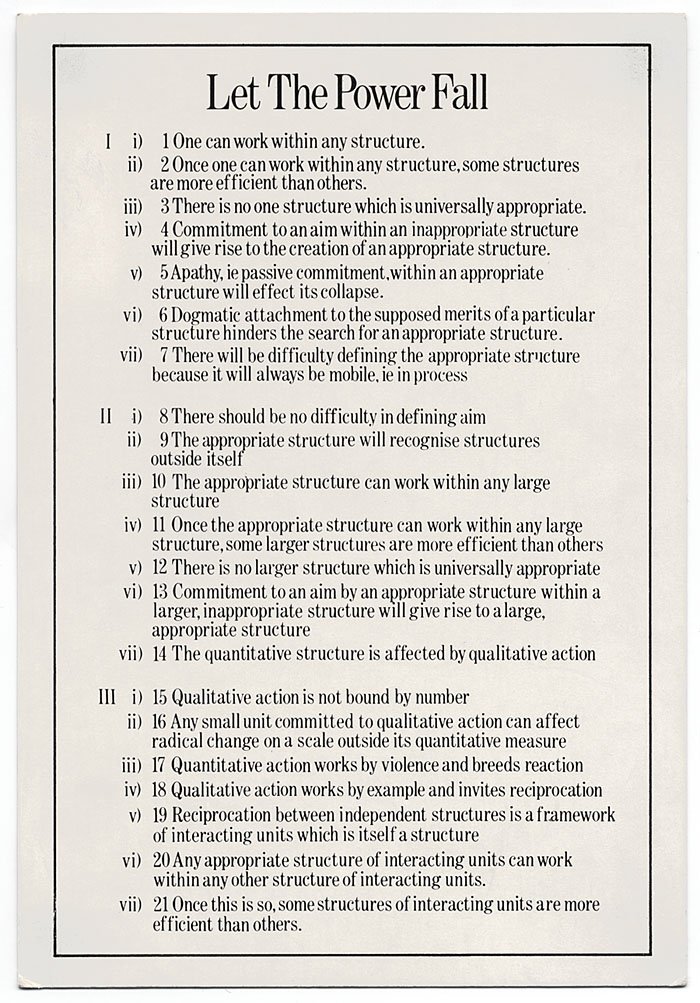
Let The Power Fall (1981) by Robert Fripp. A postcard included with the original vinyl release of the Let The Power Fall album.

Exposures 1977–1983 is the title of another wallet-busting CD/DVD/blu-ray box which will be released by DGM at the end of May. Unlike the previous King Crimson sets this one will be devoted to Robert Fripp’s first run of solo releases, covering the albums that emerged from the artistic campaign he described at the time as “The Drive to 1981”: Exposure (1979), God Save The Queen/Under Heavy Manners (1980), The League Of Gentlemen (1981), and Let The Power Fall (1981). If you’re as interested as I am in this period of Fripp’s career then this is all very exciting. Exposure has been reissued several times over the years, and exists in three different “editions” featuring alternate mixes and song variations, but the other albums have been unavailable in any form for decades, possibly as a result of the turmoil caused by the mismanagement and eventual collapse of the EG label. In addition to the reissues the box will include live recordings, a League Of Gentlemen Peel session plus a substantial quantity of Frippertronics material, including the loops that were recorded for Eno & Byrne’s My Life In The Bush Of Ghosts. Fripp retained a credit for his contribution to Regiment but the results are so far down in the mix that they’re easy to miss. Related: The Drive to 1981: Robert Fripp’s Art-Rock Classic Exposure.

• Galerie Georges-Philippe & Nathalie Valloisin, Paris, is currently creeping out visitors to Strange Aeons—We will meet you there, an exhibition by Peybak (Peyman Barabadi and Babak Alebrahim Dehkordi) that borrows its title from HP Lovecraft and includes a number of creatures, “neither embryos nor chimeras”, which may be found prostrate and breathing on the gallery floor.

• New music: Sub Zero, in which Kevin Richard Martin returns to the subterranean/subaqueous/subarctic zones he charted on his Isolationism and Driftworks compilations in the 1990s; plus The Carrier by Large Plants, an album of “psych rock belters” coming soon on the Ghost Box label.

• Science fiction as revolution: Joe Banks talks to Iain McIntyre, co-editor of Dangerous Visions and New Worlds—Radical Science Fiction, 1950–1985, about the flourishing of the New Wave of SF in the 1960s and 70s.

• “We know from his letters that Joyce sent a Greek flag to Nutting for him to colour-match. So, he was aiming for ‘Greek’ blue.” It’s that book again. Cleo Hanaway-Oakley on Ulysses, blindness and blue.

• Intermittent Eyeball Fodder: More visual delights gathered by S. Elizabeth.

• Steven Heller’s font of the month is Nicholas.

• Galerie Dennis Cooper presents…Liz Larner.

Let The Power Fall (1971) by Max Romeo | Minor Man (1981) by The League Of Gentlemen ft. Danielle Dax | Heptaparapashinokh (1981) by The League Of Gentlemen

Weekend links 609

tv1.jpg

Cover of Tom Veitch Magazine #1 (1970).

• RIP Tom Veitch, a writer with whom I almost created a comic-book series in the 1990s. Things didn’t work out for a variety of reasons but we had some good conversations. All the news notices focus on his writing for comics, a career which ranged from angry, political strips with Greg Irons to typical franchise fare. But he had short stories published in New Worlds magazine when it was at its peak under Michael Moorcock’s editorship, and in Quark, a short-lived paperback magazine edited by Samuel Delany & Marilyn Hacker. Veitch was also among the first 35 contributors to John Giorno’s Dial-a-Poem service when it launched in 1968, part of a select group that included John Ashbery, William Burroughs and Allen Ginsberg. Related: An interview with Tom Veitch on William Burroughs at Reality Studio.

• “I won’t deny that I thought very much about a post punk influence on it. Everybody knows that I love post punk, but I didn’t want to copy anybody.” Robert Hampson talking to Jonathan Selzer about the return of Loop.

• “What Joyce and Eliot, Ulysses and The Waste Land, had in common was a showiness, an overt ambition as well as a magpie approach to literature as assemblage.” John Self on the year 1922, “literature’s year zero”.

• At Spoon & Tamago: All of Japan’s 47 prefectures captured in expressive typography.

• At Public Domain Review: Composition (1905) by Arthur Wesley Dow, a book for art students influenced by the example of Japanese prints.

• At Wormwoodiana: Mark Valentine on the unending attempts to solve The Mystery of Edwin Drood.

• Mixes of the week: Fact Mix 846 by Ehua, and Soylent Green – No Escape by The Ephemeral Man.

• At Dennis Cooper’s: Matthew Suss presents…Joseph Cornell Day.

• At Bandcamp: A guide to Alvin Lucier.

Loop The Loop (1980) by Young Marble Giants | Q-Loop (1995) by Basic Channel | Loop-Loop (1996) by Michael Rother