The art of Mark Reep

reep1.jpg

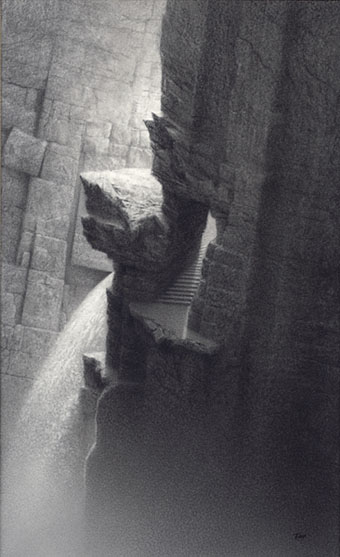
Crossing.

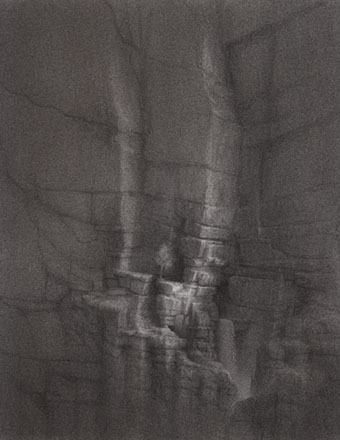
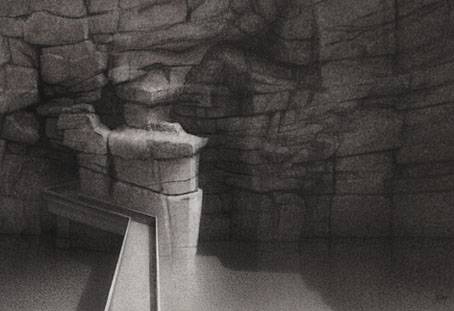
Artist Mark Reep sent me a link recently to his gallery of meticulous pencil and charcoal drawings which he calls “dreams in black and white”. The combination in many of these of isolated settings with minor architectural features is something I always enjoy seeing but don’t find often enough. Offhand I can think of Gérard Trignac‘s equally meticulous etchings, and Jean-Pierre Ugarte‘s paintings. Mark Reep has cards and prints of his drawings and photographs available for purchase at Bluecanvas and Redbubble.

reep2.jpg

Abandoned Waterworks.

reep3.jpg

Not All The Old Doors.

Previously on { feuilleton }
The art of Gérard Trignac

Weekend links 152

mackenzie.jpg

Light Moves on the Water (2010), a collage by Alexis Anne Mackenzie.

“[She] stated, emphatically and more than once, that pornography cannot and should not be linked to LGBT rights…When a gay man lives somewhere where his identity is threatened, it’s clear how sex – including pornography – and sexuality are intertwined. His sexual imagination, which is criminalized, matches the sexual images of gay pornography (which are also criminalized). Since acting out his imagination through sex would be to risk his life, the access to the images is safer. The images, created by gay men wherever it’s legal to create them, provide empowerment and diminish alienation.” An important piece by Conner Habib who asks “Why are we afraid to talk about gay porn?”

• Florida’s Parallel Universe: “The abandoned Nike Missile Site, surrounded by the Everglades, is a reminder of when humans almost destroyed the world and a warning that we could still lose everything today.” By Stefany Anne Golberg.

• In Search of Divine: A Retrospective by Katherine McLaughlin. Related: Jeffrey Schwarz, director of a new documentary, I Am Divine, talks about Divine’s career, and his film to Polari Magazine.

When Brendan Behan’s Borstal Boy was banned in 1958, it was said that a man in a pub asked him how much the book weighed, then offered to bring two thousand copies across the border instead of his usual smuggled butter. We might have called it the Black North, for being dark with Protestants, but when I was a child in the 1960s, Ulster was the place British sweets came from: Spangles, Buttons and, most notably, Opal Fruits. It was across this border that the feminists of “the condom train” staged a mass importation of illegal contraceptives in May 1971. When they arrived from Belfast into Connolly Station, the customs men “were mortified”, Mary Kenny, one of the participants, remembered, “and quickly conceded they could not arrest all of us, and let us through”.

Anne Enright on censorship in Ireland.

• Open Culture posts a copy of Nigel Finch’s 1988 Arena documentary about Robert Mapplethorpe.

The Fall of Communism Through Gay Pornography: A video by William E. Jones.

• Surrealism Made Fresh: Sanford Schwartz on the drawings of the Surrealists.

• Cult Classic: Defining Katherine Mansfield by Kirsten O’Regan.

Jonathan Barnbrook (again!) on David Bowie (again!).

Sydney Stanley illustrates Algernon Blackwood

20 Haunting Ghost Towns of the World

• At Pinterest: The Male Form

The Life Divine (1973) by Santana and McLaughlin | The Rhythm Divine (1987) by Yello feat. Shirley Bassey | Divine (2000) by Antony and the Johnsons
The art of Joanna Chrobak

chrobak1.jpg

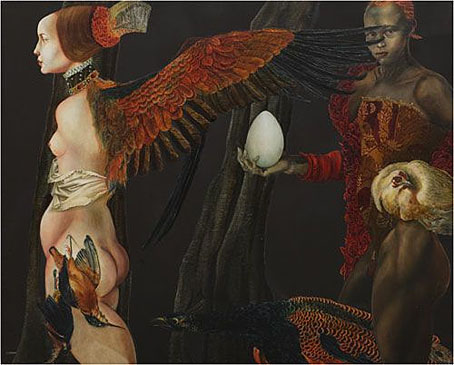
Pageant III (2005–2006).

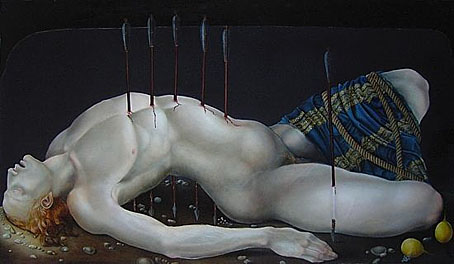
A Polish artist whose paintings have that combination of technical virtuosity and strange imagination I always like to see. She also explores traditional themes such as those below. Her website is in Polish but can be translated easily enough via Google.

chrobak2.jpg

Saint Sebastian (2007–2008).

chrobak3.jpg

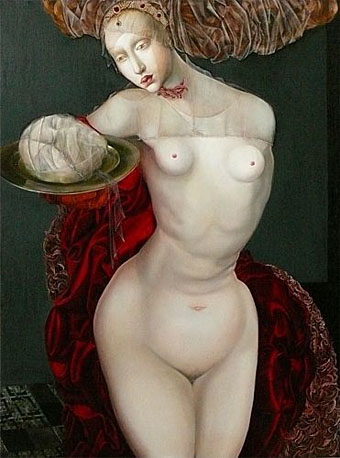
Salomé (2007–2008).

Elsewhere on { feuilleton }
The fantastic art archive
The Salomé archive

Weekend links 151

yongliang.jpg

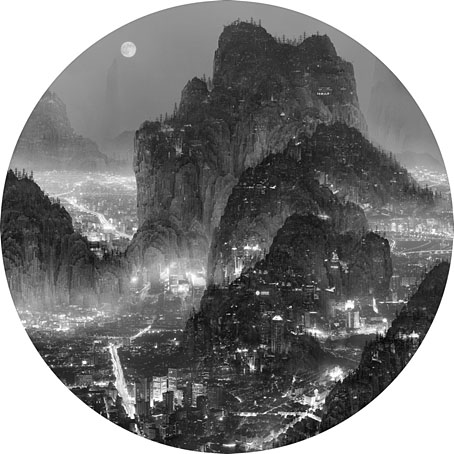
Untitled art by Yang Yongliang. There’s more at But Does It Float.

• “Newly unearthed ITV play could be first ever gay television drama“. Writer Gerald Savory, incidentally, also adapted Dracula for the BBC in 1977, still the version that’s closest to the novel.

Craig Redman and Karl Maier‘s poster designs for the Bavarian State Opera.

Lustmord: ambient’s dark star, and The Strange World of Scanner.

The cats are tapping the old man for psychic sap, milking him, stalking through rubbled dreams of the coming Land of the Dead. On subsequent US visits – to Bastrop in Texas and Phoenix, Arizona – I learned about the fellowship of those internal exiles, the hardcore writers: Michael Moorcock, Jim Sallis. Like Burroughs, they kept cats and guns (Mike’s was a replica). Cats infiltrate mystery fiction: men with coffee habits, ex-drinkers, post-traumatic spooks solving crimes the hard way. Moorcock uses cats like a scarf, like Peter Sellers in The Wrong Box; their claws scratch runes into his easy chair.

Iain Sinclair remembers visiting William Burroughs. I remember meeting those Moorcock moggies; not as interesting to reminisce about, however.

The Ghosts of Antarctica: Abandoned Stations and Huts.

• A Masterpiece of the Ridiculous by Jocelyn Brooke.

• “Chance is a good librarian,” says Alberto Manguel.

• Mix of the week: dub from Bristol duo Zhou.

The Aleph: Infinite Wonder / Infinite Pity.

Sarah Lee‘s underwater photography.

Arthur #34 is out!

Underwater (1979) by Harry Thumann | Underwater Church (1992) by Conrad Schnitzler | Underwater Flowers (2003) by John Foxx & Harold Budd

Brush of Baphomet by Kenneth Anger

anger2.jpg

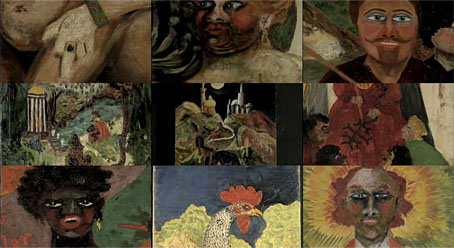
Another recent piece of Angeriana, and another short video sketch, Brush of Baphomet (2009) is a kind of addendum to Anger’s The Man We Want to Hang (2002), being a further look at Aleister Crowley’s paintings. The title refers to one of Crowley’s many occult names. As a painter Crowley’s technical ability was almost nil but that never dissuaded him from trying, and I’m sure I’m not alone in finding his work to have a naive malevolence. Anger has had a lifelong interest in Crowley’s paintings, famously journeying in 1955 to the abandoned villa in Cefalù, Sicily, where he cleaned whitewash from the walls to reveal the remains of the murals Crowley had painted there.

anger3.jpg

The music in Brush of Baphomet is a surprising choice, an extract from the second part of Morton Subotnick’s Silver Apples of the Moon (1967). Anger’s musical selections have never been random ones so you have to wonder why this particular score. Was it because the electronics are reminiscent of the Moog drones Mick Jagger supplied for Invocation of My Demon Brother (1969)? Subotnick’s title is borrowed from The Song of Wandering Aengus by WB Yeats, a poet for whom Crowley (also a poet) had little affection. In Crowley’s occult novel Moonchild, Yeats appears as “Gates”, a mediocre painter (yes, well…), who ends up being killed in an act of magical revenge. Crowley must have been mortified a few years later when Yeats was awarded a Nobel Prize.

Previously on { feuilleton }
Anger Sees Red
Kenneth Anger’s Hollywood Babylon
Lucifer Rising posters
Externsteine panoramas
Missoni by Kenneth Anger
Anger in London
Arabesque for Kenneth Anger by Marie Menken
Edmund Teske
Kenneth Anger on DVD again
Mouse Heaven by Kenneth Anger
The Man We Want to Hang by Kenneth Anger
Relighting the Magick Lantern
Kenneth Anger on DVD…finally