The Time Machine

ttm01.jpg

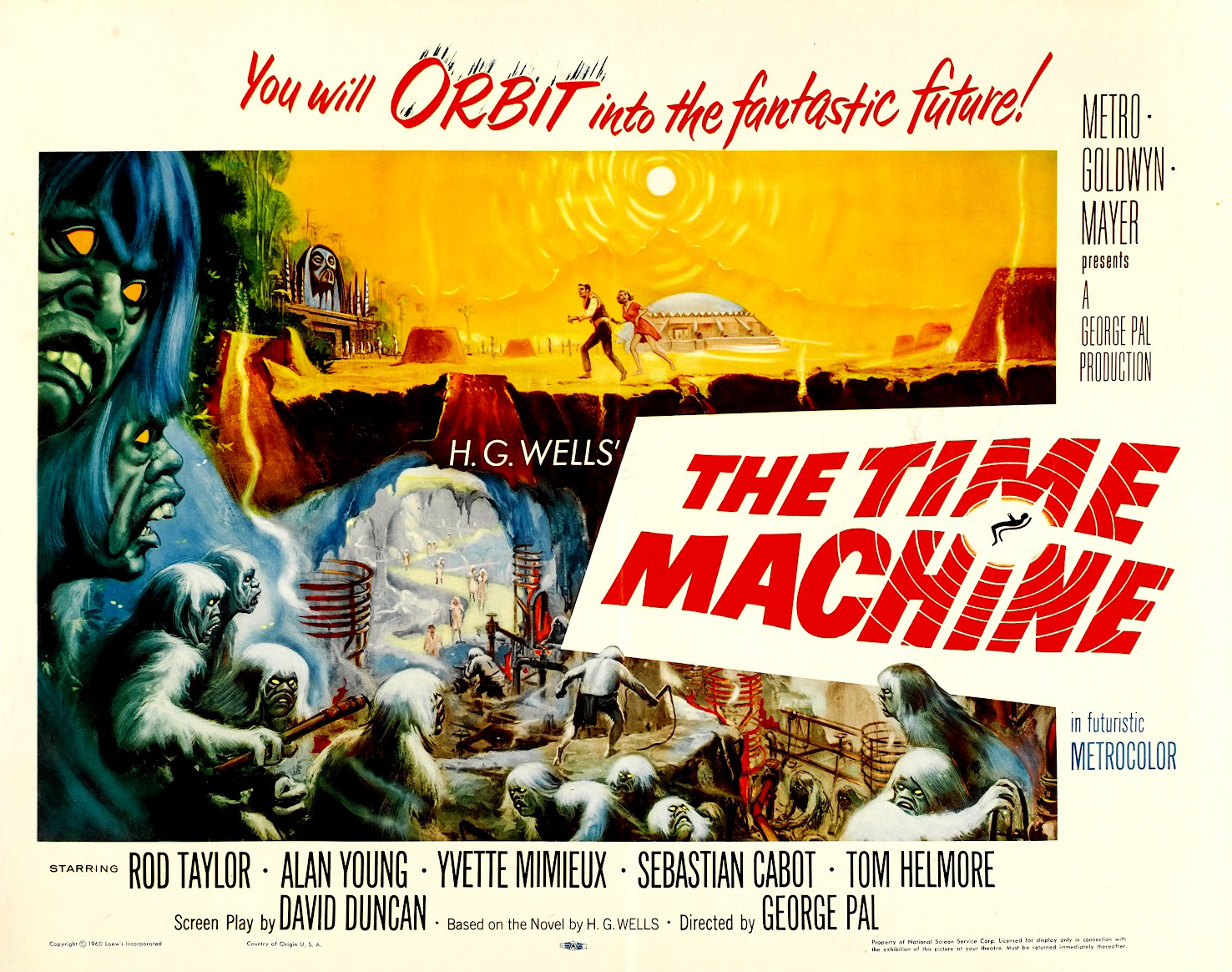
The Time Machine (1960).

The turning over of the calendar from one year to the next makes this day the ideal moment to write something about HG Wells’ celebrated story. Having re-read The Magic Shop before Christmas I decided to refresh my reading habit—lapsed these past months due to pressure of work—by revisiting more of Wells’ short stories, many of which I haven’t looked at for years.

As I said in that earlier post, it was The Time Machine that led me to Wells’ written work after being excited at an early age by George Pal’s 1960 film adaptation. Reading the story again I’m still astonished by how advanced it is compared to everything else being published in 1895. Michael Moorcock’s excellent introductory essay, The Time of ‘The Time Machine’ (1993), notes that time travel per se wasn’t a new idea for Victorian readers, there were many novels and stories using the theme, most of them merely displacing a character from one age to the next in a very simple manner. Wells’ innovation was the idea of a machine which would give the user mastery of Time itself. Moorcock also notes that Wells considered this to be his one great idea which he always felt he never exploited as fully as he wished. The need to make a living forced him to set down the story in some haste when it was accepted for serialisation in WE Henley’s New Review. (Moorcock’s introduction can be found in a recent collection London Peculiar and Other Nonfiction).
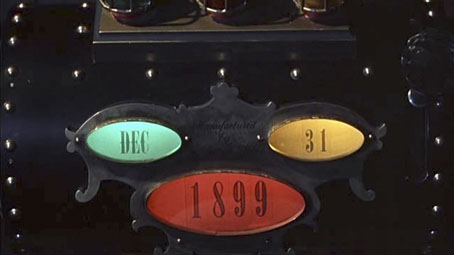
ttm11.jpg

The other notable feature this time round—and this means more to me than it would to many other readers—was being struck by the way Wells’ story prefigures so much of the fiction William Hope Hodgson would be writing a decade or so later. It’s a commonplace among Hodgson scholars that The Night Land (1912) owes something to the scenes when the Time Traveller journeys beyond the age of the Eloi and Morlocks to a period when the Earth is dead and the Sun has swollen to a baleful giant. Some of the more cosmic moments of The House on the Borderland (1908) can also be traced back to these scenes. I’d argue that the Time Traveller’s earlier battles with the Morlocks prefigure and possibly influence similar battles in The Night Land, and the attacks of the Swine-Things in Borderland. There’s even a moment near the end of Wells’ story when the Time Traveller is menaced by giant crustaceans like those which infest Hodgson’s Sargasso Sea. This may not be a fresh observation but it’s not one I’ve seen elaborated before.

Regular readers will know it’s a habit here to seek out illustrations of favourite stories. In the case of The Time Machine there are hundreds to choose from so the following selection barely scratches the surface. Something I’d not noticed before when looking at comic strip adaptations is that none of the works derived from Wells’ story (George Pal’s film included) seem able to countenance the Time Traveller’s abandoning of Weena to the Morlocks when the pair become trapped outdoors at night; all show the Time Traveller doing his best to rescue her. William Hope Hodgson’s fiction is filled with rescues, sieges and the defence of the weak against marauding and inhuman forces; The Night Land concerns an epic and apparently suicidal rescue mission across the most inhospitable terrain imaginable. It may be stretching a point but it’s possible to see much of Hodgson’s fiction as being a riposte to this incident in Wells’ story.
ttm02.jpg

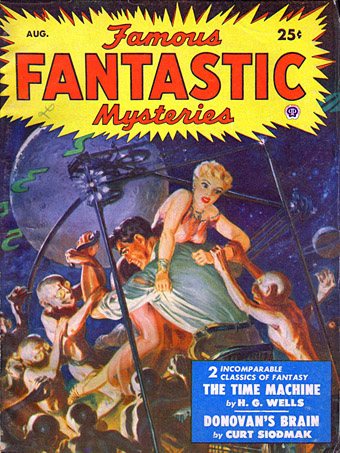
Illustration by George Saunders (August, 1950).

Recurrent points of interest in illustrations of Wells’ story are i) How is the Time Machine itself depicted? (The author’s descriptions are evasive), and ii) How are the Morlocks depicted? Wells describes them thus:

‘I turned with my heart in my mouth, and saw a queer little ape-like figure, its head held down in a peculiar manner, running across the sunlit space behind me. It blundered against a block of granite, staggered aside, and in a moment was hidden in a black shadow beneath another pile of ruined masonry.

‘My impression of it is, of course, imperfect; but I know it was a dull white, and had strange large greyish-red eyes; also that there was flaxen hair on its head and down its back. But, as I say, it went too fast for me to see distinctly. I cannot even say whether it ran on all-fours, or only with its forearms held very low.

George Saunders’ small Gollum-like creatures are closer to Wells’ conception than many later depictions. Saunders’ Weena, on the other hand, is far too tall for the equally diminutive Eloi.
ttm03.jpg

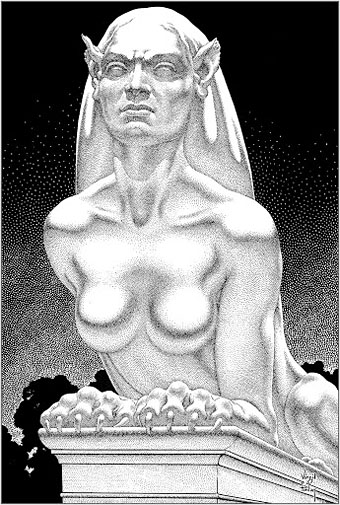
Virgil Finlay (1950).

This is still my favourite Time Machine illustration but then Finlay has a tendency to beat everyone when it comes to these assignments. His illustrations appeared inside the August, 1950 issue of Famous Fantastic Mysteries. Wells’ sphinx has wings which I imagine Finlay might have included if he wasn’t restricted by the space allowed for his illustration. He also provided the illustration of a Morlock below.

Continue reading “The Time Machine”

The weekend artists, 2012

barnes.jpg

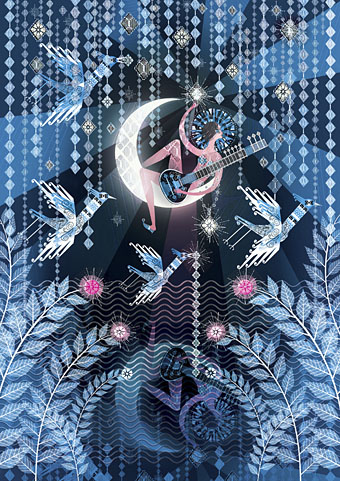
Lucy in the Sky with Diamonds (2012) by Lesley Barnes. She also has peacock wrapping paper.

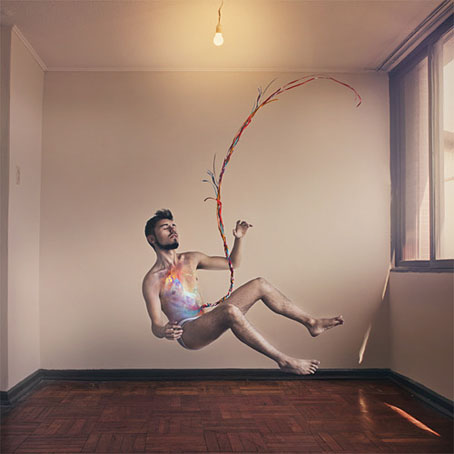
The most popular post of the year was one I made last December featuring all the artists whose work had appeared throughout 2011 in the weekend links posts. (The surge of views occurred early in January when it was linked on Stumbleupon.) Since I’ve been away this week there aren’t any links so here’s a retrospective of things that caught my eye in 2012.

durette.jpg

Heartsick (2011) by Kelly Durette.

jacobsen.jpg

Self-portrait by Jon Jacobsen from his Home series.

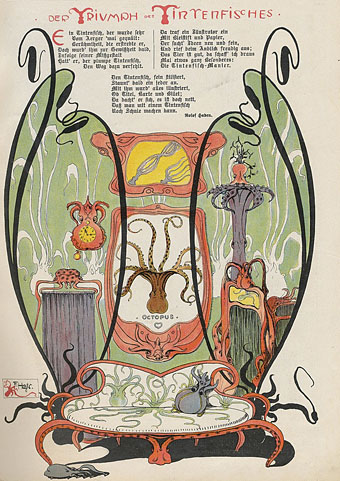
tintenfisches.jpg

Der Triumph des Tintenfisches from Meggendorfer-Blätter (c. 1900). Via Beautiful Century.

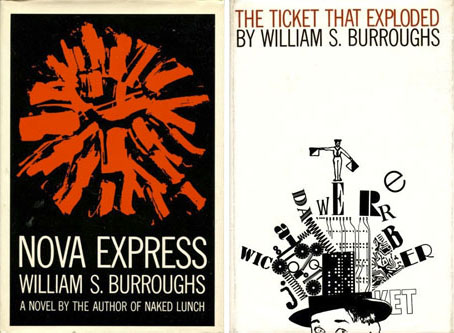
kuhlman.jpg

Two Grove Press covers by Roy Kuhlman. From Arden Kuhlman Riordan’s Pinterest page collecting her father’s cover designs.

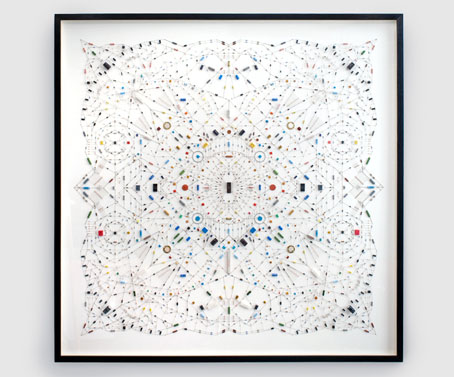
ulian.jpg

Technological mandala 02 (The beginning) (2012) by Leonardo Ulian.

Continue reading “The weekend artists, 2012”

Walter Crane’s Household Stories

crane01.jpg

The ideal follow-up to yesterday’s post would have been David Wheatley’s 1979 film for the BBC’s Omnibus series dramatising the life and works of the Brothers Grimm. This week was the two hundredth anniversary of the publication of the Grimm’s Children’s and Household Tales; I’ve never seen Wheatley’s Grimm film which—for the moment—remains unavailable.

There are, of course, plenty of illustrated editions of the Grimm’s collections although the dark tenor of the stories means these have never been as popular as Hans Christian Andersen’s tales. The Internet Archive has editions by Arthur Rackham, Robert Anning Bell and Rie Cramer, as well as a later, more stylised edition by German illustrator Albert Weisgerber whose plates can be seen at 50 Watts. Weisgerber brings some of the darkness to the fore, as in the drawing which shows Gretel about to push the wicked old woman into the oven.

crane02.jpg

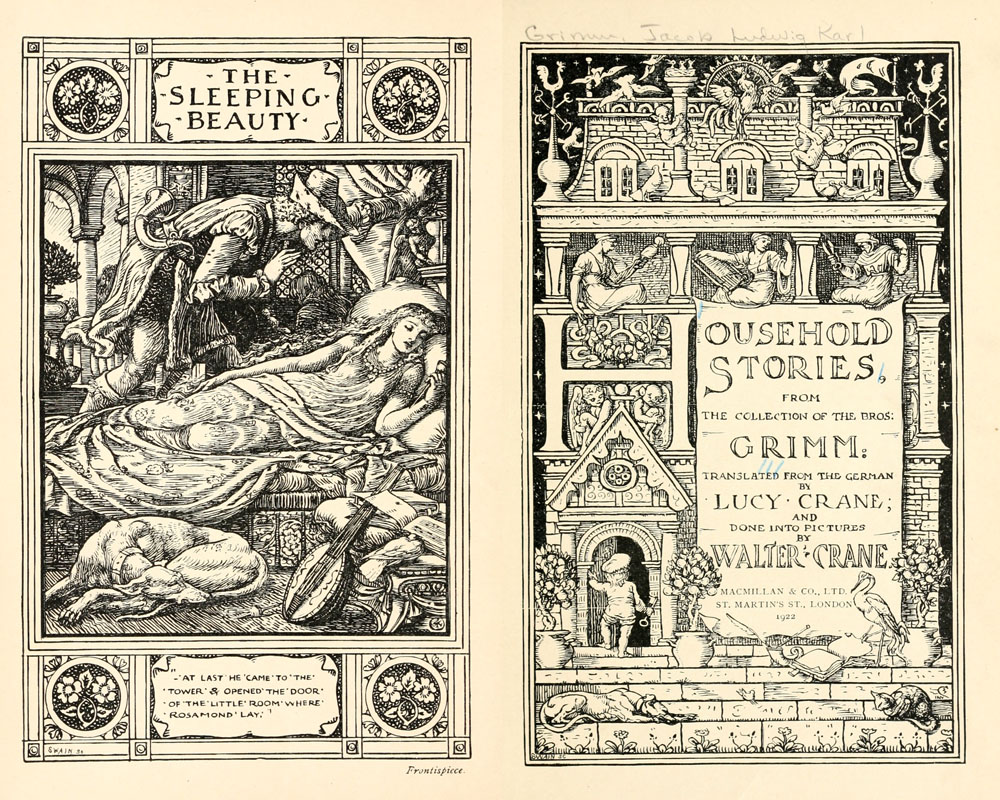
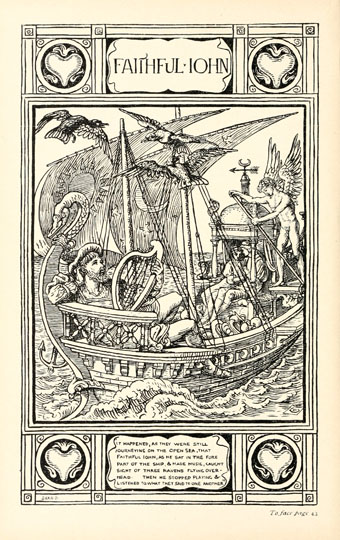
Walter Crane’s edition of Household Stories was first published in 1881. I’ve always liked the Pre-Raphaelite quality of Crane’s drawings so I favour this book over some of the other British editions. I love the house-shaped title page, and the way he embellishes the borders with details from the stories. The vignettes are as varied and inventive as you’d expect from a man who wrote a study of decorative art.

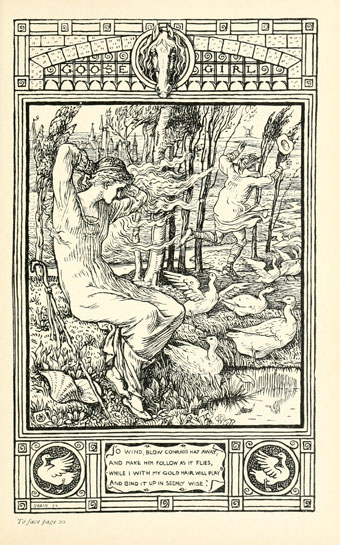
As for the stories, they can seem surprising today when the more popular Andersen fairy tales have become the versions most people know, and those mainly from anodyne film and TV adaptations. Looking at the Grimm books is like hearing older recordings of familiar folk songs (and the Perrault versions are older still): Cinderella is Aschenputtel, Little Red Riding-Hood is Little Red Cap, Snow White is Snow Drop, and so on. Walter Crane’s edition, translated by his sister, Lucy, contains 52 stories, just less than a quarter of the number in the final Grimm collection. William Morris admired Crane’s drawing of the Goose Girl enough to have it enlarged for a tapestry design. The scanned book can be browsed here or downloaded here.

crane03.jpg

Continue reading “Walter Crane’s Household Stories”

Weekend links 139

barnes.jpg

Lucy in the Sky with Diamonds (2012) by Lesley Barnes. She also has peacock wrapping paper.

Big thanks to Dennis Cooper for including this blog in his favourite music, fiction, poetry, film, art & internet lists for 2012. Lots of good company there. One benefit of end-of-year lists is the way they suggest things to look for in January.

• “…the best pictures of dicks that I’ve ever seen…” Rudy Rucker reviews Malcolm McNeill’s The Lost Art of Ah Pook Is Here and Observed While Falling, out at last from Fantagraphics. Rucker notes that William Burroughs’ text is still only available in out-of-print editions in which case you’ll need a book dealer. Elsewhere, Burroughs: The Movie has cleared 50% of its restoration Kickstarter goal but still needs supporters.

• Julia Holter has been a recurrent presence in these posts since the release in March of her acclaimed second album, Ekstasis. FACT has an alternate version of the album’s opening song, Marienbad, one of the extra tracks on the recent UK reissue.

Suttree’s saga carried me down, down, down to the bottom of a heightened surrogate reality, a nadir where the rarest jewels of clarity are found. The fourth time through the novel I arrived at a state of barometric equipoise, a balancing between my mental state and Suttree’s. Then, as he descended again, I began to rise. There was a hypnotic poetry to his fall — his life disintegrated, then the fragments disintegrated, then those fragments followed suit ad infinitum.

Jim White on the life-preserving qualities of Suttree by Cormac McCarthy.

• “An 18-year-old boy who discovers he has a fetish for the aged gets a job in a nursing home and develops an intimate relationship with one particular old man.” Gerontophilia, a proposed film by Bruce LaBruce, is looking for funding.

• Can’t wait for this: Groenland Records announces Who’s That Man?, a four-CD set of music produced and performed by Conny Plank. FACT has a track list.

• At BUTT magazine: Pink Courtesy Phone Mix by Richard Chartier, a great selection of electronica old and new.

• Another end-of-year list: Volumes 1 & 2 of The Graphic Canon are in NPR’s Indie Bookseller best of 2012 selection.

The Nightmare Paintings: art by Aleister Crowley currently touring Australia.

• Christmas with Monte: Colin Fleming on the ghost stories of MR James.

• “The war on drugs is a war on human nature” says Lewis Lapham.

Alan Moore: why I turned my back on Hollywood.

• More electronica: Chris Carter discusses synths.

Saul Bass poster sketches for The Shining.

• At Pinterest: The Pan Within.

Ah Pook Is The Mayan God Of Death (1975) by William Burroughs | Panic (1985) by Coil | Light Shining Darkly (1992) by Coil.

Harry Clarke in colour

years01.jpg

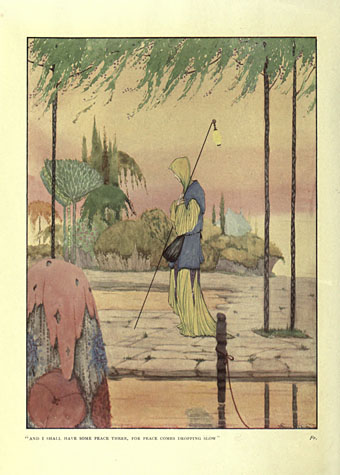
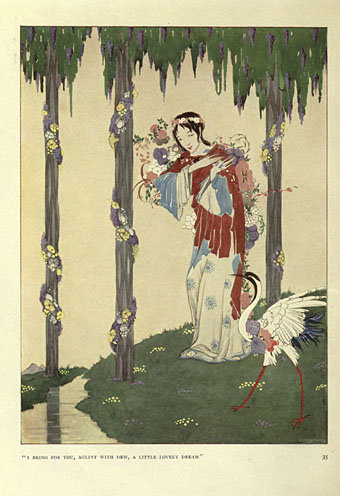
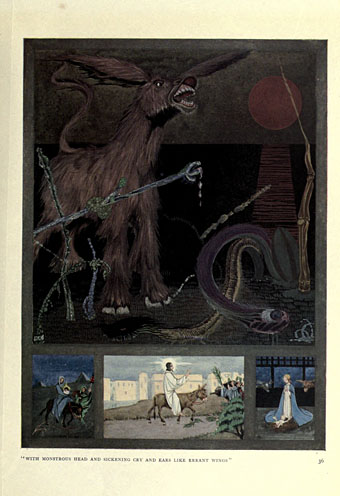
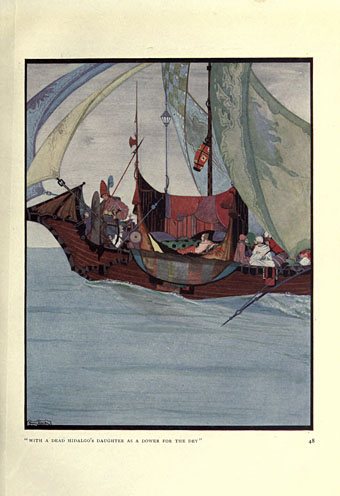
Older illustrated books often suffer at the hands of owners or a certain breed of iniquitous antique dealer who razor out their colour plates in order to frame them as prints. The Internet Archive has two copies of The Year’s at the Spring; An Anthology of Recent Poetry (1920) edited by Lettice D’Oyly Walters, and illustrated by Harry Clarke: one copy features all of the colour plates, the other has many of them missing. Looking at these again I thought it worth drawing attention to their peculiar mixture of the delicate and the grotesque, a result of illustrating a variety of content combined with Clarke’s habit of pushing book illustration into areas where few of his contemporaries would tread. His painting for The Donkey by GK Chesterton is at once an accurate illustration of the poem but also quite repellent, especially in the company of those phallic extrusions which become increasingly common in his later work. Elsewhere, when illustrating James Elroy Flecker’s The Dying Patriot, it’s a description of submerged corpses that he chooses to depict.

The rest of the book—which contains many beautiful ink drawings—may be browsed here or downloaded here. The Internet Archive is raising funds throughout December to support its running costs. I’ve been using their books as a source of reference a great deal over the past two years so was happy to contribute something.

years02.jpg

years03.jpg

years04.jpg

Continue reading “Harry Clarke in colour”