Weekend links 173

orszag.jpg

Icarus (1974–75) by Lili Ország.

• The Cabaret Voltaire albums released on the Virgin label in the 1980s have suffered the same shoddy treatment on CD as other Virgin reissues, a situation to be rectified in November with an extensive revisiting of the CV back catalogue. The long-overdue reappraisal will also include the release of Earthshaker, a collection of previously unavailable recordings from the Virgin period.

• It’s that book again: Design Observer has the preface from Lolita — The Story of a Cover Girl: Vladimir Nabokov’s novel in art and design, a book by John Bertram and Yuri Leving. At The Millions John Bertram talks to designer John Gall about the problems Lolita poses for cover designers.

• Jerry Lewis’s The Day the Clown Cried (1972) has acquired legendary status over the years for the apparent tastelessness of its subject matter—a clown in Auschwitz—and the fact that its director/star has never allowed the film to be seen in public. This week some footage arrived on YouTube.

Candy Bullets And Moon (1967), a one-off psychedelic collaboration between Don Preston and Meredith Monk.

• What’s the collective term for many bookshops? Whatever it is, there’s a lot of them in this Pinterest collection.

• At Dangerous Minds: Artist Gail Potocki’s exploration of Alice in Wonderland and the passing of time.

Anne Billson on the late Karen Black and why horror movies deserve our respect.

Tobias Carroll on the Surreal life and fiction of Leonora Carrington.

More details emerge about The Wicker Man – The Final Cut.

• Issue 35 of Arthur Magazine is now available for order.

• Graphics, drawings and collages by Jan Švankmajer.

• Every film poster designed by Saul Bass.

• Cabaret Voltaire: Just Fascination (1983) | Sensoria (1984) | I Want You (1985)
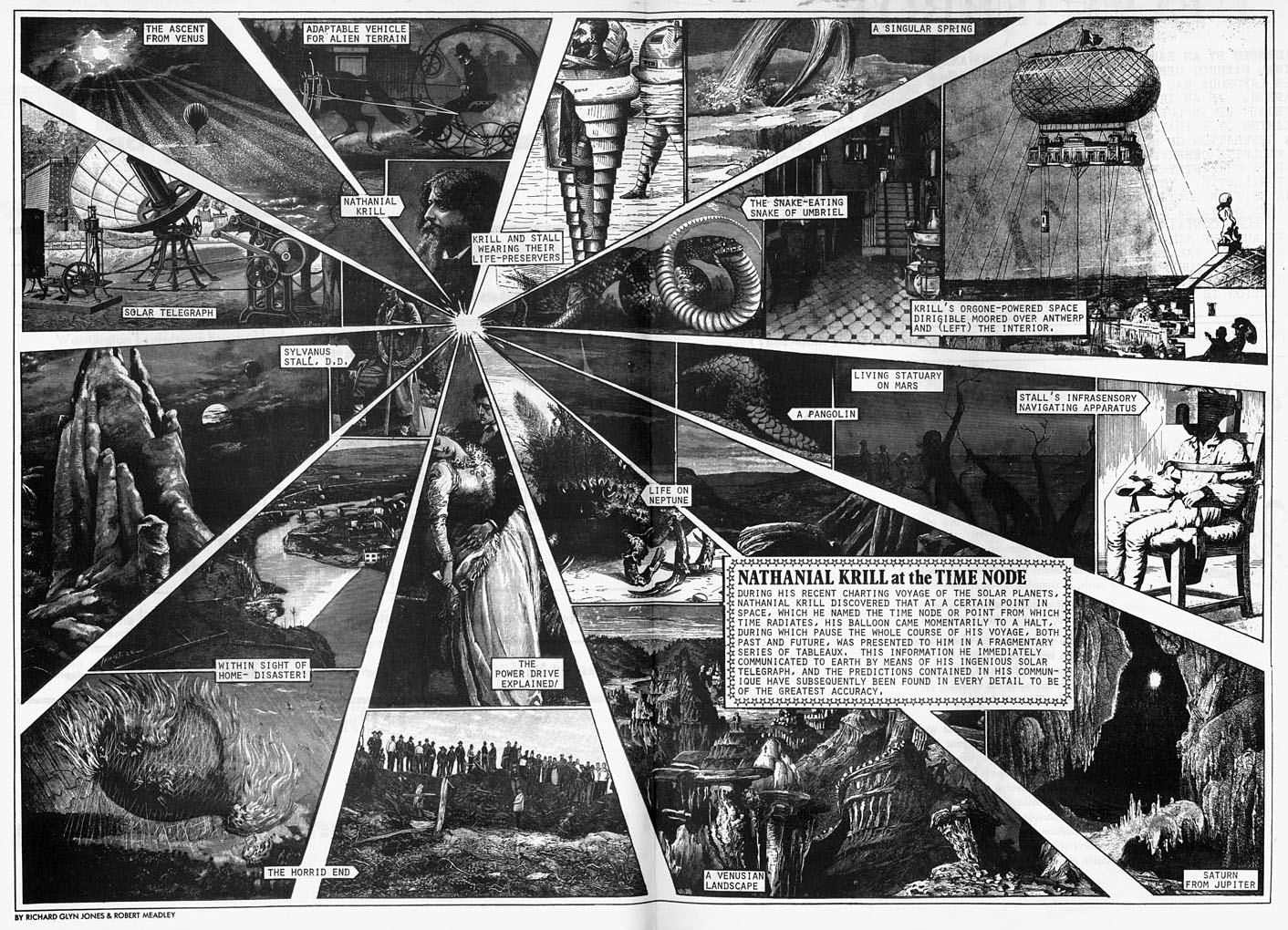
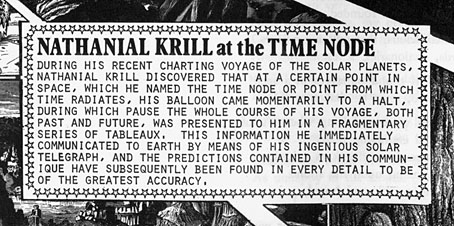
Nathanial Krill at the Time Node

krill.jpg

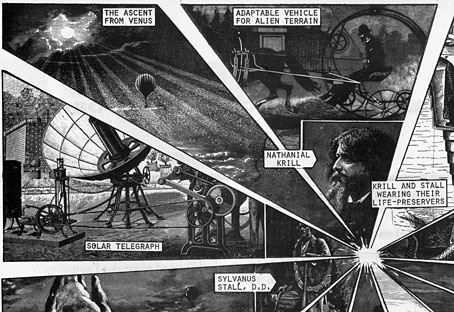
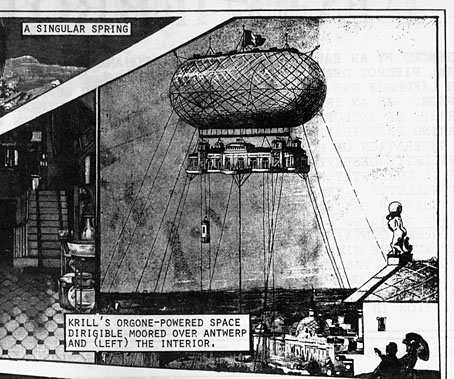
Nathanial Krill at the Time Node (1978) by Richard Glyn Jones and Robert Meadley.

Michael Moorcock’s New Worlds magazine resumed publication in 1978 after a hiatus of two years following the end of its New Worlds Quarterly paperback format. The issues for the years 1978 and 79 are the oddest in the entire run of the magazine. Issue 214 had the magazine title in Russian, a cover illustration of Union Jack anti-hero Zenith the Albino, and promised to deliver “Politics—Sport—Science”; issue 213 had an Empire-era cover, and contents which mostly dispensed with written fiction in favour of visual features such as newspaper pages from parallel time streams, or satirical collage.

krill2.jpg

Among the satire there was this two-page piece by Richard Glyn Jones and Robert Meadley which is probably the closest the magazine came to what people now call steampunk. I say probably because many of Moorcock’s alternate histories were doing in the late 60s and early 70s what steampunk does today, although not all of these appeared in NW. Nathanial Krill at the Time Node has the additional interest for me in being another example of the use of period engravings for fantastic or satirical ends, and one that few people will have seen. Richard Glyn Jones was a regular illustration contributor to New Worlds; Robert Meadley had four short stories in New Worlds Quarterly. Ten years ago I designed Meadley’s essay collection, A Tea Dance At Savoy. He’s a great writer, I keep hoping we’ll see more of his work one day.

krill3.jpg

krill4.jpg

Fiendish Schemes

fiendish.jpg

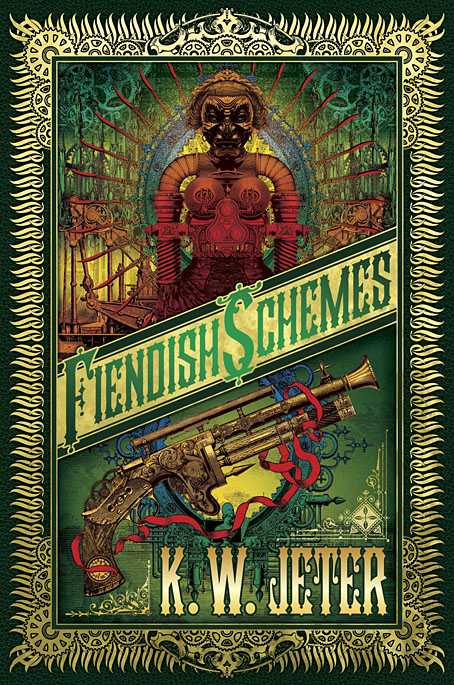
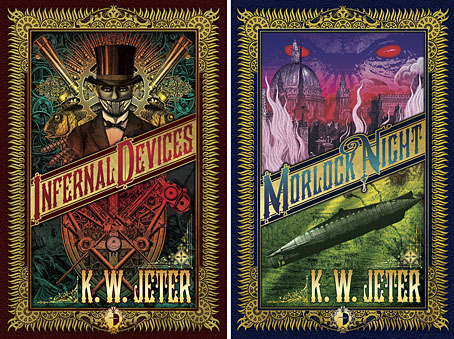
Now that this cover has appeared on Amazon I can mention it here. As usual, the machinery of publishing grinds slowly: this cover was commissioned in November last year, and worked on from the end of that month up to Christmas. Fiendish Schemes is a sequel by KW Jeter to his Infernal Devices, one of the original steampunk novels which was first published in 1987. In 2011 I created covers for reprints by Angry Robot of that title and the author’s earlier Morlock Night. Both those covers were very well received so Tor Books asked me to match their designs with a cover for the new book. This is quite unusual in publishing. Unless they make a real impact, cover designs seldom last beyond a couple of editions before being updated, and they rarely travel to other publishers.

jeter.jpg

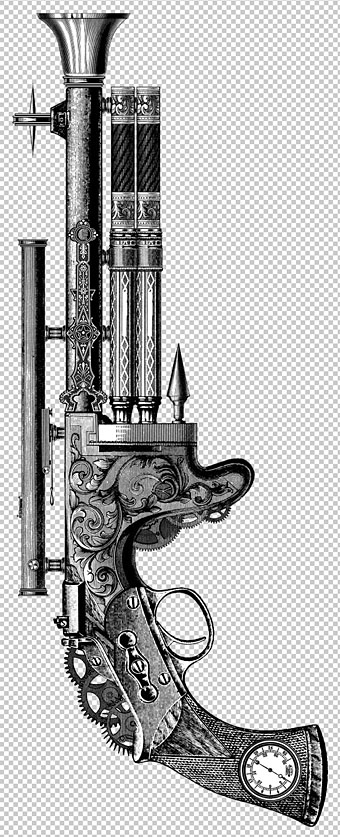
As with the earlier designs, the artwork is pieced together from very small pieces of period engravings, mostly from product catalogues or design books. In the novel, the steampunk weapon below is more alluded to than described but I was pleased with the way the illustration of it came together. Even though it’s composed of pieces of guns, fountain pens and clock parts it looks like something that could physically exist. One of the challenges I enjoy with this kind of collage illustration is trying to make something which doesn’t appear collaged at all.

Fiendish Schemes will be published on October 15th, 2013.

fiendish2.jpg

Previously on { feuilleton }
Ghosts in Gaslight, Monsters in Steam
Steampunk Revolution
The Bookman Histories
Aether Cola
Crafting steampunk illustrations
SteamPunk Magazine
Morlocks, airships and curious cabinets
The Steampunk Bible
Steampunk Reloaded
Steampunk overloaded!
More Steampunk and the Crawling Chaos
Steampunk Redux
Steampunk framed
Steampunk Horror Shortcuts

Fatality by OCTiV

fatality.jpg

Catching up with more recent work, this was a quick collage for Fatality, a single by US musician OCTiV. This has been out for about a month. The main track—a kind of dubstep/metal hybrid—can be heard here. The request was for something on the cosmic horror spectrum which would also incorporate geometric elements, hence the swiping of a couple of polyhedra from Wenzel Jamnitzer’s wonderful Perspectiva Corporum Regularium (1568).

Among the other things which have yet to materialise there’s a book cover design for Tor, and the Ghosts in Gaslight, Monsters in Steam anthology which features some of my fiction as well as my cover design. I’m very pleased that the latter has achieved its Kickstarter funding. More about these projects later.

Weekend links 160

floyd.jpg

Collage by Jeneleen Floyd.

• “…slowly, block-by-block, pedestrians are starting to take back the streets.” Wayne Curtis on the hazards of being a pedestrian in a world of cars.

• Michael Hann looks back at LA’s Paisley Underground, and also talks to some of its key members.

Meighan O’Toole interviews JL Schnabel about her Blood Milk jewellery designs.

My central thesis is that camp was always a kind of signifying practice invented out of necessity (both for survival and for sheer creative pleasure) by “queer” (in the classic sense) outsiders – fags, drag queens, transsexuals, deviants, sexual renegades – and that it was always by its very nature deeply political and committed: Some people dedicated their entire lives to it! Sontag’s interpretation always seemed a bit dismissive to me somehow.

The seldom unprovocative Bruce LaBruce talking to Mark Allen about camp in the 21st century.

• Studiocanal launches an appeal to find the lost materials of The Wicker Man.

• At Flickr: Tales from a Parallel Universe and London’s Lost Music Venues.

Michael Wood tells us what we learn when we read Italo Calvino’s letters.

• Fragments of a Portrait: Francis Bacon and David Sylvester in 1966.

• An extract of a live session from Adrian Sherwood and Pinch.

• In Baba Yaga’s Hut: Amelia Glaser on Russian folk tales.

Buckminster Fuller Book Covers from the 1970s.

A Century of Proust.

The Real World (1982) by The Bangles | With A Cantaloupe Girlfriend (1982) by The Three O’Clock | Medicine Show (1984) by The Dream Syndicate | No Easy Way Down (live in Tokyo, 1984) by The Rain Parade