Polaroids

polaroid1.jpg

I was given a Polaroid Instant Camera some years ago, not the cult SX-70, a later model. I still have it somewhere but never used it very much. The film cartridges were still available in shops, but at around £1 a shot Polaroids always seemed like a costly indulgence unless you had some specific use for them which I never did. The photo of Murnau’s Nosferatu was taken from a TV screen, and seems to be the only print I kept.
krims.jpg

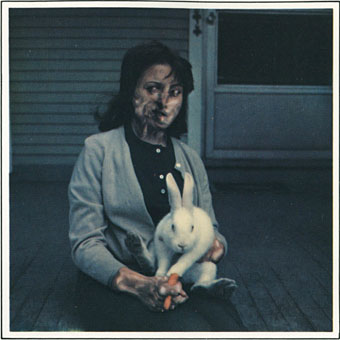
Radiation Victim Holding a Rabbit and Carrot (1974) by Les Krims.

This post was prompted by a search for the Polaroid manipulations made by Les Krims in the 1970s. Krims was one of the first people (the first?) to exploit the potential of the print’s slow processing to create surreal and grotesque images. Krims self-published a collection of these as Fictcryptokrimsographs in 1975. The Francis Bacon-like “radiation victim” is one of the more restrained examples, many of the others being male and female nudes in various stages of mutation.
gabriel1.jpg

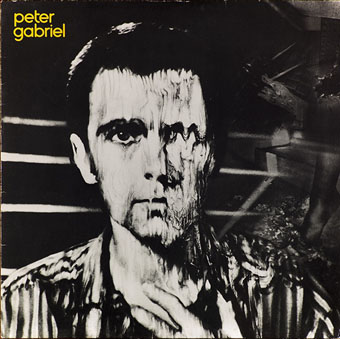
Peter Gabriel (1980).

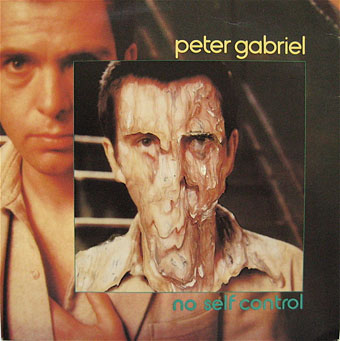
The mutation technique was more famously employed by the Hipgnosis design team and Peter Gabriel for the cover art of Gabriel’s third album. (Americans insist on calling this album “Melt” even though it was never titled as such.) The technique was also used for photos on the inner sleeve and on two of the single releases.
gabriel2.jpg

No Self Control (1980). Front and back sleeve of 7-inch single.
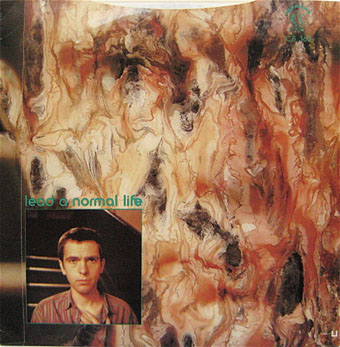
gabriel3.jpg

steadman.jpg

William Burroughs by Ralph Steadman.

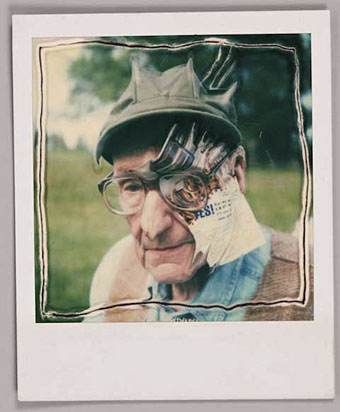
Also in 1980, Ralph Steadman says discovered the same technique while on holiday in Turkey. I recall him discussing his own manipulations, which he calls “Paranoids”, on TV around this time. There’s no indication that Steadman was aware of Krims or the Gabriel album but he’s continued to use the technique ever since. The Burroughs portrait was one of a series created in 1995 when Steadman paid a visit to Lawrence, Kansas. There’s film of the meeting here although I’m more interested in the older TV film on the same page which shows Steadman creating a new composite portrait by drawing onto the emulsion.

Previously on { feuilleton }
Portrait

Walking sticks

cane02.jpg

If I have to use a walking stick in future then my choice of implement would have certain requirements… Who needs an Apple watch when there are timepieces like these to be found?

cane06.jpg

This elegant design is from Alexander McQueen so it isn’t cheap. I wouldn’t say no to one as a present, however.

cane01.jpg

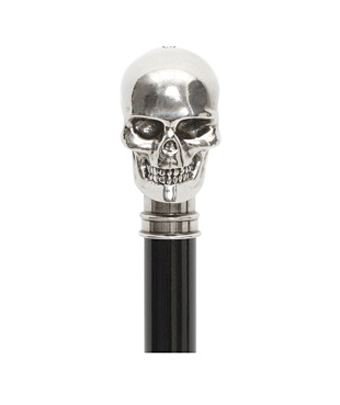
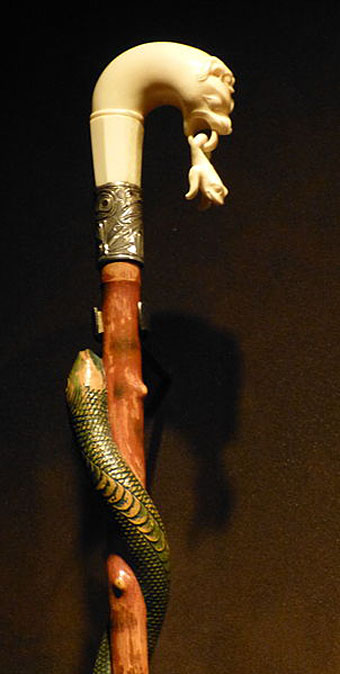
Most of these choices are skull-topped canes but this antique piece stood out from the crowd.

Continue reading “Walking sticks”

23 Skidoo

1: A slang phrase

skidoo1.jpg

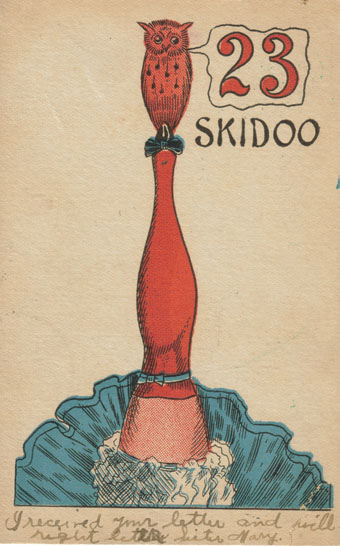
Postcard via.

From the Oxford English Dictionary:

skidoo, v. N. Amer. slang. (ski’du:) Also skiddoo. [Orig. uncertain, perh. f. skedaddle v.]

2. In catch-phrases. a. Used as an exclamation of disrespect (for a person). Esp. in nonsense association with twenty-three. (temporary.)

1906 J. F. Kelly Man with Grip (ed. 2) 99 As for Belmont and Ryan and the rest of that bunch, Skidoo for that crowd when we pass. Ibid. 118 ‘I can see a reason for ‘skidoo’,’ said one, ‘and for ‘23’ also. Skidoo from skids and ‘23’ from 23rd Street that has ferries and depots for 80 per cent. of the railroads leaving New York.’ 1911 Maclean’s Mag. Oct. 348/1 Surrounded by this conglomerate procession as I went on my way, the urchins would yell ‘Skidoo,’ ‘23 for you!’

b. spec. as twenty-three skidoo: formerly, an exclamation of uncertain meaning; later used imp., go away, ‘scram’.

1926 C. T. Ryan in Amer. Speech II. 92/1, I really do not recall which appeared first in my vocabulary, the use of ‘some’ for emphasis or that effective but horrible ‘23-Skiddoo’—perhaps they were simultaneous. 1929 Amer. Speech IV. 430 Among the terms which the daily press credits Mr. Dorgan with inventing are:…twenty-three skiddoo (go away). 1957 W. Faulkner Town iii. 56 Almost any time now Father would walk in rubbing his hands and saying ‘oh you kid’ or ‘twenty-three skidoo’. 1978 D. Bagley Flyaway xi. 80 This elderly, profane woman…used an antique American slang… I expected her to come out with ‘twenty-three, skidoo’.


2: An esoteric poem by Aleister Crowley

[23]

SKIDOO

What man is at ease in his Inn?
Get out.
Wide is the world and cold.
Get out.
Thou hast become an in-itiate.
Get out.
But thou canst not get out by the way thou camest in. The Way out is THE WAY.
Get out.
For OUT is Love and Wisdom and Power.
Get OUT.
If thou hast T already, first get UT.
Then get O.
And so at last get OUT.

From The Book of Lies (1912/13)


3: A film by Julian Biggs

biggs.jpg

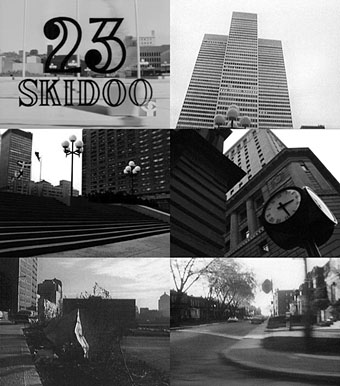
23 Skidoo (1964).

If you erase the people of downtown America, the effect is bizarre, not to say disturbing. That is what this film does. It shows the familiar urban scene without a soul in sight: streets empty, buildings empty, yet everywhere there is evidence of recent life and activity. At the end of the film we learn what has happened.


4: 23 Skidoo Eristic Elite by William Burroughs

skidoo2.jpg

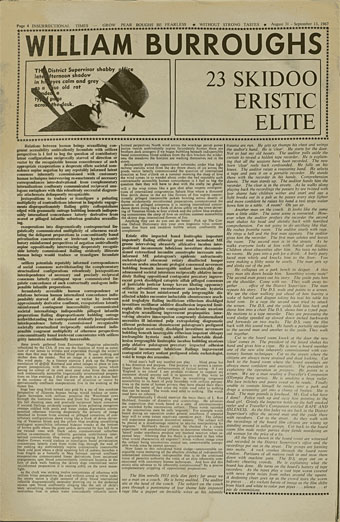
International Times, issue 18, Aug 31–Sept 13, 1967.

From Burroughs proceed to Illuminatus! (1975) by Robert Shea and Robert Anton Wilson, and many subsequent derivations.


5: A one-off comic strip by Rick Griffin and Rory Hayes

skidoo3.jpg

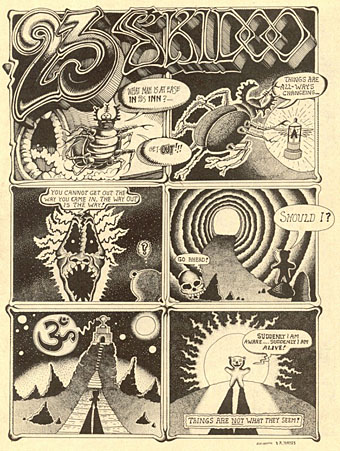
From Bogeyman Comics #2 (1969).


6: A music group

skidoo4.jpg

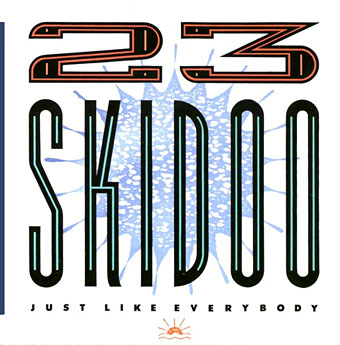
Just Like Everybody (1987). Design by Neville Brody.

Website | Discography


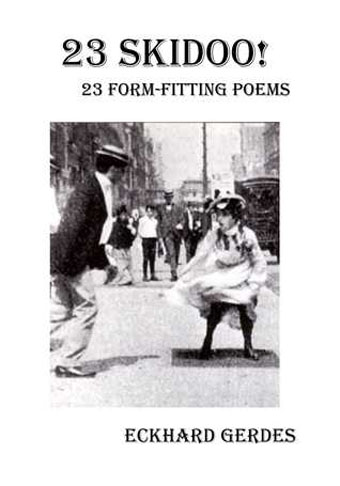
7: A poetry collection by Eckhard Gerdes

skidoo5.jpg

23 Skidoo! 23 Form-Fitting Poems (2013) by Eckhard Gerdes.

Previously on { feuilleton }
Seven Songs by 23 Skidoo
23 Skidoo by Julian Biggs
Neville Brody and Fetish Records

Brion Gysin record covers

gysin01.jpg

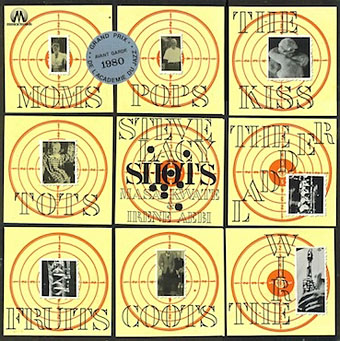
Shots (1977) by Steve Lacy.

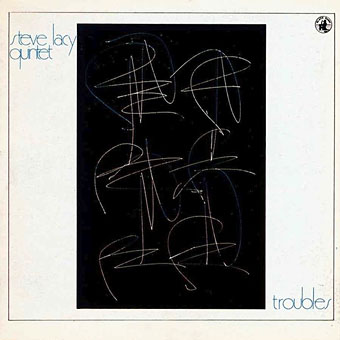
Continuing an occasional series about artists or designers whose work has been used on record sleeves. The life and work of Brion Gysin (1916–1986) is the subject of a new exhibition, Unseen Collaborator, that opened last week at October Gallery, London. The gallery page mentions Gysin’s connections to the music world: among other things, it was Gysin’s enthusiasm for the Master Musicians of Jajouka that gave those people and their music global prominence, with a little help from Brian Jones. But there are other connections, whether as a collaborator with Steve Lacy, or as a decorator of album covers. Some of these uses are posthumous but this small collection includes a few releases I’d not come across before.

gysin02.jpg

Troubles (1979) by The Steve Lacy Quintet.

gysin03.jpg

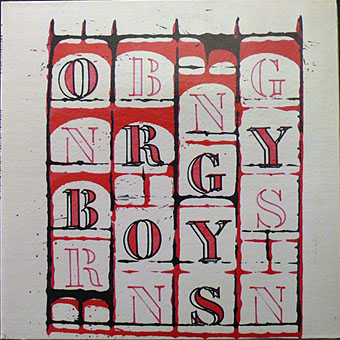
Orgy Boys (1982) by Brion Gysin.

A 12-inch single with Gysin reading from William Burroughs and his own writings. “Songs dedicated to his orgy pals: William S. Burroughs, Mick Jagger, Keith Richards, Iggy Pop, David Bowie, Fafa de Palaminy, Patti Smith, Allen Ginsberg and John Giorno…”

Continue reading “Brion Gysin record covers”

Weekend links 263

nakayama.jpg

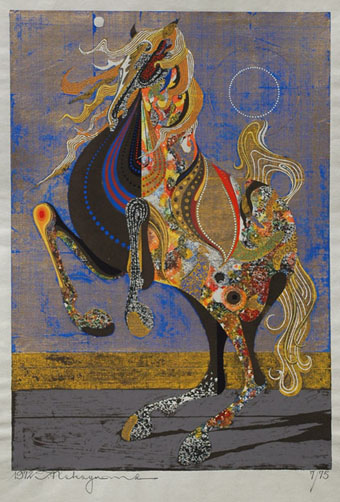
Dancing Horse (1972) by Tadashi Nakayama.

• The Wounded Galaxies Festival of Experimental Media takes place in Bloomington, Indiana, on October 7–11, 2015. The event is an offshoot of the earlier Burroughs Century, and the phrase “wounded galaxies” is one of Burroughs’ own. It’s also the partial title of Wounded Galaxies Tap At The Window, the most recent album by Cyclobe who will be performing at the festival. Cyclobe’s Stephen Thrower will be in London later this month for the launch of his new book, Murderous Passions: The Delirious Cinema of Jesús Franco, and a screening of Franco’s Vampyros Lesbos (1971).

• Gallery sites showcasing erotic art are often coy about the details of the work they’re exhibiting. That’s not the case with Artists Space, NYC, whose Tom of Finland: The Pleasure of Play is running from June 14–August 23, 2015.

• “I just loved the songs, and I didn’t mind the age in their voices, and I didn’t mind the fact that they were unaccompanied, it didn’t matter.” Shirley Collins talking to Ben Graham about her love of English folk music.

The more important question is what do we do with psychedelia now? I think the drugs themselves and the experiences they produce in individuals and for society are too important and vital to be pigeon-holed and taken hold of by a bloodthirsty media that always aims to reduce all experience to a few simple straplines for improved consumerism.

Dr Ben Sessa talking to Barnaby Smith about psychedelic drugs. Breaking Convention 2015, the Third International Conference on Psychedelic Consciousness, takes place at the University of Greenwich next month.

• “…if someone opens a door or if sunlight falls on them they shoot off the grid and suddenly you have a roomful of what sounds like sick bagpipes.” Will Gregory on the physicality of Moog synthesizers.

• Mixes of the week: The Necromancer-Queens of Neverland, an exotic collection by SeraphicManta, Secret Thirteen Mix 156 by Asusu, and an Ornette Coleman playlist.

• “In 2015, the thought of anything as incendiary as Scum or Made in Britain turning up on TV just seems bizarre.” Danny Leigh on the great Alan Clarke.

• More psychedelia: ‘Art That Transcends‘, my article for Communication Arts, has been posted on the magazine’s website.

Phantasmaphile recommends Thus Were Their Faces, a collection of short stories by Silvina Ocampo.

Earth filmed playing live in Brooklyn, NY, September 24, 2014. The full set, and a great performance.

• At Dangerous Minds: “How Far Will You Go?” Meet Smokey, the outrageously gay 70s cult rockers.

Peter Strickland on six films that fed into The Duke of Burgundy.

Things I Found In Records

Christopher Lee sings!

Polly On The Shore (1970) by Shirley & Dolly Collins | The Quiet Joys Of Brotherhood (1972) by Sandy Denny | The Banks of Red Roses (1988) by June Tabor