Hinton’s hypercubes

hinton.jpg

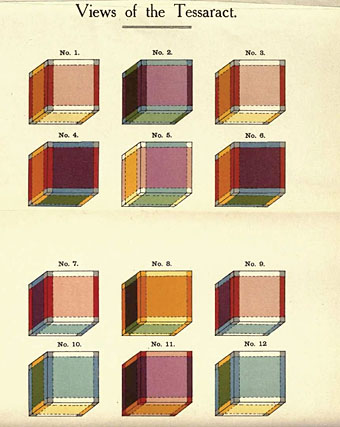
Illustration from The Fourth Dimension (1906) by Charles Howard Hinton.

A slight return to the worlds of Borges. I happened to be re-reading some of the stories in The Book of Sand (1975), one of the later collections which includes the story Borges dedicated to HP Lovecraft, There are more things. Borges’ writings are nothing if not filled with references to other works of literature, philosophies, religions, and ideas in general; following up the less-familiar references would preoccupy a reader to the detriment of the writing so there’s a tendency when reading a Borges piece to take for granted many of those nuggets of esoteric information. I’ve read There are more things many times—it’s a favourite in part for having the additional thrill of Borges going Lovecraftian—but only realised with this reading that I can now fully appreciate the following:

Years later, he was to lend me Hinton’s treatises which attempt to demonstrate the reality of four-dimensional space by means of complicated exercises with multicoloured cubes. I shall never forget the prisms and pyramids that we erected on the floor of his study.

Prior to reading this I did know that Hinton was Charles Howard Hinton (1853–1907), the British mathematician and dimensional theorist. Hinton’s name tends to turn up in discussions of the work of his mystical contemporaries, notably the Theosophists who were more taken with his theories than those in the scientific fields. (A conviction for bigamy didn’t help his reputation.) But those multicoloured cubes were a mystery until the publication of (fittingly) the fourth number of Strange Attractor Journal. Among the usual selection of fascinating articles the book contains a piece by Mark Blacklock about Hinton’s ideas including those mysterious cubes. Drawings of the cubes first appeared in A New Era of Thought (1888) where Hinton proposes using them as aids to a series of mental exercises with which the reader may visualise the higher dimensions of space. Hinton invented the word “tesseract” to describe the four-dimensional structure projected from the faces of his three-dimensional cubes.
dali.jpg

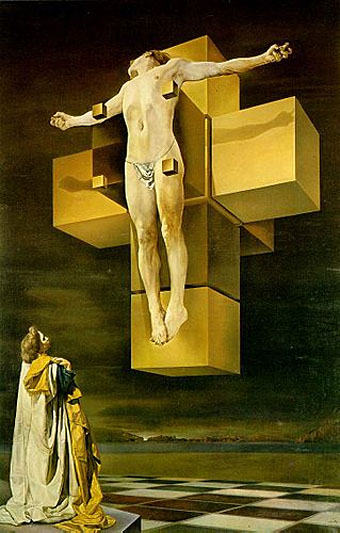
Crucifixion (Corpus Hypercubus, 1954) by Salvador Dalí.

Hinton may not have impressed his mathematical colleagues as much as he hoped but his ideas have an understandable attraction, as the Borges story demonstrates. The story concerns the refashioning of a Buenos Aires house for an unusual resident; thirty years earlier Robert Heinlein wrote “—And He Built a Crooked House—” in which an architect builds a house in the form of a four-dimensional hypercube: only the lowest cube attached to the ground is visible from the exterior. I read that story when I was a teenager, and was already acquainted with tesseracts thanks to school-friends who were maths whizzes; I was the arts whizz, and I think I was probably the first of us Dalí enthusiasts to discover the artist’s own take on the hypercube, Crucifixion (Corpus Hypercubus) from 1954. Borges and Heinlein in those stories were both writing their own forms of science fiction, and Dalí’s painting finds itself co-opted into another story with sf connections, The University of Death (1968) by JG Ballard, one of the chapters in The Atrocity Exhibition (1970):

He lit a gold-tipped cigarette, noticing that a photograph of Talbot had been cleverly montaged over a reproduction of Dalí’s ‘Hypercubic Christ’. Even the film festival had been devised as part of the scenario’s calculated psychodrama.

If we seem to have strayed a little then it’s worth noting that Borges was familiar with Ballard’s work: he included The Drowned Giant in the later editions of The Book of Fantasy, the anthology he edited with Adolfo Bioy Casares and Silvina Ocampo. The two writers also met on at least one occasion.

jlb-jgb.jpg

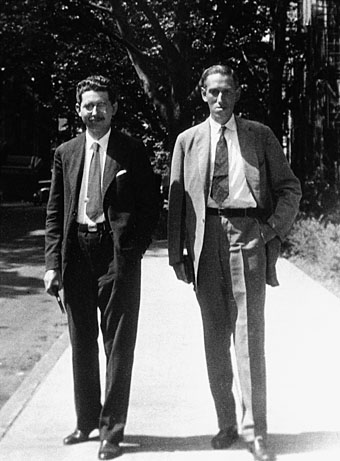
JLB and JGB, circa 1970. Photo by Sophie Baker.

Charles Hinton’s coloured cubes and tesseracts are described in detail in The Fourth Dimension (1906), a reworking of the ideas from A New Era of Thought, and also the source of the colour illustration that everyone reproduces. Mark Blacklock has his own multi-dimensional website where you can read about his construction of a set of three-dimensional Hinton cubes. As for the mental exercises, Blacklock’s piece in Strange Attractor contains an anecdotal warning that the auto-hypnotic system required to fully visualise Hinton’s dimensions can result in a degree of obsession dangerous to the balance of mind. Proceed with caution.

Previously on { feuilleton }
Borges and the cats
Invasion, a film by Hugo Santiago
Spiderweb, a film by Paul Miller
Books Borges never wrote
Borges and I
Borges documentary
Borges in Performance

Weekend links 212

non-format.jpg

Poster for the recent Ballard-themed Only Connect Festival of Sound in Oslo. Design by Non-Format.

Bulldozer by Laird Barron was my favourite piece in Lovecraft’s Monsters, the recent Tachyon anthology edited by Ellen Datlow that I designed and illustrated. So it’s good to hear that Nic Pizzolato, writer of the justly-acclaimed HBO series True Detective, is among Barron’s readers. True Detective, of course, created a stir for referencing Robert Chambers’ weird fiction in a police procedural. The series is out now on DVD and Blu-ray, and I can’t recommend it too highly.

• Citation-obsessed Wikipedians don’t believe Hauntology is a genuine musical genre, a sentiment which will probably surprise some of its practitioners. Whatever the merits of the argument, I rather like the idea of a musical form that resists strict definition.

• “This year, in order to do things differently, I will make a conscious effort to separate the man from his writing.” Giovanna Calvino, daughter of Italo Calvino, remembers her father.

With ideology masquerading as pragmatism, profit is now the sole yardstick against which all our institutions must be measured, a policy that comes not from experience but from assumptions – false assumptions – about human nature, with greed and self-interest taken to be its only reliable attributes. In pursuit of profit, the state and all that goes with it is sold from under us who are its rightful owners and with a frenzy and dedication that call up memories of an earlier iconoclasm.

Alan Bennett delivers a sermon.

Zarina Rimbaud-Kadirbaks, aka Dutch Girl In London, reviews the Chris Marker exhibition that’s currently running at the Whitechapel Gallery, London.

• Exteriorizing the Inner Realms: Christopher Laursen talks to Phantasmaphile and Abraxas magazine‘s Pam Grossman about occult art, past and present.

• The Beast is back: Erik Davis talks to Gary Lachman about his new book, Aleister Crowley: Magick, Rock and Roll, and the Wickedest Man in the World.

• The body as factory: anatomy of a New Scientist cover image. Rick Poynor on the recurrent use of a familiar visual metaphor.

• Mix of the week without a doubt is FACT Mix 445 by Stephen O’Malley, a three-hour behemoth.

• Jennifer in paradise: Photoshop developer John Knoll on the story of the first Photoshopped image.

• The trailer for Grandfather of Gay Porn, a documentary about Peter de Rome by Ethan Reid.

Giorgio’s Theme is a new piece of electronic music by Giorgio Moroder.

Agender, a series of androgynous photo-portraits by Chloe Aftel.

• RIP Little Jimmy Scott

Evil Spirits

Chase (1978) by Giorgio Moroder | Call Me (1980) by Blondie | The Apartment (1980) by Giorgio Moroder

Weekend links 206

komoda.jpg

Nova Express (2014) by Paul Komoda.

• Last week it was Kraftwerk, this week it’s Can in another astonishing 70-minute TV performance from 1970. For those who know where to look in the torrent world there are copies of these recordings circulating there.

JG Ballard: five years on. Extracts from introductions by John Gray, Hari Kunzru, Robert Macfarlane, Deborah Levy, James Lever, China Miéville and Michel Faber for a new series of Ballard editions.

• Mix of the week: Needle Exchange 147 by Inventions. Also at Self-Titled Mag: Suzanne Ciani on her Buchla beginnings, talking dishwashers, and why no one got electronic music in the ’70s.

• At Dangerous Minds: It’s So Far Out It’s Straight Down, a Granada TV documentary from 1967 featuring Paul McCartney, Allen Ginsberg, International Times, Pink Floyd et al.

The Wonderful World of Witches: Portraits of English Pagans. A photo-special from the 1960s at LIFE. Related: From 1974, the US TV ad for Man, Myth and Magic.

• Suspicious Minds: Adam Curtis on Stephen Knight, Jack the Ripper, squatters, heists, From Hell, and why people no longer trust those in authority.

• Here be men with beards and syntezators: Andy Votel‘s Top 10 Early Patch-Bay Polymaths From Eastern Europe.

The New York Public Library has made 20,000 maps available as free, high-res downloads.

• An oscilloscope video by Vincent Oliver & Steve Bliss for Riff Through The Fog by Clark.

Anne Billson interviewed Alejandro Jodorowsky in 1990.

• At BLDGBLOG: When Hills Hide Arches.

Do gay people still need gay bars?

Pixelord Dreams

I’m So Green (1972) by Can | Nova Feedback (1978) by Chrome | Gay Bar (2003) by Electric Six

Seward/Howard

burroughssphinx.jpg

William Burroughs, New York, 1953. Photo by Allen Ginsberg.

Lonely lemur calls whispered in the walls of silent obsidian temples in a land of black lagoons, the ancient rotting kingdom of Jupiter – smelling the black berry smoke drifting through huge spiderwebs in ruined courtyards under eternal moonlight – ghost hands at the paneless windows weaving memories of blood and war in stone shapes – A host of dead warriors stand at petrified statues in vast charred black plains – Silent ebony eyes turned toward a horizon of always, waiting with a patience born of a million years, for the dawn that never rises – Thousands of voices muttered the beating of his heart – gurgling sounds from soaring lungs trailing the neon ghost writing – Lykin lay gasping in the embrace can only be reached through channels running to naked photographic process – molded by absent memory, by vibrating focus scalpel of the fishboy gently in a series of positions running delicious cold fingers “Stand here – Turn around – Bend”

The Ticket that Exploded (1962)

William Burroughs always talked favourably of Ernest Hemingway, and the famously spare style of Hemingway’s prose is evidently a style he sought himself, especially in the later works where there’s less of an emphasis on linguistic pyrotechnics. Something that always strikes me when I return to Burroughs’s earlier novels is the quality of passages like the one above which is a long way from the Hemingway style. What’s even more noticeable—and this is something which attracted me to Burroughs’s work from the outset—is the degree to which some of these passages are reminiscent of HP Lovecraft. In the case of the example above, taken from The Black Meat chapter of The Ticket that Exploded, some of this may be the work of Michael Portman who Burroughs credits as co-writer. What Portman contributed to The Black Meat and another chapter of that novel I’ve never discovered but there are plenty of other examples by Burroughs alone to show that he wasn’t incapable of this himself. The Ticket that Exploded was the first Burroughs book I read, and part of the shock and fascination came from encountering a recognisable Weird Tales-style atmosphere wrenched into inexplicable and thoroughly alien territory.

hpl.jpg

Frank Belknap Long and HP Lovecraft, New York, 1931. Photo by WB Talman.

There are others connections beyond literary style. When the Simon Necronomicon was published in 1977 Burroughs was asked to provide a blurb for the book. He wasn’t as effusive as the publishers might have hoped but the dubious volume was still advertised with his recommendation:

Let the secrets of the ages be revealed. The publication of the Necronomicon may well be a landmark in the liberation of the human spirit.

If it wasn’t for this then the extraordinary Invocation which opens Cities of the Red Night (1981) would have been diminished. Among the other “gods of dispersal and emptiness” whose names are called, Burroughs mentions “Kutulu, the Sleeping Serpent who cannot be summoned”, and “the Great Old One”, among a number of the usual Mayan gods, and several Sumerian deities whose descriptions (as with Kutulu) are taken from the pages of the Simon Necronomicon. It’s impossible to imagine Saul Bellow or John Updike opening a novel this way, just as it’s impossible to imagine many genre writers wandering into the areas that Burroughs explores elsewhere in that novel. This is one reason why Burroughs (and JG Ballard) were included in DM Mitchell’s The Starry Wisdom anthology in 1994, an attempt to expand the acceptable boundaries of Lovecraftian fiction, and also wilfully trample the fences that separate the genre and literary camps. I campaigned at the time for The Black Meat chapter to be included but Dave was set on Wind Die, You Die, We Die from Exterminator! (1973), a lesser piece although in the end it didn’t seem out of place in the book as a whole.

Elsewhere on { feuilleton }
The Lovecraft archive
The William Burroughs archive

Weekend links 198

boty.jpg

Bum (1966) by Pauline Boty.

Eleanor Birne on Pauline Boty, “the only prominent female Pop artist among a generation of famous men”. Ken Russell’s Pop Art documentary, Pop Goes the Easel (1962), which features Boty, may be seen here. Two years later Boty was back with Ken Russell playing the part of the prostitute from The Miraculous Mandarin in a film about Béla Bartók. That’s something I’d love to see. There’s more about her painting, and the work of other female Pop artists, here.

• Why Are We Sleeping? Mark Pilkington on the music world’s recurrent interest in the philosophy of GI Gurdjieff. Pilkington’s most recent Raagnagrok release with Zali Krishna, Man Woman Birth Death Infinity, was reviewed by Peter Bebergal.

• Cinematic details: Frames-within-frames in The Ipcress File (1966), and the typography of 2001: A Space Odyssey (1968).

highrise.jpg

A Jay Shaw poster for Ben Wheatley’s forthcoming film of High-Rise.

• “…a large cavity must be dug in the bird’s shoulder and filled with ball bearings.” Christine Baumgarthuber on the dubious delights of The Futurist Cookbook.

• Why Tatlin Can Never Go Home Again: Rick Poynor on the difficulties of finding a definitive representation of an artwork online.

Jay Parini reviews Inside a Pearl: My Years in Paris by Edmund White. At AnOther Donatien Grau talks to White about fashion.

• At Bajo el Signo de Libra (in Spanish): the homoerotic and occasionally Surrealist art of Pavel Tchelitchew.

• At 50 Watts: Kling Klang Gloria: Vintage Children’s Books from Austria.

• The motorbike girl gangs of Morocco photographed by Hassan Hajjaj.

Geoff Manaugh on how LED streetlights will change cinema.

Stylus “is an experiment in sound, music and listening”.

• Mix of the week: Secret Thirteen mix 106 by Senking.

• At Pinterest: JG Ballard

This Is Pop? (1978) by XTC | Pop Muzik (1979) by M | Pop Quiz (1995) by Stereolab