Weekend links 44

bradley.jpg

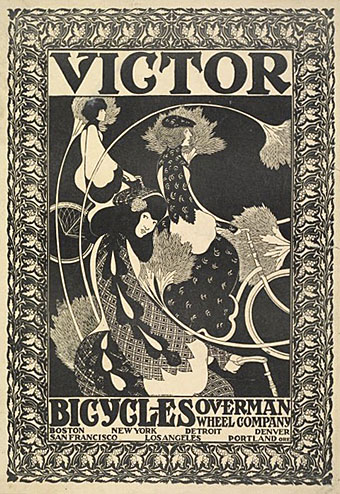
Poster by Will Bradley for Victor Bicycles (c. 1895).

• G. Wayne Clough, chief exective of the Smithsonian Institution, finally admits that he made a hasty decision in removing David Wojnarowicz’s video from the Hide/Seek exhibition of gay art. Related: “Finland’s cultural gifts to the world include Sibelius, the Moomins and an artist that the country has been less eager to celebrate.” The belated homecoming of Tom of Finland.

The Fiend with Twenty Faces: Jonathan Clements examines the legacy of Edogawa Rampo (Hirai Taro), the Japanese master of mystery and imagination.

• RIP Susannah York. The Guardian posted a selection of clips including one from Robert Altman’s Images (1972).

• More mixtapes: Trish Keenan’s Mind Bending Motorway Mix and a selection for Quietus by Chris & Cosey.

• “Ruin photos speak to our desperate desire to have our world re-enchanted.”

tomorrow.jpg

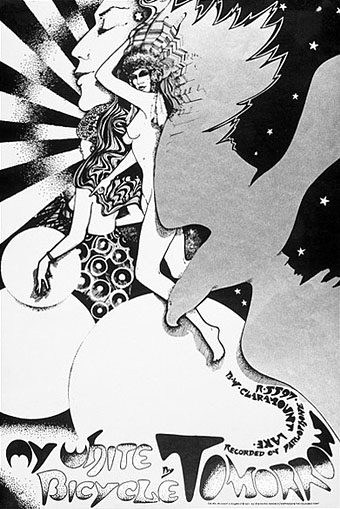
Promo poster by Hapshash and the Coloured Coat for My White Bicycle by Tomorrow (1967).

The Raging Peloton: Iain Sinclair on two wheels good, four wheels bad.

The unknown Jorge Luis Borges: five new anthologies reviewed.

The French house untouched for 100 years (and also here).

Electrotypes on Drugs: old chemists’ labels.

South China Sea Pishkun by Dinh Q. Lê.

Bike (1967) by Pink Floyd | My White Bicycle (1967) by Tomorrow | Trip On An Orange Bicycle (1968) by Orange Bicycle.

Scenes from a carriage

tenniel.jpg

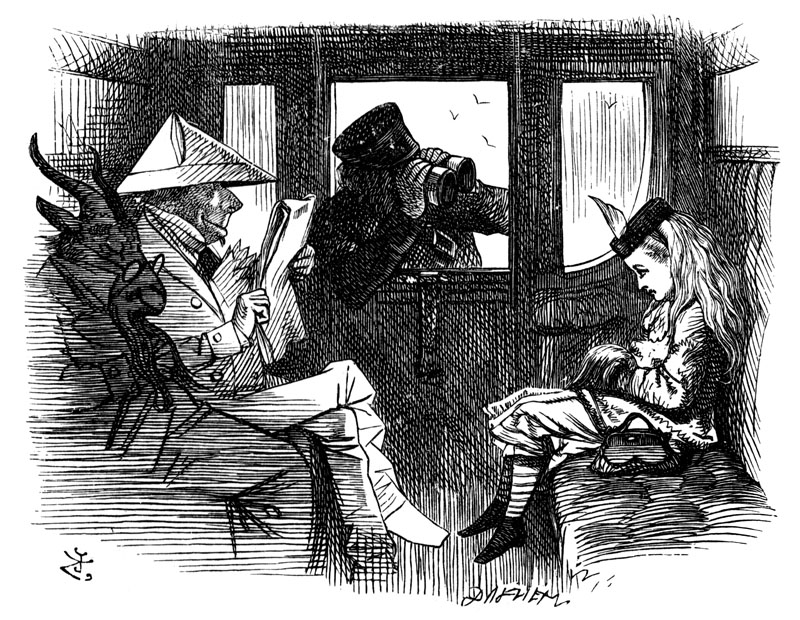
One of John Tenniel’s illustrations for Through the Looking-Glass (1871).

The collaboration with Carroll, and the production of this clairvoyant illustration gave Tenniel the chance to accuse the killer, whose identity he knew – because he had, at some level, shared in the crime. His capped (or crowned) Guard wears the Diamond and stares, eyeless, at the girl: because he is, or stands for, the Red King. He is checkmated. The Goat accuses him, a Tarot Devil, representing ‘ravishment, force, fatality’. So Tenniel is able to put into his depiction of Alice the details of the murders that the police have never made public. The hands of the victims were always tied in front of them – as Alice’s are, within her muff. They were all strangled with a knotted scarf, such as the one that Alice wears. And a single feather was knotted into their hair. I rest my case.

There’s further divination by Iain Sinclair of Tenniel’s carriage scene in his 1991 novel Downriver but you’ll have to search out the book if you want the rest. The picture above is scanned from my 1908 edition of the two Alice novels which has the sharpest reproductions of Tenniel’s illustrations I’ve seen, not least because they’re printed on quality paper. Later editions often print second- or third-generation copies with the cross-hatched areas reduced to black smudges.

ernst.jpg

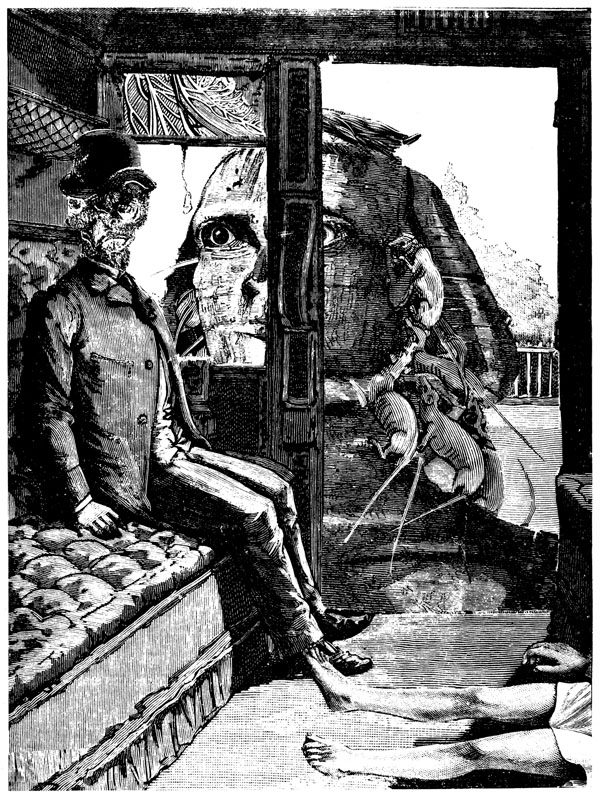
Oedipus by Max Ernst from Une semaine de bonté (1934).

Tenniel’s carriage scene has always been linked for me with this collage by Max Ernst from his Surrealist masterwork, Une semaine de bonté. Sinclair’s proposed murder scenario gives the two pictures an additional resonance when you notice the body on the floor of Ernst’s carriage. Is this Oedipus’s father, recently slain by his son, or some other victim?

ernst2.jpg

Lithograph by Max Ernst from Lewis Carroll’s Wunderhorn (1970).

Salvador Dalí illustrated Alice’s Adventures in Wonderland in 1969 which perhaps prompted Ernst’s own set of mysterious Alice-inspired lithographs a year later. I’ve yet to see a complete set of the Ernst prints, if anyone has a link then please leave a comment. The artist’s collage novel is a lot easier to find since it’s one of the many great books that Dover Publications keep in print.

Previously on { feuilleton }
Through the Psychedelic Looking-Glass: the 2011 calendar
Jabberwocky
Alice in Acidland
Return to Wonderland
Dalí in Wonderland
Virtual Alice
Psychedelic Wonderland: the 2010 calendar
Charles Robinson’s Alice’s Adventures in Wonderland
Humpty Dumpty variations
Alice in Wonderland by Jonathan Miller
The Illustrators of Alice

Compass Road by Iain Sinclair

sinclair.jpg

I was hoping to get my delayed 2011 calendar launched today but other work needed completing so here’s an interim post.

Think of your journey through mortality as a sequence of valid movies and the pain is ameliorated. Forget the tedious 60-minute division of the lecture hall or dead television (quartered by adverts): arrange just enough markers for the 90-minute slots of Golden Age cinema. And then it’s only a question of nominating the eight guides, culture-figures who will dominate your thoughts (and reveries) for as long as you stay upright. The road is endless, you aren’t. Iain Sinclair

There may be a recession on but people still keep putting out the luxury goods; maybe the bankers are buying all this stuff with their unwarranted bonuses. Compass Road is a limited edition wristwatch from Mr Jones Watches, London, and sports a design commissioned from writer Iain Sinclair, a somewhat surprising choice given that these things are more usually farmed out to those individuals we have to call celebrities. Sinclair is too intelligent and interesting to be a mere celebrity and consequently designs a watch I’d probably buy if I had an excessive income. The watch middle and the hands are based on the British road signs designed by Margaret Calvert and Jock Kinneir while the typeface used for the compass points is Calvert and Kinneir’s Transport (below) which is also used across Britain’s road signs. For the destinations Sinclair has chosen eight writers with London associations: John Clare, Gerald Kersh, Bram Stoker, Joseph Conrad, William Blake, HG Wells, JG Ballard and Louis-Ferdinand Céline. The last seems an odd choice but he did work in London for a while.

transport.jpg

Sinclair’s design is a flexible enough to be applied to other literary cities which raises the question of which names you’d choose for Paris, say, or New York. And which signage systems? Subways or the local roads? Compass Road meanwhile can be yours for £145.

Weekend links: Hodgson edition

hodgson.jpg

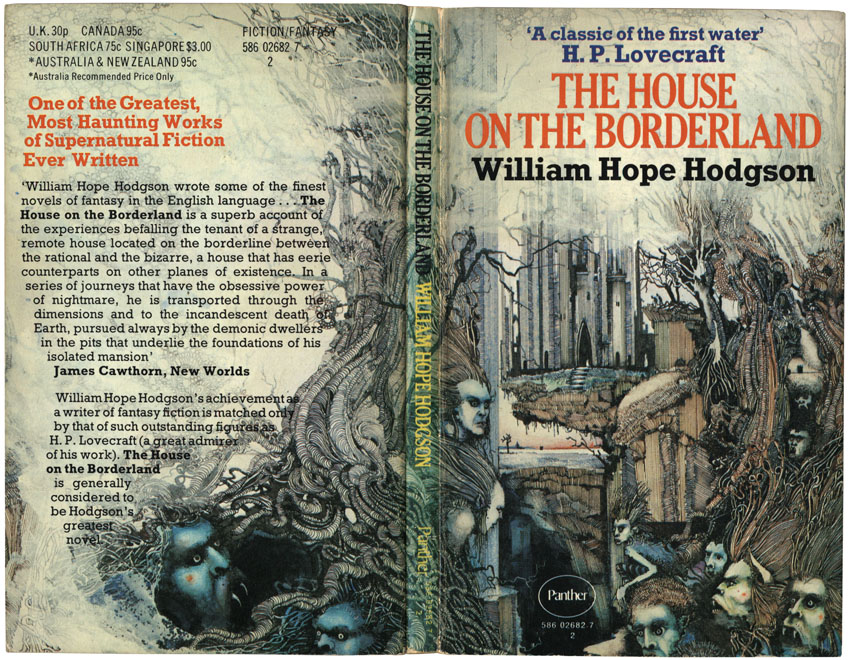
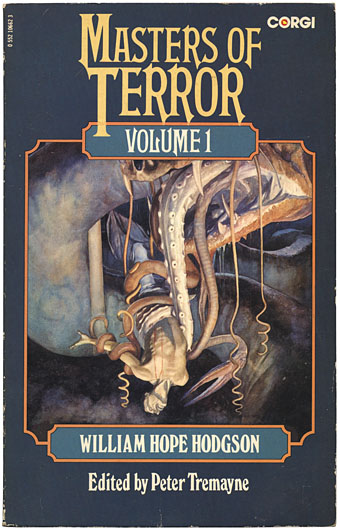
Masters of Terror, Vol 1, Corgi Books, 1977. No illustrator credited.

It was all happening this week so there’s a lot to get through. Are you ready? Deep breath…

For ye Hogge doth be of ye outer Monstrous Ones, nor shall any human come nigh him nor continue meddling when ye hear his voice, for in ye earlier life upon the world did the Hogge have power, and shall again in ye end.

The Hog (c. 1910) by William Hope Hodgson.

• “The Hog is Hodgson’s most nakedly Jungian setpiece; fetid waves of archetypes sweep repeatedly against the thin walls of quotidian reality.” Thus Iain Sinclair, writing in a 1991 afterword to Carnaki the Ghost-Finder which I highly recommend to both Hodgson and Sinclair enthusiasts. China Miéville dissected Hodgson’s Hog on Wednesday and a few hours later a student protest in London turned into an assault on the Tory HQ. Coincidence? Here at {feuilleton} we only offer the facts, it’s up to you to join the dots. M John Harrison approved. Of the protest, that is, not the raising of Porcine Malevolence from the Gulfs Beyond, although he might approve of that as well.

• Further Hodgsonia: Science of The Night Land: Dying Suns and Earth Energy while for real devotees there’s Andy Robertson’s Night Land site.

• “Amplifying the vibrations of the ether” for a view “beyond the limits of ordinary life”: The Fugitive Futurist (1924), a remarkable short film at the BFI’s YouTube channel in which Trafalgar Square is flooded, a monorail crosses Tower Bridge and a dirigible takes to the air over the Houses of Parliament. Also Trafalgar Square Riot (1913), a newsreel with suffragettes at the centre of a civil disturbance. Some of the critics of Wednesday’s events seem to have forgotten that women gained the vote in this country only after repeatedly smashing windows and causing trouble.

• Related to the above: How to Hex a Corporation at Arthur magazine. And let’s not forget Hakim Bey’s Occult Assault on Institutions.
ian_miller4

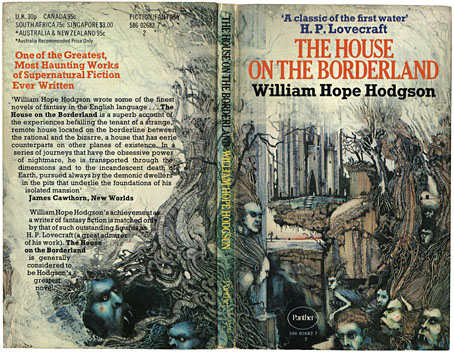
Cover illustration by Ian Miller (1972). The other great cover for THOTB was by Ed Emshwiller in 1962.

The wanderings of the Narrator’s spirit through limitless light-years of cosmic space and Kalpas of eternity, and its witnessing of the solar system’s final destruction, constitute something almost unique in standard literature.

HP Lovecraft reviewing Hodgson’s The House on the Borderland in Supernatural Horror in Literature.

• Lovecraft has long cast a shadow over Hodgson’s fevered visions even though words of praise like those above have done much to keep the earlier writer’s work in print. I’ve been talking for years about doing a series of illustrations for The House on the Borderland and may yet make good on that threat; never say never. Meanwhile, Rick Poyner returned to Design Observer this week pondering the challenge of non-Euclidean architecture in What does HP Lovecraft look like?
hodgson2.jpg

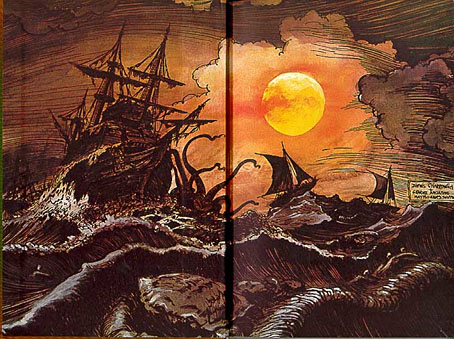
Druillet illustrates Hodgson (1971).

• In his latest piece of Barney Bubbles detective work, Paul Gorman discovered the identity of BB’s first design employer, the alluded to but never named Michael Tucker. More surprising for me than the Robert Brownjohn connection is that there’s now a tenuous link between Barney Bubbles and William Gerhardi.

777 classical music album covers from the collection of Dr Horst Scherg. Related: The Golden Age of Wacky Classical LP Covers — Westminster Gold and the Westminster Gold discography.

Chez Fini: Little Augury looks at the work and workplaces (and cats!) of the marvellous Leonor Fini.

• There’s yet more Lovecraft (and much else besides) in Nomad Codes, a new book from Erik Davis.

• The Irrepressibles: “They’re scared of what we’re going to do next”.

• New Scientist asks Is this evidence that we can see the future?

Of Electricity And Water: A Thomas Dolby Interview.

Jarvis Cocker talks to Brian Eno.

Fuck Yeah, Gay Vintage

Hog Callin’ Blues (1962) by Charles Mingus. Play loud and often.

Weekend links 31

bock.jpg

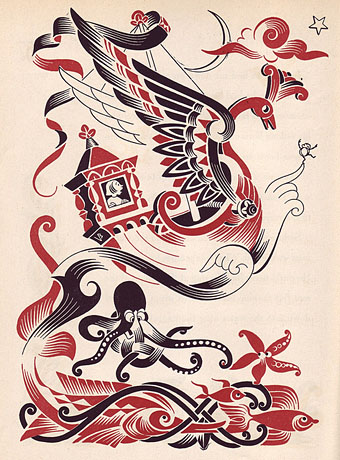
One of a series of illustrations by Vera Bock for A Ring and a Riddle (1944) by M.Ilin and E. Segal. Via A Journey Round My Skull.

The Creator of Devotion: Photos from a Vogue Hommes Japan feature by Matthew Stone. And also here.

Dressing For Pleasure: Jonny Trunk gets out the rubber gear. Related: King of Kinky.

Salvator Rosa (1615–1673) is having a show at the Dulwich Picture Gallery, London.

Hackney Dissenting Academy #1: Throbbing Gristle, Iain Sinclair & Alan Moore.

Out Of The Flesh (1984) by Chakk. A great single never reissued on CD.

• Photographer Charles Gatewood remembers William Burroughs.

mural.jpg

The Endless Mural. Follow links here to have a play around.

Vinyl record sales are at the top of a four-year sales trend.

Can explosions move faster than the speed of light?

• Buckminster Fuller’s Dymaxion Car is reborn.

• Maximus Clarke talks with William Gibson.

Why Stephen Fry loves Wagner.

Kafka’s Last Trial.

• Alice Coltrane in concert, Warsaw, 1987: Harp solo | Impressions | Lonnie’s Lament | A Love Supreme.