Weekend links 482

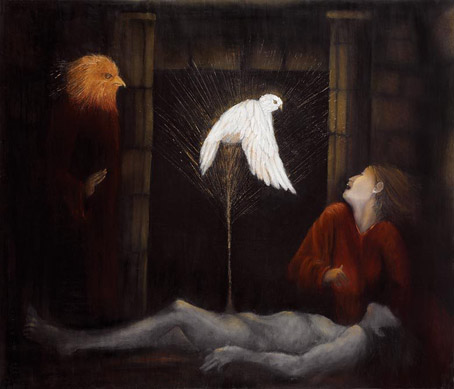
pacheco.jpg

Hades II (2004) by Ana Maria Pacheco.

• I’ve been reading a lot of Angela Carter over the past few weeks so the news of her house in Clapham being awarded a blue plaque was coincidental but also timely. Related: Angela Carter Online, and The Holy Family Album (1991), “a sacrilegious take on the history of Christian painting and iconography” written and narrated by Carter. Also, we’re still some distance from Halloween but take this as a precursor: Vampirella (1976), Angela Carter’s first radio play for the BBC, starring Anna Massey as a vampire countess.

• In May this year the Dark Entries record label announced the discovery of more tapes from Patrick Cowley’s pre-disco years in the 1970s. A selection from the archive, Mechanical Fantasy Box, will be released next month, together with a book of the same name reprinting Cowley’s homoerotic journal from the period.

• More Magma (there’s always more Magma): Warren Hatter on 7 essential albums from their sprawling discography. Related: Magma on film in 1972, appearing in Moi y’en a vouloir des sous, a short but typically intense performance.

• Out in November: Paul Wegener’s adaptation of Gustav Meyrink, Der Golem, wie er in die Welt kam (1920), receives a substantial blu-ray release from Eureka.

• Joe Banks’ forthcoming space-rock exegesis, Hawkwind: Days of the Underground, now has its own website.

• Mix of the week: The Stations Of Summer by Cafe Kaput.

Photos of London’s abandoned Underground stations.

• At Dennis Cooper’s: Alan Boyce grows invisible.

Gudrun Gut‘s favourite albums.

Tanz Der Vampire (1969) by The Vampires Of Dartmoore | Ketch Vampire (1976) by Devon Irons | Vampires (1999) by Pet Shop Boys

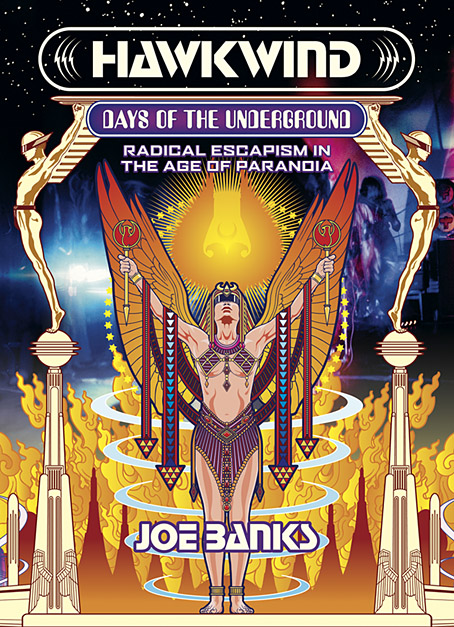
Hawkwind: Days of the Underground

hawkwind.jpg

As mentioned at the weekend, Joe Banks’ account of the first ten years of Hawkwind will be published by Strange Attractor Press later this year with a wraparound cover of my design. I never expected to be doing anything else for Hawkwind after moving on to other things in 1985, but it was the group’s first decade of music that fuelled the drawings which brought me to their attention, so this cover design brings everything full circle. The earliest of my Hawkwind drawings dates to 1979 which means this cover is also an anniversary piece.

The design combines Barney Bubbles’ Space Ritual template with elements of the art he created before and afterwards, notably the inner and outer sleeve of Doremi Fasol Latido, and the futuristic Art Deco of his tour poster for The “1999” Party. All the Bubbles Hawk-art up to and including Space Ritual is a blend of the ancient (Egypt, tribal motifs, characters that resemble pirates or barbarians), the previous century (Art Nouveau in particular), and the far future as depicted in comics and pulp magazines. I wanted to reflect this blend without being too imitative of the details, so the cover works a variation on Space Ritual, with a similar hieratic woman as the focus, and a margin of stylised flames separating the foreground from Laurie Lewis’s photos of the band (the latter are unused shots from the same session used for Space Ritual).

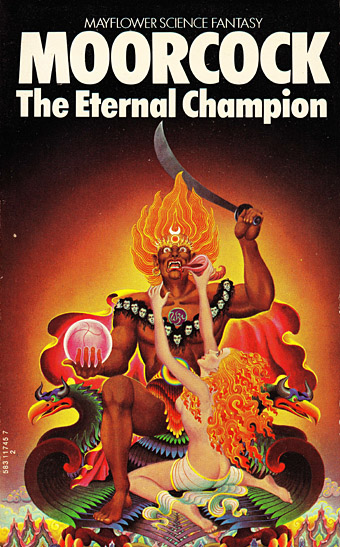
haberfield.jpg

Art by Bob Haberfield, 1970.

All the background elements run across the wrap but this hasn’t been revealed yet so you’ll have to wait a while to see the full design. The flames are based on Tibetan designs in a nod to the ancient side of the equation, as well as Bob Haberfield’s covers for the Moorcock novels published by Mayflower in the early 70s, many of which featured art derived from Tibetan Buddhism. (And one of the Mayflower Moorcocks, The Black Corridor, is the origin of the monologue of the same name on Space Ritual.) The full wrap shows a futuristic city whose Frank R. Paul-derived architecture is either on fire or menaced by a wall of encroaching flames. Many of Hawkwind’s songs of the period concern flight from cities or from the Earth itself—Born To Go, Time We Left (This World Today)—so the back cover also has a number of vehicles fleeing the scene: the radical escapism of the book’s subtitle in literal form. “Sign my release from this planet’s erosion,” as Nik Turner sings in Brainstorm.

Continue reading “Hawkwind: Days of the Underground”

Weekend links 480

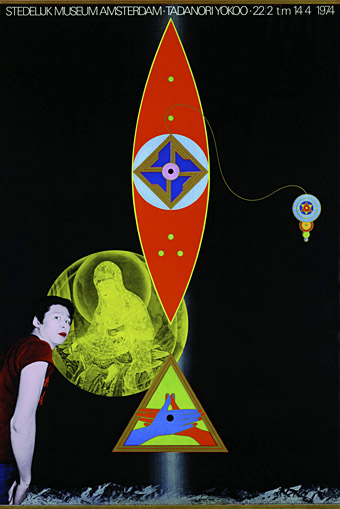
yokoo.jpg

Tadanori Yokoo (1974) by Tadanori Yokoo and Will van Sambeek. A poster from the Colourful Japan exhibition at the Stedelijk Museum, Amsterdam.

• The first decade of space-rock pioneers Hawkwind is explored by Joe Banks in Hawkwind: Days of the Underground — Radical Escapism in the Age Of Paranoia, coming soon from Strange Attractor Press. I created the wraparound cover for this one, and will be talking about it here in a later post. Those interested in the book should note that the special edition hardback will include an extra book, plus a print and postcards. Limited to 500 copies so don’t wait around.

• “What we look for in our formative years can be very different from the demands we make later as analytical adults, and it was certainly more important to me that representations of gayness were complex or colourful than that they were positive, whatever that meant.” Ryan Gilbey on 50 years of Midnight Cowboy.

• Mixes of the week: Through A Landscape Of Mirrors Vol. II – France I by David Colohan, and As Imperceptibly As Grief The Summer Lapsed Away by Haunted Air.

If we imagine the material world about us having a concealed component of the fictional and the fantastic, visions buried in its stones and mortar waiting for their revelation, then we may suppose that 18th-century Lambeth was a teeming hub of such imaginal biodiversity. Bedlam alone could account for this ethereal population boom, but then nearby was the Hercules Buildings residence of William Blake, which can have only added to the sublime infestation.

Alan Moore on the visionary art of William Blake

• At the Internet Archive: Ten issues of Ed Pinsent’s The Sound Projector Music Magazine (1996–2002), with bonus Krautrock Kompendium.

• “Like many dictators Franco considered himself an artist.” Jonathan Meades on how fascism disfigured the face of Spain.

Occulting Disk is a new album from the master of unnerving doomscapes, Deathprod, which will be released in October.

• Making MAD: Chris Mautner on the beginning and end of MAD magazine.

John Margolies’ photographs of roadside America.

Fair Sapphire by Meadowsilver.

Jarboe‘s favourite music.

Theme from Midnight Cowboy (1969) by John Barry | Astral Cowboy (1969) by Curt Boettcher | Dayvan Cowboy (2005) by Boards Of Canada

Weekend links 458

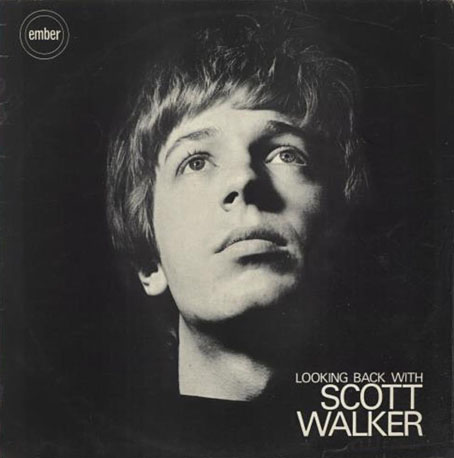
scott.jpg

Photo by Dezo Hoffmann, 1968.

If there’s one thing everyone can agree on about the late Scott Walker it’s that his career was not only improbable but almost impossible in its range and trajectory. My mother saw the Walker Brothers perform in Blackpool 52 years ago, headlining a touring bill that featured Cat Stevens (the artist she most wanted to see) and the soon to be very famous Jimi Hendrix. She enjoyed good pop songs and big orchestras, so even though she’s never expressed a preference for the Walker Brothers or Walker solo I’m sure she could listen to an album or two. But she wouldn’t be able to stand more than a minute of Walker’s output from Tilt (1995) onwards, and even the four watershed tracks on Nite Flights (1978) would be deemed unacceptable. Walker’s progress inverted the stereotype of the 20th-century pop career, the all-too-common descent into blandness and irrelevance, by following a course closer to that taken by painters and literary artists. He walked the walk.

• When Scott Walker’s Climate Of Hunter was announced in 1984, Richard Cook persuaded its introverted creator to talk to the press for the first time in many years. Cook and Walker met again in 1995 when Tilt was released. From 2008: Sean O’Hagan talking to Scott Walker two years after the release of The Drift; at The Wire again: a recording of Rob Young discussing Walker’s career; at the BFI: Scott Walker’s selection of some favourite films; at The New Yorker: Amanda Petrusich on the weird and vast and periodically devastating music of Scott Walker.

• At The Paris Review: Jane Alison suggests meanders, spirals, radials, fractals and cells as alternative to the narrative arc, while Peter Bebergal argues for seeing belief and disbelief in a superposition when it comes to art and the occult.

Sarasota Half in Dream, a feature-length documentary by Derek Murphy and Mitchell Zemil about a decaying Florida suburb.

• Chris Marker, Always Moving: Max Nelson on a Paris exhibition, Chris Marker, les 7 vies d’un cinéaste.

• There’s a little more Scott Walker, inevitably, in this interview with Stephen O’Malley of Sunn O))).

Michael Moorcock talking to The Austin Chronicle about his long association with Hawkwind.

M. John Harrison chooses favourite stories for Jonathan Gibb’s Personal Anthology series.

• Rat Cunning and Bloodshed: An interview with Simon Sellars by Lee Rourke.

In Search of the Seas of Pleiades, a free download by Jenzeits.

• Rammstein are back with a video epic: Deutschland.

Sex Magick is Satanic doo-wop by Twin Temple.

Time, Forward! by Georgi Sviridov.

Orpheus (1967) by The Walker Brothers | Lullaby (By-By-By) (2000) by Ute Lemper | Darkness (2006) by Scott Walker

The Ingenious by Darius Hinks

hinks.jpg

My latest cover for Angry Robot Books was revealed this week at the Barnes & Noble blog (where I talk a little about the design aspects) so here it is. The Ingenious is an alchemy-themed fantasy by Darius Hinks, the brief for which required a depiction of the city of Athanor, the central character, Isten, and some indication of the novel’s occult flavour:

Thousands of years ago, the city of Athanor was set adrift in time and space by alchemists called the “Curious Men.” Ever since, it has accumulated cultures, citizens and species into a vast, unmappable metropolis.

Isten and her gang of half-starved political exiles live off petty crime and gangland warfare in Athanor’s seediest alleys. Though they dream of returning home to lead a glorious revolution, Isten’s downward spiral drags them into a mire of addiction and violence. Isten must find a way to save the exiles and herself if they are ever to build a better, fairer world for the people of their distant homeland.

I was also asked to do something in the detailed drawing style of artists such as Philippe Druillet and Ian Miller, a challenge I was happy to accept with the proviso that both those artists are inimitable. As I say in the B&N post, I went in a Miller direction although I don’t know whether anyone would spot the influence. I was more overt years ago in some of my borrowings from Druillet whose aesthetics can be discerned in my poor artwork for Hawkwind and my much better artwork for The Call of Cthulhu. The background pattern was the kind of thing I often do where I spend hours working on something then cover it over, but more of the interlacing and symbolism (all genuine alchemical symbols) will be visible on the back of the book.

The Ingenious will be published on 9th February, 2019.

Previously on { feuilleton }
De Sphaera
Delineations
Musaeum Hermeticum
A triangular book about alchemy
Alembic and Ligier Richier
Atalanta Fugiens
Splendor Solis revisited
Laurie Lipton’s Splendor Solis
The Arms of the Art
Splendor Solis
Amphitheatrum Sapientiae Aeternae
Cabala, Speculum Artis Et Naturae In Alchymia
Digital alchemy