Weekend links 264

dakin.jpg

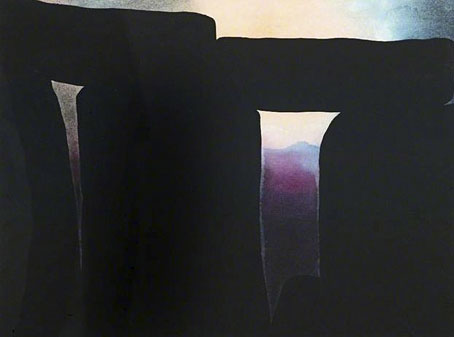
Stonehenge Suite, No.10 (1977) by Malcolm Dakin.

• “Part of me always wanted to write a teatime drama. That’s something that I wanted to get out of my system,” says director Peter Strickland. The results may be heard here. In the same interview there’s news that Strickland will be adapting Nigel Kneale’s The Stone Tape for radio later this year.

• “He was, as one obituary stated in terms unusually blunt for the time, ‘not as other men’.” Strange Flowers on the eccentric and profligate Henry Cyril Paget (1875–1905) aka The Dancing Marquess.

• “Please tell Mr Jagger I am not Maurits to him.” MC Escher rebuking The Rolling Stones. The artist is the subject of a major exhibition at the National Galleries of Scotland from June 27th.

Often mentioned in the same breath as works of James Joyce and Samuel Beckett, Ó Cadhain’s novel is, in some ways, even more radically experimental. For starters, all the characters are dead and speaking from inside their coffins, which are interred in a graveyard in Connemara, on Ireland’s west coast. The novel has no physical action or plot, but rather some 300 pages of cascading dialogue without narration, description, stage direction, or any indication of who’s speaking when.

Niamh Ní Mhaoileoin on the newly-translated Cré na Cille (The Dirty Dust) by Máirtín Ó Cadhain

Paul Woods examines “10 Edgy Properties No Film Producer Dared To Touch
(Yet)”. No. 2 is David Britton’s Lord Horror.

Mallory Ortberg ranks paintings of Saint Sebastian “in ascending order of sexiness and descending order of actual martyring”.

The Sign of Satan (1964): Christopher Lee in a story by Robert Bloch for The Alfred Hitchcock Hour.

Sympathy For The Devil – The True Story of The Process Church of the Final Judgment.

• At Dangerous Minds: Paul Gallagher on the seedy malevolence of Get Carter (1971).

• Mix of the week: Sonic Attack Special – Earth by Bob’s Podcasts.

Sanctuary Stone (1973) by Midwinter | The Litanies Of Satan (1982) by Diamanda Galás | Sola Stone (2006) by Boris
Weekend links 263

nakayama.jpg

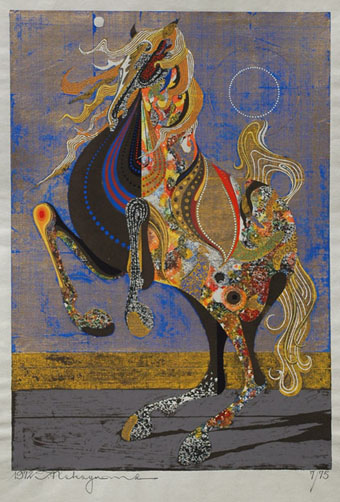
Dancing Horse (1972) by Tadashi Nakayama.

• The Wounded Galaxies Festival of Experimental Media takes place in Bloomington, Indiana, on October 7–11, 2015. The event is an offshoot of the earlier Burroughs Century, and the phrase “wounded galaxies” is one of Burroughs’ own. It’s also the partial title of Wounded Galaxies Tap At The Window, the most recent album by Cyclobe who will be performing at the festival. Cyclobe’s Stephen Thrower will be in London later this month for the launch of his new book, Murderous Passions: The Delirious Cinema of Jesús Franco, and a screening of Franco’s Vampyros Lesbos (1971).

• Gallery sites showcasing erotic art are often coy about the details of the work they’re exhibiting. That’s not the case with Artists Space, NYC, whose Tom of Finland: The Pleasure of Play is running from June 14–August 23, 2015.

• “I just loved the songs, and I didn’t mind the age in their voices, and I didn’t mind the fact that they were unaccompanied, it didn’t matter.” Shirley Collins talking to Ben Graham about her love of English folk music.

The more important question is what do we do with psychedelia now? I think the drugs themselves and the experiences they produce in individuals and for society are too important and vital to be pigeon-holed and taken hold of by a bloodthirsty media that always aims to reduce all experience to a few simple straplines for improved consumerism.

Dr Ben Sessa talking to Barnaby Smith about psychedelic drugs. Breaking Convention 2015, the Third International Conference on Psychedelic Consciousness, takes place at the University of Greenwich next month.

• “…if someone opens a door or if sunlight falls on them they shoot off the grid and suddenly you have a roomful of what sounds like sick bagpipes.” Will Gregory on the physicality of Moog synthesizers.

• Mixes of the week: The Necromancer-Queens of Neverland, an exotic collection by SeraphicManta, Secret Thirteen Mix 156 by Asusu, and an Ornette Coleman playlist.

• “In 2015, the thought of anything as incendiary as Scum or Made in Britain turning up on TV just seems bizarre.” Danny Leigh on the great Alan Clarke.

• More psychedelia: ‘Art That Transcends‘, my article for Communication Arts, has been posted on the magazine’s website.

Phantasmaphile recommends Thus Were Their Faces, a collection of short stories by Silvina Ocampo.

Earth filmed playing live in Brooklyn, NY, September 24, 2014. The full set, and a great performance.

• At Dangerous Minds: “How Far Will You Go?” Meet Smokey, the outrageously gay 70s cult rockers.

Peter Strickland on six films that fed into The Duke of Burgundy.

Things I Found In Records

Christopher Lee sings!

Polly On The Shore (1970) by Shirley & Dolly Collins | The Quiet Joys Of Brotherhood (1972) by Sandy Denny | The Banks of Red Roses (1988) by June Tabor

The Cosmic Grill

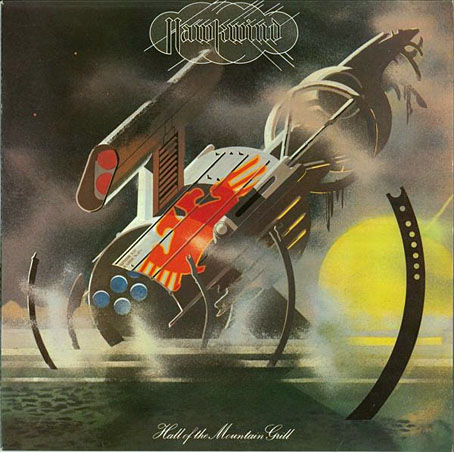
hotmg1.jpg

Design and illustration by Barney Bubbles.

The past week’s music listening has alternated between the back catalogue of Seattle band, Earth (who I recommend highly), and the early recordings of my erstwhile employers, Hawkwind. The latter were reissued recently in a 10-CD box, This Is Your Captain Speaking…Your Captain Is Dead (The Albums And Singles 1970–1974) which I also recommend, it’s very good value, and packages the albums in those facsimile card sleeves that now seem de rigueur for album reissues. A swathe of my rare Hawkwind vinyl got sold off circa 1990, and I’ve never replaced any of the albums or singles so this was a good opportunity to catch up. If you like this period of the band there’s the added bonus of the complete Greasy Truckers concert from the Roundhouse in 1972, a ramshackle performance that nonetheless sounds pristine (my Greasy Truckers vinyl—which I do still own—was ruined by a previous owner with a spillage of tea on the Hawkwind side); there’s also the entirety of the 1999 Party concert from Chicago which I’d not heard before.

hotmg2.jpg

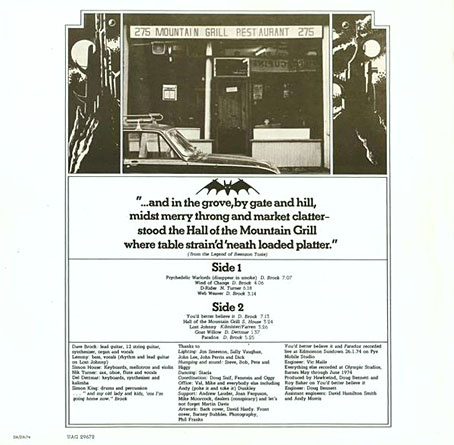
Listening again to Hall Of The Mountain Grill (1974) had me thinking about the origin of the album’s title. Hawkwind never took themselves as seriously as many of their contemporaries, but naming an album of ostensible space rock after a very mundane café in the Portobello Road was one of their more eccentric moments. The humour is compounded by Barney Bubbles’ cover design which for the title uses the kind of typeface (Palace Script) that you see on menus; on the inner sleeve there’s a photo of the fabled restaurant flanked by a pair of Barney’s futuristic towers. The verse beneath the photo (“from the Legend of Beenzon Toste”) refers to nearby Ladbroke Grove, and, of course, to Notting Hill Gate which in 1974 was still a haven for counterculture freaks, the very antithesis of that film. The verse was probably the work of Robert Calvert who explained the attraction of the restaurant in Pete Frame’s Hawkwind family tree:

The Mountain Grill was a working man’s café in Portobello Road—frequented by all the dross and dregs of humanity. Dave Brock always used to go and eat there—which is how I first met him…because I used to eat there too, when I worked on Frendz magazine. It was a kind of Left Bank café/meeting place for Notting Hill longhairs—a true artists’ hangout…but it never became chic, even though Marc Bolan, David Bowie and people like that often went there to eat lunch.

portobello.jpg

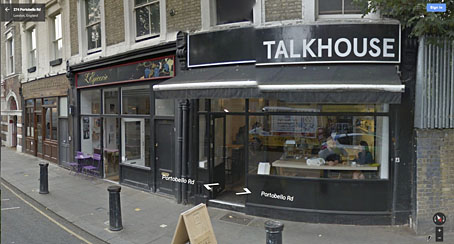
Photos on Flickr show how the place looked in 1977 when the sign from the album sleeve was still intact, and also in 2003 shortly before the restaurant closed down. The premises are a very different kind of eaterie today, remodelled and upmarket as befits a gentrified area.

Previously on { feuilleton }
Void City
Hawk things
The Sonic Assassins
New things for July
Barney Bubbles: artist and designer

Art that transcends

ca56.jpg

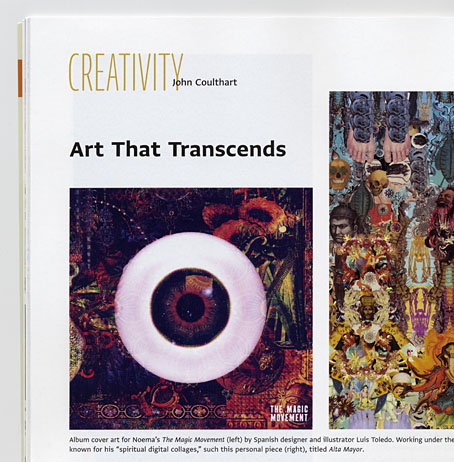
Late last year, US design magazine Communication Arts asked me to write a piece about psychedelic art, past and present. The resulting feature has been out for a couple of weeks in the May/June issue (no. 56) but I hadn’t seen it in print until a copy turned up today. Attempting to wrangle discussion of a very wide-ranging and amorphous field into 1500 words isn’t an easy task but I managed to sketch a history of psychedelic art beginning with Aldous Huxley and Humphrey Osmond’s mescaline experiments in the 1950s. Art that can be considered psychedelic goes back into prehistory but Huxley’s The Doors of Perception (1954) is the first book that considered art in general from a psychedelic viewpoint. That book, and the later Heaven and Hell (1956), are still valuable for their aesthetic meditations however much Huxley’s optimism may have been tainted by the ferment of the 1960s.

earth.jpg

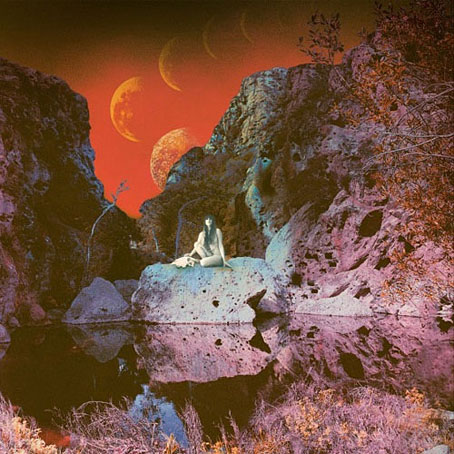
Primitive And Deadly (2014) by Earth. Art by Samantha Muljat.

The psychedelic art of the 60s isn’t exactly overlooked so I paid more attention to tracing the influence of the psychedelic style, and also mentioning painters such as Ernst Fuchs, Alex Grey, Martina Hoffmann and Mati Klarwein. Among the more recent artists, I was pleased that Samantha Muljat‘s album cover for Earth was featured. I’ve been listening to this album a great deal over the past few months, and loved that cover as soon as I saw it. One of the other contemporary names, Brazilian artist Duda Lanna, works in a very different style: bold, vivid, and often abstract. There seems to be a lot of this kind of work around at the moment, so much so that I kept spotting new examples after the article had been delivered. It’s difficult to say whether this is a developing trend or simply a case of there being more of everything around these days. I’ll play safe and suggest it’s probably a bit of both although, as I say at the end of the article, if the movement to legalise drugs gains momentum we can expect to see a lot more psychedelic art.

lanna.jpg

Garden of Psychedelic Delights by Duda Lanna.

Weekend links 225

mori.jpg

Still from The Shaman-Girl’s Prayer (1997), a video piece by Mariko Mori. This page has pictures of Mori’s futuristic/cosmic performances, films & environments.

Time Out of Mind (1979) was a BBC TV series about science fiction writers, five short films concentrating on Arthur C. Clarke, John Brunner, Michael Moorcock, Anne McCaffrey and an sf convention. I was only interested in the Moorcock film at the time, not least because it featured a short clip of Hawkwind playing Silver Machine, and inserted scenes from the film of The Final Programme (1973) between the interviews. The Moorcock episode is less about his books than about New Worlds magazine and the so-called New Wave of sf in general, so you also see rare footage of M. John Harrison in a Barney Bubbles “Blockhead” T-shirt talking then ascending a limestone cliff, and bits of interviews with Brian Aldiss and Thomas Disch. Ballard isn’t interviewed but is present via a scene from the Harley Cokeliss film Crash! (1971) in which Gabrielle Drake slides in and out of a car while someone reads Elements of an Orgasm from The Atrocity Exhibition.

• “…there happened to be a book on Ritual Magick that talked about John Dee and summonings and Dr. Faust and all that kind of stuff. So then obviously at that age, too, I read HP Lovecraft and then Michael Moorcock and what they call fantasy literature. Through HP Lovecraft I discovered Arthur Machen, and I think that sort of percolated down inside…” Dylan Carlson of Earth talking to Steel for Brains. The Wire has the vinyl-only track from the new Earth album, Primitive And Deadly, and a track from Carlson’s solo album, Gold. Related: Artwork by Samantha Muljat, designer/photographer for the new Earth album.

Phantasmaphile has details of the next two issues of deluxe occult magazine Abraxas. Issue 6 includes a major feature on Leonora Carrington while Luminous Screen is a special issue devoted to occult cinema.

• More Broadcast: Video of a performance at Teatro Comunale di Carpi, March 2010 (part 2 here), and “constellators and artifacts” at A Year In The Country.

• “Petition demands return of ‘Penis Satan’ statue to Vancouver.” There’s an uncensored photo of the contentious statue here.

• Literary Alchemy and Graphic Design: Adrian Shaughnessy on James Joyce’s writings among graphic designers.

• Frank Pizzoli talks to John Rechy about “the gay sensibility”, melding truth and fiction, and his literary legacy.

• Mixes of the week: Secret Thirteen Mix 127 by Roberto Crippa, and FACT Mix 459 by Craig Leon.

Alan Moore has finished the first draft of his million-word novel, Jerusalem.

• Crazy pavings: Alex Bellos on Craig Kaplan’s parquet deformations.

Noise Not Music: “Live recordings, obscure cassettes and more…”

Pylon of the Month

Zoot Kook (1980) by Sandii | Rose Garden (1981) by Akiko Yano | Telstar (1997) by Takako Minekawa