Weekend links 799

cope.jpg

A Night Alarm: The Advance! (1871) by Charles West Cope.

• At Spoon & Tamago: Meet the artist creating humorous, nihonga-style images of daily life with their rescue cat.

• The thirteenth installment of Smoky Man’s exploration of The Bumper Book of Magic has been posted (in Italian) at (quasi).

• New music: I Remember I Forget by Yasmine Hamdan; Clearwater by Maps And Diagrams.

His boss was a cards-to-his-chest type named Boynt Crosstown—and here I admit to having dropped that in as the merest excuse to revel right now in more of Pynchon’s christenings: Dr. Swampscott Vobe, Wisebroad’s Shoes, Connie McSpool, Glow Tripworth de Vasta, Cousin Begonia, “child sensation Squeezita Thickly”—for this author’s longstanding genius there on that private swivel chair of the Department of Character Appellations matches long-gone Lord Dunsany’s for imaginary gods and cities.

William T. Vollmann reviews Shadow Ticket, the new novel by Thomas Pynchon

• At Colossal: Twelve trailblazing women artists transform interior spaces in Dream Rooms.

• At Public Domain Review: Ballooning exploits in Travels in the Air (1871 edition).

• At the BFI: Josh Slater-Williams on where to begin with the films of Satoshi Kon.

Colm Tóibín explains why he set up a press to publish László Krasznahorkai.

• At Print Mag: Ken Carbone on a pool of perfection in Paris.

• Mix of the week: Bleep Mix #310 by Rafael Anton Irisarri.

• Steven Heller’s font of the month is OTC Textura.

Ron Mael’s favourite albums.

Shadowplay (1979) by Joy Division | Shadow (1982) by Brian Eno | Shadows (1994) by Pram
Weekend links 585

bertha_lum.jpg

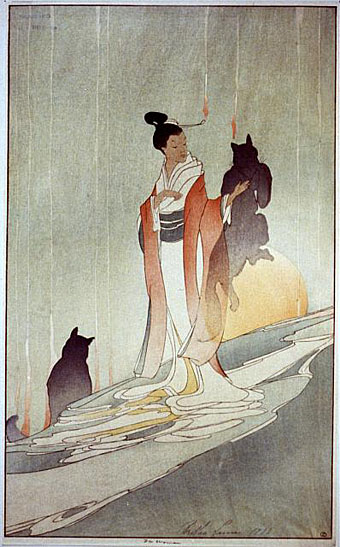
Fox Woman (c. 1916) by Bertha Lum.

• “Apparently he had been walking though customs/arrivals with a large cube of weed stuck on the end of his silver Dr Martens and a foot long silver flashlight full of seed, but when they realised who he was, and that today was his 60th birthday, he was released with just a warning.” Radio Lancashire DJ Steve Barker remembers the late Lee “Scratch” Perry, and links to one of his shows with Perry (and Roger Eagle) here.

• “…it’s the chase itself that shapes the film’s distinctive aesthetic—the under-lit interiors and the sunless and frigid exteriors of the many locations across the city, sites that take the cops well beyond their usual beat, to places both above and below ground.” Chris McGinley explains how William Friedkin’s The French Connection reinvented (and exploded) the police procedural.

• “Toibin, who is himself gay, has always extended historical sympathy to sexual outsiders. As he’s written elsewhere, ‘There are no 19th-century ballads about being gay.'” Dwight Garner reviews Colm Toibin’s The Magician, a novel about Thomas Mann.

Here is the key point: to experience such marvels you have to risk an unsophisticated, even credulous love for corn, and part of that love involves a willingness to submit to what [Phil] Ford calls a “magical hermeneutics” capable of transforming marginal chunks of pop culture. As he writes in the wonderful 2008 essay that inspired the episode, exotica is “less a genre of music than a class of cultural objects that share a characteristic projection of the self across boundaries of space and time.” This makes it essentially psychedelic—“film music for daydreams”—and Ford draws out that historical connection in his essay, which argues that while the hippie movement that Nature Boys like Ahbez prophesied looks like a radical rejection of the space-age bachelor pad of ’50s consumerism, tendrils of transcendent yearning link the exotica imaginary to the earnest if stoned mysterioso to come.

Erik Davis on Eden Ahbez and Californian exotica

Edgar Froese interviewed on WSHU radio in 1974 where he talks about Tangerine Dream, live performance and the future of electronic music.

• At Dangerous Minds: A momentary lapse of reason…when Dario Argento interviewed Pink Floyd in 1987.

• It’s that man again: John Doran interviews Kevin Martin, aka The Bug.

David McKenna on The Strange World of France, La Nòvia & friends.

• At Dennis Cooper’s: Tape deck.

Exotica (1958) by Martin Denny | Exotica Lullaby (1976) by Harry “The Crown” Hosono | Exotica (1979) by Throbbing Gristle

Weekend links 465

palladini.jpg

The Star (1970) from The Aquarian Tarot by David Palladini.

• Artist David Palladini died in March but I only heard the news this week. His poster for Werner Herzog’s Nosferatu has been a favourite of mine ever since the film’s release, while some of his other works have featured here in the past. Still popular among Tarot users is the Aquarian Tarot (1970), a deck published a few years after Palladini had helped with the production of the Linweave Tarot. From the same period as the Aquarian deck is a set of Zodiac posters, all of which exhibit Palladini’s distinctive blend of Art Nouveau and Deco stylings. In addition to posters, Palladini produced book covers and illustrations, and even a few record covers. A book collecting all of this work would be very welcome.

Erotikus: A History of the Gay Movies (1974? 75? 78?): Fred Halsted presents a 90-minute history of American gay porn, from the earliest beefcake films to the hardcore of the 1970s, some of which Halsted also helped create. Related: Centurians of Rome [sic]: Ashley West and April Hall on the bank robber who made the most expensive gay porno of all time.

Peter Bradshaw reviews Too Old to Die Young, a Nicolas Winding Refn TV series described as “a supernatural noir”. Sign me up.

Naomi Wolf’s Outrages establishes the context for [John Addington] Symonds’s desperate efforts to justify his own sexual feelings. Since he was born in 1840, he was 15 when the first edition of Walt Whitman’s Leaves of Grass appeared, the same year that legislation in Britain streamlined the laws against sodomy and ensured that men found guilty of it served long prison sentences. With intelligence and flair, Wolf uses the various responses to Whitman to show the levels of intense need in the decades after the publication of Leaves of Grass for images and books that would rescue homosexuality from increasing public disapproval.

Colm Tóibín reviews Outrages: Sex, Censorship and the Criminalisation of Love by Naomi Wolf

• Record label Dark Entries has discovered 40 more reels (!) of music by Patrick Cowley dating from 1974 to 1979.

• “Is Stockhausen’s Licht the most bonkers operatic spectacle ever?” asks Robert Barry.

• Sex, Spunk, Shoes and Sweet Satisfaction: A Q&A with artist Cary Kwok.

• Tripping his brains out: Eric Bulson on Michel Foucault and LSD.

• Paul O’Callaghan chooses 10 best Dennis Hopper performances.

• “More obscene than De Sade.” Luc Sante on the fotonovela.

• Karl Blossfeldt’s Urformen der Kunst (1928).

• The Strange World of…Gong

Neonlicht (1978) by Kraftwerk | Brüder Des Schattens, Söhne Des Lichtes (1978) by Popol Vuh | Lichtfest (2017) by ToiToiToi

Weekend links 341

fountaingod.jpg

Fountain (1917) by R. Mutt (Marcel Duchamp), and God (1917) by Elsa von Freytag-Loringhoven.

• “What is there left to know about David Bowie? What is there left to unearth?” asks Ian Penman whose lengthy review of recent Bowie books is better by far than a shelf full of cash-in doorstops.

Strázci z hlubin casu is a collection of stories by HP Lovecraft and August Derleth from Czech publisher Volvox Globator. The book reprints artwork of mine on the cover and inside.

• Mixes of the week: Through December by David Colohan, At Alien Altars: A Conjurer’s Hexmas by Seraphic Manta, and Secret Thirteen Mix 204 by James Welburn.

• “Something vindictive resides in soot.” Timothy Jarvis on the weird fiction of Stefan Grabiński. From 2003: China Miéville on Grabiński.

• Paintings by Jakub Rozalski of eastern European peasants with mechas and werewolves.

Colm Tóibín on James Joyce’s A Portrait of the Artist as a Young Man, 100 years on.

Jesse Singal on why straight rural men (in the USA) have “bud-sex” with each other.

Mark Valentine recommends books on tasseography, or divination by tea leaves.

• “Northampton Calling: A Conversation with Alan Moore,” by Rob Vollmar.

Bill Schutt at Scientific American asks what human flesh tastes like.

Gwendolyn Nix on the Tritone, aka The Devil’s Musical Interval.

• At Dennis Cooper’s: _Black_Acrylic presents…Penda’s Fen Day.

• The latest Buddha Machine from FM3 is Philip Glass-themed.

Listen to The Wire’s top 50 releases of 2016

Tritone (Musica Diablo) (1980) by Tuxedomoon | Diabolus In Musica (1987) by The Foetus All Nude Review | Tritone (Musica Diablo) (2016) by Aksak Maboul

Weekend links 324

waliszewska.jpg

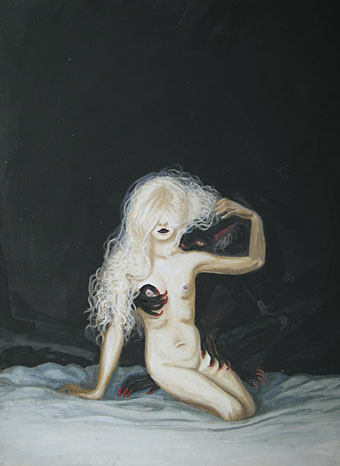
Untitled painting by Aleksandra Waliszewska. The artist is profiled by S. Elizabeth at Dirge Magazine.

• “…from my point of view, the only thing to do with any genre, any medium, is pretty much to break it, to transcend it, to find out what its limits are, and then go beyond them, and see what happens.” Alan Moore (again) talking to Heidi MacDonald about his novel, Jerusalem, which is out next month.

• A Monument to Outlast Humanity: Dana Goodyear gets the reclusive Michael Heizer to talk about his decade-spanning sculptural project, City, work on which is almost finished.

William Burroughs’ appearances in adult men’s magazines: a catalogue which includes some downloads of uncollected Burroughs essays and other writings.

• Mixes of the week: Homegirls & Handgrenades Mix by Moor Mother, Secret Thirteen Mix 194 by Kareem, and hieroglyphics #014 by Temples.

Remoteness of Light is a new album by The Stargazer’s Assistant inspired by the depths of the oceans and the vastness of space.

• RIP Gilli Smyth. “The silliness ran deep in Gong, but they could groove like mothers, too,” says Joe Muggs.

Guide to Computing: historic computers presented by James Ball as though they were new machines.

• “Oscar Wilde’s De Profundis is one of the greatest love letters ever written,” says Colm Tóibín.

• “Will You Dance With Me?” Derek Jarman films dancers in a gay club in 1984.

• Snapshots from an editor: Donald Weise on working with Edmund White.

Stupid by Wrangler (Stephen Mallinder, Phil Winter and Benge).

The Rutt-Etra-Izer

Dynamite/I Am Your Animal (1971) by Gong | Witch’s Song/I Am Your Pussy (1973) by Gong | Prostitute Poem (1973) by Gong