Nova Express, a film by Andre Perkowski

nova1.jpg

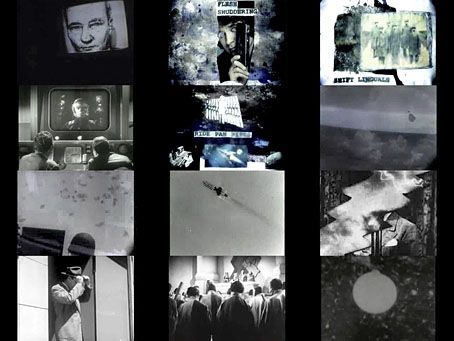
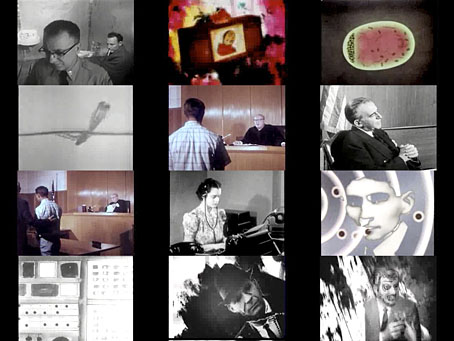
Andre Perkowski’s Nova Express describes itself as “a 3-hour experimental epic adaptation of the novel by William S. Burroughs… with Allen Ginsberg, Brion Gysin, Phil Proctor, Peter Bergman, Jürgen Ploog, and Anne Waldeman”. The technique is relatively simple, if laborious: a large quantity of copyright-free film & TV footage, animation and visual material is matched to readings of Burroughs’s novel by the author and others. As far as this goes it’s an interesting answer to the question of filming Burroughs’ early works. Ideally this kind of juxtaposition of word and image should create something which isn’t present when word and image are separated, rather than simply operate on the level of what animator Chuck Jones once called “illustrated radio”. The clips on YouTube veer between these two poles. Notable by its absence is this kind of thing:

The naked cadets entered a warehouse of metal – lined cubicles – stood a few inches apart laughing and talking on many levels – Blue light played over their bodies – Projectors flashed the color writing of Hassan i Sabbah on bodies and metal walls – Opened into amusement gardens – Sex Equilibrists perform on tightropes and balancing chairs – Trapeze acts ejaculate in the air – The Sodomite Tumblers doing cartwheels and whirling dances stuck together like dogs – Boys masturbate from scenic railways – Flower floats in the lagoons and canals – Sex cubicles where the acts performed to music project on the tent ceiling a sky of rhythmic copulation – Vast flicker cylinders and projectors sweep the gardens writing explosive bio-advance to neon – Areas of sandwich booths blue movie parlors and transient hotels under ferris wheels and scenic railways – soft water sounds and frogs from the canals  – K9 stood opposite a boy from Norway felt the prickling blue light on his genitals filling with blood touched the other tip and a warm shock went down his spine and he came in spasms of light – Silver writing burst in his brain and went out with a smell of burning metal in empty intersections where boys on roller skates turn slow circles and weeds grow through cracked pavement –

Nova Express isn’t as homoerotic as the other books from this period but the whole of the Smorbrot chapter runs like that, and there are other moments elsewhere. (I should note that there’s no Smorbrot section in the available clips but I expect there will be in the complete film.) This side of Burroughs’ work is still the least represented where adaptations are concerned. Ignore it and you’re ignoring a major component of his fiction. Andre Perkowski talked to Graham Rae at Reality Studio in 2010.
nova2.jpg

Elsewhere on { feuilleton }
The William Burroughs archive

Weekend links 155

austin.jpg

Poster design by Mishka Westell for this month’s Austin Psych Fest. Billy Gibbons’ pre-ZZ Top psychedelic outfit, The Moving Sidewalks, surprised everyone by reforming for a New York gig last month, their first performance together in 44 years.

• Pye Corner Audio played the Boiler Room, London, last week, and remixed a track from FC Judd’s Electronics Without Tears. Also on the latter is Chris Carter who talks about his own remix (and the “Radiophonic” Mr Judd) here.

Tom Bianchi’s Fire Island Pines, Polaroids of New York’s gay enclave from 1975–1983. Related: In Conversation with the Violet Quill: Andrew Holleran, Felice Picano, and Edmund White.

• From 2011: Sex, prison and lost ligatures: The story of Herb Lubalin’s Avant Garde typeface. Related: The ITC Avant Garde Gothic group at Flickr.

• Music reissues: Tape Works 1981–1982 by Laughing Hands is out now, and Scott Walker’s early solo albums will be reissued in the summer.

fraser.jpg

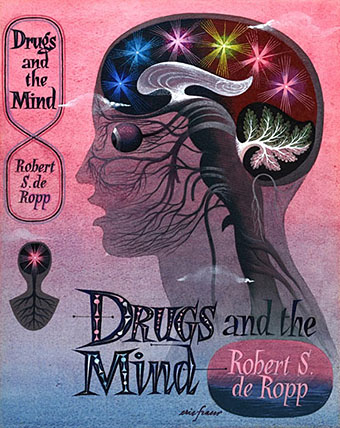
Drugs and the Mind (ii), a cover design from 1957 by Eric Fraser (1902–1983) whose illustrations and designs are in exhibition at the Chris Beetles gallery, London.

• At Ubuweb: William S. Burroughs + Brion Gysin + Genesis P-Orridge – Cold Spring Tape (1989).

The World According to John Coltrane, an hour-long documentary.

Neko Font: for when you need a word made of cats.

Fuck yeah, Sarah Bernhardt

Sordid Spheres!

99th Floor (1967) by The Moving Sidewalks | Over Fire Island (1975) by Brian Eno | Ledge (1980) by Laughing Hands

Burroughs: The Movie revisited

burroughs.jpg

Photo by Kate Simon.

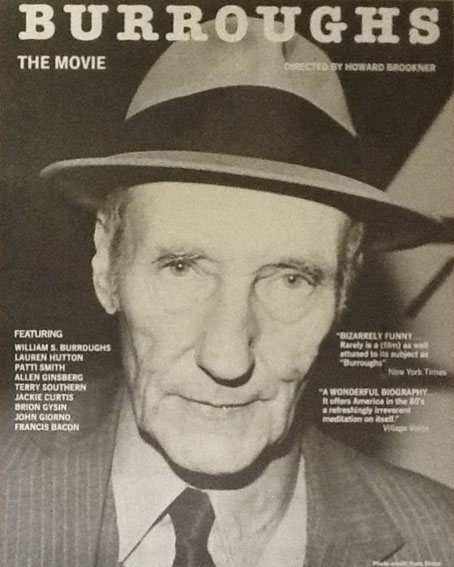
Howard Brookner’s 86-minute documentary Burroughs: The Movie (1983) has been mentioned here on several occasions, and with good reason since it’s the best film anyone has made or will make about William Burroughs and the Beat circle he emerged from in the 1950s. Brookner’s documentary is a model film biography, opening with the writer’s appearance on Saturday Night Live in 1981 then backtracking to his childhood in St. Louis, his family life, the Beat period, the Bunker years, and so on, ending with his move to Lawrence, Kansas in the early 1980s. It’s intimate, frequently very funny, and reveals a human side to Burroughs too often buried by the weight of a sinister reputation. Brookner spent several years working on the film which features appearances from, and interviews with, a priceless range of friends, relatives and collaborators: Allen Ginsberg, Herbert Hunke, John Giorno, James Grauerholz, Brion Gysin, Patti Smith, Terry Southern, Mortimer Burroughs (William’s brother), William S. Burroughs Jr (William’s son who died while the film was in production), Francis Bacon, Jackie Curtis and many others. Tom DiCillo and Jim Jarmusch helped with the camera and sound duties.

The BBC screened the film as part of their Arena arts strand during the miraculous run of that series in the 1980s, since when it’s become difficult to see unless you have a copy on tape. So it’s been good to hear that Aaron Brookner is intending on restoring and reissuing his uncle’s debut film, having found the original print along with many outtakes. Howard Brookner died of AIDS in 1989 so Aaron is launching a Kickstarter fund to restore the film today, December 1st, which is World AIDS Day:

Burroughs: The Movie is a very special film: with in-depth interviews from Allen Ginsberg, Brion Gysin, and many more; intimate scenes such as Burroughs and James Grauerholz with Burroughs’ son Billy Jr.; and it is the only time on camera Burroughs speaks candidly about the tragic shooting accident that left his wife Joan dead.  As Janet Maslin wrote in The New York Times Review: “Rarely is a documentary as well attuned to its subject as Howard Brookner’s Burroughs, which captures as much about the life, work and sensibility of its subject as its 86 minute format allows. Part of the film’s comprehensiveness is attributable to William S. Burroughs’ cooperation, since the author was willing to visit old haunts, read from his works and even playfully act out a passage from Naked Lunch for the benefit of the camera. But the quality of discovery about Burroughs is very much the director’s doing, and Mr. Brookner demonstrates an unusual degree of liveliness and curiosity in exploring his subject”. (more)

Given that so many of the film’s participants are now dead this project has historical as well as aesthetic significance. If you have some spare cash and a more than passing interest in William Burroughs than I’d urge you to lend your support.

Elsewhere on { feuilleton }
The William Burroughs archive

Weekend links 136

tintenfisches.jpg

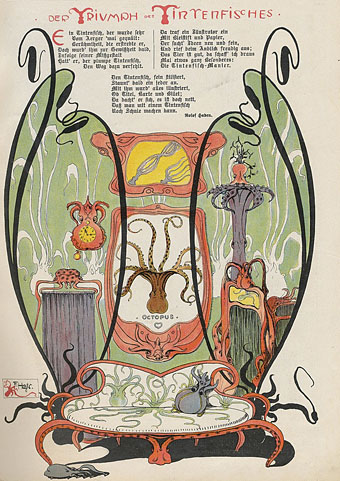
Der Triumph des Tintenfisches from Meggendorfer-Blätter (c. 1900). Via Beautiful Century.

Much dismay this week at the news that Coilhouse—the web and print magazine founded in 2008 by Nadya Lev, Meredith Yayanos and Zoetica Ebb—was closing its doors for the foreseeable future. I always loved what they were doing, and was delighted when S. Elizabeth interviewed me for the website two years ago. Looking at the list of their featured articles is like seeing the contents of my head laid bare. Have a browse and see what you may have missed. And fingers crossed they return soon.

• “I think we are just used to seeing naked women because they are used as objects of desire in advertisements and TV. Naked men are not that common—we are not used to seeing a penis. I think that is the main problem for people.” The shock of the (male) nude.

Michael Clarke asks “What Can Publishers Learn from Indie Rock?” Also: Michelle Dean on the value of used books.

Queers find themselves on both sides of the free speech question. Those of us who are writers want the freedom to write and say what we want. I know I do. Yet a preponderance of LGBT people have become part of the larger wave of those who would limit free speech. Because while we want to be able to say whatever we want about “them,” we do not want “them” to say whatever they want about us.

Victoria Brownworth on The Case Against Censorship

• Caspar Henderson re-reads The Book of Imaginary Beings by Jorge Luis Borges.

One hundred classic minimalism, electronic, ambient and drone recordings.

• BLDGBLOG visits the Chand Baori stepwell in Abhaneri, India.

Brion Gysin’s Dreamachine is launched in the UK.

Ken Hollings visits Ludwig II’s Venus Grotto.

• A guide to Meredith Monk‘s music.

• RIP Boris Strugatsky.

Maldorora: a Tumblr.

Stalker: Meditation (1979) by Edward Artemiev | Undulating Terrain (1995) by Robert Rich & B. Lustmord | Stalker (2004) by Shackleton.

Weekend links 117

lux1.jpg

Illustration and design by Karlheinz Dobsky.

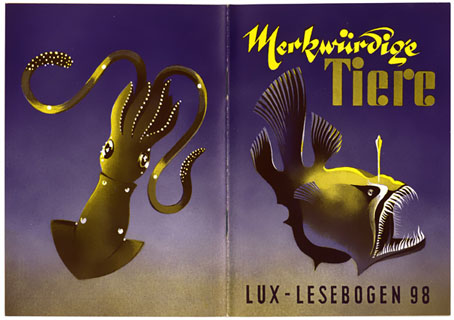
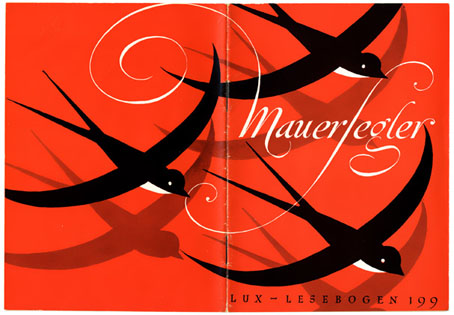
Above and below: samples from Die Lux-Lesebogen-Sammlung, an exhibition of booklets for young people published by Sebastian Lux from 1946–1964. All were designed and illustrated by Karlheinz Dobsky.

• At The American Scholar: “Vladimir Nabokov’s understanding of human nature anticipated the advances in psychology since his day,” says Nabokov biographer Brian Boyd, and An Unquenchable Gaiety of Mind: “On visits to Cambridge University late in life, Jorge Luis Borges offered revealing last thoughts about his reading and writing,” says George Watson.

• The British Library releases The Spoken Word: “A rare collection of recordings featuring the American writer William S Burroughs and the British-born artist Brion Gysin.” Related: Interzone – A William Burroughs Mix by Timewriter.

• Charting the Outlaws: Christopher Bram (again) talking to Frank Pizzoli about his recent study Eminent Outlaws: The Gay Writers Who Changed America.

• The BBC asks “Where are you on the global fat scale?” I’ve always been thin but was still surprised to find my BMI at the very bottom of the scale.

The “otherness” of Ballard, his mesmeric glazedness, is always attributed to the two years he spent in a Japanese internment camp in Shanghai (1943–45). That experience, I think, should be seen in combination, or in synergy, with the two years he spent dissecting cadavers as a medical student in Cambridge (1949–51). Again the dichotomy: as a man he was ebulliently social (and humorous), but as an artist he is fiercely solitary (and humourless). The outcome, in any event, is a genius for the perverse and the obsessional, realised in a prose style of hypnotically varied vowel sounds (its diction enriched by a wide range of technical vocabularies). In the end, the tensile strength of The Drowned World derives not from its action but from its poetry.

Martin Amis on The Drowned World by JG Ballard.

The Chickens and the Bulls: “The rise and incredible fall of a vicious extortion ring that preyed on prominent gay men in the 1960s.”

• It’s that Zone again: Jacob Mikanowski on Andrei Tarkovsky’s Stalker and Geoff Dyer’s Zona.

• Scans of the rare film programme for London screenings of Fritz Lang’s Metropolis.

lux2.jpg

Illustration and design by Karlheinz Dobsky.

• “The web is a Library of Babel that could go the way of the Library of Alexandria.

Fila Arcana: alchemy- and occult-themed embroidery by Mina Sewell Mancuso.

A Very Edgy Alice In A Very Weird Wonderland: illustrations by Pat Andrea.

Malka Spigel reveals a new track from her third solo album.

John Martin and the Theatre of Subversion.

Olafur Eliasson: Little Sun at Tate Modern.

• Meanwhile, back in 1972: Mahavishnu Orchestra live at the BBC (30 mins), and the complete performance of the MC5 on Beat Club (29 mins).