The Return of the Crawling Chaos

nyarlathotep.jpg

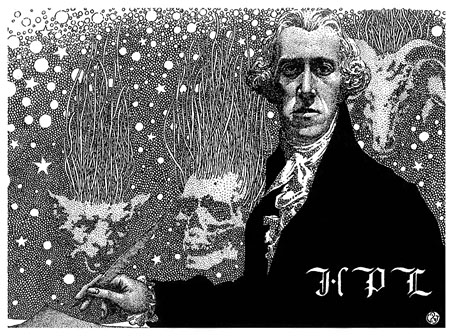
Behold Nyarlathotep, v. 3.0, this being yet another revision of an old illustration. Some readers may recognise the imagery from version 2.0 (2009) or even the original that appeared in my Haunter of the Dark book in 1999. Earlier this month the work I’ve been doing for the new edition of the book reached the end of another stage with the completion of all the necessary redrawing of The Dunwich Horror. I’ve also just finished drawing page 24 of the story, the page I’d left half-done when the strip was abandoned in 1989. Everything I do from now on will be new material.

Having got this far I decided to pay a little more attention to the upgrading of the book’s fourth section, The Great Old Ones, by finishing Nyarlathotep, something I began this time last year then set aside when I got involved in rescanning all the old comics pages. As I’ve mentioned before, several of the pieces for this section of the book were some of my earliest digital illustrations, created a few months after I’d bought a secondhand and very underpowered Macintosh computer. Nyarlathotep was an attempt to depict the hybrid nature of a Mythos entity which combines elements of an Egyptian pharaoh, the diabolic “Black Man” of European witch cults, a sinister stage magician or scientist, and the winged abomination that Robert Blake finds lurking in the steeple of the Starry Wisdom church. Version 1 was one of my very first digital collages which suffered as a result of my inexperience with the new medium, hence my eagerness to rework the design in 2009 when Cyaegha, a metal band I’d been working with, requested a Nyarlathotep-themed T-shirt. The first version had been aimed more at the theatrical/scientific aspect of the character, with a poster in the background from John Nevil Maskelyne’s Egyptian Hall in London. For version 2 I added a number of organic elements to bolster the “Haunter of the Dark” side of the character. Version 3 keeps all the details from version 2 while replacing some of the collaged elements with similar ones taken from better sources. The new design is also slightly taller to account for the enlarged page size of the new book.

sephiroth.jpg

The Sephiroth chart from the second edition of the book, 2006.

The most notable additions to the new piece are the names of the character in Latin letters and Egyptian hieroglyphs (𓋔𓇋𓄿𓂋𓈌𓊵), the latter being a suggestion from this Reddit post. The Egyptian spelling is conjectural but I have a guidebook to the hieroglyphic language which confirms that most of the letters are the ones they should be. The words aren’t included solely as decoration. The Great Old Ones was a collaboration with Alan Moore in which Alan wrote eleven texts or invocations which position each god or entity on one of the spheres of the Kabbalistic Tree of Life. Alan was heavily involved with the Kabbalah at this time, being also engaged with the first few issues of Promethea, a story which involves a physical (or metaphysical) journey from Malkuth to Kether. The Great Old Ones takes the same journey in reverse, and from a much darker perspective, like a Lovecraftian equivalent of the Qliphoth, the “nightside” of the Kabbalistic spheres. In Alan’s scheme, Nyarlathotep is positioned at sphere 8, Hod (or “Splendour”), a sphere associated with gods of magic and language like Thoth, Hermes and Mercury. I imagine most Mythos-acquainted occultists would agree with adding Nyarlathotep to this pantheon. In addition to being gods of magic and language, Thoth, Hermes and Mercury also serve as celestial messengers, a function which Lovecraft assigns to Nyarlathotep in The Whisperer in Darkness when one of the Mi-Go declares “To Nyarlathotep, Mighty Messenger, must all things be told.”

As for the rest of The Great Old Ones, I have four more of them still to be reworked, one of which, Abdul Alhazred (or Lovecraft himself) is almost finished. Further progress will be posted here.

Elsewhere on { feuilleton }
• The Lovecraft archive

Previously on { feuilleton }
• Lettering Lovecraft
• Weird ekphrasis and the Dunwich Horrors
• Kadath and Yog-Sothoth
• Another view over Yuggoth
• Nyarlathotep: the Crawling Chaos

Ambagious Tactics

cards1.jpg

Ambagious Tactics is a box containing 120 small white cards, most of which show a short aphorism, suggestion or piece of advice for the creatively-minded. A few cards at the end of the box feature line drawings instead of words; there are also three blank cards for the user’s own contributions. Anyone familiar with  Brian Eno and Peter Schmidt’s Oblique Strategies will recognise the form: “over one hundred worthwhile dilemmas” which artists, writers (and anyone else) can use as a prompt to jolt a creative endeavour away from familiar ruts or to provide a solution to an impasse or problem.

cards2.jpg

The first deck of Oblique Strategies was published in an edition of 500 copies 50 years ago which makes Ambagious Tactics an anniversary celebration as well as “An Oblique Tribute Act—A choir of over 100 versatile enigmas”. The main difference between the Strategies and the tributes is that the Strategies were mostly the work of Eno and Schmidt, although I think Eno says somewhere that the pair asked friends and colleagues for contributions. For the tributes Alistair Fruish has collected a single suggestion from many different people, myself included:

Some of these creatives are connected to Eno and Schmidt, and some are folk who regularly used Oblique Strategies, others are members of Arts Labs around the country, and some people were asked for the hell of it.

I’m very familiar with Oblique Strategies, mostly via their recent manifestations as online editions or freeware applications. The only physical deck I’ve seen is Alan Moore’s heavily-used first edition, and Alan happens to be one of the contributors to this deck.

cards4.jpg

My own contribution may seem a little glib or obvious at first: when you’re creating something you’re invariably on the lookout for things you don’t like. The question is intended to have a wider reach than this, and refers to something Jon Hassell used to talk about with regard to his own creations: the question of what you really like in a fundamental sense, and how this can be distilled into your own creative activities. Asking yourself what you really like helps you avoid falling into the slipstream of prevailing trends (unless that’s what you really like…), or doing something solely to fulfil other people’s expectations. Hassell couldn’t be involved with the project so this was my attempt to bring some of his own thinking to the tribute act. My original idea—”Do the washing up”—was one I had to reject after I confirmed that it’s one of the suggestions you’ll find in Oblique Strategies. (It’s one I recommend all the same. Try it.)

cards3.jpg

Ambagious Tactics has been published by the Northampton ArtsLab and Alan Moore’s Mad Love imprint. I don’t know how much you might have to pay if you want a set of the cards but there’s an email address on this page for those requiring further details.

Before I started writing this post I thought I’d see what random suggestion the Oblique Strategies application on my phone might have to offer. The advice is suitably oblique and rather fitting as well:

Revaluation (a warm feeling)

Previously on { feuilleton }
• Jon Hassell, 1937–2021
• Imaginary Landscapes: A film on Brian Eno

Weekend links 794

views.jpg

Green Castle (1975) by Roger Dean.

• Roger Dean’s first book, Views, was published 50 years ago this month. The book sold 60,000 copies in its initial run, and was reprinted twice the following year. This extraordinary success gave Dean and his associates at the newly-formed Dragon’s Dream the resources to publish a line of art books by other imaginative artists such as Chris Foss, Ian Miller and Syd Mead. Without Views there wouldn’t have been a Dragon’s Dream, and without Dragon’s Dream there wouldn’t have been Paper Tiger, a publishing house launched by Roger Dean, Martyn Dean and Hubert Schaafsma in 1976. All this activity made a huge impression on me at the time, with books that provided a showcase for artists whose work would otherwise only be seen on the covers of paperbacks or vinyl records.

• At Alan Moore World: 3 novels and The Great When, an extract from a new video interview in which Alan talks about three of the books that have influenced his novels.

• At the BFI: “Dead of Night: 80 years on, Ealing’s anthology horror is still a waking nightmare,” says Edward Parnell.

…Drexler’s vision of nanotechnology was a chimera. It was like the philosophers’ stone of the alchemists: magic dressed in the science of its time, by means of which almost anything becomes possible. I call these oneiric technologies: they do not and quite probably cannot exist, but they fulfil a deep-rooted dream, or a nightmare, or both.

These are not simply technologies of the future that we don’t yet have the means to realise, like the super-advanced technologies that Arthur C Clarke said we would be unable to distinguish from magic. Rather, oneiric technology takes a wish (or a terror) and clothes it in what looks like scientific raiment so that the uninitiated onlooker, and perhaps the dreamer, can no longer tell it apart from what is genuinely on the verge of the possible. Perpetual motion is one of the oldest oneiric technologies, although only since the 19th century have we known why it won’t work (this knowledge doesn’t discourage modern attempts, for example by allegedly exploiting the ‘quantum vacuum’); anti-gravity shielding is probably another.

Philip Ball on unrealistic prognostications in science, from nanotechnology to artificial intelligence

• New music: Rún by Rún; Other Sides Of Nowhere by Underwater Sleep Orchestra; I Believe In You by Ladytron.

• At Dennis Cooper’s it’s Curtis Harrington‘s Day.

• Steven Heller’s font of the month is Ritualist.

• A View From Her Room (1982) by Weekend | A Private View (1982) by Bill Nelson | Aerial View (2014) by Jon Hassell

Weekend links 790

firebird.jpg

Set design by Vladimir Pleshakov for the Ballets Russes’ The Firebird (1923).

• The latest book from Swan River Press is A Mystery of Remnant and Other Absences, a collection of fictions by the late B. Catling. Copies include postcards with accompanying texts by Alan Moore and Catling’s friend and regular collaborator, Iain Sinclair.

• New music: The Loneliness Of The Hollow Earth Explorer Vol. 1 by Arrowounds; The Eraserhead: Music Inspired By The Film Of David Lynch by Various Artists.

• Among the new titles at Standard Ebooks, the home of free, high-quality, public-domain texts: The Purple Cloud by MP Shiel.

• A catalogue of lots at another After Dark: Gay Art and Culture online auction. Homoerotic art, photos, historic porn. etc.

• At Colossal: Laser-cut steel forms radiate ornate patterns in Anila Quayyum Agha’s immersive installations.

• Photographs by Man Ray and Max Dupain showing at the Heide Museum of Modern Art, Melbourne.

• Mix of the week: Isolatedmix 134 by Artefakt.

• At Dennis Cooper’s it’s Anna Karina’s Day.

• Three Imposters

• Purple Haze (1967) by The Jimi Hendrix Experience | Pilots Of Purple Twilight (1981) by Tangerine Dream | Purple Rain (live, 1985) by Prince & The Revolution

Weekend links 780

ginsburg.jpg

An early illustration by Burne Hogarth from Federal Illustrator, Winter 1931–1932, credited to the artist’s original name, Bernard Spinoza Ginsburg. (Via)

• RIP Simon House, a musician whose death was announced in the same week as news of a remixed edition of Hall Of The Mountain Grill by Hawkwind, the first of the group’s albums to feature House on violin and keyboards. House’s keyboards made a considerable difference to Hawkwind’s sound, expanding the range of their songwriting; the melodramatic scale of Assault And Battery/The Golden Void wouldn’t have been possible without those massed Mellotrons. Post-Hawkwind it was House’s violin that was sought after during his time as a session musician, on songs like Yassassin by David Bowie, and Talking Drum by Japan. He’s also one of the musicians credited on Thomas Dolby’s biggest hit, She Blinded Me With Science (violin again), although his contribution there is easy to mistake for a synthesizer.

• “We did want the name to be weighty and metal-related because it is a kind of a metal band. So what is heavy and what is metal: that was the answer.” Hildur Guðnadóttir talking about Osmium, an experimental quartet comprising Guðnadóttir with James Ginzburg, Rully Shabara and Sam Slater.

• At Criterion: Stephanie Zacharek on Richard Lester’s The Three Musketeers and The Four Musketeers, films from a time “when delighting audiences meant more than catering to the predetermined whims of a dogged fandom”.

• The week in maps: At Public Domain Review, Bernard Sleigh’s Anciente Mappe of Fairyland (ca. 1920 edition); at Nautilus, the first maps of the Earth’s magnetic field.

• The eleventh installment of Smoky Man’s exploration of The Bumper Book of Magic has been posted (in Italian) at (quasi), and in English at Alan Moore World.

• Not on any map: Mark Valentine describes the time he tried to buy a phantom island from the Hudson’s Bay Company.

• At Colossal: “In surreal portraits, Rafael Silveira tends to the garden of consciousness“.

• New music: Osmium by Osmium, and Along The Wind Spear by Survey Channel.

• Anne Billson chooses Anjelica Huston’s ten best roles.

• Owls in Towels

• Five Owls (1970) by Canned Heat | Night Owl (1996) by System 7 | Owls And Flowers (2006) by Belbury Poly