Philippe Jullian, connoisseur of the exotic

jullian01

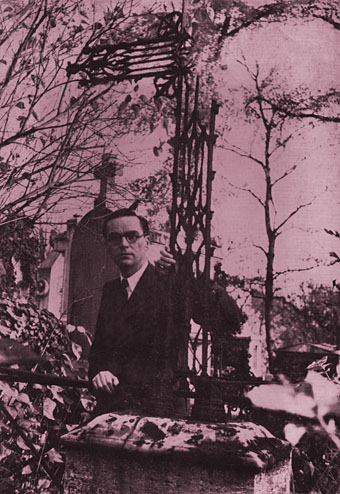
Monsieur Jullian as seen on the back cover of Dreamers of Decadence (1971).

Here at last is the long-promised (and long!) piece about the life and work of Philippe Jullian (1919–1977), a French writer and illustrator who’s become something of a cult figure of mine in recent years. Why the fascination? First and foremost because at the end of the 1960s he wrote Esthètes et Magiciens, or Dreamers of Decadence as it’s known to English readers, a book which effectively launched the Symbolist art revival and which remains the best introduction to Symbolist art and the aesthetic hothouse that was the 1890s. If I had to choose five favourite books Dreamers of Decadence would always be on the list. This point of obsession, and Philip Core’s account of the writer, made me curious about the rest of Jullian’s career.

jullian13

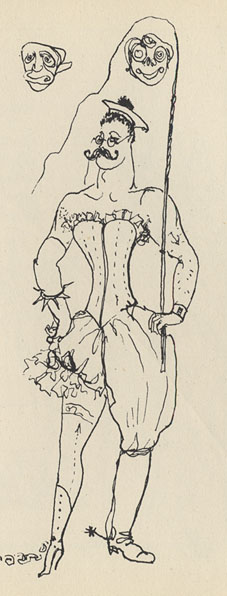
An illustration from Wilson & Jullian’s For Whom the Cloche Tolls (1953). “Tata has called these his Krafft-Ebbing (sic) pictures of his friend Kuno, whatever that means.”

Philip Core was friends with Philippe Jullian, and Core’s essential Camp: The Lie that Tells the Truth (1984) has Jullian as one of its dedicatees. It’s to Core’s appraisal that we have to turn for details of the man’s life. There is an autobiography, La Brocante (1975), but, like a number of other Jullian works, this doesn’t seem to have been translated and my French is dismally pauvre. Core’s piece begins:

Philippe Jullian, born to the intellectual family of Bordeaux Protestants which produced the well-known French historian, Camille Jullian, was a last and lasting example of pre-war camp. His career began as an artist in Paris with a reputation for drag-acts parodying English spinsters. Snobbery, a talent for sensitive daydreaming, and a consuming passion for antiques, obscure art and social history, made a very different figure out of the thin and dreamy young man. Jullian suffered terribly during the Second World War; he managed to survive by visiting some disapproving cousins dressed as a maiden aunt, whom they were happy to feed. However, he made a mark in the world of Violet Trefusis, Natalie Barney and Vita Sackville-West by illustrating their books with his wiry and delicate doodles; this led to a social connection in England, where he produced many book jackets and covers for Vogue throughout the 1950s.

Having only seen Jullian in his besuited and bespectacled guise it’s difficult to imagine him dragged up, but the cross-dressing interest is apparent in his humorous collaboration with Angus Wilson and in a later novel, Flight into Egypt. As for the wiry and delicate doodles, they’re very much of their time, in style often resembling a less-assured Ronald Searle. One early commission in 1945 was for the first of what would become a celebrated series of artist labels for Château Mouton Rothschild. Later cover illustrations included a run for Penguin Books some of which can be found at Flickr.

Philip Core continues the story:

Elegant in the austerely tweedy way the French imagine to be English, Jullian exploited his very considerable talents as a writer, producing a series of camp novels throughout the 1950s (Scraps, Milord) which deal frankly but amusingly with the vicissitudes of handsome young men and face-lifted ladies, grey-haired antique dealers and criminals. One of the first to reconsider Symbolist painting, Jullian reached an enormous public in the 1960s with his gorgeous book, Dreamers of Decadence – where an encyclopaedic knowledge of the genre and its accompanying literature helped to create the boom in fin de siècle revivalism among dealers and museums.

An acerbic wit accompanied this vast worldly success; always docile to duchesses, Jullian could easily remark to a hostess who offered him a chocolate and cream pudding called Nègre en chemise, “I prefer them without.” Less kindly, to a gay friend who objected to Jullian’s poodles accompanying them into a country food shop by saying “Think where their noses have been”, he could also retort “Yes, that’s what I think whenever I see you kiss your mother.”

Continue reading “Philippe Jullian, connoisseur of the exotic”

Weekend links 39

galas.jpg

The Divine Punishment (1986) by Diamanda Galás. Design by Paul White/Me Company.

What the Catholic League and certain members of the House presumably wish to remove from their consciousness is thirty years of death sentences handed down to their parishioners and citizenry, who were told not to wear condoms, and the mistreatment of those stigmatized as miscreants and sinners by their viral status and/or homosexuality and/or status as drug addicts.

• Diamanda Galás responds in her usual forthright manner to the censoring of David Wojnarowicz’s film (and her music which accompanied it) by the Catholic League and members of the House of Representatives earlier this week. Related: Demonstrators gather to protest removal of Wojnarowicz art from NPG | Is the censored David Wojnarowicz video really ‘anti-Christian’? | Vengeance is hers: a conversation with Diamanda Galás.

Update: Hide/Seek: Too shocking for America. One of the exhibition curators speaks out against the censorship.

“Their attitude is: ‘Next time you think of writing about sex, don’t,'” said Susie Bright, who was the editor of the Best American Erotica anthology series for 15 years. “I can’t think of any other fundamental human experience that writers would be encouraged to keep to themselves.” Melissa Katsoulis, a literary reviewer for the Times of London, certainly seemed to conform to Bright’s impression when asked to comment on the award by the BBC: “Sex is a subject best avoided altogether,” she said. “If I was writing a novel, I wouldn’t attempt to write it except in the most Victorian and prim way, because it’s awful. It’s a cliché, but the moments of genuine frisson in books are when hardly anything happens.” Speak for yourself, missy.

Laura Miller dissing the Literary Review‘s annual Bad Sex Award. Good to find more voices being raised against this drivel and the admission of failure which it implies.

The latest offbeat experiment from filmmaker David Lynch: pop singles. He gets crazy with the vocoder here. Related: David Lynch talks new music projects.

scenaillustrata.jpg

Scena Illustrata (1914). Cover by Ezio Anichini (?). Via this set of magazine covers from 1880–1920.

• Tumblrs of the week: Heart Killer and Pretty Pictures from the Paleo-Future Blog.

The Big Picture’s 2010 Hubble Space Telescope Advent Calendar.

National Geographic‘s Best Underwater Views of 2010.

A seasonal gift from a famous Northampton resident.

Paris versus New York: A Tally of Two Cities.

This is your browser on drugs.

Double-Barrel Prayer (1988) by Diamanda Galás, with a video directed by the late Peter Christopherson.

Weekend links 36

high_society.jpg

Mervyn Peake’s Caterpillar from Alice’s Adventures in Wonderland finds itself used to promote High Society, an exhibition at the Wellcome Collection devoted to the long history of human drug-taking. There’s more about the exhibition here and also an accompanying book by Mike Jay from Thames & Hudson. Related: The Most Dangerous Drug:

A group of British drug experts gathered by the Independent Scientific Committee on Drugs (ISCD) rated alcohol higher than most or all of the other drugs for health damage, mortality, impairment of mental functioning, accidental injury, economic cost, loss of relationships, and negative impact on community.

• Unless the magazine Man, Myth & Magic was advertised on TV in 1970 (and I suspect it would have been) Austin Osman Spare’s work has never been seen on British television, certainly not in any detail or with a credit to the artist. This week the BBC finally paid him some attention with a brief spot on The Culture Show as a result of the Fallen Visionary exhibition which is still running (until November 14) in London. Alan Moore, Fulgur‘s Robert Ansell and others attempt to summarise Spare’s career in seven minutes.

fujita.jpg

Neil Fujita designs: Mingus Ah Um (1959) and The Godfather (1969).

• RIP graphic designer Neil Fujita. Related:

“By taking the “G” and extending it to the “D,” I created a house for “God.” The way the word was designed was part of the logo and so was the type design. So when Paramount Pictures does a film version or Random House, which bought out the book from Putnam, does another Godfather book, I still get a design credit. In fact, before the first Godfather film opened in New York I saw a huge billboard going up in Times Square with my design on it. I actually got them to stop work on it until we were able to come to an agreement.” Waxing Chromatic: An Interview with S. Neil Fujita

French SF illustration. Related: Where did science fiction come from? A primer on the pulps, a feature by Jess Nevins with some of the craziest covers you’ll see this month.

• Gay-bashers in 1970s San Francisco had to beware the wrath of the Lavender Panthers.

• More Marian Bantjes as she discusses her work in an audio interview.

Music from Saharan cellphones.

Origami Beauty Shots.

Krautrock.com

Better Git It In Your Soul (1959) by Charles Mingus.

Weekend links 35

cr.jpg

Marian Bantjes designs the cover of the latest Creative Review and there’s a feature about her work inside.

• “…the question: ‘was Shakespeare gay?’ strikes me as so daft as to be barely worth answering. Of course he was. Arguably he was bisexual, of sorts, but his heart was never on his straight side.” Don Paterson throws the cat among the pigeons in an examination of the Shakespeare’s sonnets. Related (sort of): Shakespeare and Company: The bookshop that thinks it’s a hotel. Also related: Jeanette Winterson revisits Shakespeare and Company.

100 orbs of light float in the Schuylkill River. Also in Philadelphia: Animators Amok in a Curiosity Cabinet: the Brothers Quay are making a film in the Mütter Museum. Can’t wait to see it.

• More Alan Moore: Fossil Angels, a lengthy essay about magic and the occult, was written in 2002 but hasn’t been given a public airing until now.

Alberto Manguel is always worth reading:

As Borges was well aware even then, the history of literature is the history of this paradox. On the one hand, the deeply rooted intuition writers have that the world exists, in Mallarmé’s much-abused phrase, to result in a beautiful book (or, as Borges would have it, even a mediocre book), and, on the other hand, to know that the muse governing the enterprise is, as Mallarmé called her, the Muse of Impotence (or, to use a freer translation, the Muse of Impossibility). Mallarmé added later that all who have ever written anything, even those we call geniuses, have attempted this ultimate Book, the Book with a capital B. And all have failed.

• Here Comes Everybody: Wake In Progress is a self-described “foolhardy attempt to illustrate Finnegans Wake”. Easier to illustrate than make a film of the book, I’d have thought, and Mary Ellen Bute already attempted the latter.

hoffmeister.jpg

Psychic Explosion: Adolf Hoffmeister’s illustrations for a 1967 edition of Lautréamont’s Poesies at A Journey Round My Skull.

Craig Colorusso’s Sun Boxes can be seen at Turner Falls, Massachusetts, during November.

Clive Hicks-Jenkins has a book and retrospective exhibition of his art due next year.

• A sneak peek into The Steampunk Bible to which I’m a contributor. And also here.

• “Human or other; depends who comes”: the Ballardian films of Paul Williams.

Transmission (1979) by Joy Division; Transmission (1995) by Low; Monkey (2010) by Robert Plant.

Alan Moore: Tisser l’invisible

moore.jpg

Arriving in the post this week was Alan Moore: Tisser l’invisible from French imprint Les Moutons Électriques. The book is a substantial collection of appreciative texts and analyses of work by the Northampton Ipsissimus edited by Julien Bétan, and, as the title would imply, is in French throughout. A couple of the pieces are reprints which I presume are receiving their first translation here. Michael Moorcock’s Homage to Cornucopia first appeared in Alan Moore: Portrait of an Extraordinary Gentleman and is also reprinted in Moorcock’s Into the Media Web which I designed and Savoy Books published earlier this year.

highpost.jpg

Best thing for me about the French collection is seeing some of my Moore-related work printed in colour as a mini gallery at the front of the book. There are two of the poster designs for the Moon & Serpent CDs, The Highbury Working (above) and Angel Passage, and also my 1999 portrait of Promethea and the Kabbalistic Underground map which I created as a design of my own and Alan subsequently incorporated into the Promethea comic series.

And speaking of Mister Moore, issue 6 of Dodgem Logic is now on sale sporting a cover which can either be interpreted as a gloomy Halloween design or a faithful depiction of the nation’s slough of despond; you decide.

Previously on { feuilleton }
Into the Media Web by Michael Moorcock
Watchmen
Alan Moore interview, 1988