Weekend links 170

macarthur.jpg

Owl portrait by Iain Macarthur.

• “Ghost Box is a glance through a window seeing something running alongside our version of reality. Like, what if Paul McCartney had made records with the Radiophonic Workshop?” Ghost Box designer and Mr Focus Group, Julian House is interviewed.

• “…that book with the girl with the hatchet in her head…” Dave Tompkins remembers Denis Gifford’s A Pictorial History of Horror Movies (1973), a formative influence of mine, and that of many other people, it seems.

Salvador Dalí’s 1946 illustrated edition of Macbeth. Related: From Macbeth to the Wizard of Oz: New exhibition explores the erotic side of witchcraft.

I do not want to live in a world where the government and a select few conservative feminists get to decide what we may and may not masturbate to, and use the bodies of murdered women or children as emotional pawns in that debate. It is supremely difficult to achieve radical ends by conservative means. Feminists and everyone who seeks to end sexual violence should be very cautious when their immediate goals seem to line up neatly with those of social conservatives and state censors.

Laurie Penny on the recent Tory policy of attempting to limit online pornography.

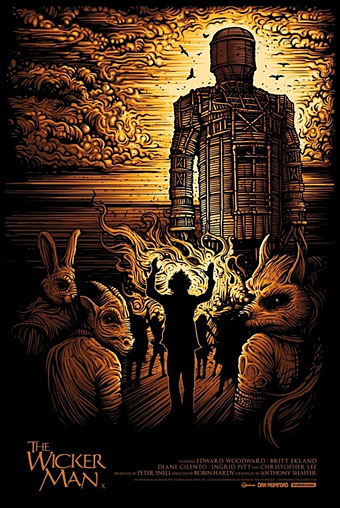
The Facebook page for The Wicker Man has details of the pursuit for a complete print of the film. A Blu-ray edition will be released in October.

Anne Billson visited the Hotel Thermae Palace in Ostend, the columnated location of Daughters of Darkness.

Kenneth Anger on how he made Lucifer Rising. The ICA in London is screening his films this weekend.

krenkel.jpg

Roy Krenkel illustrates Tales of Three Planets by Edgar Rice Burroughs, 1964.

The Electric Banana Blows Your Mind: The soundtrack library alter ego of The Pretty Things.

• Mix of the week: an ambient (in the 90s’ sense of the word) DJ set by Surgeon.

Bernie Krause shares the happiest sounds he’s heard in nature.

• RIP Walter De Maria, sculptor and musician.

Sexodrome by Asia Argento with Morgan.

• Metabolist: Identify (1980) | Curly Wall (1980) | Ymuzgo/Pigface (1981)

Weekend links 161

descent.jpg

My friend James Marriott died last year. He was 39. His final book, The Descent, a study of Neil Marshall’s acclaimed horror film, is launched on Friday at the Cube Microplex in Bristol. The book is published by Auteur, a UK imprint, in their Devil’s Advocates series. James was finishing the book a year ago this month, and sent me a late draft for comments. In addition to examining Marshall’s film in detail he also looks at its sequel and explores the micro-genre of cavern-oriented horror. When it came to literature James preferred Robert Aickman and Thomas Ligotti; he enjoyed their cinematic equivalents too but he also had a great appetite for horror films of any description, and would happily wade through hours of giallo trash in the hope of finding something worthwhile. I miss our long, digressive email exchanges, and the opportunity they afforded to swap new discoveries.

• “For artists not working in digital media — those who cut, build, draw, paint, glue, bend, and make things in the more traditional manner — there is something of a ‘Surrealist’ popularity at hand today,” says John Foster.

• At Open Culture: Duke Ellington’s Symphony in Black starring a 19-year-old Billie Holiday, and Nina Simone performs six songs on The Sound of Soul (1968).

• I’m not remotely interested in Baz Luhrman’s latest but I do like the Art Deco graphics and logos created by Like Minded Studio for The Great Gatsby.

Alejandro Jodorowsky: “I am not mad. I am trying to heal my soul”

• The Clang of the Yankee Reaper: Van Dyke Parks interviewed.

• A 45-minute horror soundtrack mix by Spencer Hickman.

• At But Does It Float: Album art by Robert Beatty.

Topological Marvel: The Klein Bottle in Art

Anne Billson on The Art of the Voiceover.

Soviet board-games, 1920–1938

A Brief History of Robot Birds

Le Chemin De La Descente (1970) by Cameleon | Descent Into New York (1981) by John Carpenter | The Descent (1985) by Helios Creed

Weekend links 157

focusgroup.jpg

Elektrik Karousel, a new release on the Ghost Box label by The Focus Group. “For a clue to its moods, think Czech animation, Italian Giallo, early Radiophonics, HP Lovecraft stories, 1960s underground cinema, Lewis Carroll and baroque psych.” Julian House’s package design is “heavily inspired by 1960s underground press and conceived as a kind of mind altering DIY board game”.

Joseph Stannard of The Outer Church compiles a mix for Kit Records, and talks about rural psychedelia and malevolent lighthouses, among other things.

• At Sci-Fi-O-Rama: a sampling of Dan Nadel & Norman Hathaway’s Electrical Banana – Masters of Psychedelic Art (2012).

Stranger than Paradise: Tilda Swinton photographed by Tim Walker in the Surrealist Wonderland of Las Pozas, Mexico.

Whistler in Limehouse & Wapping: stunning etchings by the 25-year-old artist when he was newly arrived in London.

• The complete catalogue of Sunn O))) recordings is now on Bandcamp for preview and purchase.

La Danza de la Realidad: Alejandro Jodorowsky returns to his childhood in Tocopilla, Chile.

• Enjoy The Silence: Jude Rogers talks to Michael Rother about joy of quiet.

Dressing the Air, “the Bureau of Sensory Intelligence”, had a relaunch.

Fast forward – and press play again: Cassettes are back

The Lovecraft Expert: An Interview with S.T. Joshi

Book Graphics: an illustration blog.

Paint Box (1967) by Pink Floyd | Beat Box (1984) by Art of Noise | Glory Box (1994) by Portishead

Weekend links 152

mackenzie.jpg

Light Moves on the Water (2010), a collage by Alexis Anne Mackenzie.

“[She] stated, emphatically and more than once, that pornography cannot and should not be linked to LGBT rights…When a gay man lives somewhere where his identity is threatened, it’s clear how sex – including pornography – and sexuality are intertwined. His sexual imagination, which is criminalized, matches the sexual images of gay pornography (which are also criminalized). Since acting out his imagination through sex would be to risk his life, the access to the images is safer. The images, created by gay men wherever it’s legal to create them, provide empowerment and diminish alienation.” An important piece by Conner Habib who asks “Why are we afraid to talk about gay porn?”

• Florida’s Parallel Universe: “The abandoned Nike Missile Site, surrounded by the Everglades, is a reminder of when humans almost destroyed the world and a warning that we could still lose everything today.” By Stefany Anne Golberg.

• In Search of Divine: A Retrospective by Katherine McLaughlin. Related: Jeffrey Schwarz, director of a new documentary, I Am Divine, talks about Divine’s career, and his film to Polari Magazine.

When Brendan Behan’s Borstal Boy was banned in 1958, it was said that a man in a pub asked him how much the book weighed, then offered to bring two thousand copies across the border instead of his usual smuggled butter. We might have called it the Black North, for being dark with Protestants, but when I was a child in the 1960s, Ulster was the place British sweets came from: Spangles, Buttons and, most notably, Opal Fruits. It was across this border that the feminists of “the condom train” staged a mass importation of illegal contraceptives in May 1971. When they arrived from Belfast into Connolly Station, the customs men “were mortified”, Mary Kenny, one of the participants, remembered, “and quickly conceded they could not arrest all of us, and let us through”.

Anne Enright on censorship in Ireland.

• Open Culture posts a copy of Nigel Finch’s 1988 Arena documentary about Robert Mapplethorpe.

The Fall of Communism Through Gay Pornography: A video by William E. Jones.

• Surrealism Made Fresh: Sanford Schwartz on the drawings of the Surrealists.

• Cult Classic: Defining Katherine Mansfield by Kirsten O’Regan.

Jonathan Barnbrook (again!) on David Bowie (again!).

Sydney Stanley illustrates Algernon Blackwood

20 Haunting Ghost Towns of the World

• At Pinterest: The Male Form

The Life Divine (1973) by Santana and McLaughlin | The Rhythm Divine (1987) by Yello feat. Shirley Bassey | Divine (2000) by Antony and the Johnsons

Paul Delvaux: The Sleepwalker of Saint-Idesbald

delvaux.jpg

Saint-Idesbald is a small, unremarkable seaside town on the Belgian coast situated between Ostend and the border with France. I spent a week there on a school camping holiday in the 1970s unaware that it was the home of the great Surrealist painter Paul Delvaux (1897–1994). I suppose you could make the argument that the location of Dalí’s home in Cadaqués was equally unremarkable, but Dalí’s house was well-known, and that area of the Spanish coast is familiar from many of his paintings. The surprise in later discovering that Delvaux lived in Saint-Idesbald, rather than Brussels or Bruges, or even Ostend, is that the town is quite unlike the tram-haunted, cobblestoned, moonlit vistas of his paintings. It’s appropriate that JG Ballard thought highly enough of Delvaux to mention his paintings in some of his stories, and also commission reproductions of two lost canvases; Ballard’s Shepperton was an equally unlikely home for such a vivid imagination.

Paul Delvaux: The Sleepwalker of Saint-Idesbald is a film from the Naxos record label that lasts all of three minutes, but which happens to feature the first footage I’ve seen of Paul Delvaux as a working artist. Despite Ballard’s attention, Delvaux has often been passed over as a subject of Surrealist documentaries in favour of the usual trinity of Dalí, Magritte and Max Ernst. There are older documentaries in existence, however, so I’ll continue to hope they may turn up eventually. For anyone who happens to journey near Saint-Idesbald, many of Delvaux’s paintings can be seen in the museum there.

Previously on { feuilleton }
The Public Voice by Lejf Marcussen
Ballard and the painters
Taxandria, or Raoul Servais meets Paul Delvaux