Creel Pone

creel1.jpg

One of the many surprises for me about Enter the Void was finding recordings by electronic composer Jean-Claude Eloy mixed into its droning soundscape, namely extracts from his 1979 album, Shànti. I’d been listening to this a week or so before watching the film after having downloaded a large quantity of obscure electronic releases on the bootleg Creel Pone label.

creel3.jpg

Flowers Of Evil (1969) by Ruth White.

The Creel Pone project by Keith Fullerton Whitman began with the intention of reissuing in a limited form 100 albums of electronic or electro-acoustic music dating from the period 1947 to 1983 (or 1952 to 1984 according to the label seal); The Analogue Age, in other words. Most of the albums were long out of print, and few had ever been available on CD when the project began although some have since had official reissues. The recordings were transferred from vinyl then burned to 50 CD-Rs per album, each release coming in a CD-sized facsimile of the original cover. Simon Reynolds wrote a piece about the label for The Wire in 2010 but I first encountered the releases a couple of years earlier via an acquaintance who was one of the collectors trying to accumulate the entire run. The run finished some time ago so the reissues themselves will soon be as difficult to find as the releases they made available, hence the recourse to mp3, and this cache of almost the entire catalogue. I haven’t listened to everything there yet (iTunes tells me this would take 2.2 days, non-stop)—and I find my patience often runs out with tape-collage electro-acoustic compositions unless I’m in the mood—but some of these albums are so good, the Thomas Köner-like Shànti among them, you have to wonder why they were overlooked for so long. A few of the uploads have tracks missing, and they’re all variable quality, but you won’t find this amount of Creel Pone material anywhere else in a hurry. (There’s also no guarantee they’ll be there for long so don’t complain to me if you’re visiting this post after they’ve all been deleted.)
creel6.jpg

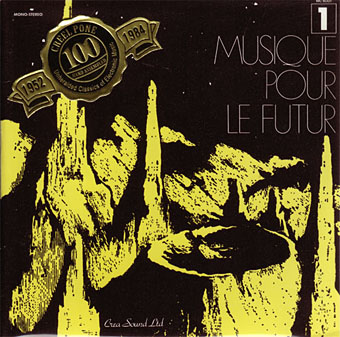
Musique Pour Le Futur (1970) by Nino Nardini.

Discogs has an incomplete catalogue listing. Several of Jean-Claude Eloy’s albums are now available on CD. Gil Mellé’s excellent soundtrack for The Andromeda Strain was given a limited CD release two years ago but is out of print again. For some recordings it seems, the struggle to reach an audience is a continual one.

creel4.jpg

The Andromeda Strain: Original Electronic Soundtrack (1971) by Gil Mellé.
creel7.jpg

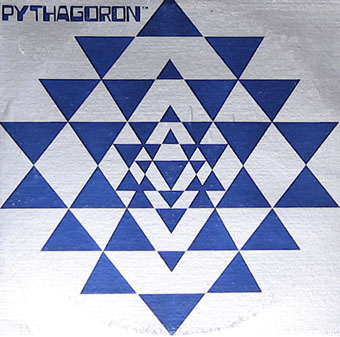
Pythagoron (1977) by Pythagoron™

creel5.jpg

Reflecting On The First Watch, We Uncover Treasure Buried For The Blind (1978) by Cellutron & The Invisible.

creel2.jpg

Shànti (1979) by Jean-Claude Eloy.

Previously on { feuilleton }
Enter the Void
Cristalophonics: searching for the Cocteau sound
The Avant Garde Project

Philippe Druillet album covers

druillet1.jpg

Docteur Faust (1971) by Igor Wakhévitch.

Philippe Druillet: album cover artist. As with John Martin, I’m surprised there aren’t more examples. Once again, Discogs.com proves incomplete so I’ve added a couple more including the first on this list, Docteur Faust. If you know of any others, please leave a comment.

Igor Wakhévitch’s berserk masterpiece is a cult item in this house, and something I’ve written about already. The cover art is the icing on an unclassifiable cake.

druillet10.jpg

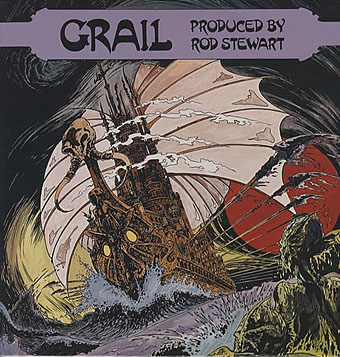
Grail (1970) by Grail.

The cover is the opening page of The Wild Wind Isles, one of Druillet’s Lone Sloane stories. Produced by Rod Stewart; did you notice? “We are sailing…”

druillet4.jpg

Electric Ladyland (1975) by The Jimi Hendrix Experience.

A gatefold sleeve for a series of four Hendrix reissues on the Barclay label. The other covers were provided by Moebius, Jean Solé and an artist unidentified on the link above but it looks to me like the work of Philippe Caza.

druillet3.jpg

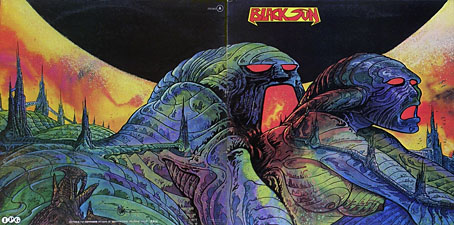
Black Sun (1978) by Black Sun.

Black suns are a regular feature of Druillet’s work (and mine, ahem) so the artist at least suits the title. The debut album of a short-lived French funk/soul group.

East/West (1980) by Richard Pinhas.

The French equivalent of Krautrock doesn’t have a name but Richard Pinhas is one of its leading practitioners. This is still my favourite among his solo works, not least because it’s more successfully musical than other albums which feature great slabs of guitar or synth doodling. In addition to a cover of David Bowie’s Sense Of Doubt there’s also science fiction author Norman Spinrad ranting through a vocoder on the opening and closing tracks. The great cover art is a page from Druillet’s 1980 adaptation of Flaubert’s Salammbô.

Continue reading “Philippe Druillet album covers”

Weekend links 99

moebius.jpg

From the Crystal Saga portfolio (1986) by Moebius. Via Quenched Consciousness.

Moebius: A while ago, [science fiction] was filled with monstrous rocket ships and planets; it was a naive and materialistic vision, which confused external space with internal space, which saw the future as an extrapolation of the present. It was a victim of an illusion of a technological sort, of a progression without stopping towards a consummation of energy. But we’ve completely changed that vision. It’s been a sharp, radical change, and somewhat brutal.
HM: Why brutal?
Moebius: Because all those beautiful projects we believed in are gone. But the real sense of science fiction is the discovery that the voyage is interior, and the real energy, the rockets of the past, is what is contained in people’s spirits.
HM: One doesn’t have to read other people’s visions then, one can make the discovery oneself?
Moebius: Well, that, and also the fact that the “new planet” of old science fiction is right here: it’s the Earth.

The Moebius Interview by Diana K. Bletter, Heavy Metal, August 1980.

RIP Jean Giraud, aka Moebius, one of the great artists of the 20th century. My approach to drawing comics was almost wholly derived from the illustrational style of the French, Belgian and other artists being published in Heavy Metal magazine in the late 1970s/early 1980s. Many of the stories were appearing in English for the first time, and for me they revitalised a medium in which (undergrounds aside) I’d lost all interest. It wasn’t only the exceptional artwork that was attractive. The narratives of Moebius, Druillet, Bilal and co. presented a more sophisticated approach to science fiction and fantasy than the simple-minded fare filling the superhero titles or the pages of 2000 AD. Moebius’s work was wittier, sexier and far more imaginative than any American comics I’d seen up to that time. Some of the stories read like graphic equivalents of New Worlds-era science fiction so it came as no surprise to find Moebius drawing a strip called The Airtight Garage of Jerry Cornelius (the title was later amended at Moorcock’s request) while Druillet in his September 1980 Heavy Metal interview mentioned enjoying books by William Burroughs, Michael Moorcock and Thomas Disch, and singled-out Ballard’s Crash as a favourite novel. Without the examples of Druillet and Moebius (and the intoxicating inspiration of the October 1979 issue of Heavy Metal) I wouldn’t have spent 17 months adapting The Call of Cthulhu as a comic strip.

Hasko Baumann’s 2007 documentary, Moebius Redux: A Life in Pictures (some of which can be seen on YouTube) is a good place to start when trying to appraise Jean Giraud’s extensive career. The film is now available on DVD.

Update:
The hour-long cut of Moebius Redux has been posted to Vimeo
An obituary by Kim Thompson at The Comics Journal
The Moebius posts at But Does It Float

moebius2.jpg

From Les Yeux du Chat (1978) by Jodorowsky & Moebius. Via Quenched Consciousness.

• “Naked Lunch,” Ballard wrote later, “was a grenade tossed into the sherry party of English fiction.” The criss-crossing careers of JG Ballard and William Burroughs are examined in detail at RealityStudio. Related: The Discipline of D.E. (1982) by Gus Van Sant and The Unlimited Dream Company (1983) by Sam Scoggins.

• Dr John’s forthcoming album, Locked Down, has been produced by The Black Keys‘ Dan Auerbach. Those of us who favour the Doctor’s voodoo-inflected early albums are hoping this might mean he gets groove back after wandering for years in an MOR swamp. One of the new recordings, Revolution, sounds promising.

I don’t think sexuality is fixed anymore. I think more from the gay male side than the lesbian side, there is often a wish for things to be fixed. I heard Lady Gaga’s Born This Way and I don’t know why they like it. Maybe, they need more certainty than girls do. For me, it’s like why do you care anyway? Maybe you were, maybe you weren’t. What’s the big deal? I can’t connect to that emotionally, so it baffles me.

Jeanette Winterson talks to Sassafras Lowrey.

• “In [Jacob’s Room], [Virginia] Woolf makes the subject matter not Jacob himself but the ways in which we know and don’t know each other – the gaps in our knowledge.” Alexandra Harris on Modernism in art and literature.

• The Northwest Film Forum in Seattle hosts Magick in Cinema on 5th April, an evening of occult-themed short films which includes a rare screening of Curtis Harrington’s Wormwood Star.

• John Bertram’s Lolita cover competition from 2009 is due to appear in June as a book-length study entitled Recovering Lolita. Bertram previews the contents here.

• “Erotic fiction is having a steamy renaissance and its hottest authors are women.”

LSD helps to treat alcoholism.

• The other Moebius (Dieter): News (1980) by Moebius & Plank | Tollkühn (1981) by Moebius & Plank | Conditionierer (1981) by Moebius & Plank.

Weekend links 98

postcard.jpg

The Arcimboldo Effect again. An undated postcard from the image section of A Virtual Wunderkammer: Early Twentieth Century Erotica in Spain.

“I took George Clinton and Bootsy Collins to the Battle Station for the first time, and they left feeling like they’d just had a close encounter,” said the bassist and music producer Bill Laswell, who met Rammellzee in the early 1980s and remained one of the few people who saw him regularly.

Rammellzee’s Work and Reputation Re-emerge

• Also in the NYT: China Miéville on Apocalyptic London: “Everyone knows there’s a catastrophe unfolding, that few can afford to live in their own city. It was not always so.” Reverse the perspective and find Iain Sinclair writing in 2002 about Abel Ferrara’s The King of New York: “A memento mori of the century’s ultimate city in meltdown.”

• The Inverted Gaze: Queering the French Literary Classics in America by François Cusset. Related: Glitterwolf Magazine is asking for submissions from LGBT writers/artists/photographers.

• The vinyl releases of Cristal music by Structures Sonores Lasry-Baschet continue to be scarce and unreissued. Mark Morb has a high-quality rip of the group’s No. 4 EP here.

Henri’s Walk to Paris, the children’s book designed by Saul Bass in 1962, is being republished. Steven Heller takes a look.

As the critic Jon Savage points out, even rock’n’roll’s very roots, the blues, contained a weird gay subculture. The genre was home to songs such as George Hannah’s Freakish Man Blues, Luis Russell’s The New Call of the Freaks, and Kokomo Arnold’s Sissy Man Blues. “I woke up this morning with my pork grindin’ business in my hand,” offers Arnold, adding, “Lord, if you can’t send me no woman, please send me some sissy man.”

Straight and narrow: how pop lost its gay edge by Alexis Petridis

David Pelham: The Art of Inner Space. James Pardey interviews the designer for Ballardian.

BBCX365: Johnny Selman designs an entire year of news stories.

• Sarah Funke Butler on Nabokov’s notes for Eugene Onegin.

• Leslie S. Klinger on The cult of Sherlock Holmes.

How piracy built the US publishing industry.

SynthCats

The Light Pours Out Of Me (1978) by Magazine | Touch And Go (1978) by Magazine | Motorcade (1978) by Magazine | Feed The Enemy (1979) by Magazine | Cut-Out Shapes (1979) by Magazine.

Aether Cola

aethercola.jpg

Another piece of work from the end of last year has now been unveiled. The brief this time was from UK company Cybercandy who asked for a steampunk-themed cola can. If this sounds like the mechanical shark has been well-and-truly vaulted then it’s necessary to note that Cybercandy specialise in novelty food products with science fiction (or similar) themes. They also import food products from other countries. The cans are small size (250 ml) for which I chose a bronze/copper metallic ink that looks great on the finished articles. The job made a welcome change from work for books or CDs.

aethercola2.jpg

Aether Cola is available from Cybercandy’s UK outlets. I’m not sure about the availability elsewhere but there’s a dedicated site for the drink here with details of their shops here.

aethercola3.jpg

Previously on { feuilleton }
Crafting steampunk illustrations
SteamPunk Magazine
Morlocks, airships and curious cabinets
The Steampunk Bible
Steampunk Reloaded
Steampunk overloaded!
More Steampunk and the Crawling Chaos
Steampunk Redux
Steampunk framed
Steampunk Horror Shortcuts