Weekend links 550

moebius

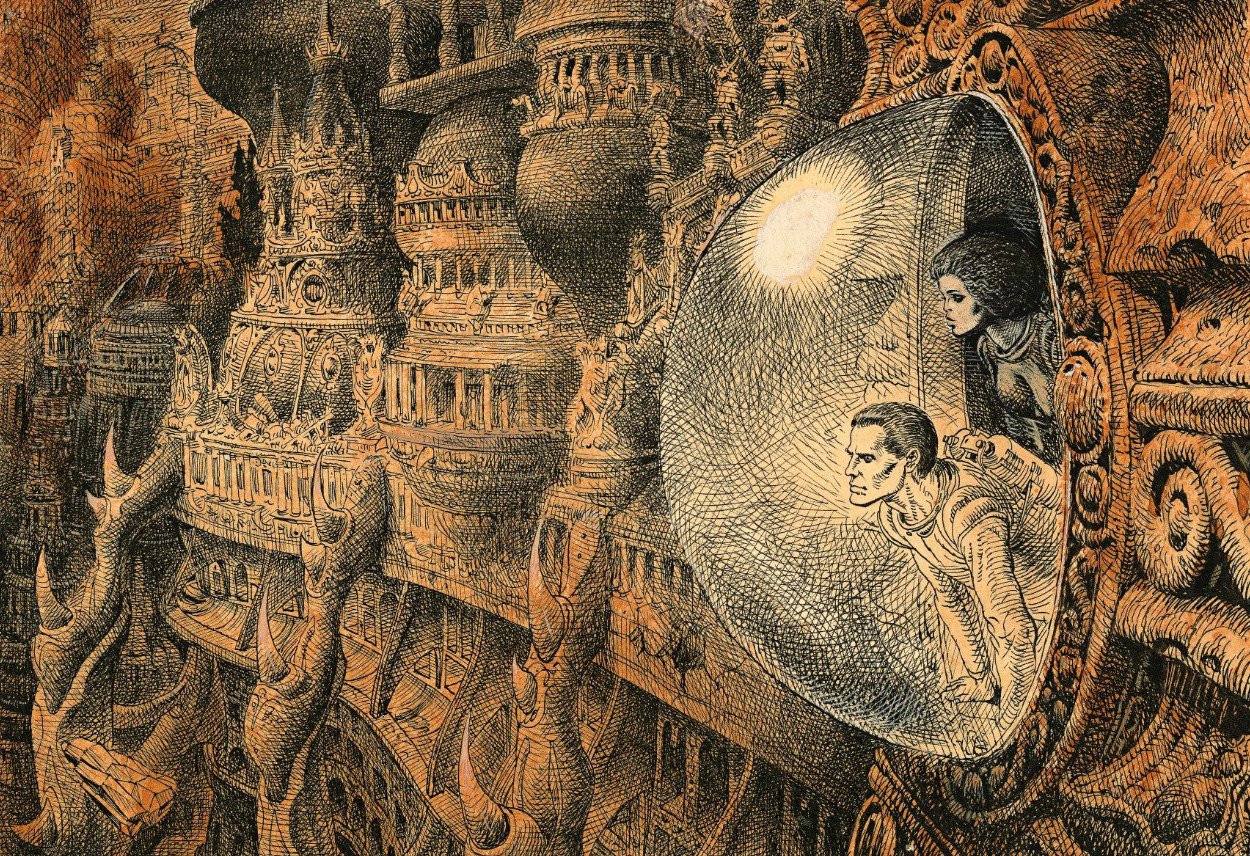
Illustration by Moebius for Les Robinsons du Cosmos (1970) by Francis Carsac.

Notre Dame des Fleurs is a collection of art based on or inspired by the Jean Genet novel. The book, which includes some new work of mine, will be published in February. Editor Jan van Rijn has a trailer for it here. It’s limited to 150 copies so anyone interested is advised to pre-order.

• Books that made me: William Gibson‘s influential reading. Good to see him mention Suttree by Cormac McCarthy, an outstanding novel that might be better known if it wasn’t for the gravitational pull of McCarthy’s other works.

• Zagava have announced a paperback reprint of The Art of Ilna Ewers-Wunderwald, a collection of neglected Art Nouveau drawings and designs compiled by Sven Brömsel.

• At Dennis Cooper’s: Black_Acrylic presents…He Stood In The Bath And He Stamped On The Floor: A Joe Meek Day.

• More yearly roundups: Our Haunted Year 2020 by Swan River Press, and The Year That Never Was by blissblog.

• New music: Spaceman Mystery Of The Terror Triangle by The Night Monitor.

Ralph Steadman’s guided tour through six decades of irrepressible art.

• At Greydogtales: Valentine Dyall: Mystery and Mesmerism.

• At Wormwoodiana: The Esoteric in Britain, 1921.

• At Strange Flowers: Marie Menken’s Lights.

I Want To See The Bright Lights Tonight (1974) by Richard and Linda Thompson | Neon Lights (1978) by Kraftwerk | Lights (1980) by Metabolist
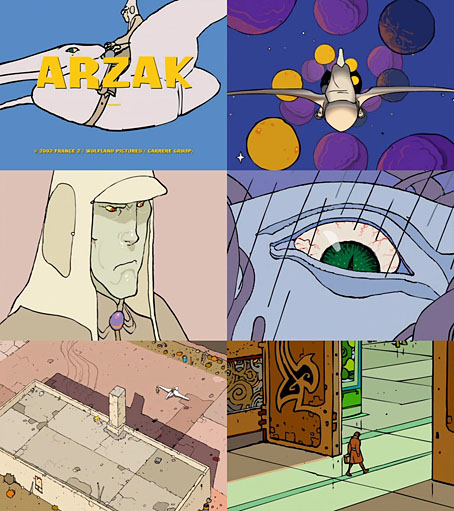
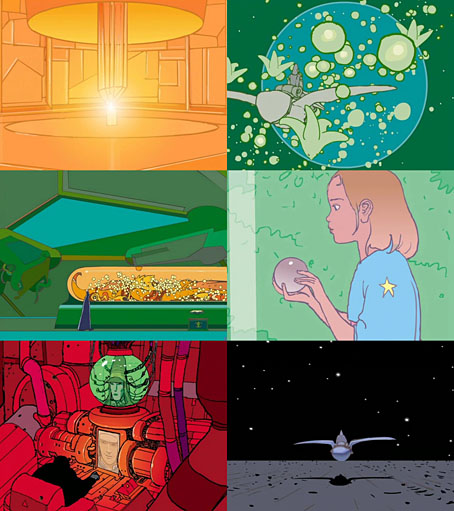
Arzak Rhapsody

arzak1.jpg

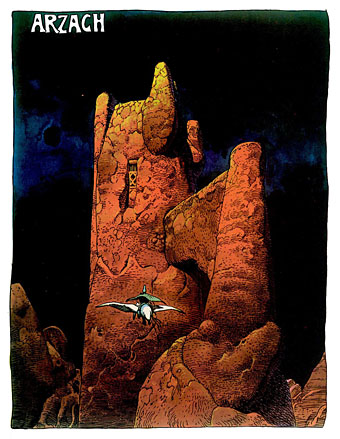
The first appearance of Arzach in Métal Hurlant, 1975.

Arzak (or Arzach, or Harzak, or Harzakc, etc) is one of the oldest of the comic characters created by Moebius, and an enduringly popular one even though the amount of pages devoted to the character is small. Moebius returned to Arzak sporadically after the first strips appeared in Métal Hurlant in 1975, where the first panel of the first story establishes the principal ingredients: the stern and resourceful explorer navigating an alien world on the back of a large white bird. Arzak’s flying companion is often described as a pterodactyl but it’s really a Moebius bird whose ancestors or cousins may be seen elsewhere in the Moebius-verse, notably the character of Deepo from The Incal.

arzak2.jpg

Arzak Rhapsody is a late entry in the Arzak mythos, a series of 4-minute animated films made for French TV in 2002, all of which were written by Moebius. The animation is crude when compared to René Laloux’s Moebius-designed Time Masters (1982), but the Moebius aesthetic is present throughout, from the desert landscapes of his early strips to the glowing crystals of his later work. The stories recycle moments from the comics, most of which concern Arzak evading one of the many lethal hazards presented by the flora and fauna of the place named in the animations as “Desert B”. All 14 episodes may be viewed here with the superfluous narration translated into English. Now when do we get to see Time Masters on blu-ray?

arzak3.jpg

Previously on { feuilleton }
The Captive, a film by René Laloux
The horror
Chute Libre science fiction
Heavy Metal, October 1979: The Lovecraft Special

Weekend links 544

wright.jpg

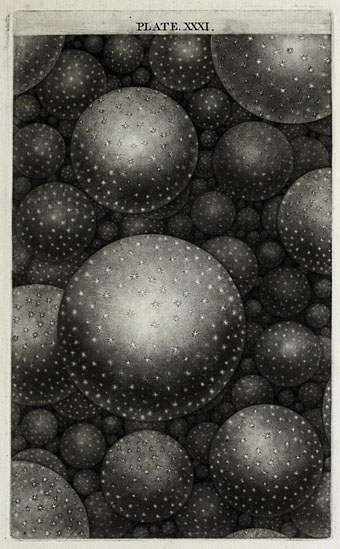
“You may if you please, call a partial View of Immensity, or without much Impropriety perhaps, a finite View of Infinity.” An illustration from Thomas Wright’s An Original Theory or New Hypothesis of the Universe (1750).

• If you read about electronic music for any length of time today you’ll eventually come across the term “pad”, referring to a feature of the music itself not the instrumentation. I’ve noticed increasing instances of this with no accompanying explanation of what the term actually refers to. Rob Wreglesworth has the answer.

• At Dangerous Minds: Richard H. Kirk talks to Oliver Hall about Cabaret Voltaire and Shadow Of Fear. No comment from Kirk as to why the new album warrants the CV name when the music is indistinguishable from his many solo works.

• Eyeball Fodder: The Art of the Occult Edition. S. Elizabeth presents artwork featured in her new book, together with links to artist interviews, including one to the interview we did for Coilhouse magazine a few years ago.

• More electronica: Music From Patch Cord Productions is a new compilation of music by Mort Garson that features some previously unreleased pieces. Great cover art by Robert Beatty as well.

• A trailer for Fireball: Visitors from Darker Worlds, a documentary film about meteorites by Werner Herzog and Clive Oppenheimer.

• From 2019: John Waters and Lynn Tillman in conversation. “The pair discussed Waters’s recent exhibitions and art career.”

Harlan Ellison’s The Last Dangerous Visions may finally be published, after a five-decade wait.

Turn your feline into a god with this cardboard Shinto shrine for cats.

• Mix of the week: XLR8R Podcast 670 by Dadub.

• At Dennis Cooper’s: Harry Dean Stanton Day.

John Cooper Clarke‘s favourite songs.

Meteor Storm (1994) by FFWD | The Third Chamber: Part 5 – 7pm Tokyo Shrine (1994) by Loop Guru | Fireball (1994) by Sun Dial

Weekend links 543

cliffhouse.jpg

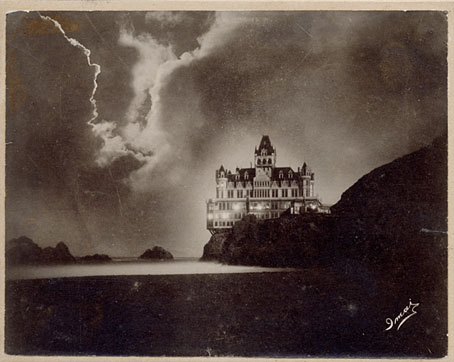
Adolph Sutro’s Cliff House in a Storm (c. 1900) by Tsunekichi Imai.

• Good to see a profile of Wendy Carlos, and to hear that she’s still working even though all her albums (to which she owns the rights) have been unavailable for the past two decades. I’d be wary of praising Switched-On Bach too much to avoid giving new listeners a wrong impression. The album was a breakthrough in 1968 but was quickly improved upon by The Well-Tempered Synthesizer (1969) and Switched-On Bach II (1973). And my two favourites, A Clockwork Orange – The Complete Original Score (1972) and the double-disc ambient album, Sonic Seasonings (1972), are superior to both.

• “[Sandy Pearlman] told me that one of the main inspirations was HP Lovecraft. I said, ‘Oh, which of his books?’ He said, ‘You know, the Cthulhu Mythos stories or At The Mountains Of Madness, any of those.'” Albert Bouchard, formerly of Blue Öyster Cult, talks to Edwin Pouncey about BÖC’s occult-themed concept album, Imaginos (1988), and his affiliated opus, Re Imaginos.

• More electronica: Jo Hutton talks to Caroline Catz, director of the “experimental documentary” Delia Derbyshire: The Myths and Legendary Tapes.

• At the V&A blog Clive Hicks-Jenkins talks to Rebecca Law about his award-winning illustrations for Hansel and Gretel: A Nightmare in Eight Scenes.

• New music: Archaeopteryx is a new album by Monolake; What’s Goin’ On is a further preview of the forthcoming Cabaret Voltaire album, Shadow Of Fear.

Celebrating A Voyage to Arcturus: details of two online events to mark the centenary year of David Lindsay’s novel.

• “Streaming platforms aren’t helping musicians – and things are only getting worse,” says Evet Jean.

• At Spoon & Tamago: the cyberpunk, Showa retro aesthetic of anime Akudama Drive.

• At A Year In The Country: a deep dive into the world of Bagpuss.

Sinister Sounds of the Solar System by NASA on SoundCloud.

• At Dennis Cooper’s: Shirley Clarke Day.

Mary Lattimore‘s favourite albums.

• Solaris, Part I: Bach (1972) by Edward Artemiev | Bach Is Dead (1978) by The Residents | Switch On Bach (1981) by Moderne

The Cthulhu Mythos in the pulps

mythos01.jpg

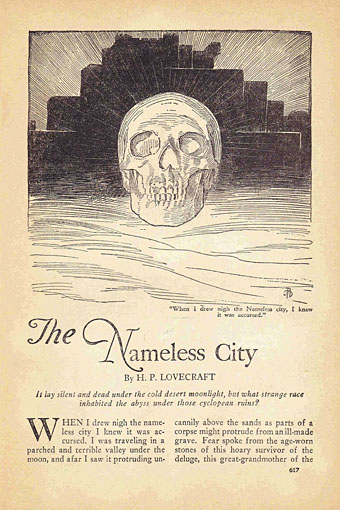
The Nameless City: First published in The Wolverine, November 1921. Reprinted in Weird Tales, November 1928. Illustration by Joseph Doolin.

This would have been “The Cthulhu Mythos in Weird Tales” if some of HP Lovecraft’s more substantial stories hadn’t been published elsewhere. To prevent sprawl I’ve limited the list to Lovecraft’s own stories even though the Mythos takes in the work of contemporaries such as Clark Ashton Smith, Robert E. Howard, Frank Belknap Long, Zealia Bishop, August Derleth and others. I like seeing the first appearance in print of familiar tales, and I like seeing their accompanying illustrations even if the drawings are inferior pieces, which they often were for the first decade of Weird Tales. These are the short-story equivalent of first editions, and in the case of The Call of Cthulhu you get to see the first printing anywhere of that mysterious name.

mythos02.jpg

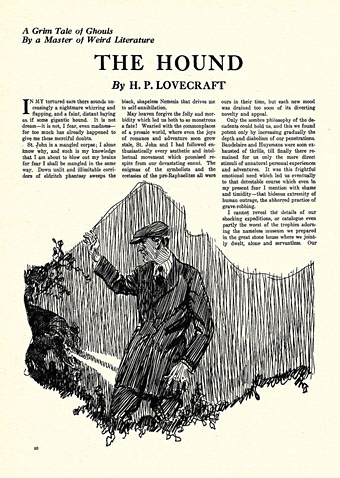
The Hound: Weird Tales, February 1924. Illustration by William Fred Heitman.

This issue is also notable for a story by Burton Peter Thom which shares a title with a Mythos-derived song by Metallica, The Thing That Should Not Be.

mythos03.jpg

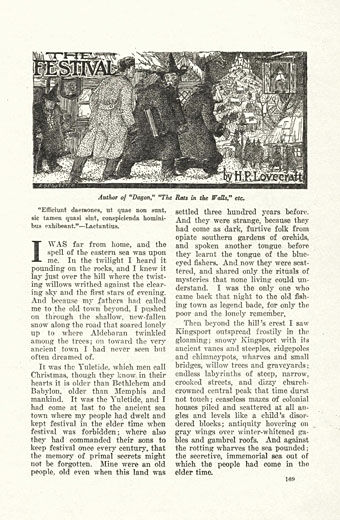
The Festival: Weird Tales, January 1925. Illustration by Andrew Brosnatch.

mythos22.jpg

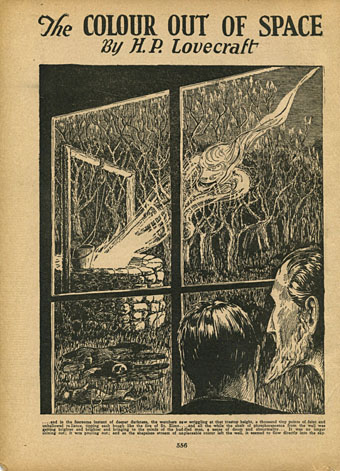
The Colour Out of Space: Amazing Stories, September 1927. Illustration by JM de Aragon.

Lovecraft didn’t think that Weird Tales would appreciate this one even though it’s more horror than science fiction so he sent it to Amazing Stories instead.

mythos04.jpg

mythos26.jpg

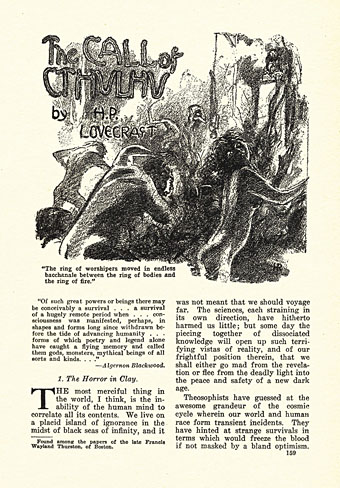
The Call of Cthulhu: Weird Tales, February 1928. Illustration by Hugh Rankin.

It’s doubtful that Rankin, Senf and co. would have been up to the task of depicting Great Cthulhu or the non-Euclidean nightmare of R’lyeh, but this hardly excuses editor Farnsworth Wright’s decision to give the cover to Elliott O’Donnell’s ridiculous ghost table.

Continue reading “The Cthulhu Mythos in the pulps”