Rooms with a paranormal view

room1.jpg

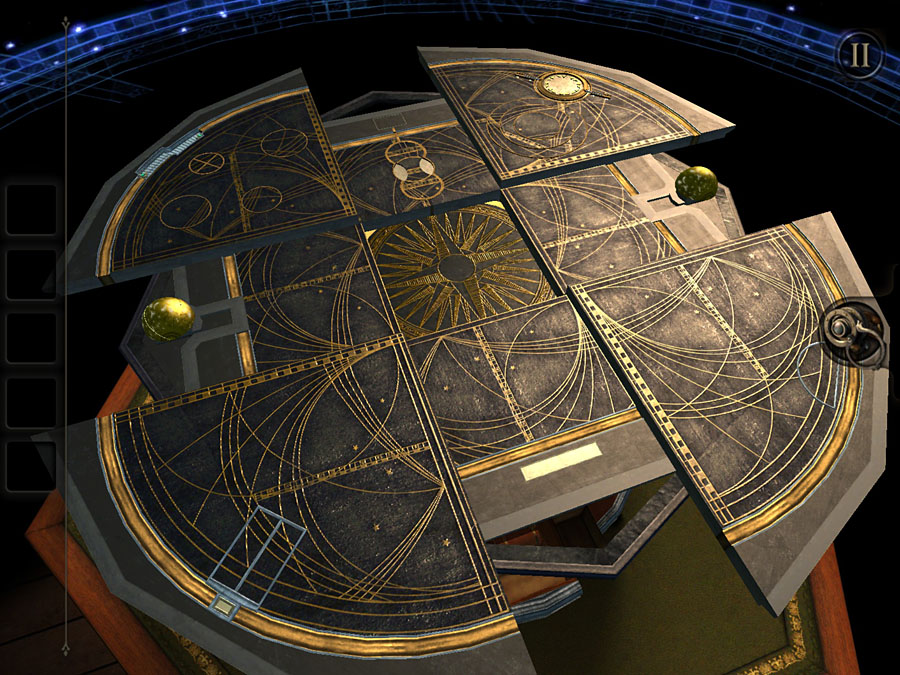
The Room: the cosmic tabletop.

A few words of praise for the Room series from Fireproof Games. I don’t play many computer games, and I think this may be my first post dedicated to such a thing, but I maintain an interest in the medium. The Room and its sequels only came to my attention a couple of weeks ago when I was wondering if there was anything Myst-like available for the tablet. I never got to play the original Myst but enjoyed its follow up, Riven, although the enjoyment was mostly for the graphics, the music and the island environments. The game itself was less satisfying, requiring pen and paper to keep track of its complexities, and involving a great deal of fruitless journeying from one location to another in the search for new clues.
room2.jpg

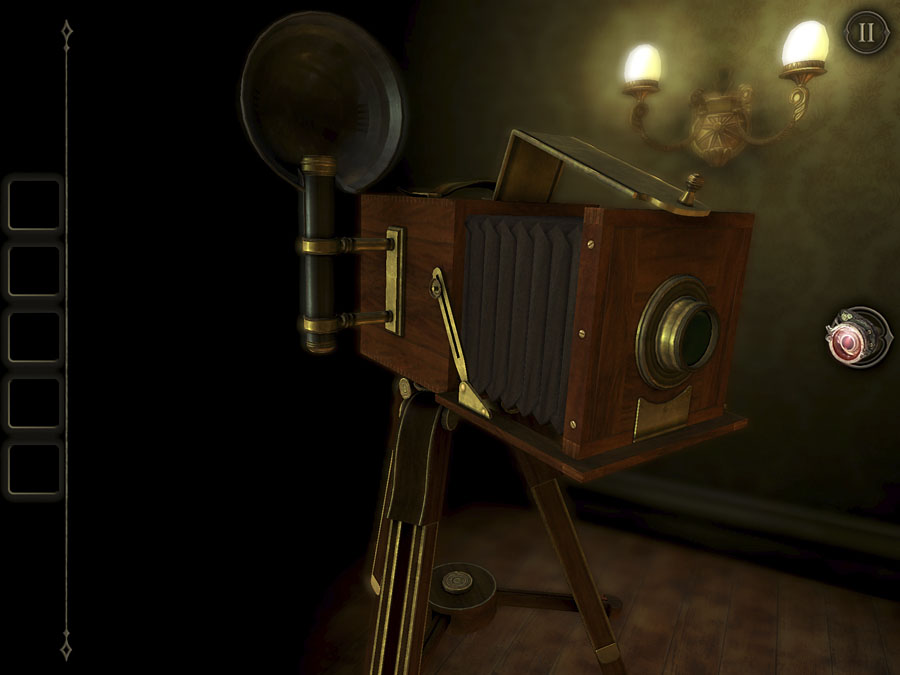
The Room 2: the camera.

The Room follows the template established by Myst in presenting you with a number of mechanical artefacts, all of which have to be examined and opened or operated before you can proceed to the next stage. The dominant aesthetic is 19th-century-mechanical—there’s a lot of wood and brass to these devices—but to call it steampunk would be a mistake; there’s little steam involved, and most of the cogs are kept inside their cases. There is a hint of Jules Verne, however, in the notes from an absent inventor whose initials, “A.S.”, may be a nod to Journey to the Centre of the Earth. As the title suggests, the location is a single room, while in the sequels, The Room 2 and The Room 3, you’re presented with a series of connected spaces. The third installment is the closest to the original Myst with a central hub that leads to other areas of a rambling complex of buildings, not all of which are revealed at the outset. The main structure is based on William Beckford’s Fonthill Abbey which pushes things into Gothic territory even without the developments outlined below.
room3.jpg

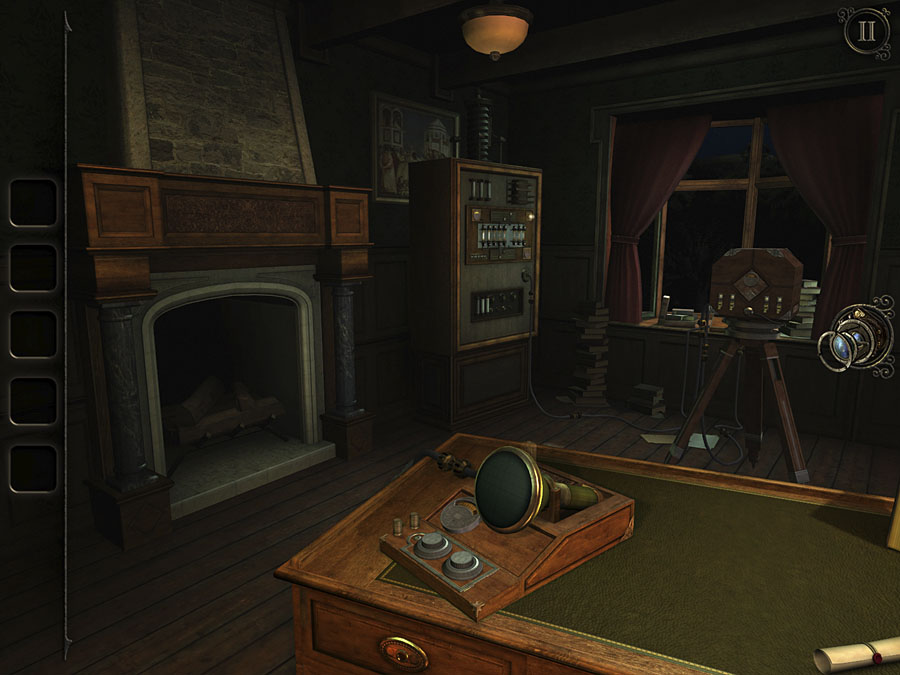
The Room 3: the oscilloscope is one of several which need to be powered up and manipulated in order to open the Null portals.

The MacGuffin for all the games is a new element, the Null, whose discovery and potential obsesses the creators of the games’ devices, and whose manipulation of space creates many of the portals that lead to new rooms. As the series progresses, the Null becomes a growing menace that leads to full-on cosmic horror, with oil-slick Tentacles From Beyond writhing around the interdimensional portals you have to travel through. This development was surprising and, for this player, very welcome, turning the games from a series of eleborate puzzles into something much more sinister. The aesthetic evolves accordingly, with an increasing profusion of occult sigils and pentacles, and, in The Room 2, Tarot cards and séance devices. (Fireproof have a set of their Tarot designs available as a free download.) In the second game there’s a further requirement to piece together mundane machines—a camera or a typewriter, say—before they will function properly. This process reaches a peak in The Room 3 where you’re faced with a succession of increasingly complex tasks, from woodworking and metal forging to electro-mechanical engineering and astronomy. As with the Myst universe, there are no monsters here (although there is the occasional ghost), nothing needs to be fought with weapons, it’s just you, a room full of objects and a continual background murmur of unnerving whispers and distant sounds. The gameplay in The Room 3 is sufficiently non-linear to lead to a variety of different endings, not all of which may be survivable. I managed to escape the Tentacles From Beyond when they finally destroyed the house but I also missed finding an important artefact. I’ll be returning, wiser and, I hope, more attentive to the half-hidden details.
room4.jpg

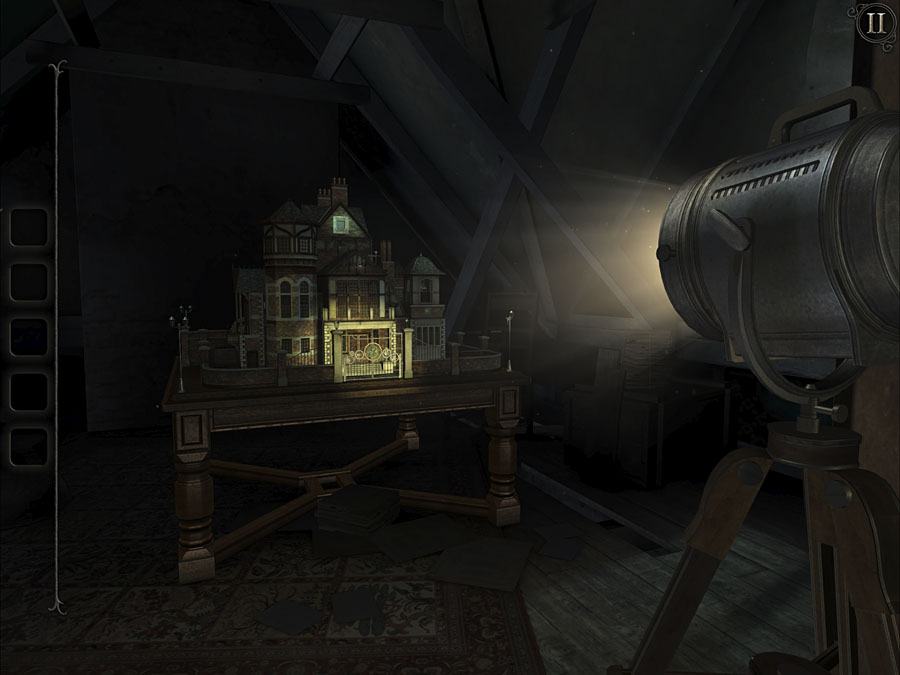
The Room—Old Sins: the haunted doll’s house as seen at the beginning of the game.

I’m currently playing the fourth game in the series, Old Sins, which returns you to a single room but plays with scale via a large doll’s house. The exterior of the building is all detailed model work, while the interiors—accessed through Null physics—are scaled-down replicas of the rooms in a house where another Null investigator and his wife have gone missing. It’s not clear yet whether the attic where the toy house is stored is also the attic of the real house the model is based upon but having dealt with a similar model in The Room 3 this seems likely.

While I enjoyed the surface details of Riven I was never very interested in the fantasy background of the Myst universe. The Room series is much closer to my own core preoccupations, a beguiling blend of antique technology with borderline occultism and those Tentacles From Beyond, a scenario that wouldn’t be out of place in an issue of Weird Tales. Just the thing for the darkening days of October.

Ron Cobb, 1937–2020

cobb02.jpg

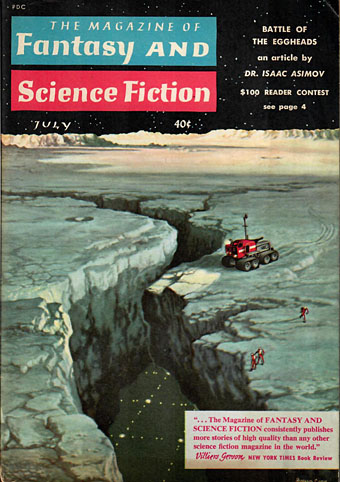
The Magazine of Fantasy and Science Fiction, July 1959.

The death of American illustrator/cartoonist/designer Ron Cobb was announced yesterday. All the obituaries are concentrating on the designs he produced for Hollywood feature films so here’s an alternative view of a long and varied career.

cobb01.jpg

After Bathing At Baxter’s (1967) by Jefferson Airplane.

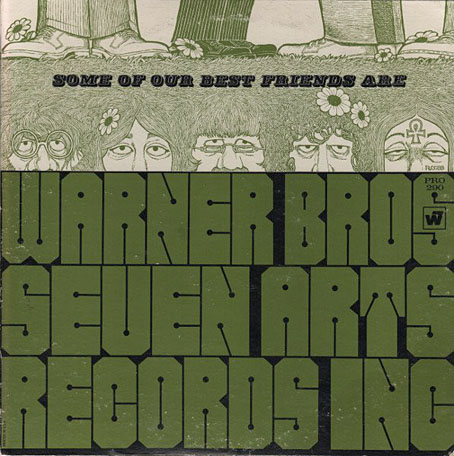
Cobb’s first album cover is his most famous, and probably his most familiar work outside his film designs, but there were a few more, some of which may be seen below. The San-Francisco-house-as-aircraft always reminds me of the car/plane hybrid piloted by Professor Pat Pending in the Wacky Races cartoons.

cobb04.jpg

Some Of Our Best Friends Are (1968) by Various Artists.

cobb10.jpg

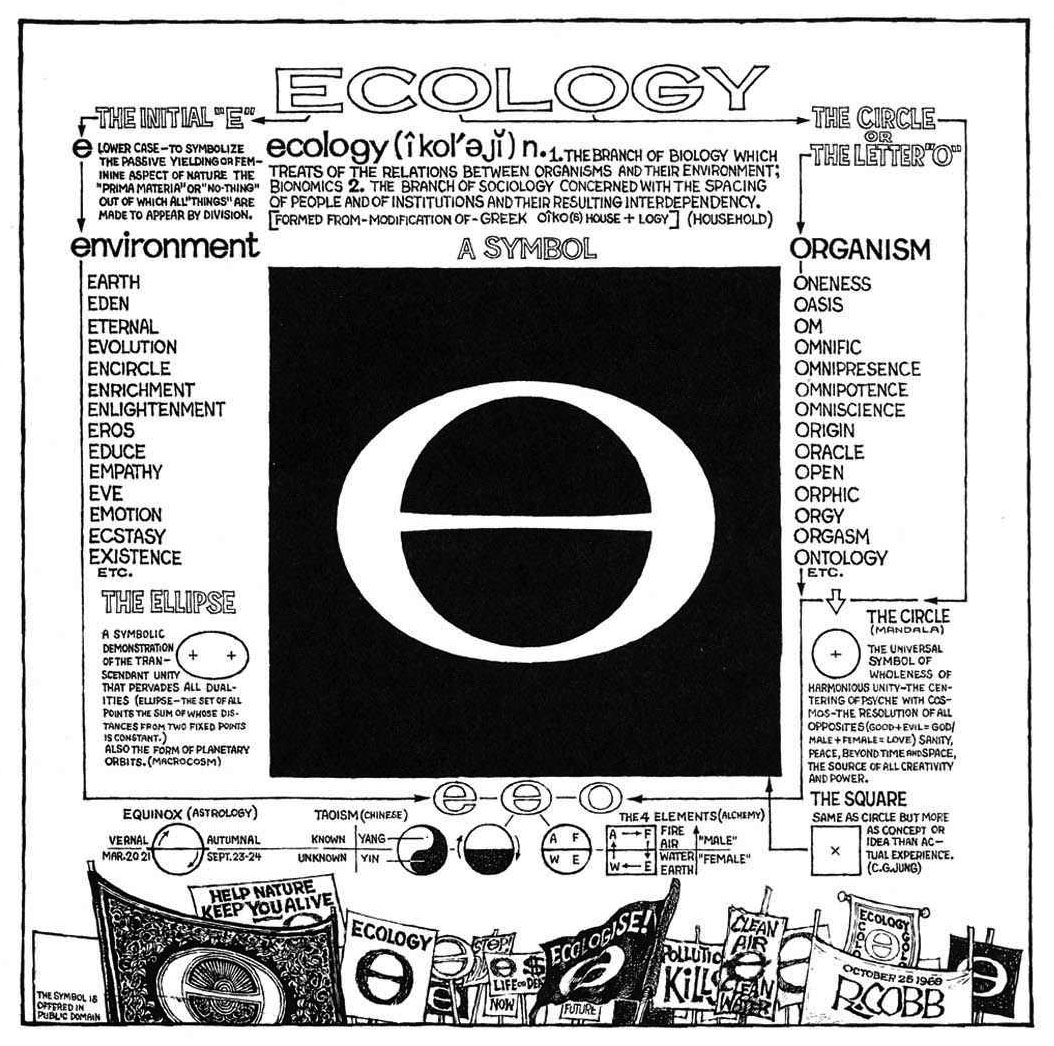
Ecology symbol, October 1969.

Cobb’s copyright-free design for an ecology symbol was published in the Los Angeles Free Press in November, 1969. The “Freep” also ran Cobb’s cartoons, some of which were later collected in The Cobb Book (1975). Satire has a tendency to date very quickly but many of Cobb’s barbs are still relevant today.

cobb07.jpg

Undated cartoon.

cobb05.jpg

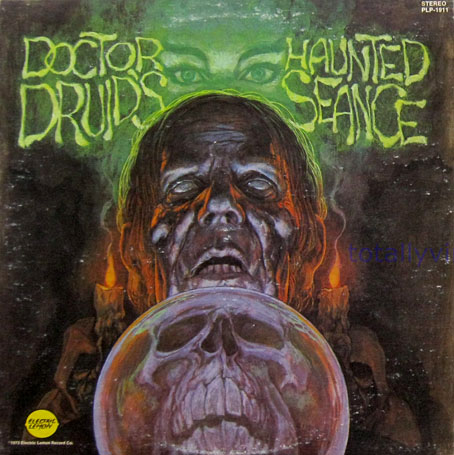
Doctor Druid’s Haunted Seance (1973).

Continue reading “Ron Cobb, 1937–2020”

Weekend links 534

hasui.jpg

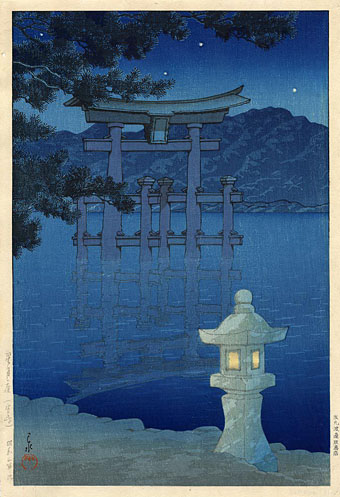
Beautiful night – moon and stars, Miyajima Shrine (1928) by Hasui Kawase.

• One announcement I’d been hoping for since last summer was the news of a second box of Tangerine Dream albums to follow the excellent In Search Of Hades collection. The latter concentrated on the first phase of the group’s Virgin recordings, up to and including Force Majeure. This October will see the release of a new set, Pilots Of Purple Twilight, which explores the rest of the Virgin period when Johannes Schmoelling had joined Froese and Franke. Among the exclusive material will be a proper release of the soundtrack for Michael Mann’s The Keep (previously a scarce limited edition), together with the complete concert from the Dominion Theatre, London. Also out in October, Dark Entries will be releasing a further collection of recordings from the recently discovered tape archive of Patrick Cowley. The new album, Some Funkettes, will comprise unreleased cover versions, one of which, I Feel Love by Donna Summer, is a cult item of mine that Cowley later refashioned into a celebrated megamix.

• “Did you know that Video Killed The Radio Star was inspired by a JG Ballard story?” asks Molly Odintz. No, I didn’t.

Casey Rae on the strange (musical) world of William S. Burroughs. Previously: Seven Souls Resouled.

• “And now we are no longer slaves”: Scott McCulloch on Pierre Guyotat’s Eden Eden Eden at fifty.

• At Dennis Cooper’s: Frank Jaffe presents…Dario Argento and his world of bright coloured blood.

• At Wormwoodiana: The Serpent Calls. Mark Valentine on a mysterious musical instrument.

• At Spoon & Tamago: Long-Exposure Photographs of Torii Shrine Gates by Ronny Behnert.

• Mix of the week: mr.K’s Soundstripe vol 4 by radioShirley & mr.K.

• Rising sons: the radical photography of postwar Japan.

• The illicit 1980s nudes of Christopher Makos.

• RIP Diana Rigg.

Garden Of Eden (1971) by New Riders Of The Purple Sage | Ice Floes In Eden (1986) by Harold Budd | Eden (1988) by Talk Talk

Robot Artists and Black Swans

robotartists.jpg

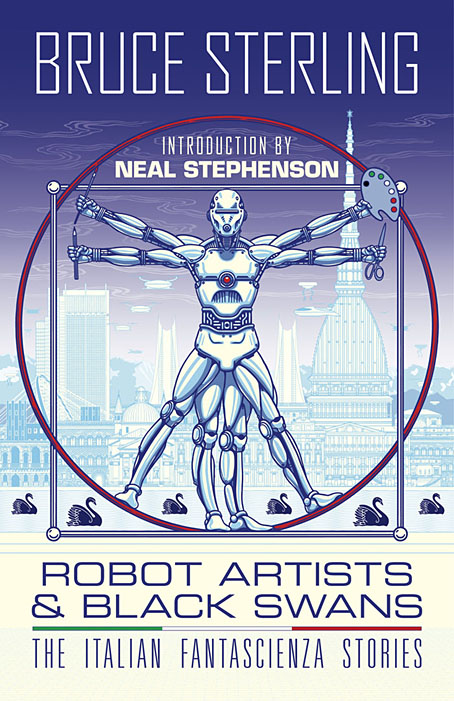
Four years ago I designed and illustrated a book for Tachyon written by Bruce Sterling, Pirate Utopia. Robot Artists and Black Swans is a kind of sequel, being the work of the same author for the same publisher, and with a similar geographical focus on southern Europe. The new book differs from the earlier one by being a collection of stories rather than a single piece, many of which are set in or near the city of Turin where Sterling and his wife, Jasmina Tesanovic, spend much of their time. Sterling has been living in Europe for many years, long enough to have cultivated an alter-ego, Bruno Argento, an Italian science-fiction writer who is offered as the real author of the stories in Robot Artists and Black Swans.

Pirate Utopia was an easy book to design because of the Futurist theme which I illustrated by adapting graphics by artist and designer Fortunato Depero. For the cover of the new volume I considered trying something similar with another Italian artist/designer, Franco Grignani (1980–1999). In addition to having studied in Turin, Grignani was commissioned by David Pelham to create cover art for a handful of Penguin science fiction titles in the late 1960s. Much of Grignani’s artwork is heavily indebted to the Op Art style popularised by Bridget Riley and Victor Vasarely, especially the early Riley formula of dazzling arrangements of parallel lines, a formula he made his own after Riley’s work evolved in other directions. Despite these favourable qualities, Grignani’s art proved too abstract for my purposes, and for Tachyon’s who wanted something more illustrative, so I ended up co-opting a very different Italian artist/designer, Leonardo da Vinci. The figure of Da Vinci’s Vitruvian Man has been parodied and pastiched many times so this isn’t remotely original (I’ve also used the original drawing on a pastiche book cover I designed for the Lambshead Disease Guide), but making the figure a robot was a convenient way of combining the title with Italian history. One of the stories in the collection, Pilgrims of the Round World, concerns the inhabitants of Turin during the Renaissance years, and mentions Leonardo (or “the Vinci boy”) several times, so the figure does have some actual relevance beyond being recognisably Italian. The background is, of course, the city of Turin given a slightly futuristic tweak, although it’s more Turinesque than a match for the place itself.

As usual, I’ll save discussion of the book’s interior until after publication which will be in March, 2021. Watch this spacetime.

Previously on { feuilleton }
Pirate Utopia by Bruce Sterling
Futurismo!

Taking Tiger Mountain

ttm1.jpg

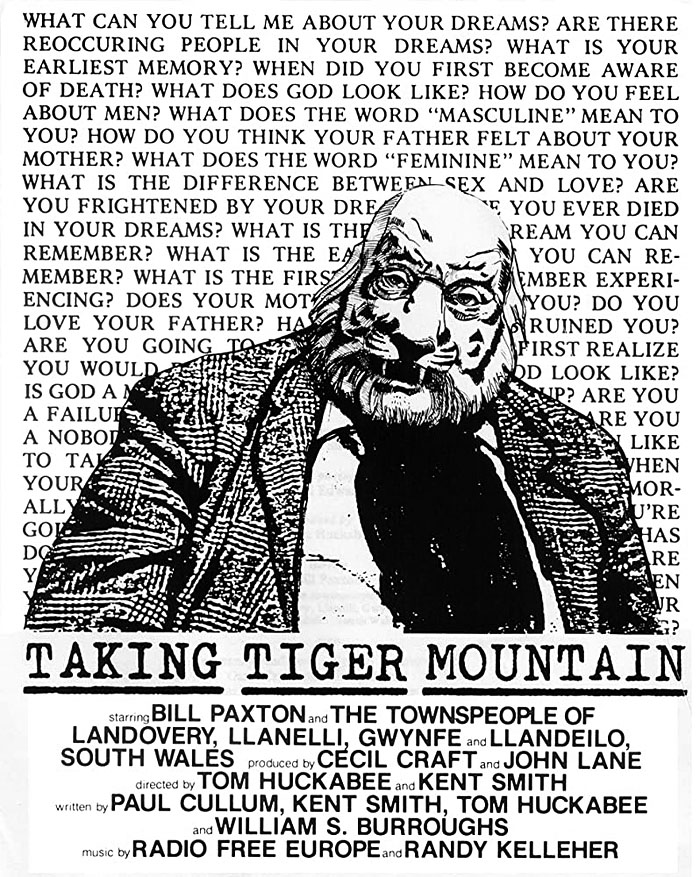
Another week, another obscure black-and-white science fiction film. I hadn’t heard of this one at all until it was announced in 2012 that co-director Tom Huckabee would be attending a rare screening in New York. The film is an oddity with a complicated history that I’m too lazy to try and condense so here’s the borrowed detail:

IMDB: In a dystopian future, Europe is unified under a totalitarian patriarchy, where each town is assigned a single economic purpose. In Brendovery, Wales the occupation is prostitution. Arriving by train from London is Billy Hampton, a young American expatriate and draft evader (Bill Paxton in his first lead role), ostensibly there to enjoy a sex-filled holiday. Unknown to him he is a time bomb assassin, programmed by a feminist terrorist cell to assassinate the local minister of prostitution.

Wikipedia: Taking Tiger Mountain is a 1983 American science fiction film directed by Tom Huckabee and Kent Smith, and starring Bill Paxton in one of his earliest on-screen acting roles. Originally conceived as an experimental art film inspired by a novel by Albert Camus’s 1942 novel The Stranger and a poem by Smith, the film was initially directed by Smith and shot in Wales. Aside from Paxton, the film’s cast is made up of townspeople from the areas in which shooting took place. It was filmed without sound, with the intention of adding dialogue in post-production. During post-production, Huckabee took over as the film’s director, abandoning Smith’s original concept and instead loosely basing the film on the 1979 novella Blade Runner (a movie) by William S. Burroughs. The film premiered on March 24, 1983. Over three decades later, Huckabee re-edited the film and released it as an alternate cut titled Taking Tiger Mountain Revisited.

Tom Huckabee: The story went through four distinct periods of creation:
1. Kent Smith’s original script, entitled Taking Tiger Mountain, written in 1974, based loosely on the John Paul Getty III’s kidnapping of 1973 and Albert Camus’ The Stranger. It was set in the casbah of Tangier, Morocco.
2. After Bill and Kent got ejected from Morocco before shooting even a foot of film, they drove to Wales, adapting the script significantly to the new location and the people and opportunities that presented themselves; but they ran out of film and money after shooting about half of their script.
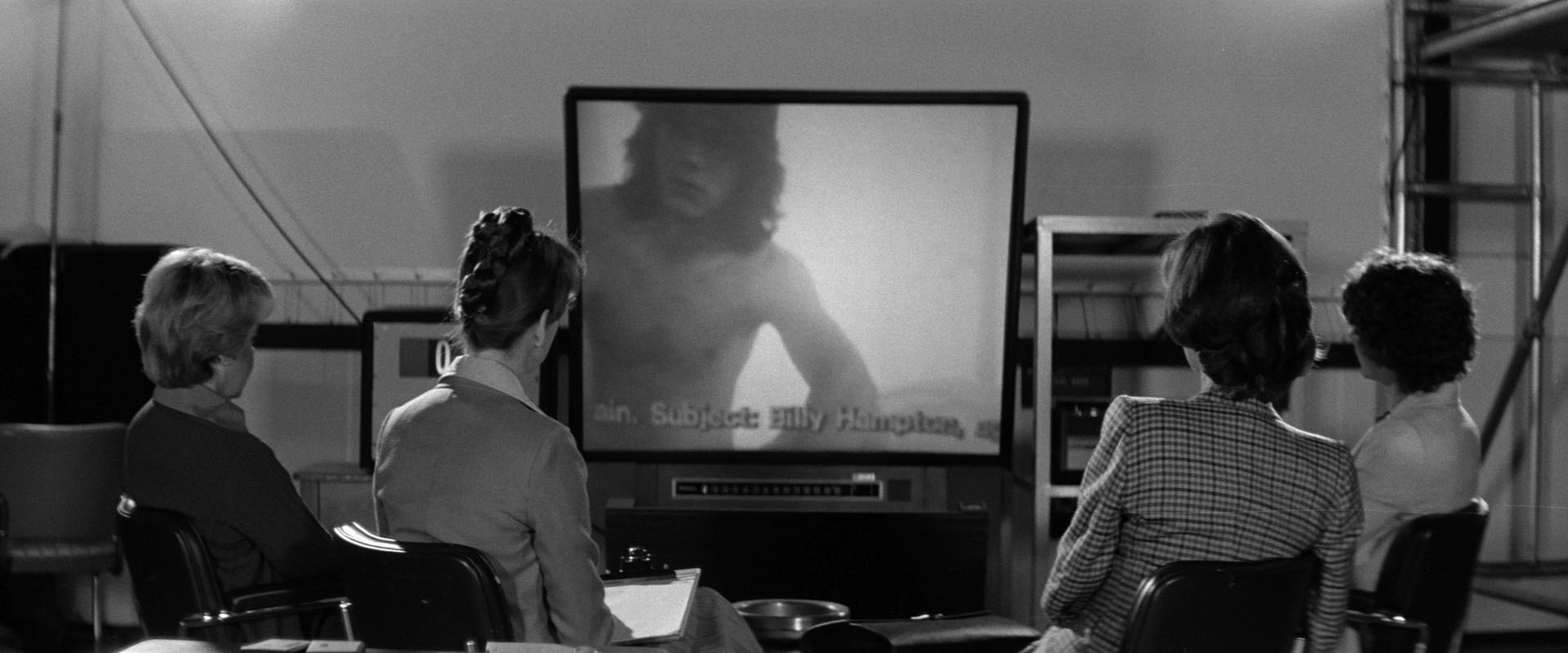
3. After I acquired the footage in 1979, I knew I couldn’t go back to Wales, so after editing their footage to about 55 minutes, I wrote a new story with a lot of help from collaborators, like Paul Cullum, Lorrie O’Shatz, and Ray Layton. I incorporated the Burroughs material and dropped the 55 minutes from Kent and Bill’s script into it. We wrote the ten-minute introductory section with the women and shot it on a sound stage in Austin, incorporating footage from another unfinished film by Kent and Bill called D’Artangan. I also built ten minutes of scenes from outtakes. In 1980, Paxton came to Austin for a few days to “loop” all of his dialogue, as no sound had been recorded in Wales. He improvised a lot of his voice-over narration, while under hypnosis. This film, called Taking Tiger Mountain, was released on 35mm in 1983 and toured the Landmark Theater chain of art cinemas.
4.  In 2016 I got a small advance from Etiquette Pictures for digital distribution and decided to do a major upgrade. I cut out ten minutes and added five, including the new ending, which comes after the end credits, significantly changing the message of the film. I reworked the narrative, making it easier to follow.

In addition to the complications of the production it’s necessary to note that the title has nothing to do with either Brian Eno’s Taking Tiger Mountain (By Strategy), or the Chinese opera the Eno album is named after, although we do get to hear about a tiger mountain. This reflects the equally tangled history of the “Blade Runner” title, which Taking Tiger Mountain does have some connection with via William Burroughs’ Blade Runner: A Movie. This was Burroughs’ cinematic reworking of a science fiction novel by Alan E. Nourse, The Bladerunner (1974), a piece of futurism about the very American dystopia of a nightmare healthcare system. Blade Runner: A Movie followed Burroughs’ earlier screenplay/novella, The Last Words of Dutch Schultz, although the Nourse adaptation was a much more ambitious scenario with little chance of ever being filmed. No studio in the 1970s (or today, for that matter…) would have put up the money for something that’s like a wilder version of Escape from New York with added gay sex and time travel, however attractive this may sound. As is well known by now, the treatment’s title was later purloined by another film that has little else in common with anything discussed here.

ttm2.jpg

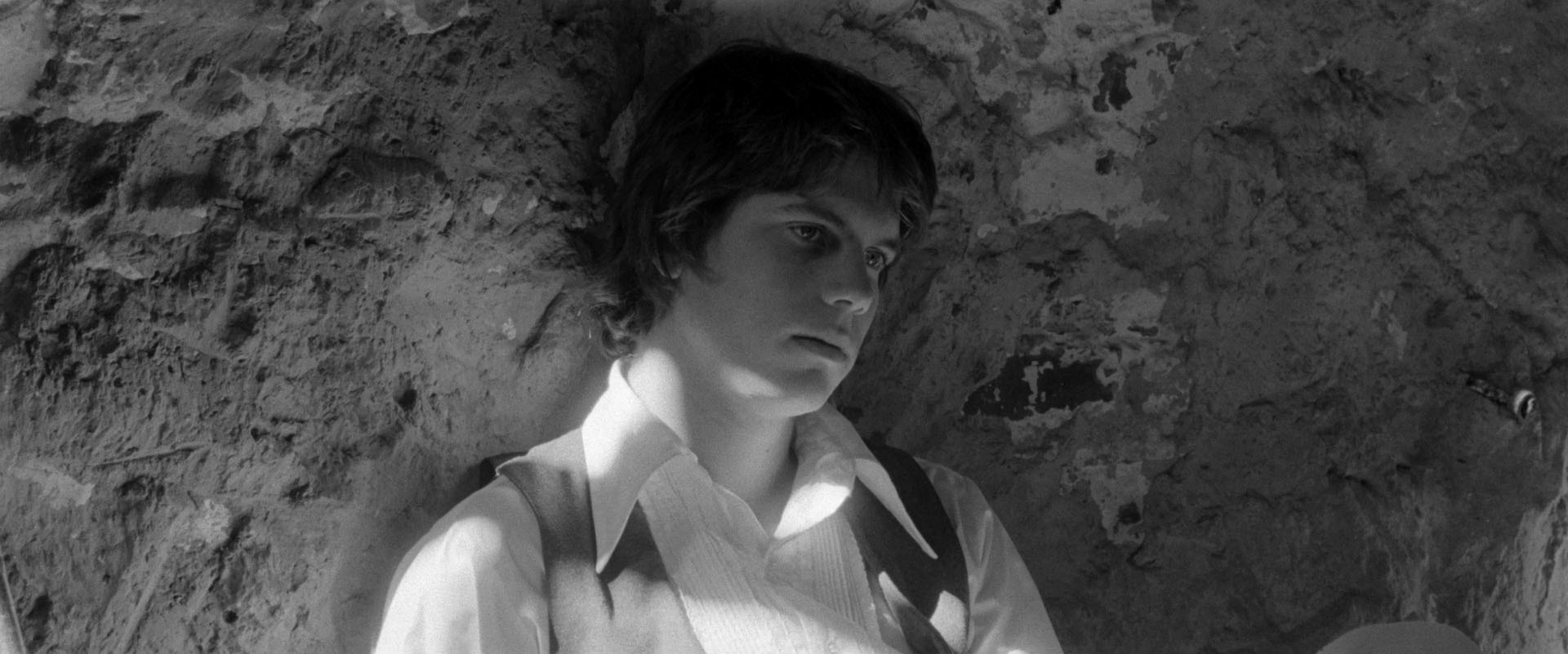
All of which means that Taking Tiger Mountain is exactly the kind of thing guaranteed to stoke my curiosity: a Burroughs-derived science-fiction film made on the cheap by Americans in south Wales, of all places. Why Wales? Because Bill Paxton had been there as a foreign exchange student. I’m not sure I would have been as interested without the disjunctive frisson of gloomy, rain-swept Wales in the mid-1970s colliding with William Burroughs. That said, the blu-ray release from Vinegar Syndrome has two things immediately in its favour: for a micro-budget production the film has excellent photography (the black-and-white stock was provided by leftovers from Bob Fosse’s Lenny); and there’s a surprising amount of unsimulated sex, something that isn’t such a big deal today but certainly was in 1974. The youthful Bill Paxton is gorgeous and exceptionally photogenic, so the film is a pleasure to watch even when little of substance is happening.

ttm3.jpg

Continue reading “Taking Tiger Mountain”