Weekend links 63

solaris.jpg

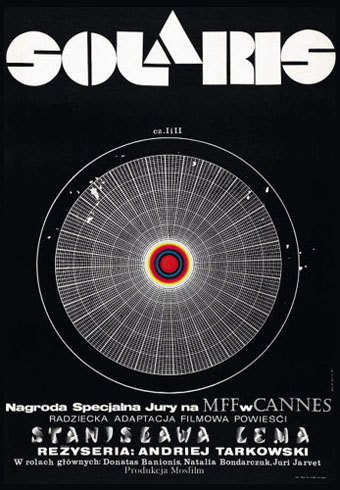
Polish poster by Andrzej Bertrandt for Andrei Tarkovsky’s 1972 film of Solaris.

• Stanisław Lem’s Solaris receives its first ever direct English translation by Bill Johnston (only on Audible for the moment), all previous editions having been sourced from a poor French translation. An all-too-common state of affairs for non-English fiction where bad or bowdlerised translations persist for years.

• Now that Minnesota politician Michelle Bachmann is running for US president it’s a good time to examine her views when (theoretically) her actions could one day impact on us all. The Daily Beast gathered together some of her worst pronouncements, including the following about gay people: “It’s a very sad life. It’s part of Satan, I think, to say that this is gay.” Her husband describes his attempts to counsel (ie: cure) gay teenagers with the words “Barbarians need to be educated.” It’s no surprise that both these people find confirmation of their views in the usual narrow interpretation of Christian doctrine. Not all American Christians are this ignorant or offensive, of course. The Heartland Proclamation calls for “an end to all religious and civil discrimination against any person based on sexual orientation and gender identity and expression”.

Journalist Andrew Sullivan in 2003 proposed a label for people like Bachmann: “I have a new term for those on the fringes of the religious right who have used the Gospels to perpetuate their own aspirations for power, control and oppression: Christianists. They are as anathema to true Christians as the Islamists are to true Islam.” It’s a term that ought to have more widespread use.
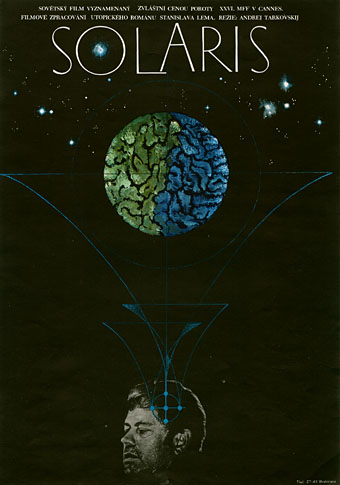
solaris-czech.jpg

Czech poster for Solaris. No designer credited.

• Probing the secrets of psilocybin: “Scientists at the Johns Hopkins University School of Medicine have zeroed in on the dose levels of the ‘sacred mushroom’ chemical capable of yielding positive, life-changing experiences, while minimizing the chance of transient negative reactions in screened volunteers under supportive, carefully monitored conditions.”

• Rick Poynor relates a visit to the Frederic Marès Museum, Barcelona, home to the 50,000 objects Marès collected over his lifetime. Further details of the collection can be found at the museum website.

In her 1969 essay “The Pornographic Imagination,” [Susan] Sontag insisted that Story of O could be correctly defined as “authentic” literature. She compared the ratio of first-rate pornography to trashy books within the genre to “another somewhat shady subgenre with a few first-rate books to its credit, science fiction.” She also maintained that like science fiction, pornography was aimed at “disorientation, at psychic dislocation.”

If so, that aim is far more interesting than what most generic “mainstream” novels set out to do. No one could describe O as predictable or sentimental. Its vision was dark and unrelenting; everything about it was extreme. Sontag also compared sexual obsession (as expressed by Réage) with religious obsession: two sides of the same coin.

Carmela Ciuraru on the story of The Story of O by Pauline Réage.

• “No hay banda! There is no band. It is all an illusion.” David Lynch will be opening a Club Silencio in Paris (Montmartre, of course). Facebook pages here and here.

• Sad to say that Chateau Thombeau is now closed but Thom has begun a more personal journal here.

• Picture galleries of the Vorticists at the Tate here and here. Related: Into the Vortex.

• Illuminated Persian pages from 1604 at BibliOdyssey.

• Tape drawings by Chris Hosmer.

• Miles Davis and co. at the Isle of Wight Festival, 1970: part 1 | part 2 | part 3 | part 4
Weekend links: Apocalypse not now

apocalypse.jpg

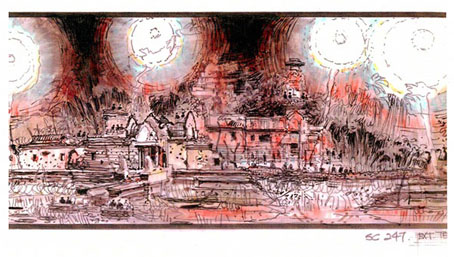
The Kurtz compound prior to destruction. An Apocalypse Now storyboard, one of a number which will be included among the extras on the Blu-Ray release of Francis Coppola’s film when it appears in the UK next month. The film is given a new cinema release on May 27th.

Radio broadcaster Harold Camping, a man denounced by fellow Christians as a false prophet, achieved one thing at least this week by making himself and his followers a global laughing-stock after the Rapture failed to materialise. I would have put money on him blaming those terrible gays somewhere along the way, such complaints being so common among a certain brand of American fundamentalist that you could write their sermons for them. Sure enough, here’s the old fool blathering about “lespianism” and describing the beautiful city of San Francisco as a cesspool. Shall we chalk this up as another victory for the gays, Harold? Related: No dogs go to heaven.

The internet has always been a home for ridicule but occasions like this bring out the wags in droves. The Oatmeal showed us how God is managing the Rapture using a Windows Install Wizard, and also pointed to a selection of sarcastic tweets. Meanwhile, this page has a comprehensive catalogue of previous apocalypse dates; the biggy is next year, of course.

Burroughs himself was no stranger to prosecution. In 1962 he was indicted on grounds of obscenity. Naked Lunch was not available in the US until 1962 and in the UK until 1964. The writer Norman Mailer and the poet Allen Ginsberg had to defend the book in court before the ruling could be reversed. In Turkey, it is now our turn to stand up for the novel.

Turkish writer Elif Shafak criticising the paternalism of the Turkish state in trying to protect its people from troubling novels. Related: William Burroughs publisher faces obscenity charges in Turkey.

An A–Z of the Fantastic City by Hal Duncan. “This guidebook leads readers and explorers through twenty-six cities of yore (Yore, while included, is one of the shorter entries).” Illustrated by Eric Schaller.

• The creepiest Alice in Wonderland of all, Jan Švankmajer’s semi-animated Alice (1988), receives a very welcome re-issue on DVD this month. With Brothers Quay extras and other good things.

smith.jpg

Robert E Howard’s sinister magus from the Conan stories, Thoth-Amon, as depicted by Barry Windsor-Smith. From a portfolio of five Robert E Howard characters, 1975.

What is computer music (or does it matter)? Related: A History of Electronic/Electroacoustic Music (1937–2001), 511 (!) downloadable pieces.

Unearthly Powers: Surrealism and SF: Rick Poynor explores the Tanguy-like strangeness of Richard Powers.

Magic Trip: Ken Kesey’s search for a kool place.

The Library of Congress National Jukebox.

Vladimir Nabokov’s butterflies.

Amy Ross’s Wunderkammer.

Rapture (1981) by Blondie | Apocalypse (1990) by William Burroughs | Rapture (2000) by Antony and the Johnsons.

A Book of Images by WT Horton

horton1.jpg

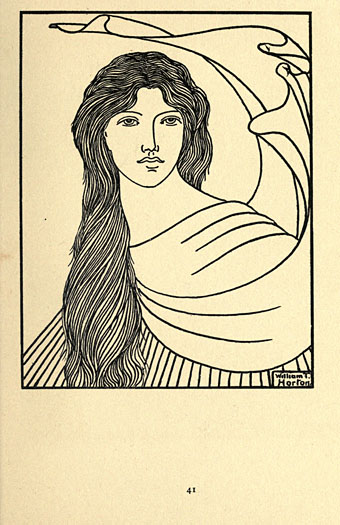
Diana.

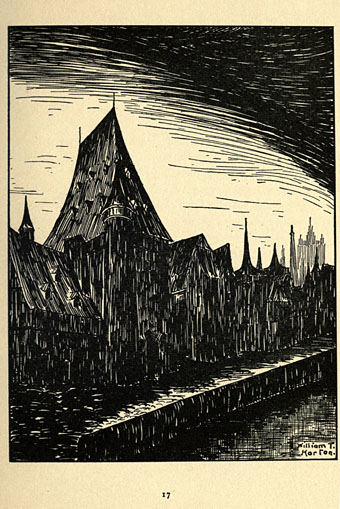
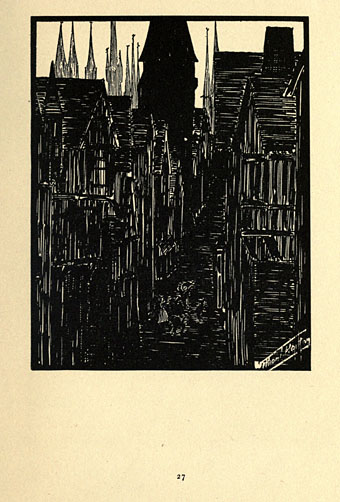
A Book of Images is an odd volume, a small collection of full-page drawings published by the Unicorn Press in 1898. William Thomas Horton (1864–1919) wasn’t in the first rank of black-and-white artists (although he did do better than this later on) but he was fortunate to have his book introduced by WB Yeats who generously lists the artist among some of the great talents of the 1890s. The series evolves from mundane views to mystical vision, and it’s this latter quality which Horton would explore in subsequent works.

horton2.jpg

By the canal.

horton3.jpg

La Rue des Petit-Toits.

Continue reading “A Book of Images by WT Horton”

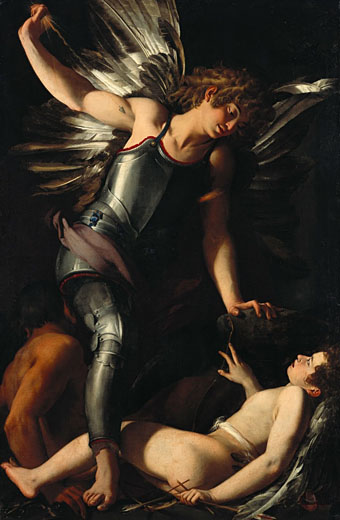
The Divine Eros Defeats the Earthly Eros

baglione1.jpg

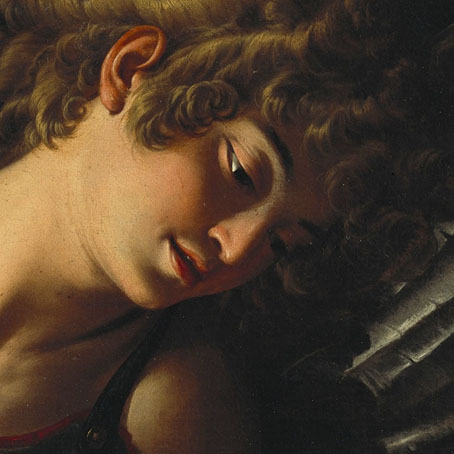
Another favourite painting receiving the Google Art Project high-res treatment. Giovanni Baglione’s picture (also known as Sacred Love versus Profane Love) was painted circa 1602 as a riposte to Caravaggio’s provocative Amor Vincit Omnia. Where Caravaggio showed Eros triumphing over worldly concerns Baglione gives us an image of religious propaganda which displeased the older artist. Salt was rubbed in the wounds when Baglione produced a second (and lesser) version which puts Caravaggio’s features on the figure of the Devil. There’s an irony in this spat in the way that Baglione’s noble aspiration is subverted by erotic tension, the victorious angel shown happily astride a vulnerable and capitulating youth. If someone had pointed this out to Caravaggio he might not have felt so aggrieved.

Both Amor Vincit Omnia and The Divine Eros Defeats the Earthly Eros are part of the Old Master collection at the Gemäldegalerie, Berlin, where they can be viewed side by side.

baglione2.jpg

Previously on { feuilleton }
Chiaroscuro
Angels 1: The Angel of History and sensual metaphysics

Weekend links 58

delpozo1.jpg

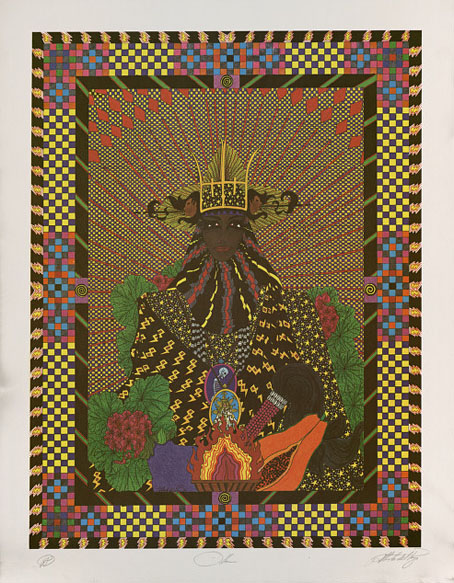
Oya by Alberto del Pozo (1945–1992). Also known as Yansa, Oya is Changó’s third wife. She is the goddess of the winds and of lightning and is mistress of the cemetery gates. Passionate and brave she fights by her husband’s side if needed. Her favorite offerings are papaya, eggplant and geraniums. From Santeria at BibliOdyssey.

Austin Osman Spare is a good example of the dictum that quality will out in the end, no matter how long it remains buried. Overlooked by the art establishment after he retreated into his private mythologies, a substantial portion of his output was equally ignored by occultists who wanted to preserve him as a weird and scary working-class magus. One group dismissed his deeply-felt spiritual interests in a manner they wouldn’t dare employ if he’d been a follower of Santeria, say (or even a devout Christian), while the other group seemed to regard his superb portraits as too mundane to be worthy of attention. Now that Phil Baker’s Spare biography has been published by Strange Attractor we might have reached the end of such short-sighted appraisals and can finally see a more rounded picture of the man and his work:

[Kenneth] Grant preserved and magnified Spare’s own tendency to confabulation, giving him the starring role in stories further influenced by Grant’s own reading of visionary and pulp writers such as Arthur Machen, HP Lovecraft, and Fu Manchu creator Sax Rohmer. Grant’s Spare seems to inhabit a parallel London; a city with an alchemist in Islington, a mysterious Chinese dream-control cult in Stockwell, and a small shop with a labyrinthine basement complex, its grottoes decorated by Spare, where a magical lodge holds meetings. This shop – then a furrier, now an Islamic bookshop, near Baker Street – really existed, and part of the fascination of Grant’s version of Spare’s London is its misty overlap with reality.

Austin Osman Spare: Cockney visionary by Phil Baker.

Austin Osman Spare: The man art history left behind | A Flickr set: Austin Osman Spare at the Cuming Museum | HV Morton meets Austin Spare (1927).

• More quality rising from obscurity: Jerzy Skolimowski’s Deep End. Skolimowski’s drama is one of unpleasant characters behaving badly towards each other. Anglo-American cinema featured a great deal of this in the 1970s when filmmakers disregarded the sympathies of their audience in a manner that would be difficult today. John Patterson looks at another example which is also given a re-release this month, the “feral, minatory and menacing masterwork” that is Taxi Driver.

delpozo2.jpg

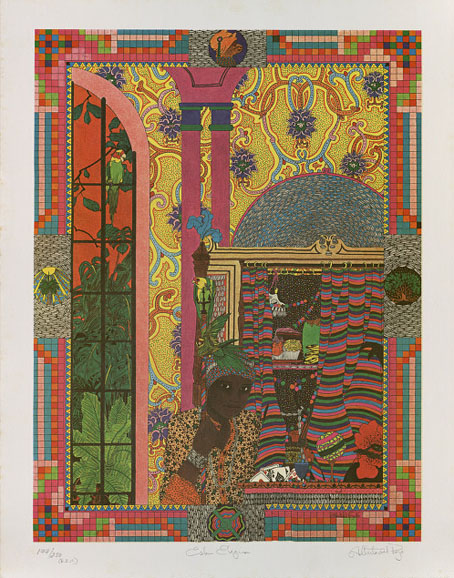
Echú Eleguá by Alberto del Pozo. Among the most ancient of the orishas Echú Eleguá is the messenger of the gods, who forges roads, protects the house, and is heaven’s gate-keeper. In any ceremony he is invoked first. He owns all cowrie shells and is the god of luck. A prankster, Echú Eleguá frequently has a monkey and a black rooster by his side. Like a mischievous boy he enjoys gossip and must be pampered with offerings of toys, fruit, and candy.

Minutes, a compilation on the LTM label from 1987: William Burroughs, Jean Cocteau, Tuxedomoon, Jacques Derrida, The Monochrome Set, and er…Richard Jobson. Thomi Wroblewski designed covers for a number of Burroughs titles in the 1980s, and he also provided the cover art for this release.

Mikel Marton Photography: a Tumblr of erotic photography and self-portraits.

From Death Factory To Norfolk Fens: Chris & Cosey interviewed.

NASA announces results of epic space-time experiment.

Oritsunagumono by Takayuki Hori: origami x-rays.

Plexus magazine at 50 Watts.

Mother Sky (1970) by Can | Late For The Sky (1974) by Jackson Browne.