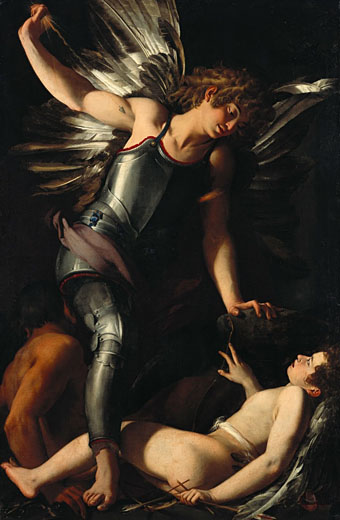
The Divine Eros Defeats the Earthly Eros

baglione1.jpg

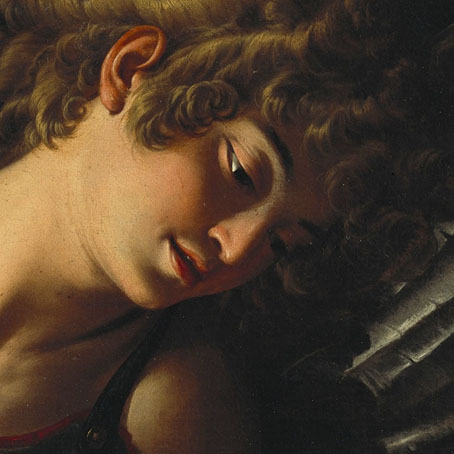
Another favourite painting receiving the Google Art Project high-res treatment. Giovanni Baglione’s picture (also known as Sacred Love versus Profane Love) was painted circa 1602 as a riposte to Caravaggio’s provocative Amor Vincit Omnia. Where Caravaggio showed Eros triumphing over worldly concerns Baglione gives us an image of religious propaganda which displeased the older artist. Salt was rubbed in the wounds when Baglione produced a second (and lesser) version which puts Caravaggio’s features on the figure of the Devil. There’s an irony in this spat in the way that Baglione’s noble aspiration is subverted by erotic tension, the victorious angel shown happily astride a vulnerable and capitulating youth. If someone had pointed this out to Caravaggio he might not have felt so aggrieved.

Both Amor Vincit Omnia and The Divine Eros Defeats the Earthly Eros are part of the Old Master collection at the Gemäldegalerie, Berlin, where they can be viewed side by side.

baglione2.jpg

Previously on { feuilleton }
Chiaroscuro
Angels 1: The Angel of History and sensual metaphysics

Weekend links 58

delpozo1.jpg

Oya by Alberto del Pozo (1945–1992). Also known as Yansa, Oya is Changó’s third wife. She is the goddess of the winds and of lightning and is mistress of the cemetery gates. Passionate and brave she fights by her husband’s side if needed. Her favorite offerings are papaya, eggplant and geraniums. From Santeria at BibliOdyssey.

Austin Osman Spare is a good example of the dictum that quality will out in the end, no matter how long it remains buried. Overlooked by the art establishment after he retreated into his private mythologies, a substantial portion of his output was equally ignored by occultists who wanted to preserve him as a weird and scary working-class magus. One group dismissed his deeply-felt spiritual interests in a manner they wouldn’t dare employ if he’d been a follower of Santeria, say (or even a devout Christian), while the other group seemed to regard his superb portraits as too mundane to be worthy of attention. Now that Phil Baker’s Spare biography has been published by Strange Attractor we might have reached the end of such short-sighted appraisals and can finally see a more rounded picture of the man and his work:

[Kenneth] Grant preserved and magnified Spare’s own tendency to confabulation, giving him the starring role in stories further influenced by Grant’s own reading of visionary and pulp writers such as Arthur Machen, HP Lovecraft, and Fu Manchu creator Sax Rohmer. Grant’s Spare seems to inhabit a parallel London; a city with an alchemist in Islington, a mysterious Chinese dream-control cult in Stockwell, and a small shop with a labyrinthine basement complex, its grottoes decorated by Spare, where a magical lodge holds meetings. This shop – then a furrier, now an Islamic bookshop, near Baker Street – really existed, and part of the fascination of Grant’s version of Spare’s London is its misty overlap with reality.

Austin Osman Spare: Cockney visionary by Phil Baker.

Austin Osman Spare: The man art history left behind | A Flickr set: Austin Osman Spare at the Cuming Museum | HV Morton meets Austin Spare (1927).

• More quality rising from obscurity: Jerzy Skolimowski’s Deep End. Skolimowski’s drama is one of unpleasant characters behaving badly towards each other. Anglo-American cinema featured a great deal of this in the 1970s when filmmakers disregarded the sympathies of their audience in a manner that would be difficult today. John Patterson looks at another example which is also given a re-release this month, the “feral, minatory and menacing masterwork” that is Taxi Driver.

delpozo2.jpg

Echú Eleguá by Alberto del Pozo. Among the most ancient of the orishas Echú Eleguá is the messenger of the gods, who forges roads, protects the house, and is heaven’s gate-keeper. In any ceremony he is invoked first. He owns all cowrie shells and is the god of luck. A prankster, Echú Eleguá frequently has a monkey and a black rooster by his side. Like a mischievous boy he enjoys gossip and must be pampered with offerings of toys, fruit, and candy.

Minutes, a compilation on the LTM label from 1987: William Burroughs, Jean Cocteau, Tuxedomoon, Jacques Derrida, The Monochrome Set, and er…Richard Jobson. Thomi Wroblewski designed covers for a number of Burroughs titles in the 1980s, and he also provided the cover art for this release.

Mikel Marton Photography: a Tumblr of erotic photography and self-portraits.

From Death Factory To Norfolk Fens: Chris & Cosey interviewed.

NASA announces results of epic space-time experiment.

Oritsunagumono by Takayuki Hori: origami x-rays.

Plexus magazine at 50 Watts.

Mother Sky (1970) by Can | Late For The Sky (1974) by Jackson Browne.

Deutsche Kunst und Dekoration #21

dkd21-01.jpg

The Eternal Idol by Auguste Rodin.

Continuing the delve into back numbers of Deutsche Kunst und Dekoration, the German periodical of art and decoration. Volume 21 covers the period from October 1907 to March 1908, and the highlight of this issue is a feature on the black-and-white art of Julius Klinger, an artist whose drawings appeared regularly in Jugend.

If you’ve been following this series it’s worth noting that volume 3 which is missing from the collection at the Internet Archive can be found at the University of Heidelberg. I would have featured it here but it turns out to be surprisingly dull compared to the other early editions. As before, anyone wishing to see these samples in greater detail is advised to download the entire number at the Internet Archive. There’ll be more DK&D next week.

dkd21-02.jpg

dkd21-03.jpg

Continue reading “Deutsche Kunst und Dekoration #21”

Weekend links 56

kallela.jpg

Ad Astra (1907) by Akseli Gallen-Kallela.

• Andres Serrano’s works are photo prints so you can’t damage an exhibition item the way you can with a painting. That didn’t stop Catholic protestors in France attacking a copy of Piss Christ on Monday. By coincidence, Dave Maier had posted an essay about Serrano’s work a few hours earlier, and with a reminder that the notorious photograph was part of a series, a detail which is often forgotten or conveniently ignored.

• The Avant Garde Project which made available deleted experimental audio works (see this earlier post) ceased activity a while ago so it’s good to see that its archives will now be hosted at Ubuweb.

…African Head Charge again was a studio name I had to start with, and it evolved into a band about eight years later. That started out again I read an interview in a newspaper where Brian Eno talked about he’d made an album called My Life in the Bush of Ghosts with another musician—that Talking Heads fellow [David Byrne]—and he said “I had a vision of a psychedelic Africa”. And I thought, “Oh, that’s pretentious”. But then I thought about it, and thought “No, what a good idea! Make really trippy African dub”.

Adrian Sherwood on thirty years of On-U Sound.

• Related: Brian Eno has a new album out in July, Drums Between The Bells, a collaboration with Rick Holland.

“Do you think Lord Leighton could by any chance have been a homosexual?” enquired Richard. “It says here,” I replied, consulting a laminated information card, “that there is no evidence one way or the other.”

“Rent boys leave no evidence,” said Richard.

A private view of Lord Leighton’s home in Holland Park, London, which opened to the public again last year.

Passengers, an exhibition of urban transit photos by Chris Marker at Peter Blum, NYC. For a different kind of rail transport there’s this exploration of London’s disused underground Post Office Railway.

• Reappraising the recent past: Jon Savage on Taxi zum Klo, Christiane F, David Bowie and the seedy attraction of Berlin in the 70s and 80s; Iain Sinclair on the Festival of Britain sixty years on.

Stella Steyn’s illustrations for Finnegans Wake as seen in transition magazine, 1929. And speaking of literary magazines, the return of New Worlds has been announced.

Clive Hicks-Jenkins is an art monograph published next month by Lund Humphries. Clive enthused about the book’s arrival.

• 50 Watts announces the Polish Book Cover Contest.

• 4th June, 2011 is Radiophonic Creation Day.

• Americans: has your state banned sodomy?

Stardust (1931) by Louis Armstrong | Stardust (1940) by Artie Shaw | Stardust (1957) by Nat King Cole.

Joachim Beuckelaer’s Four Elements

beuckelaer1.jpg

The Four Elements: Water. A Fish Market with the Miraculous Draught of Fishes in the Background (1560–1574).

Flemish artist Joachim Beuckelaer (1533–1574) depicts the four elements using foodstuffs. All four paintings can be explored via Google’s Art Project.

beuckelaer2.jpg

The Four Elements: Fire. A Kitchen Scene with Christ in the House of Martha and Mary in the Background (1560–1574).

Continue reading “Joachim Beuckelaer’s Four Elements”