Weekend links 68

dorosheva.jpg

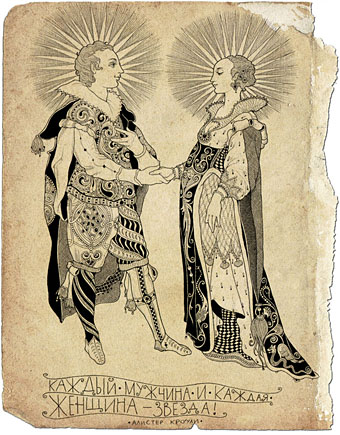
Every man and every woman is a star by Sveta Dorosheva.

• Matt Taylor (illustration) with Gregg Kulick and Paul Buckley (design) provide new Penguin covers for John Le Carré. I love the look which seems inspired by Daniel Kleinman’s title sequence for Casino Royale even if it doesn’t quite suit the shabby world of George Smiley and the Circus.

[Deborah Kass] told me that when she was going to art school in the ’70s, she tripped on LSD almost every week and she said she felt it was her “moral duty as an artist to take the trip.” […] I think psychedelic experience makes you think that there are multiple realities, that there isn’t just this one normal real world to which we’re supposed to conform, but that the reality changes depending on the state of consciousness that we’re in when we’re experiencing it. So, any different kind of art kind of posits a different reality. (more)

New York Times art critic Ken Johnson discussing his new book Are You Experienced?: How Psychedelic Consciousness Transformed Modern Art.

• “That got me thinking that evolution really isn’t survival of the fittest, when it comes to these things, it is more like survival of the interesting, survival of the beautiful, survival of the weird, cool stuff that managed to evolve.” Laurie Anderson and David Rothenberg discuss music and animals.

• Laura Cumming on the late Lucian Freud. And Stephen Heller on Alex Steinweiss, the originator in 1939 of the artistic record sleeve who also died last week.

• Alan Moore says “Think Locally: Fuck ‘Globally'”. He and Queen Calluz explain how Dodgem Logic magazine puts their ideas into practice.

Adam Curtis gets interviewed while Alan Bennett returns to Armley Public Library in Leeds.

Peacock’s Garden, a celebration of pavonine splendour.

• A visit to Seher Shah’s studio in Brooklyn, New York.

• Maximum androgyny at Epicenity, a Tumblr.

Does your god have a penis?

Chrysalide (1978) is an album of “cosmic” guitar instrumentals by Michel Moulinié which sounds at times like a French equivalent of Manuel Göttsching. It’s never been released on CD but a copy can be found here.

Alchemy & Inquiry

tomaselli.jpg

The Dust Blows Forward, The Dust Blows Back (2011) by Fred Tomaselli.

Artistic alchemy has been thriving in New York for the past few weeks. Alchemy & Inquiry is a show which has been running at the Glyndor Gallery, Wave Hill, the Bronx, since April, featuring paintings by Philip Taaffe, Fred Tomaselli and Terry Winters. “Alchemy” here is used in its broadest sense:

The word “alchemy” in the exhibition title alludes to transformation on many levels: chemical, magical and spiritual. Creative powers are summoned to transform common elements physically and metaphorically into substances of great value. With practices and insights that prefigure many important discoveries in biology, chemistry and physics, alchemy likewise fascinated and continues to fascinate poets and painters, serving as an allegory for the physical manifestation of immaterial spirit. This tradition unites the work of Winters, Tomaselli and Taaffe. (more)

A PDF catalogue containing commentary by the always enlightening Peter Lamborn Wilson can be downloaded here. A sample:

Certain extra-formal aspects of art cannot be ruled out as irrelevant to our experience of that art or to our understanding of it. A visitor from Alpha Centauri would not know that Tomaselli’s paintings actually contain real pills, maryjane leaves, spore prints, or whatever—real illegal drugs. But we earthlings cannot fail to consider this witty provocation when thinking about Tomaselli’s works. To own one of his paintings—if the Feds ever wanted to make an issue of it—would be, simply, a crime. Is a crime, actually. This fact adds nothing formal to Tomaselli’s art. But, oh, how much it adds, let’s say, conceptually. How much weight? What an aura.

If proof were needed, contra all the puritan anti-drug fascists and priests, that genuine mystical drug states are accessible via entheogenic drugs and various (illegal) ditchweeds, then we could enter Tomaselli’s paintings as evidence. The point is that if drugs could not do this then there would be no reason to make them illegal. Imagine: icons that are also reliquaries, containing edible body parts of vegetable saints, forbidden by the Babylonian Ugly Spirit, the eternal Mind Police.

The NYT reviewed the exhibition but missed a trick in not connecting it to the Alchemically Yours group art show which has been running at Observatory, Brooklyn throughout the past month. That show ends this weekend; Alchemy & Inquiry runs until June 19th. Thanks to Jay for the tip!

Previously on { feuilleton }
Alchemically Yours
Laurie Lipton’s Splendor Solis
The Arms of the Art
Splendor Solis
Amphitheatrum Sapientiae Aeternae
Cabala, Speculum Artis Et Naturae In Alchymia
Vision Quest
Digital alchemy

In the Land of Retinal Delights

williams.jpg

In the Land of Retinal Delights (1968) by Robert Williams.

More psychedelia. I’d wanted to link to a decent version of this painting by Robert Williams for some time but it took a while for one to turn up. When people mention psychedelic art it’s usually concert posters they’re talking about. Williams’ super-detailed canvas is a good example of psychedelic painting when it conveys particular aspects of the hallucinogenic experience such as hyper-reality and a sense of physical distortion, something that the posters and album covers seldom convey. That said, Williams’ picture did appear as a cover illustration for The Acid Trip, Vernon Joynson’s guide to psychedelic music in 1984, setting that volume apart from similar books which are often spoiled by poor artwork.

Robert Williams at Beinart

acidtrip.jpg

Elsewhere on { feuilleton }
The fantastic art archive

Previously on { feuilleton }
The art of Mati Klarwein, 1932–2002
The art of LSD

Signals from Mars

signal.jpg

Raymond Taylor’s composition, A Signal from Mars (1901).

This sheet music cover turned up recently as one of the pieces of science fiction-related graphics which will be on display at the British Library’s Out of this World: Science Fiction but not as you know it exhibition when it opens on Thursday. I don’t know what the music sounds like but the design is very familiar from a reworked version used for the cover of A Beacon from Mars, the second album by psychedelic band Kaleidoscope. It was always obvious that this cover had been copied from somewhere but I hadn’t seen the original until now. On the reissue CD there are no design credits so I’ve no idea who drew the cover; given its rather crude felt-tipped appearance that may be just as well. It’s a nice idea but poorly rendered.

beacon.jpg

A Beacon from Mars (1968) by Kaleidoscope.

There are two Kaleidoscopes among the psychedelic groups of the late 60s so it should be emphasised that it’s the American one we’re dealing with here. The UK group were very good, especially on their second album, Faintly Blowing (1969), but the US band are in a different league altogether. I’d rate them as highly as any other group you care to name from the period 1967–69, including The Beatles. A troupe of formidable multi-instrumentalists, they started out as the Baghdad Blues Band (the name change was prompted by their manager), and played a unique blend of psych-rock, blues, bluegrass, English folk and Middle Eastern instrumentals. Jimmy Page called them his favourite band of all time, and it’s notable that Led Zeppelin adopted a similarly eclectic formula shortly after. The last of Kaleidoscope’s trio of 60s albums is aptly titled Incredible; the standout piece on that opus is Seven-Ate Sweet which can be heard in its full 11-minute glory here. For more about the band, this fan site is the place to go.

Elsewhere on { feuilleton }
The album covers archive

Weekend links 59

duetemmo.jpg

Or So It Seems (1983) by Duet Emmo. Design by The Brothers Quay.

• “Make things, no rules, but be quick.” Bruce Gilbert, musician in (among others) Wire, Dome and Duet Emmo is interviewed. Related: Daniel Miller, Mute label boss and another member of Duet Emmo is interviewed (and provides a mix) at The Quietus. For more electronica with nothing at all to do with Duet Emmo there’s this Matmos interview.

donovan.jpg

Design by Dick Smith.

“It’s psychedelic not because we were stoned before we wrote the songs, or stoned during composing them, but the experiences of searching for the transcendental world though altered states of consciousness were in the songs,” he says, which sounds suspiciously like another way of saying he was stoned before he wrote them, but perhaps it’s best not to quibble with the description of the method in the face of such impressive results…

Donovan revisits one of his finest works, Sunshine Superman.

• Yet more Guardian features: A Clockwork Orange: The droog rides again | Ira Cohen: psychedelic photography master | A life in writing: China Miéville | The stars of modern SF pick the best science fiction.

• There are many stars of the gaseous variety in Nick Risinger’s 5000-megapixel photograph of the Milky Way.

“It is quite true I have worshipped you with far more romance of feeling than a man should ever give to a friend. Somehow I have never loved a woman…. From the moment I met you, your personality had the most extraordinary influence over me…. I adored you madly, extravagantly, absurdly. I was jealous of everyone to whom you spoke. I wanted to have you all to myself. I was only happy when I was with you.”

Salon reviews the new unexpurgated edition of The Picture of Dorian Gray.

• Paul Gorman discovered the gay art origins of the notorious Cowboys T-shirt.

The full complement of Saul Bass’s designs for Vertigo‘s print advertising.

Photos of the recent Dodgem Logic event by Rosie Reed Gold.

Peter Ashworth is still taking great photos.

Jodorowsky’s Dune Finally Revealed?

Sunshine Superman (1966) by Donovan | Or So It Seems (1983) by Duet Emmo.