Weekend links 72

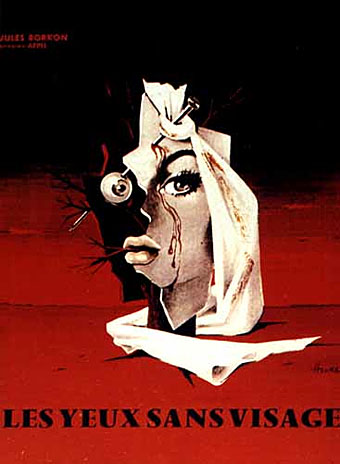
lesyeux.jpg

If Jean Cocteau had made a horror film it might have resembled George Franju’s dreamy and disturbing body-horror masterwork Les Yeux Sans Visage (1960). I’ve not been able to trace the artist for this poster but it’s a good example of the diluted Surrealism which was still prevalent in poster graphics at this time.

If I were asked what’s needed today, I’d say innovation, and greater timbral variety. If you truly want the audience to experience the clammy thrill of the grotesque, the uncanny and the fearful, you have to reach for the unfamilar, the perplexing, even the ugly; there’s an infinite Lovecraftian sound-world out there waiting to be explored. We need new combinations, new textures in film scoring. Horror has a licence to be weird – it’s supposed to mess with our heads. (more)

Stephen Thrower.

Stephen Thrower is an ex-member of Coil, a current member of Cyclobe, was the editor of a great magazine, Eyeball, devoted to horror cinema and what Kim Newman (casting about for a wider, non-generic label) calls “nightmare movies”, and is the author of Nightmare USA and Beyond Terror: The Films of Lucio Fulci. In other words, he’s more than qualified to write about horror film soundtracks. The reason is an event at the South Bank Centre, London, two weeks from now, Sound of Fear: The Musical Universe of Horror, one of the highlights of which will be a performance by John Carpenter’s soundtrack collaborator Alan Howarth. Related: my post about Italian horror soundtracks from 2008.

lovato.jpg

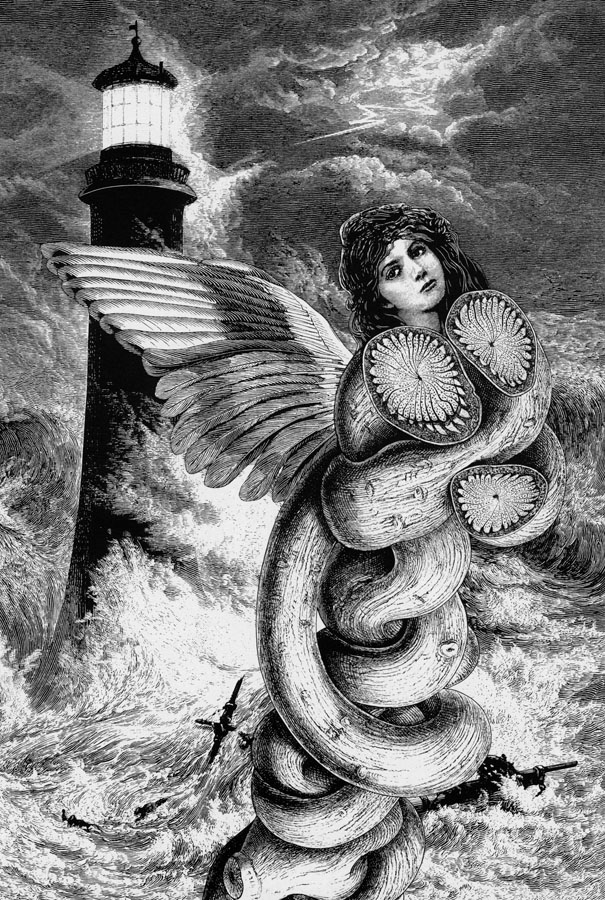
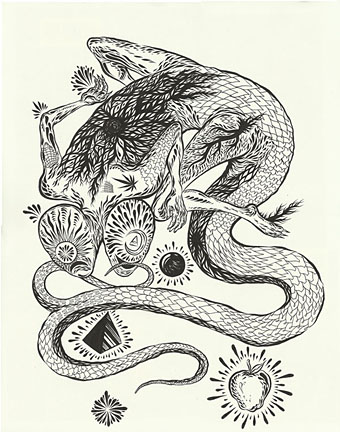
Art by Justin Lovato.

Mind Over Matter: Alan Fletcher’s The Art of Looking Sideways. “The Art of Looking Sideways captures the sensory overload of contemporary visual culture, while also acting as a primer in visual intelligence.” Related: Alan Fletcher profiled at the Design Museum.

• More music and more psychedelia: Past Present Future Space-Time “Wysing Arts Centre explores the legacy of psychedelia in this year’s annual music event”.

The Coilhouse International Silent Auction is GO and ends Sunday night if you want to bid for some rare and special things.

The Garden of Kama and Other Love Lyrics from India (1901), illustrated by John Byam Shaw.

• Chris Marker’s take on the recent London riots: Overnight.

• Bristol’s graffiti artists are redecorating the city’s streets.

• Women and knives: a Dario Argento poster gallery.

Inferno (1993) by Miranda Sex Garden, from their album Suspiria.

Hapshash Takes a Trip

ufocoming.jpg

UFO Coming (1967) by Hapshash and the Coloured Coat.

It’s always difficult to choose a favourite from the posters that Nigel Waymouth and the late Michael English produced under the name Hapshash and the Coloured Coat, their standards remained high (so to speak) throughout their partnership. But I always liked the ejaculating penis butterfly on this early design for Joe Boyd’s UFO club, a detail which would have given Aubrey Beardsley a chuckle and which is probably unique in art. The gorgeous Hapshash posters receive another airing next month in an exhibition at the Idea Generation Gallery, London, entitled Hapshash Takes a Trip: The Sixties Work of Nigel Waymouth:

Waymouth’s own archive plays a major part in the retrospective. Kept privately for decades and rarely seen since their first creation in the late ’60s, the artist’s personal collection features works made as part of Hapshash and his designs for Granny Takes a Trip. Furthermore it contains his own album covers, photographs, press clippings and magazines. This extraordinary collection unites rare works with rare moments, through photographs never before seen in public.

The exhibition opens on September 9th. There’s more detail on the press release (PDF) including a promise that “Huge silk-screened reproductions of their iconic posters will fill the entirety of one of the Gallery’s soaring 20 foot walls.”

The exhibition title alludes to the celebrated King’s Road boutique Granny Takes A Trip whose series of striking shopfronts were decorated by Waymouth before and during his partnership with Michael English. The Look posted some pictures of Waymouth’s 1947 Dodge decor earlier this week.

Previously on { feuilleton }
The Dukes declare it’s 25 O’Clock!
Psychedelic Wonderland: the 2010 calendar
Michael English, 1941–2009
Max (The Birdman) Ernst
The Look presents Nigel Waymouth
The New Love Poetry

Weekend links 70

swinburne1.jpg

Faustine (1928) by Harry Clarke.

• This week’s Harry Clarke fix: 50 Watts reposts the Faust illustrations while Golden Age Comic Book Stories has the illustrated Swinburne.

What Goes Steam in the Night is an evening with contributors to The Steampunk Bible hosted in London by The Last Tuesday Society on September 6th:

Co-author S. J. Chambers invites you to the official U.K. celebration of her book The Steampunk Bible (Abrams Image). Part lecture, part signing, and part entertainment, S. J. will be accompanied by contributors Jema Hewitt (author of Steampunk Emporium ) and Sydney Padua (Lovelace & Babbage) for a discussion of the movement, a special performance by Victorian monster hunter, Major Jack Union, and inevitable hi-jinks and shenanigans to later be announced.

• RIP Conrad Schnitzler, an incredibly prolific electronic musician, and founder member of Tangerine Dream and Kluster/Cluster.

Golden Pavilion Records reissues fully-licensed late 60’s and 70’s psychedelic, progressive, acid-folk & art-rock music.

Dressing the Air is “an exclusive consulting and online resource for the creative industries”.

Luke Haines explains how to cook rabbit stew whilst listening to Hawkwind.

Wood pyrography by Ernst Haeckel from his home, the Villa Medusa.

swinburne2.jpg

Satia Te Sanguine (1928) by Harry Clarke.

The truth is, the best novels will always defy category. Is Great Expectations a mystery or The Brothers Karamazov a whodunnit or The Scarlet Letter science fiction? Does Kafka’s Metamorphosis belong to the genre of fantasy? In reality men don’t turn into giant insects. And it’s funny. Does that mean it’s a comic novel? […] At a time when reading is in trouble, those readers left should define themselves less rigidly.

Howard Jacobson: The best fiction doesn’t need a label.

Pace the redoubtable Jacobson, Alan Jacobs believes We Can’t Teach Students to Love Reading.

How Ken Kesey’s LSD-fuelled bus trip created the psychedelic 60s.

Salvador Dalí creates something for Playboy magazine in 1973.

JG Ballard: Relics of a red-hot mind.

Electric Garden (1978) by Conrad Schnitzler | Auf Dem Schwarzen Kanal (1980) by Conrad Schnitzler.

The City of the Singing Flame

cas1.jpg

Wonder Stories, July 1931. Illustration by Frank R. Paul.

Looking over Bruce Pennington’s artwork this week sent me back to some of my Clark Ashton Smith paperbacks, many of which sport Pennington covers. One of my favourite Smith stories, The City of the Singing Flame, is also one of his finest pieces, and a story that Harlan Ellison has often referred to as his favourite work of imaginative fiction.

cas2.jpg

Tales of Wonder, Spring 1940. Illustration by WJ Roberts.

The story as it’s known today was originally a shorter piece, The City of the Singing Flame, followed by a sequel, Beyond the Singing Flame; both stories were published in Wonder Stories magazine in July and November of 1931, then as one in Arkham House’s CAS collection Out of Space and Time in 1942. The two-in-one story is now the definitive version.

Smith’s tale concerns the discovery of a dimensional portal somewhere in the Sierras. Beyond this there lies a path leading through an otherworldly landscape to a colossal city peopled by a race of mute giants. A temple at the heart of the city protects the prodigious green flame of the title, an eerie and alluring presence whose siren call draws creatures from adjacent worlds who prostrate themselves before the flame before immolating themselves in its fire. A narrator, Philip Hastane, give us details of diary entries from a friend who discovered the portal, and who subsequently has to decide whether to resist the lure of the mysterious flame or follow the other creatures into the fire. More than this would be unfair to divulge if you’ve never read Smith’s remarkable piece of fiction.

Continue reading “The City of the Singing Flame”