Weekend links 360

sasaki.jpg

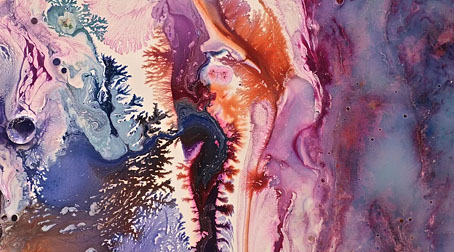
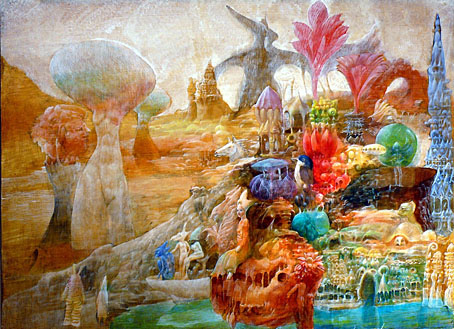
Threshold (2008) by Roku Sasaki.

• A previously unseen interview with Angela Carter from 1979 in which she talks to David Pringle about her evolution as a writer, literary influences and genre fiction.

• Among the highlights in the latest edition of Wormwood there’s Doug Anderson on Panacea by Robert Aickman, a “vast unpublished philosophical work”.

• The London Review Bookshop podcast: Marina Warner and Chloe Aridjis discuss Leonora Carrington.

The prose works, conversely, read like surrealist poetry. They were written according to a compositional method Roussel called le procédé (the procedure), in which a complicated system of puns rather than traditional narrative logic determines the progression of the story. In Locus Solus, the mad scientist Martial Canterel takes his colleagues on a tour of his country estate—“the lonely place” of the title—to show them the bizarre inventions generated by Roussel’s procédé. These include a device that constructs a mosaic made out of human teeth; a water-filled diamond in which a dancer, a hairless cat, and the head of Danton are suspended; and a series of corpses Cantarel has brought back to life with the fluid “ressurectine,” which compels them to act out the most important event of their former lives, to the scientists’ astonishment.

Ryan Ruby on Raymond Roussel, The Accidental Avant-Gardist

• The latest manifestation of paranormal electronica by The Electric Pentacle is entitled Black Ectoplasm.

Sergey Bessmertny‘s account of working as a camera technician on Andrei Tarkovsky’s Stalker.

• City Of Fallen Angels: The Bug vs. Earth. In conversation with Kevin Martin and Dylan Carlson.

• Sex and art by the Grand Canal: Judith Mackrell on Peggy Guggenheim in Venice.

• A Guide Through the Darkened Passages of Dungeon Synth.

• Mix of the week: XLR8R Podcast 489 by Samuel Rohrer.

• The late Mika Vainio/Panasonic live in 1996.

Xan Brooks on Cary Grant’s 100 acid trips.

Resurrection (1968) by Steppenwolf | Resurrection (1975) by Master Wilburn Burchette | Resurrection (1987) by Demons Of Negativity

The art of John Thompson

thompson01.jpg

Cosmic Trigger: Final Secret of the Illuminati (And/Or Press, 1977).

John Thompson’s detailed, mystical and erotic illustrations gained prominence in the San Francisco comic scene in the late 1960s–early 1970s, appearing in a handful of titles drawn in their entirety by Thompson or done as collaborations with local artists including Robert Crumb. But it’s as an illustrator of Robert Anton Wilson’s Cosmic Trigger that Thompson is probably best known, something I was reminded of recently with the opening of Daisy Campbell’s play based on Wilson’s book. Wilson had seen Thompson’s comics work, and approached him as illustrator of his (ostensibly) non-fiction sequel to the very popular Illuminatus! trilogy, an encounter that Thompson elaborates on in this interview.

thompson02.jpg

Here in the UK the comics published by Last Gasp et al weren’t always easy to find (imported comics were still being seized by UK customs into the 1990s), so Cosmic Trigger was my first introduction to Thompson’s art via a sighting of the US edition in a London shop in 1978. The UK paperback was a disappointment when it appeared a year or so later: Thompson’s cover art had been replaced with something more generic but they did at least retain the interior illustrations, albeit shrunk to fit the smaller book size. Many of the drawings in Cosmic Trigger had appeared already in Thompson’s comics which may seem surprising when they don’t resemble typical comic pages, but Thompson’s comics are unusual even compared to the undergrounds of the time. The undergrounds were most obviously radical in the wildness and excess of their content, especially where sex and drugs were concerned. But there’s a smaller subset of underground strips whose approach to narrative is so far removed from typical comic storytelling as to verge on the abstract. Victor Moscoso’s comics exemplify this style but even an ostensible traditionalist like Robert Crumb could experiment with the form (see his Cubist Bee Bop Comics in XYZ, 1972). Thompson’s comics are of this type at all times, blending motifs from a variety of myths and religions with Tantric yoga, astrology, alchemy and pop culture. When speech balloons appear they often contain allusive, esoteric phrases along with untranslated Greek or Hebrew text. It’s a beguiling mix which shows the ability of the comic book to do more than simply ape the stories of film or television. As with many other things from the late 1960s it’s a direction that hasn’t been pursued very much since.

thompson03.jpg

The interview with Thompson explains why he seemed to vanish after the work for Cosmic Trigger: he says he quit comics and illustration to become a therapist although he still creates private work. The examples here are from The Kingdom of Heaven is Within You (1969), Kukawy [sic] Comics 1 (1969; “Kukawy” is actually a Greek word meaning Cyclops), Tales from the Sphinx 2 (1972) and Eternal Comics (1973).

thompson04.jpg

Continue reading “The art of John Thompson”

Weekend links 348

wright.jpg

The Masque of the Red Death (1932) by John Buckland Wright.

• Thanks to MeadesShrine I’ve been working my way through Jonathan Meades’ television essays so this is timely: The Plagiarist in the Kitchen, an “anti-cookbook” by the man with forthright opinions.

• “‘Decopunk’ deserves to be bigger than Steampunk,” says Sam Reader. I consider my work on Bruce Sterling’s Pirate Utopia to be more Futurist than Deco but the period is right.

• “Celebrating the cinematically surreal, bizarre, cult, oddball, fantastique, strange, psychedelic, and the just plain WEIRD!”: 366 Weird Movies

But Fascism is also a political and economic system. Why, then, cannot we have a clear and generally accepted definition of it? Alas! we shall not get one—not yet, anyway. To say why would take too long, but basically it is because it is impossible to define Fascism satisfactorily without making admissions which neither the Fascists themselves, nor the Conservatives, nor Socialists of any colour, are willing to make. All one can do for the moment is to use the word with a certain amount of circumspection and not, as is usually done, degrade it to the level of a swearword.

George Orwell discussing the imprecise application of the “F” word

• At The Psychedelic Museum, a report on this month’s art show, Alice’s Adventures in Underground Culture.

M. John Harrison announces a new story collection which will be published later this year by Comma Press.

• Mixes of the week: Iceland: Foreboding Joy by Abigail Ward, and Secret Thirteen Mix 211 by Fluxion.

Daisy Woodward on how LSD adventures inspired John Waters’ Multiple Maniacs.

• More Moomins: Graeme Miller talks to Patrick Clarke about his soundtrack music.

• Some recent cultural highlights as chosen by Timothy J. Jarvis.

Benge presents a list of his favourite electronic albums.

Is this the underground Everest?

Strange Things Are Happening (1968) by Rings & Things | Strange Magic (1975) by Electric Light Orchestra | Strange (1977) by Wire |

Alice’s Adventures in the Horse Hospital

alice_poster.jpg

A few snapshots of the exhibits from Wednesday’s sold-out event at the Horse Hospital, Bloomsbury, London. As noted here before, the impetus for the event was Paul Guest’s printing of my series of psychedelic Alice pictures (above) as blotter prints, sheets of blotting paper having been a common medium for the delivery of LSD doses in the late 60s and 1970s. Since my pictures are relatively small and only filled out one of the walls the rest of the exhibition space was filled with Alice art of a similar tone. The opposite wall also featured a variety of fascinating period artefacts from The Psychedelic Museum, including a few original (and rare) blotter sheets. My time was taken up preparing for the discussion so I wasn’t as diligent as I usually try to be in documenting all the artists involved.

alice04.jpg

The discussion itself went really well. The audience was receptive and small enough to be easily communicable, while the talk never strayed too far from the subject at hand. My thanks to my fellow participants—Nikki Wyrd, Jake Fior, Sophia Satchell-Baeza and Andy Roberts—and huge thanks to Vyvy and John and the rest of the Horse Hospital staff for making the event run so smoothly.

alice05.jpg

The exhibition continues through to Saturday (Feb. 4th), noon to 6pm; entry is free. My blotter prints will remain on sale at the exhibition, and they can also be ordered from Paul at Blotterart.biz, either as single prints or a collected set of 12. For serious collectors the set of 12 will be available as a boxed edition of signed and numbered prints (limited to 100 sets) with a lid design adapted from my 2010 Alice calendar. I should note that the print quality is excellent, and web reproduction doesn’t do justice to the colour or the detail.

alice14.jpg

alice1.jpg

Continue reading “Alice’s Adventures in the Horse Hospital”

Exhibitionism

bilal.jpg

Art by Enki Bilal.

My work is featured in two very different exhibitions over the next few weeks, so different, in fact, that they’re almost at opposite poles to each other.

hch5.jpg

Hard Core Horror 5 (1990).

The first, Shoah et bande dessinée, takes place at Mémorial de la Shoah, Paris, and opens on 19th January. This is an exhibition of comic-book art dealing with the Holocaust, and will include three of my pages from the death-camp scenes in the final issue of the Lord Horror series, Hard Core Horror (created with David Britton in 1990, and published by Savoy). This is one instance where the term “comic” is particularly inappropriate, unlike the more neutral French designation, bande dessinée. I haven’t yet seen a list of all the other artists being represented but I was very pleased to see a drawing by Enki Bilal being used to promote the event. Bilal was one of several French comic artists whose work I discovered in the pages of Heavy Metal/Metal Hurlant in the 1970s, and it was the example of the artists there that kept me interested enough in the comics medium to attempt something of my own a few years later. The exhibition will run until 30th October, 2017, and will feature a printed catalogue.

alice1.jpg

The second event, Alice’s Adventures in the Underground, has already been mentioned here, and takes place at the Horse Hospital, London, at the beginning of February:

“Feed your head…” An evening discourse on all things Wonderland, with John Coulthart, Andy Roberts, Nikki Wyrd and Jake Fior (facilitator).

This event marks the opening of a three day exhibition hosted by the Horse Hospital, featuring John Coulthart’s psychedelia-themed ‘Alice’ artwork, printed for the first time as (drug-free) blotter art. John’s depictions of the twelve chapters of ‘Alice’s Adventures in Wonderland’ view the 1860s through the iridescent lens of the 1960s; Victoriana refracted through a psychedelic prism. Come along for a discussion of the links between psychedelic art and music, and the persistent fascination of Lewis Carroll’s books. There will be talk of many things, not only cabbages and kings, but far more than you can possibly imagine before breakfast. Signed blotter prints will be on sale.

Psychedelic artists – particularly in the 60s – and many other outsider creative types (before and since that influential decade), have drawn their inspiration from the well of imagery found within the ‘Alice’ books. As well as John’s artwork, there will be Alice themed creations by other artists on show. In addition, the Psychedelic Museum will be holding its second pop-up museum display, with particular focus on the 60s counterculture.

alice2.jpg

This show came about after an offer from Paul at Blotter Art to produce a series of blotter prints from my psychedelic Alice series. The first set of sheets are shown here, and I’m very pleased with the print quality after having been a little worried that the paper might not reproduce the colour and detail to the best effect. As noted above, signed sheets will be on sale (either as singles or a series of 12) during the event and afterwards via the Blotter Art website. People often ask about signed prints but most of my print sales are through CafePress which doesn’t allow this; so here’s a rare opportunity to get something spoiled by my signature. In addition to my work there should be Alice-themed art by other artists filling out the space. This exhibition will run to 4th February. I’m looking forward to it.

alice3.jpg