Weekend links 826

vasarely.jpg

Hexa (1971) by Victor Vasarely.

• New music of the week is Tape 05, three minutes from Boards Of Canada following their thirteen-year silence, which was released on Thursday after several days of the group and their record label teasing a comeback with mysterious VHS cassettes and cryptic posters. I’ve been listening to the Sandison brothers’ discography for most of the week while trying to get a major illustration commission finished; this revelation has been the icing on a deteriorated, over-processed cake. I’m now looking forward to whatever emerges next.

The Long London Uncovered: Alan Moore (again) and Iain Sinclair (again) in conversation. Alan’s second novel in the Long London cycle, I Hear A New World, will be published next month.

• RIP Chris Mullen. Not a name that most will recognise but Mullen’s sprawling website, The Visual Telling of Stories, has been linked here on many occasions. A remarkable resource.

• More new music: Boots On The Ground by Massive Attack, Tom Waits; Angel Lost by Luca Formentini; Phaser For The Ocean, Chorus For The Moon by Hatchback.

• Coming soon from Strange Attractor: Sensual Laboratories, Light Shows, Experimental, Film and Psychedelic Art by Sophia Satchell-Baeza.

• At Public Domain Review: “A beautiful purplish hue”: Frank Dudley Beane’s experience with ergot and Cannabis Indica (1884).

• Mixes of the week: An Invisible Jukebox mix for Irmin Schmidt at The Wire; and DreamScenes – April 2026 at Ambientblog.

• At The Quietus: Greg Anderson and Stephen O’Malley of Sunn O))) discuss their love of hiking.

• At Film Quarterly: Elinor Dolliver on the surprising folklore of analogue horror.

• Steven Heller’s font of the month is Gilway Paradox.

• The Strange World of…Spacemen 3.

Tape Kebab (1974) by Can | The Attic Tapes (1975/6) by Cabaret Voltaire | The Black Mill Video Tape (2012) by Pye Corner Audio

Visa de censure numéro X

visa1.jpg

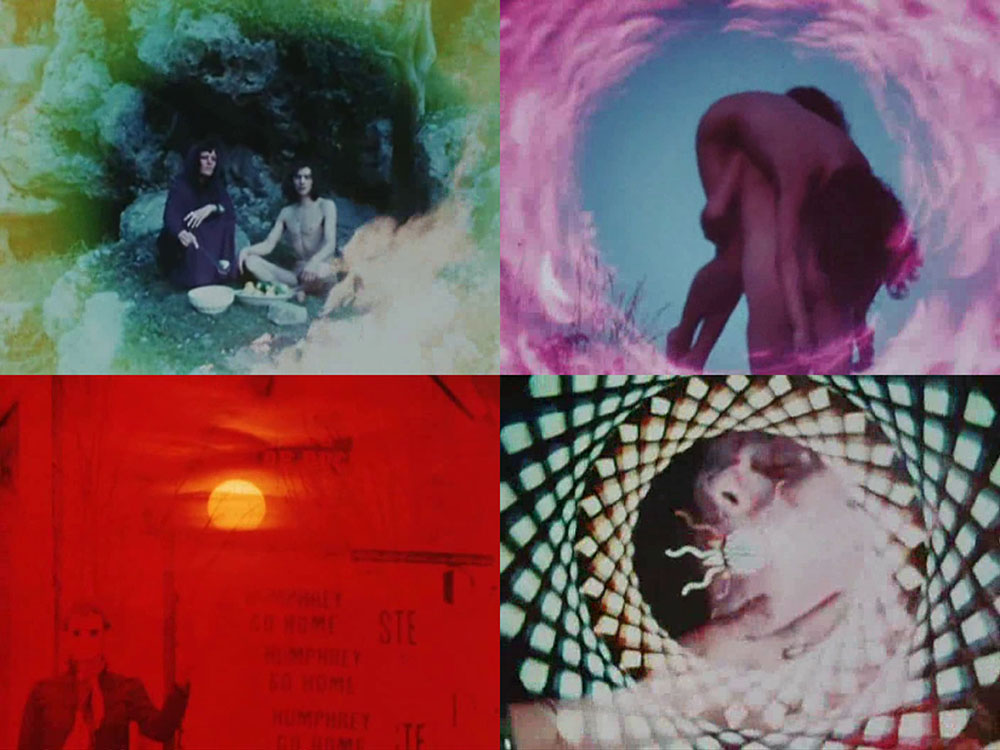
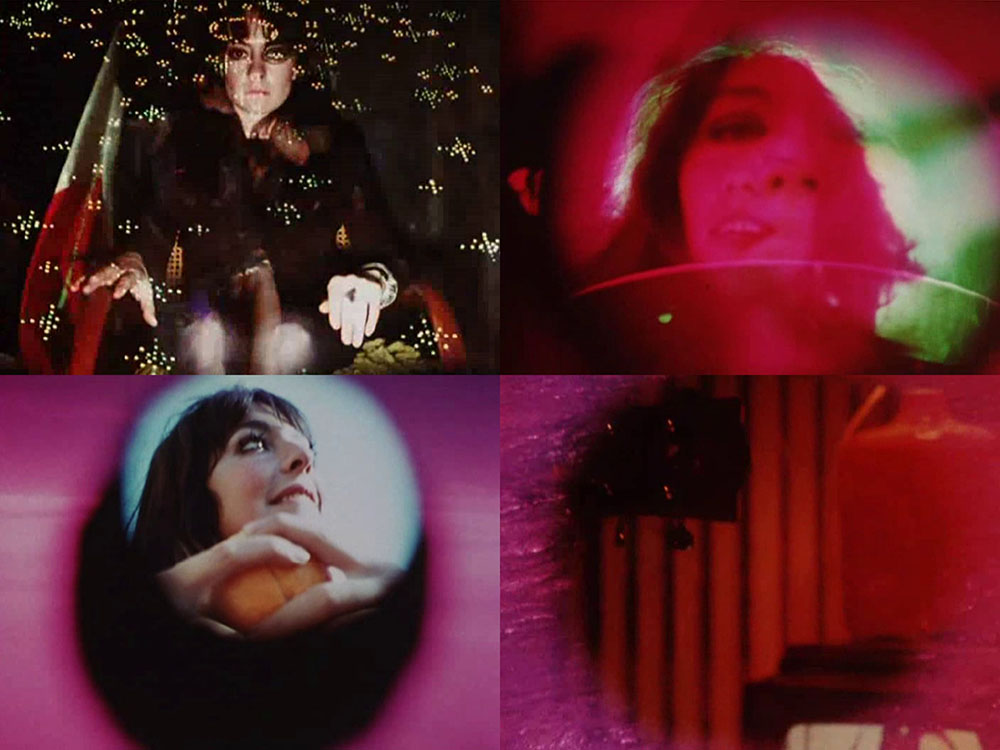
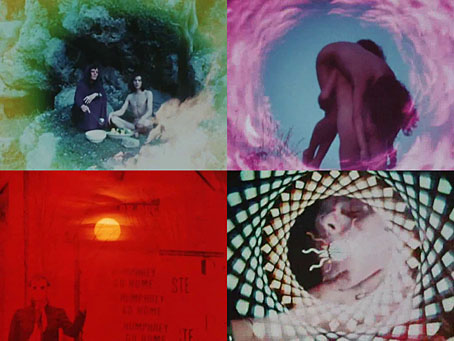
Synopsis: This flamboyantly poetic film includes two works of art: Livret De Famille and Carte De Vœux. A hallucinogenic voyage, psychedelic images float across the screen, of family and friends (Jean-Pierre Kalfon, Yves Beneyton, Valérie Lagrange…) as they share their adventures.

A slight return to Cyrille Verdeaux via actor Pierre Clémenti. If you watch enough European art cinema from the 1960s and 70s you’ll eventually run across Clémenti in films by Visconti, Pasolini, Buñuel, Bertolucci and others. His roles were often minor ones but his fashion-model looks made him stand out wherever he appeared. Clémenti also had a side career as a director, producing a number of mostly short films from the late 60s on. Visa de censure numéro X appears to be a product of his earliest experiments with a camera, being a collage of silent home-movie fragments which have been chopped up, filtered and overlaid to create a French hippy equivalent of Kenneth Anger’s Invocation of My Demon Brother; or maybe Derek Jarman’s early Super-8 films, although Jarman’s painterly approach to cinema tends to be more sedate.
visa2.jpg

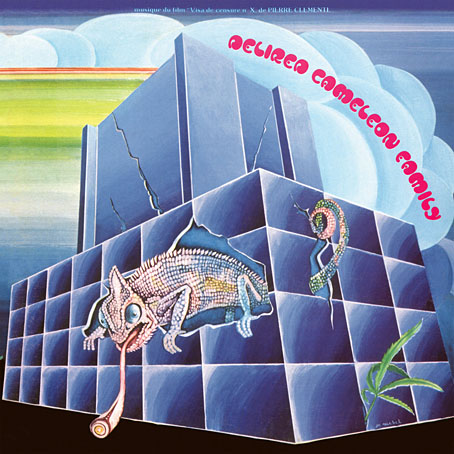
Where Anger had his film soundtracked with an irritating Moog score from Mick Jagger, Clémenti had the good sense to ask Cyrille Verdeaux and Ivan Coaquett to write some original music when the film was being prepared for release in 1975. Visa de censure numéro X runs for 42 minutes which is longer than most people want to spend watching a group of hippies partying, running around naked or cavorting in the woods. But this does give us a whole album of music in which Verdeaux and company—Christian Boulé and Tim Blake among them—go all-out for psychedelic rock; Boulé is credited with “cosmic guitar”. The improvisations were released under the name Delired Cameleon Family, an ensemble whose sole release sounds like Clearlight if they’d been liberated from the necessity of following Verdeaux’s compositions. As Clémenti’s film demonstrates, France had embraced the psychedelia of the 1960s as much as other European countries but French psychedelic rock wasn’t so common. The Delired Cameleon Family album is a notable exception, albeit one that arrived several years too late.
dcf.jpg

Cover art by Jean-Claude Michel.

All the online copies of Visa de censure numéro X that I’ve seen are horizontally stretched: the film should be viewed in 4:3, not 16:9. This copy at the Internet Archive may be downloaded then viewed in any application that allows you to change aspect ratios.

Previously on { feuilleton }
Clearlight: Symphonies
Into the Midnight Underground
Us Down By The Riverside, a film by Jud Yalkut
Kusama’s Self-Obliteration, a film by Jud Yalkut

Weekend links 822

tomaselli.jpg

Untitled (2013) by Fred Tomaselli.

• The latest book from A Year In The Country is Ghost Signals: The Shadowlands of British Analogue Television 1968–1995, an exploration of “a shadowland of terrestrial TV hidden in plain sight across the unmediated and unmarketed corners of the internet”.

• New music: After The Rain, Strange Seeds by The Leaf Library; Music For Intersecting Planes by Leila Bordreuil + Kali Malone.

• RIP airbrush artist Philip Castle. Steve Mepstead talked to Castle in 2011 about his work for Stanley Kubrick and others.

Strassman began to see patterns in these encounters and created a typology: aliens; guides and helpers; clowns, jokers and jesters; elves and dwarves; or reptilian or insect-like figures. Variations and outliers notwithstanding, this spectrum remains remarkably consistent with DMT studies today. Strassman also looked into the historical literature and found similar descriptions as far back as Szára, who wrote that one of his subjects reported meeting “dwarfs or something.” Forty years later and a continent away, one of Strassman’s participants put it succinctly: “That was real strange. There were a lot of elves.”

A long read by Joanna Steinhardt on the history and nature of hallucinated spirit guides and “self-transforming machine elves”

• Jet Propulsion Laboratory: Ben Cardew on the pivotal role of Stereolab’s Super-Electric.

• At Colossal: Pejac transforms basic graph paper into detailed, trompe-l’œil tableaux.

Sixty finalists from the 23rd Annual Smithsonian Magazine Photo Contest.

• At BLDGBLOG: The landscape architecture of auroras on demand.

• Mix of the week: Float V mix by DJ Food.

We Have Always Been Here (1995) by ELpH vs Coil | 5-Methoxy-N,N-Dimethyl- (5-MeO-DMT) (1998) by Time Machines/Coil | Machine Elves (2024) by Polypores

Locked Groove

locked1.jpg

It’s been a while since Scotto Moore’s newsletter turned up any of the abstract animated visuals I enjoy. Locked Groove by Emanuele Kabu fits the bill perfectly, an exercise in vibrant random symmetry which bears the subtitle “A hypnotic audiovisual animation inspired by pareidolia”. The video might also have been inspired by psychedelic hallucination given the way it captures the tendency of the abstract patterns generated by psychedelic delirium to continually change their size, shape and colour. This is one feature of the psychedelic experience you don’t see reproduced very often even though animation has long been the ideal medium for creating such effects. Kabu has soundtracked the metamorphoses with analogue synth noises but you could just as easily watch them with a suitably psychedelic piece of music.

locked2.jpg

Previously on { feuilleton }
Short films by Hideki Inaba

Weekend links 807

kouninos.jpg

Poster art by Nicholas Kouninos for Procol Harum / Pink Floyd / HP Lovecraft at the Fillmore, San Francisco, 1967.

• Take a break from so-called reality with Gruesome Shrewd, more queasy psychedelia by Moon Wiring Club. MWC’s Ian Hodgson described his intentions to Simon Reynolds in a Reynolds roundup which notes the 20th anniversary of the Ghost Box project. The label is apparently on hold for the moment but I have to admit that my interest waned some time after the 10th anniversary, when it became increasingly apparent that the ghost had fled the box. Reynolds ends his piece with a list of favourite GB recordings which I mostly agree with, although I’d shuffle the order and swap some entries with Pye Corner Audio.

• “‘You know that feeling you get when you’ve just gotten back from the dry cleaners a pair of slacks, Dacron slacks, and you reach your hand in a pocket and you feel those fuzzy sandwiches with your fingers? Well, that’s the feeling I’m looking for.’ I just nodded and replied, ‘OK, Dave, I know exactly what you mean.’” Barry Gifford remembers David Lynch.

Aschenbach’s Last Journey: Lesley Chamberlain, the most recent translator of Thomas Mann’s Death in Venice, approaches the text by following the progress of its doomed protagonist from Brioni to the Venetian Lido. Related: Polly Barton describes to Katy Whimhurst some of the difficulties involved in translating Japanese fiction to English.

• From The Shout to Bait: Darran Anderson on the uses of sound in cinema. Rupert Hines’ soundtrack to The Shout has just been released by Buried Treasure.

• Video footage of modular synthesists Arc (Ian Boddy & Mark Shreeve) performing Arcturus live in 2004: part one | part two.

• At Aeon: “Black holes may be hiding something that changes everything,” says Gideon Koekoek.

• At the BFI: Michael Brooke selects 10 great Hungarian films.

• Steven Heller’s font of the year is Fillmore.

Shout The Storm (1984) by :Zoviet:France: | Shout At The Devil (2002) by Jah Wobble & Temple Of Sound | Shout (2005) by Tod Dockstader