
Weekend links 837

grimshaw.jpg

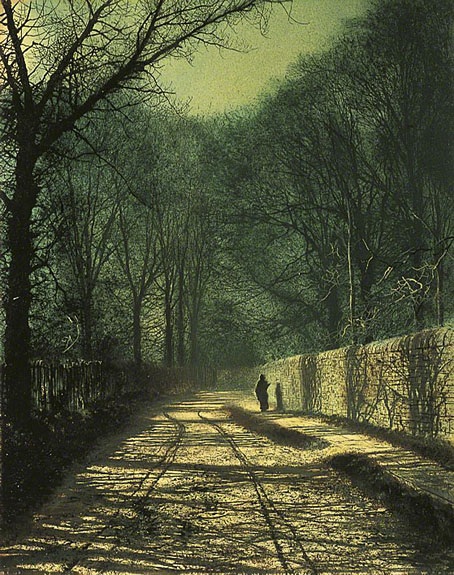
Tree Shadows on the Park Wall, Roundhay, Leeds (1872) by John Atkinson Grimshaw.

• “In many cases, the rules of physics that apply in a real scene appear to be optional in a painting; they can be obeyed or ignored at the discretion of the artist to enhance the painting’s intended effect.” An extract from The Visual World of Shadows by Roberto Casati and Patrick Cavanagh, in which the authors examine some of the rule-breaking that takes place when artists are dealing with shadows in paintings. I mentioned this aspect of artistic licence in a recent interview, making the point that meticulously accurate light and shade is a tell-tale sign of AI art.

• Orson Welles’ unfinished film of Don Quixote is back in the news again. Welles spent twenty years shooting scenes when he had the time and the money, and I seem to have spent an equivalent time reading about attempts to release the film. Any assembled footage will lack Welles’ bravura editing but I’d still like to see it.

• Read an extract from Still In A Dream: Shoegaze, Slackers And The Reinvention Of Rock, 1984–994 by Simon Reynolds.

• Mixes of the week: King Tubby – The Heaviest Dubs – A DJ Mix by Mista Savona, and Bleep Mix #319 by Yu Su.

• “What makes music psychedelic?” James McKeown on the music of Terry Riley.

• At the BFI: Gayle Sequeira selects 10 great films about dinner parties.

• Steven Heller’s font of the month is Loopy.

• The Strange World of…King Tubby.

Shadows (1967) by The Leather Boy | The Never-Deserting Shadow (1991) by Jarboe | Moon Shadows (2001) by Laraaji

Telepathic Heights by Hawksmoor

hawksmoor.jpg

No designer credited but probably the work of Adrian Self.

Too much unanticipated website wrangling has set my work back this week, but in the meantime I’ve enjoyed listening to more of the mostly-electronic music of Cabaret Voltaire (inevitably), plus the mostly-electronic music of Hawksmoor (James McKeown), whose latest album, Telepathic Heights, arrived a few days ago. According to the promotional copy this one “follows a path along the electronic skyways first created by the German/Krautrock electronic pioneers of the 1970s such as Cluster, Ash Ra Tempel, Roedelius and Michael Rother”. And so it does to an extent, although Hawksmoor’s buzzing timbres and synthesized rhythms are closer to those created by The Human League on their first two albums, Reproduction and Travelogue, a percussive pulse which an early reviewer of the League’s music compared to steamhammers in a mineshaft. The early League records, and the first album by Marsh & Ware as the B.E.F., Music For Stowaways, have always been cult items round here, so anything that approaches them is liable to catch my attention. Hawksmoor’s other albums push further buttons of interest with subjects that include Nicholas Hawksmoor’s churches (no surprise there), JG Ballard’s Concrete Island and The Crystal World, the psychogeography of Milton Keynes, and Old Weird Britain. I’m looking forward to seeing what future paths this 21st-century Hawksmoor chooses to follow.

Telepathic Heights is out now on Soul Jazz.

Previously on { feuilleton }
Talking time: Cabaret Voltaire interviews
Serious houses: The Lud Heat Tapes, 1979
German gear
Old music and old technology
A Clockwork Orange: The Complete Original Score