Weekend links 282

ligotti.jpg

Thomas Ligotti photographed by Jennifer Gariepy.

• More Thomas Ligotti (he’s been marginalised for decades, the attention is overdue): “Songs of a Dead Dreamer and Grimscribe are fugues of the creeping unknown,” says Peter Bebergal who profiles Ligotti for The New Yorker, and gets him to talk about the impulses that produce his fiction; at the Lovecraft eZine eleven writers and editors ask Ligotti a question related to his work.

• As usual, Halloween brings out the mixes. This year there’s a choice of The Ivy-Strangled Path Vol. XII by David Colohan, Samhain Séance 4 : The Masks of Ashor by The_Ephemeral_Man, The Voluptuous Doom of Bava Yaga by SeraphicManta, Spool’s Out Radio #27 with Joseph Curwen, and The Edge Of The Holloween Oven – 10/26/15 by The Edge Of The Ape Oven.

Broadcast’s James Cargill has provided a soundtrack for Peter Strickland’s radio adaptation of The Stone Tape by Nigel Kneale. John Doran and Richard Augood review the new and old versions for The Quietus. Related: Peter Strickland’s favourite horror soundtracks.

My mission was to make sounds that didn’t exist in reality, whether it’s a star ship or a laser or a monster or an exploding planet. You started with basic sounds that were acoustic and then you manipulated them. There’s a scene in Raiders of the Lost Ark, when he falls into the well of souls and pushes over that statue and there are all those snakes? The sound of the snakes was made by pulling masking tape off glass. When the statue falls over and breaks the wall there’s the noise of lots of big rocks breaking. We just took some bricks and smashed them up and then slowed the tape recording down. I remember doing a lot of great scary effects using dry ice and a bunch of pots and pans out of the kitchen. You heat them up really hot and then you drop a load of dry ice into the hot pan so the rapid thermal change would make it scream.

Composer and sound designer Alan Howarth talks to Mat Colegate about working for films

Jordan Hoffman reviews Jacques Rivette’s legendary 13-hour feature film Out 1: Noli Me Tangere (1971). The film will be in cinemas next month, and available on DVD/BR in January.

The Stone Tape was originally a one-off TV drama shown at Christmas in 1972. Michael Newton looks at the BBC’s habit in the 1970s of screening ghost stories at Christmas.

Steven Arnold’s Epiphanies: A look back at some of the artist’s surrealist photographs.

Greydogtales just concluded a month of posts dedicated to William Hope Hodgson.

• At Dirge Magazine: Tenebrous Kate on seven songs based on dark literary classics.

Phil Legard opens some grimoires for a short history of signs and seals.

Micah Nathan on Tuesday’s Child, “LA’s best Satanist magazine”.

• “The Occult was a kind of awakening,” says Colin Wilson.

Shagfoal: witchcraft and horror-blues by Dante.

Jenny Hval‘s favourite albums.

The Attic Tapes (1975) by Cabaret Voltaire | Those Tapes Are Dangerous (1997) by The Bug | The Black Mill Video Tape (2012) by Pye Corner Audio

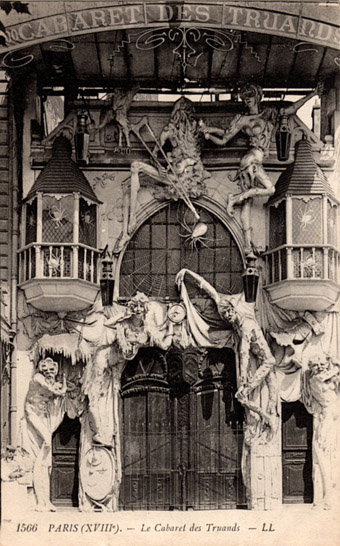
Cabaret des Truands

truands1.jpg

Up until 1950 Montmartre retained an aura of evil for provincials and foreign visitors, and did its best to satisfy them with a tawdry kind of satanism. The most famous of these places, in the Boulevard de Clichy, was called L’Enfer.

Philippe Jullian, Montmartre (1977)

L’Enfer is still the most famous of these vanished Parisian establishments thanks to photos by Eugène Atget and others of its hell-mouth entrance. Among the other novelty cabarets on the Boulevard de Clichy there was Le Ciel (Heaven) next door to L’Enfer, and the death-themed Cabaret du Néant (Cabaret of Nothingness, or Limbo as Jullian has it). The exterior of the latter was suitably funereal but otherwise mundane, although once inside you were in crypt-like surroundings.

truands2.jpg

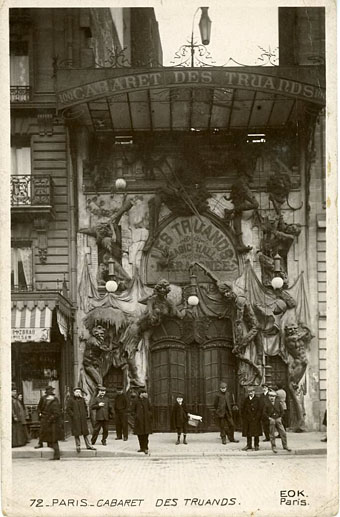
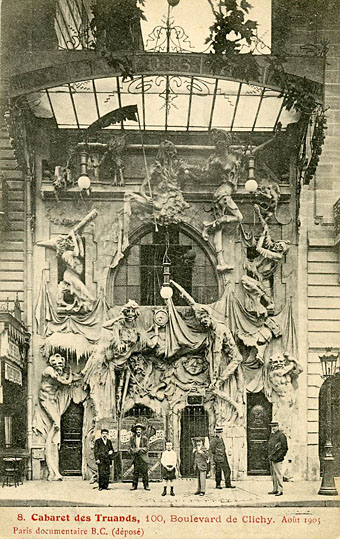
Another cabaret with a striking exterior that I hadn’t come across before was at no. 100 Boulevard de Clichy. The Cabaret des Truands (Cabaret of Truants) had a generally medieval interior with staff dressed like serving wenches and troubadours, but the exterior could almost be that of a fairground haunted house, replete with spider webs and plaster grotesques. Descriptions in English are unclear but the spiders seem to relate to a shared establishment, L’Araignée. It’s surprising to think of all these extravagant façades standing in a single (long) street in the heart of Paris, but then Montmartre in the late 19th century was the wild nighttown. Searching for photos of the Cabaret des Truands reveals an exterior changing by degrees with the passing years.

truands3.jpg

Previously on { feuilleton }
Infernal entrances

Weekend links 280

crisafi.jpg

Keepers of the Moon by Bill Crisafi.

• More Thomas Ligotti for obvious reasons: Weird Fiction Review now has two Ligotti interviews, one from 2011, and a new one prompted by the Penguin edition of his stories. Also at Weird Fiction Review, two Ligotti narratives: The Night School, and The Red Tower. The latter demonstrates how weird fiction can dispense with character and story and still have a powerful effect.

• Related to the above: Terrors supernatural and psychological: Laird Barron on Ray Russell’s The Case Against Satan; Russell’s novel is also being reprinted by Penguin this month. And at Dangerous Minds: a collection of vintage dolls and ventriloquist dummies.

• “Time and again his books—even as they tell of remote planets and their inhabitants—foresee something perplexingly close to our present-day society, from visionary constructions to machines of destruction.” Strange Flowers on Paul Scheerbart.

Coil’s out-of-print discography gets a career-spanning reissue through Threshold Archives. Related: Russell Cuzner interviews Thighpaulsandra.

• Mixes of the week: The Ivy-Strangled Path Vol. XI by David Colohan, and Sounds From Beyond (October 2015) by Glossop Record Club.

Bill Crisafi: Artist, Dreamer, Feral Mystic. An interview with the artist by S. Elizabeth for Dirge magazine.

• Also being given the revenant treatment, out-of-print short stories by Aleister Crowley.

Alex Mar on the powerful appeal of modern witchcraft—even for a skeptic.

A Rest Before The Walk is a new album by Keith Seatman.

The Wounded Kings set out their stall at Bandcamp.

The Witch Queen Of New Orleans (1971) by Redbone | Witch (1977) by Goblin | Ditch Witch (2009) by Pink Mountain

Weekend links 279

ray.jpg

Untitled painting by Jen Ray.

• Lots of architecture links this week so it’s fitting that one of them is director Ben Wheatley talking to David Fear about his forthcoming film of JG Ballard’s High-Rise: “I was just thinking about this the other day, how hard it was to get a hold of stuff before the Internet. You really had to hunt down stuff or have someone who knew what was up to say, ‘You gotta read Naked Lunch, mate. You gotta read Crash.’ […] They were secretive things you had to ferret out, those books. It was the same with music and certain movies. And drugs.” Related: Souvenir d’un Futur, photographs by Laurent Kronental of the high-rise banlieues of Paris.

• “In Ancient Egypt, if a lowly official received the glyph of an owl from the Pharaoh, it was understood that the recipient should take his own life.” Carey McHugh in a brief history of the owl.

• I’d always thought the red buildings seen briefly in Blow-Up (1966) had been painted to Antonioni’s orders. Not so, says Another Nickel In The Machine.

He belongs right up there with Poe and Kafka. The best writer of weird fiction in the past half century. And the reason he belongs there is Ligotti’s both visceral and intellectual, formally experimental and able to tell a traditional horror story with equal ease. He’s also modernized the weird tale, from his early work on. The later workplace stories complete that process. The other thing he brings is a very dark sense of humor and a sense of the absurdity of the world—and a critique of that world that serves as subtext. All of these elements in harmony—symbiosis and contamination—equal genius. I read his work in a continuum that includes Kafka, Poe, Angela Carter, Bruno Schulz, Rikki Ducornet, and the great Caitlin R. Kiernan, but also absurdists and realists and flat-out surrealists. I appreciate that Ligotti stories can be revisited and reveal new dimensions.

Jeff VanderMeer on Thomas Ligotti

David Ferry talks to the people trying to excavate the remains of sets from Cecil B. DeMille’s first film of The Ten Commandments.

• As part of the ongoing vinyl reissue deluge, Crammed Discs are releasing a 10-disc box of albums by the great Tuxedomoon.

• At Strange Flowers: I see for it is night, remembering Marie Cermínová, better known as Surrealist artist Toyen.

Blue Sun Chiming, an animated video by Elisa Ambrogio for the song of that name by Six Organs of Admittance.

• At BLDGBLOG: Occult Infrastructure and the “Funerary Teleportation Grid” of Greater London.

• Enigmatic music makers Watch Repair are now selling their works at Bandcamp.

• Video by Harald Albrigtsen of whales basking under the Northern Lights.

• The urban explorations of Russian photographer Ralph Mirebs.

• Mix of the week: Secret Thirteen Mix 164 by Discipula.

The lost rivers that lie beneath London

Egypt (1985) by Tuxedomoon | Whales Tails (1986) by Cocteau Twins | London’s Lost Rivers (1996) by Coil

Weekend links 278

sanmartin.jpg

El Hotel Satina (2006) by Oscar Sanmartin.

Andrew Kötting’s By Our Selves is “a melancholy, maverick film” says David Jays. With Toby Jones following in the footsteps of poet John Clare, Iain Sinclair in a goat mask, and Alan Moore warning about the “vision sump” of Northampton.

• “Shunga means ‘spring pictures’. They depict sometimes spectacular sexual contortions and come imbued with the power of taboo. For years they have largely been out of sight—until now.” Related: shunga prints at Ukiyoe Gallery.

• “Who else could link Smokey Robinson and JG Ballard, Iggy Pop and Josephine Baker, James Bond and Stephen Sondheim, Gary Numan and Johnny Cash, Tricky and Tom Moulton…” Grace Jones is the best, says Joe Muggs.

Ballardian space – what he called “inner space” to differentiate it from the science fiction that concerned itself with distant planets and space rockets – is in fact a fusion of inner and outer space. There is no “out there” totally separate from his characters; just as there is no exclusively private, isolated inner life. His most psychologically fulfilled characters look to transcend their physical surroundings, however hostile, by embracing them.

Chris Hall on High-Rise by JG Ballard

• “In March 1984, Jorge Luis Borges began a series of radio ‘dialogues’ with the Argentinian poet and essayist Osvaldo Ferrari, which have now been translated into English for the first time.”

• “I came up with a couple of tunes, literally in my bedroom. People think of bedroom recordings as a modern, laptop invention. It wasn’t.” Daniel Miller on the accidental success of Mute Records.

• “It was in Prague that I first awoke.” Strange Flowers on Gustav Meyrink’s life in Prague.

• At 50 Watts: Stencilled ornament and illustration by William Addison Dwiggins.

• Mix of the week: The Ivy-Strangled Path Vol. X by David Colohan.

Wyrd Daze, Lvl2 Issue 4, is free and brimming with the weird.

Mythology, a new series of drawings by Howard Hardiman.

Spike Jones is the best, says MetaFilter.

Peacocks at National Geographic.

Warm Leatherette (1980) by Grace Jones | Warm Leatherette (1998) by Chicks On Speed | Warm Leatherette (2013) by Foetus