Andrey Avinoff revisited

avinoff1.jpg

(My apologies for the recent downtime. The hosting for this site has been a bit more unstable than usual.)

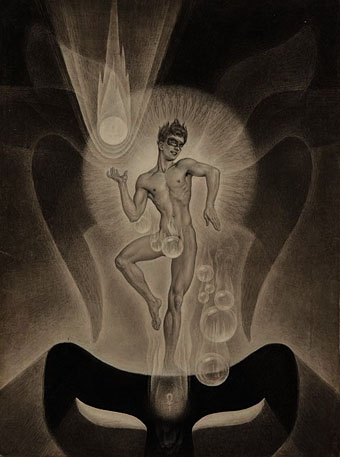
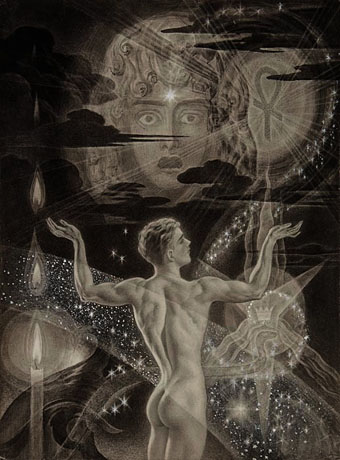
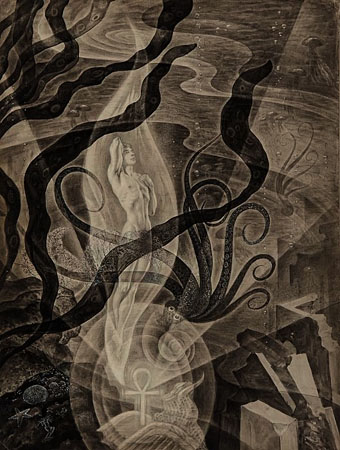
At a time when various Russians are trying to rewrite their nation’s gay history, there’s hardly been a better moment to remind ourselves of some of the people who contributed to that history. When I discovered the art of Andrey Avinoff (1884–1949) in 2007 most of the online examples of his work were in the collection of the Kinsey Institute. Avinoff was a friend of Kinsey’s (the artist escaped the revolution to live in the USA), and the professor no doubt took an interest in the evident homoeroticism of the drawings.
avinoff2.jpg

The homoerotics (mostly male nudes in fantasy scenes) are combined with some remarkable occult designs in Avinoff’s 21 illustrations for The Fall of Atlantis, a book-length poem by George Golokhvastoff published in 1944. The book was a limited edition, and a complete set of the drawings wasn’t forthcoming in 2007 so it’s been great to find Javier at Bajo el Signo de Libra posting the complete set. These are stunning illustrations which really ought to be seen by a wider audience; Avinoff isn’t a name you find very often in either the gay or the occult art world yet his draughtsmanship and imagination demand attention from both.
avinoff3.jpg

Elsewhere on { feuilleton }
The gay artists archive

Elsewhere on { feuilleton }
The art of Andrey Avinoff, 1884–1949
Weekend links 178

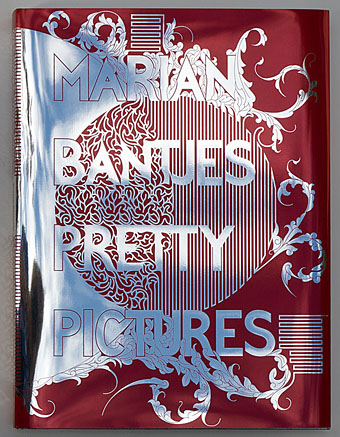
bantjes.jpg

Pretty Pictures, a new book by designer Marian Bantjes, is out on October 1st.

• A writer admired by Angela Carter, Michael Moorcock, Harlan Ellison, Anthony Burgess, Jonathan Meades and Iain Sinclair; a “writer’s writer…[whose] best stories bear comparison with the Ficciones of Jorge Luis Borges”; a writer with an “unsettling quality to his writing, a whiff of brimstone that links him to fin-de-siècle occult figures such as HP Lovecraft—and even, at a further remove, Aleister Crowley”. David Collard explains why you may want to read something by Gerald Kersh (1911–1968), four of whose books are being republished.

• The Eccentronic Research Council and Maxine Peake pay homage to Delia Derbyshire’s The Dreams project with a new single out at the end of the month (Pye Corner Audio and Carol Morley appear on the flip). Ms Peake’s barm-cake reverie may be heard here.

• “Applying for grants, writing artist statements, showing up to openings—artists have to do far more than just make art if they want to find an audience for it.” Jen Graves on lies and deception in the art world.

The material does not make the work. The life does not make the art. Exactly the opposite. The work creates the material. The art creates the life. Did Trinidad exist before Naipaul? Did cargo ships exist before Joseph Conrad? Did Newark and the New Jersey suburbs exist before Philip Roth? Did women in playgrounds in New York City exist before Grace Paley? See how the writer invents the material? These places did not exist as literary subjects. They were invisible to literature. The magic of a great book is that it makes its own subject seem inevitable. The danger is, it makes the subject seem like the source of power in the work.

Phyllis Rose on life and literature.

• Mix of the week: Secret Thirteen Mix 087, 40 minutes of original electronic music by Geistform (Rafael Martinez Espinosa).

• “You’ve Got This“, an It Gets Better-style video support campaign for people recently diagnosed with HIV.

• At Dangerous Minds: Babalon Working: Brian Butler’s trippy occult odyssey with Paz de la Huerta.

Manfred Mohr‘s computer-created artwork, from the 1960s to the present.

Robert Macfarlane on the strange world of urban exploration.

Rick Poynor on Bohumil Stepan’s Family Album of Oddities.

• Oli Warwick talks to Martin Jenkins, aka Pye Corner Audio.

• The 384-page BUTT calendar for 2014 is now on sale.

• Pye Corner Audio: We Have Visitors (2010) | Toward Light (2011) | The Mirror Ball Cracked (2012)

Abraxas 4

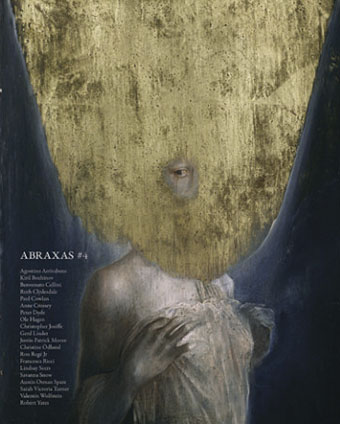
abraxas4.jpg

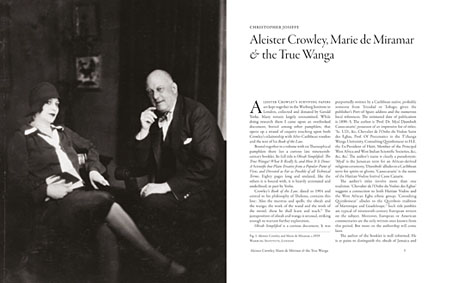
My thanks to Livia Filotico at Fulgur Esoterica for sending these previews from the forthcoming issue of Abraxas, the Journal of Esoteric Studies. Abraxas is a beautifully produced large-format book whose artist interviews—as I’ve mentioned before—are especially valuable. Issue 4 will include:

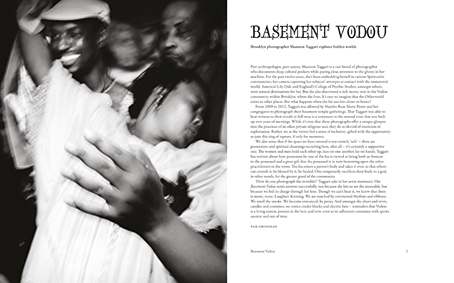
Prof. Sarah Victoria Turner’s interview with artist Christine Ödlund on theosophy and synaesthesia, a special feature on the Italian artist Agostino Arrivabene, a documentation of Art Angel artist Lindsay Seer’s ancestral performance/installation Nowhere Less Now, Shannon Taggart’s extraordinary photographs of Brooklyn vodou and Valentin Wolfstein insightful analysis of the Mystic Fool. Following this tarot theme, the artist Francesca Ricci provides an account of her working with urban symbols, and their subsequent transformation into a unique tarot, titled Anarca.

Mention of combining urban symbols with the Tarot sounds especially interesting after I’ve recently dealt with that challenge myself. Those who buy the limited edition hardback will receive a signed suite of Francesca Ricci’s Tarot cards. Abraxas 4 is published on September 22nd. Further details and page previews here.

abraxas1.jpg

Nowhere Less Now by Lindsay Seer.

abraxas2.jpg

abraxas3.jpg

Previously on { feuilleton }
Abraxas: The International Journal of Esoteric Studies

Alas Vegas Tarot cards

alasvegasdevil.jpg

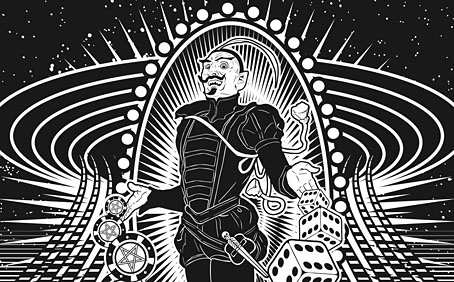
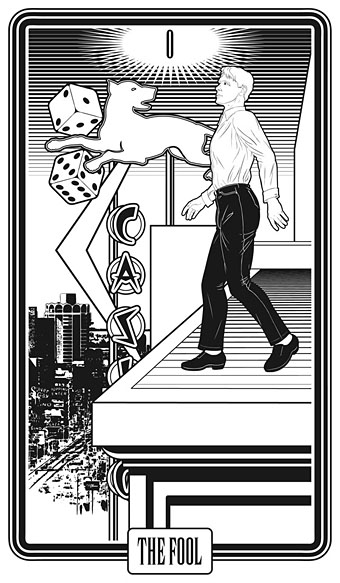
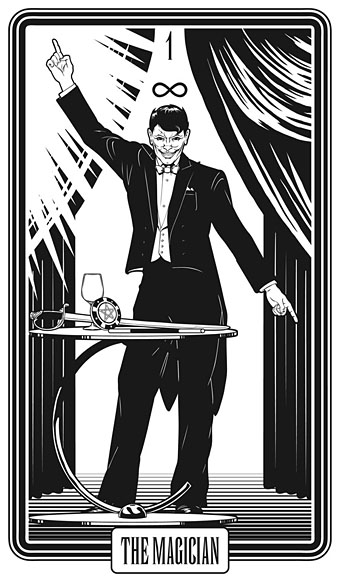
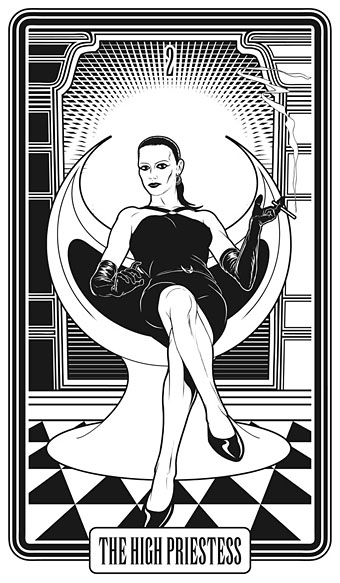
Back in February I bought a Wacom drawing tablet and said I’d show some proper results from its use later. For the past few months I’ve been working on this project using a combination of Wacom drawing and vector graphics. The initial brief from games designer James Wallis was for six Tarot-style card designs for his Alas Vegas role-playing game which has as its theme a fantasy extrapolation from Las Vegas and its gaudy mythology. The Kickstarter funding for the game turned out to be more successful than was anticipated so James asked me to expand the six cards idea into a full set of black-and-white Major Arcana designs.

This has been a fun series to work on although a number of the cards presented problems at first, the antique nature of the Tarot symbolism being a difficult thing to map across a very commercial American city. The symbolism from the Rider-Waite-Smith (RWS) deck was used as a rough guide although we deviated in a few places from the more traditional attributes. Las Vegas has changed over the years so rather than represent a single period of the city’s history there are references to different eras, from the huge casinos of today back to the buildings of the 50s and 60s with their distinctive “Googie” architecture. Notes for the cards follow below. The artwork can be seen at larger size here.

alasvegas00.jpg

The Fool is usually a young man about to step off a cliff edge with a dog barking a warning at his heels, hence the dog on the sign.

alasvegas01.jpg

Several of the cards convert the Tarot characters into cabaret acts. This one was pretty inevitable, and I’m sure it’s not the first time a stage conjuror has appeared on this card.

alasvegas02.jpg

The chair is based on the 1965 “Ball Chair” design by Eero Aarnio (as seen in The Prisoner TV series), adapted here to resemble the Priestess’s crescent moon.

alasvegas03.jpg

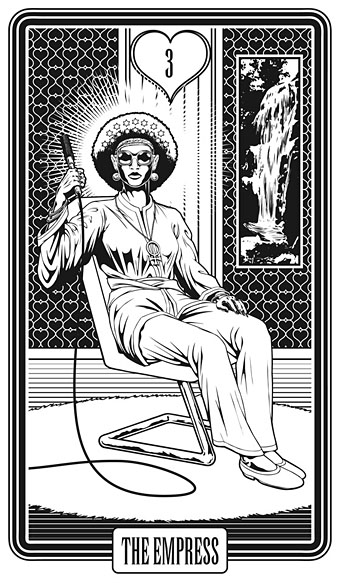
The style on this one is more 70s than 60s: patterned wallpaper (the hearts derive from the symbolism of The Empress, and from playing cards, of course), white rug, Kung Fu pyjamas.

Continue reading “Alas Vegas Tarot cards”

More Cameron

cameron3.jpg

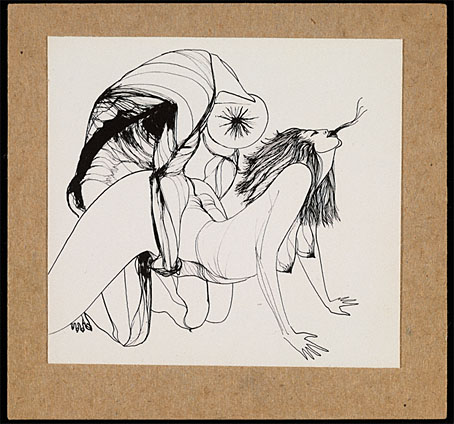
Untitled (Peyote Vision), 1955, Cameron (from Semina journal, no. 1).

Thanks to Erik Davis for drawing my attention to a small online exhibition of Marjorie Cameron artwork and documentary material. Semina was the magazine founded by Cameron’s artist friend, Wallace Berman. The exhibition note tells us that:

Wallace Berman’s only exhibition at Ferus Gallery in 1957 was raided by the LAPD vice squad because of the small reproduction of this sexually graphic work by Cameron that was part of Berman’s assemblage, Temple.

Allen Ginsberg’s Howl successfully fought off an obscenity charge in the same year but the immediacy of visual art means it always fares less well with disapproving authorities. We can assume that Cameron had personal experience of peyote given some verse written by her husband, Jack Parsons, that Robert Anton Wilson quotes in Cosmic Trigger (1977):

I hight Don Quixote, I live on peyote,
marjuana, morphine and cocaine,
I never know sadness, but only a madness
that burns at the heart and the brain.

cameron4.jpg

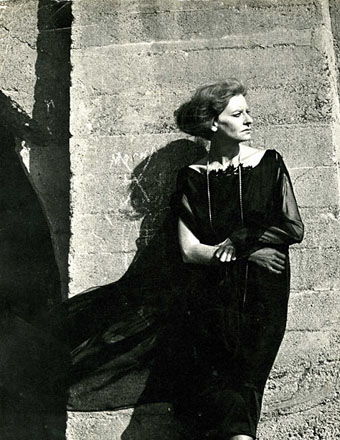
On the same site is this wonderful still (or is it a location photo?) from the shooting of Curtis Harrington’s Night Tide in 1961. Seeing this makes me want to watch the film again.

Previously on { feuilleton }
The Wormwood Star
Street Fair, 1959
House of Harrington
Curtis Harrington, 1926–2007
The art of Cameron, 1922–1995