Weekend links 163

michishita.jpg

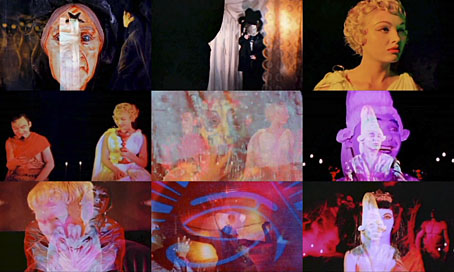
Le Cadavre Exquis by Yukio Michishita. As featured in The Purple Book: Sensuality & Symbolism in Contemporary Art & Illustration by Angus Hyland & Angharad Lewis.

• ” Like Polo’s magic cities, which in the end all turn out to be Venice, fantasy finally refers us back to reality and the challenge of everyday social engagement.” Jonathan Galassi on The Dreams of Italo Calvino. In the same edition of the NYRB, Anna Somers Cocks on The Coming Death of Venice?

• Mix of the week: Solid Steel Radio Show 7/6/2013 Part 3 + 4: Peter “Look Around You” Serafinowicz compiles 70 minutes of Boards of Canada-inflected ambience.

• “Magic and art tend to share a lot of the same language. They both talk about evocation, invocation, and conjuring.” Alan Moore talks to Peter Bebergal.

The gay rights movement around the world has promoted a basic idea: we want to show society that we are human beings like everyone else. The problem is that the train driver at the Kashirskaya train station doesn’t necessarily think that those few dozen passengers in whose face he closes the doors are a priori inferior and deserve such treatment. He feels that he becomes superior to them by means of using his power over them. This sense of superiority can be trumped only by some higher superiority.

On the Moscow Metro and Being Gay by Dmitry Kuzmin.

• “I went from being a very promising young writer to being completely ignored in two novels.” Madeleine Monson-Rosen on Angela Carter.

Sequence6, another excellent sampler from Future Sequence: 40 new pieces of music as a free download.

timlin.jpg

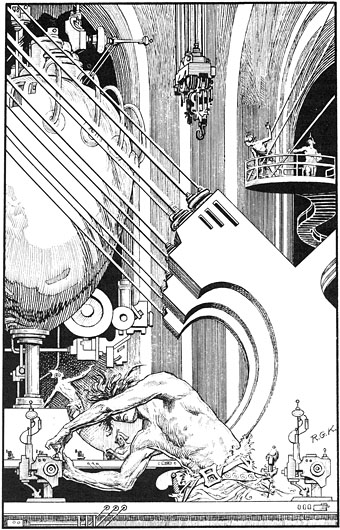
The Arrival on Mars, an illustration from The Ship That Sailed to Mars (1923) by William Timlin.

• At PingMag: An Icon for Everyone: Shoryu Hatoba, Japanese Crest Artist.

• More Japanese weirdness at Sardines Bizarres.

• Larry Nolen on Bruno Schulz.

Magic Ritual (1976) by Black Renaissance | Magic Fly (1977) by Space | Magic Vox (1981) by Ippu-Do

Palladini’s Aquarian Tarot

palladini01.jpg

For the past two months I’ve been busy drawing a new set of Tarot designs. More about these later, but sporadic research has naturally led to me to look at a few earlier sets, although my Trumps have mostly been following Pamela Colman Smith’s illustrations for the Waite deck. Tarot designs have really proliferated in the past few years (Is there a Lego Tarot? Yes, of course there is), so much so that many previous designs which would once have been notable are now swamped by mediocre decks.

David Palladini’s Aquarian Tarot first appeared in 1970 when the occult revival was getting into its stride. Palladini had contributed to the Linweave Tarot in 1967 along with three other artists, something you can read more about at the excellent Sweet Jane’s Pop Boutique. I’m sure I must have seen the Aquarian Tarot in the past but probably dismissed it for being too modish and not occult enough; for a long time Aleister Crowley’s Thoth deck was the only one I’d look at. Palladini’s art is a lot more familiar now that his fabulous poster for Nosferatu the Vampyre looks down on me every day, and I’ve grown to enjoy his combination of Art Nouveau and Deco motifs so much that I wouldn’t mind a pack of these cards. The Aeclectic site reviews the deck, and has a few more examples of the designs. They also review the New Palladini Tarot which the artist produced in 1996. Given the choice I’d still go for the earlier set.

palladini02.jpg

Continue reading “Palladini’s Aquarian Tarot”

Abraxas: The International Journal of Esoteric Studies

abraxas.jpg

A welcome arrival in the post recently was two issues of Abraxas, the book-format journal of esoteric studies from Fulgur Esoterica. I’ve always observed the contemporary occult scene from a distance, being more interested in cultural spin-offs whether those happen to be music-oriented—as was the late, lamented Coil—or art-oriented. Something I always enjoyed about Kenneth Grant’s books was the amount of unique art material they contained, much of it by his wife, Steffi Grant, or previously unseen work by Austin Osman Spare. Fulgur have for many years continued this artistic focus, starting out by reprinting Spare’s books (and publishing new ones, such as the revelatory Zos Speaks!), and more recently turning their attention to the work of contemporary artists following similar paths.

kostromitin2.jpg

Study for Salome (2012) by Denis Forkas Kostromitin.

Abraxas is a venue for the latter group, especially in the most recent issue, no. 3, which features a wealth of new art, photography, essays and poetry. In the past I’ve complained about the misunderstandings Austin Spare’s work used to generate among otherwise intelligent and sensitive critics when faced with the artist’s occult obsessions; the usual response would be to lazily dismiss this side of his work as “black magic”, and therefore either kitsch or nonsense. Things have improved in recent years but it’s taken a long time for critics and curators who would show the greatest respect to a minority belief from South America, say, to offer the same respect to equally sincere artists who happen to be working in London or New York. One of the values of Abraxas for artists such as Jesse Bransford and Denis Forkas Kostromitin, both of whom are interviewed here, is that they can have a conversation with someone who won’t treat their work or their interests in a condescending manner. I’m particularly taken with Kostromitin, a Russian artist whose work I only discovered recently.

kostromitin3.jpg

M L K (Moloch) (2011) by Denis Forkas Kostromitin.

Elsewhere in Abraxas 3 there’s a feature on the recent exhibition of Aleister Crowley’s extravagant daubs, an article by Francesco Dimitri about tarantism in southern Italy, a piece about Dada by Adel Souto, and text by Paracelsus with illustrations by Joseph Uccello which is printed on a different paper stock. The production quality is as good as any art book but then that’s standard for a Fulgur publication. Mention should be made of the interior design of this issue which far exceeds the often perfunctory layout of many publications from smaller publishers. Tony Hill is credited on the masthead as Creative Director so I’m assuming he’s the person responsible. Abraxas is an essential purchase for anyone interested in contemporary occult art. The hardback of no. 3 is a limited edition that includes a signed and numbered lithograph by Denis Forkas Kostromitin.

Previously on { feuilleton }
I:MAGE: An Exhibition of Esoteric Artists

I:MAGE: An Exhibition of Esoteric Artists

francov.jpg

El Trigono de las lesiones (2010) by Cristina Francov.

I:MAGE is an exhibition of occult-inspired art which opens a week on Sunday, 19th May at the Store Street Gallery, Bloomsbury, London. As exhibitions go it’s modest in scale but with an impressive roster of contributors old and new: Agostino Arrivabene, Ithell Colquhoun, Denis Forkas Kostromitin, Steffi Grant, Orryelle, David Chaim Smith, Michael Bertiaux, Andrew Chumbley, Cristina Francov, Barry William Hale, Francesco Parisi, Austin Osman Spare, Jesse Bransford, Peter Dyde, Rik Garrett, Noko, Residue, and Michael Strum. A few examples of the work on display are shown here, some of which will be available for purchase.

The event is being organised by Fulgur Esoterica, and their website has details of some related events including John Constable’s one-man play, Spare (about artist Austin Osman Spare), a one-off performance which will be held at Treadwell’s, London, on the 24th. This catches my attention because Constable was responsible for the acclaimed theatre adaptation of Mervyn Peake’s Gormenghast which David Glass and company staged in the 1990s. It’s always good to find one’s favourite people joined through these lateral connections.

garrett.jpg

The Earth Magic Series (2012) by Rik Garrett.

grant.jpg

Steffi Grant.

kostromitin.jpg

Demon by Denis Forkas Kostromitin.

Weekend links 158

soderberg.jpg

Pan II (2012) by Fredrik Söderberg.

• “Aubade was a surprise success, selling some 5000 copies and going into a second printing and an edition published in America.  Martin was immediately a minor celebrity, being interviewed for articles that couldn’t mention what his book was actually about.” Rediscovering the works of Kenneth Martin.

• “I can’t stand covers which imitate other covers, or which slavishly look like whatever their designated genre is supposed to look like.” Ace cover designer Peter Mendelsund is interviewed.

• At The Outer Church Isablood & Henry of Occult Hand are interviewed about their mixtape.

I’d decided to pay my respects in an unorthodox way, by time-travelling into the period of Thatcher’s pomp, when she occulted the light, alchemised the bad will of the populace and did her best to choke the living daylights out of the awkward, sprawling, socially coddled essence of metropolitan London. Hers was a tyranny of the suburbs operating from a position of privilege at the centre: she might have invested in a Dulwich retirement property, but she couldn’t sleep in it.

Iain Sinclair visits Tilbury on the day of the Thatcher funeral. Related: Iain Sinclair and Jonathan Meades in Conversation, Oxford Brookes University, March 2013.

Ormond Gigli’s best photograph: women in the windows in Manhattan. See it full size here.

Balzac and sex: How the French novelist used masturbation to fuel his writing process.

• At Dangerous Minds: Kenneth Williams and John Lahr discuss Joe Orton in 1978.

• Yet more Bowie: Sukhdev Sandhu reviews Ziggyology by Simon Goddard.

The Spectacular, Wild World of Tenjo Sajiki and its Posters.

• In 1967 Susan Sontag made lists of her likes and dislikes.

Stephen Sparks on fin de siècle author Marcel Schwob.

Day Jobs of the Poets by Grant Snider.

James Turrell’s Ganzfeld Experiment.

The Pan Piper (1960) by Miles Davis & Gil Evans | Panorphelia (1974) by Edgar Froese | Pandora (1984) by Cocteau Twins