Musaeum Hermeticum

alchemy11.jpg

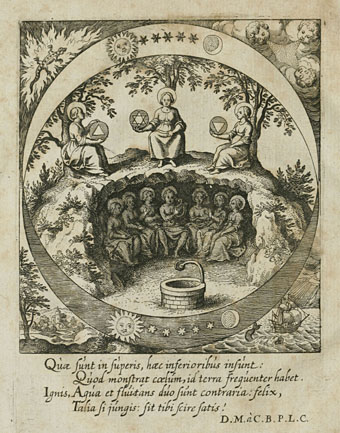
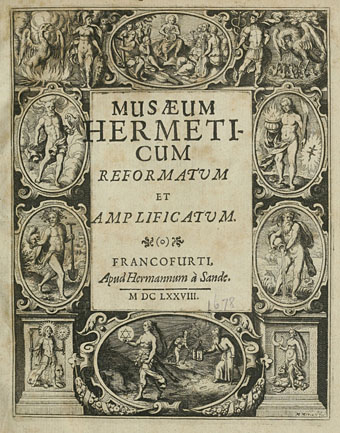
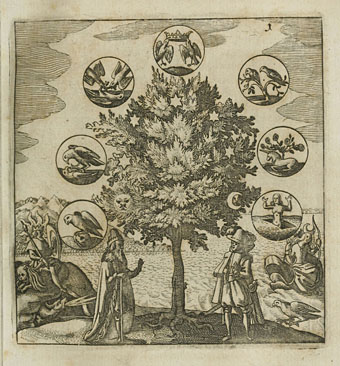
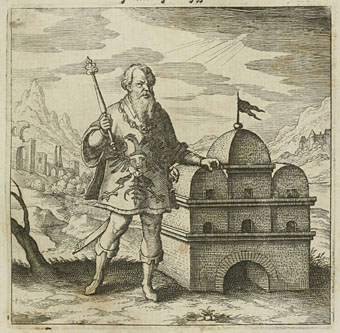
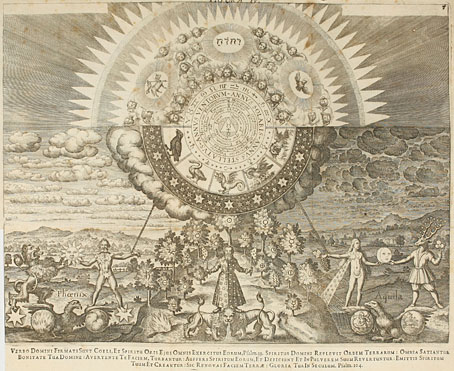
More from the storehouse of wonders that is the Getty Alchemy Collection at the Internet Archive. The illustrations here are from the 1678 edition of the Musaeum Hermeticum, a lengthy collection of alchemical texts with engraved illustrations by Matthäus Merian (1593–1650). Merian’s illustrations are some of the most frequently reprinted of all those you’ll find in alchemical books of this period, and justifiably so, he had a knack for presenting the allegories of the alchemical process in an elegant and detailed manner that’s also gloriously strange. The same quality of strangeness can be found in his other major alchemical work, Atalanta Fugiens (aka Scrutinium Chymicum). Browse Musaeum Hermeticum here or download it here.

alchemy01.jpg

alchemy02.jpg

alchemy03.jpg

alchemy04.jpg

Continue reading “Musaeum Hermeticum”

Weekend links 206

komoda.jpg

Nova Express (2014) by Paul Komoda.

• Last week it was Kraftwerk, this week it’s Can in another astonishing 70-minute TV performance from 1970. For those who know where to look in the torrent world there are copies of these recordings circulating there.

JG Ballard: five years on. Extracts from introductions by John Gray, Hari Kunzru, Robert Macfarlane, Deborah Levy, James Lever, China Miéville and Michel Faber for a new series of Ballard editions.

• Mix of the week: Needle Exchange 147 by Inventions. Also at Self-Titled Mag: Suzanne Ciani on her Buchla beginnings, talking dishwashers, and why no one got electronic music in the ’70s.

• At Dangerous Minds: It’s So Far Out It’s Straight Down, a Granada TV documentary from 1967 featuring Paul McCartney, Allen Ginsberg, International Times, Pink Floyd et al.

The Wonderful World of Witches: Portraits of English Pagans. A photo-special from the 1960s at LIFE. Related: From 1974, the US TV ad for Man, Myth and Magic.

• Suspicious Minds: Adam Curtis on Stephen Knight, Jack the Ripper, squatters, heists, From Hell, and why people no longer trust those in authority.

• Here be men with beards and syntezators: Andy Votel‘s Top 10 Early Patch-Bay Polymaths From Eastern Europe.

The New York Public Library has made 20,000 maps available as free, high-res downloads.

• An oscilloscope video by Vincent Oliver & Steve Bliss for Riff Through The Fog by Clark.

Anne Billson interviewed Alejandro Jodorowsky in 1990.

• At BLDGBLOG: When Hills Hide Arches.

Do gay people still need gay bars?

Pixelord Dreams

I’m So Green (1972) by Can | Nova Feedback (1978) by Chrome | Gay Bar (2003) by Electric Six

Weekend links 204

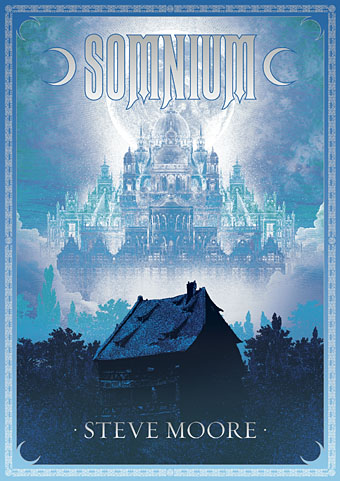
somnium.jpg

RIP Steve Moore. We never met, unfortunately, but I was very pleased he asked me to create a cover for his unique occult novel, Somnium, in 2011. Prior to this we’d been connected by shared acquaintances, colleagues, and membership in the informal cabal that was (and maybe still is) The Moon & Serpent Grand Egyptian Theatre of Marvels. Steve’s long friendship with Alan Moore (no relation) is well-documented, not least by Alan himself who made Steve the subject of his Unearthing project. One surprising connection for me was that Steve also had a link to Savoy Books. In the late 1960s he was working for comics publisher Odhams where he was able to copy for David Britton some Ken Reid comic art which Odhams had refused to print. Dave published the forbidden pages in his first magazine, Weird Fantasy, in 1969. In 2011 Steve talked to Pádraig Ó Méalóid about Somnium, and also to Aug Stone at The Quietus. Aug Stone penned a few memorial words here.

• “People love using the word ‘porn’ as long as there’s a partner for it. Pair ‘porn’ with something else and it’s usually a good thing. A celebration of style and culture. But that word on its own? Well.” Porn star Conner Habib asks why people have such a problem with porn actors.

Dave Maier‘s Russian cinema recommendations. Several favourites there including the magical and remarkable Shadows of Our Forgotten Ancestors (1964) which, as Maier notes, isn’t really Russian but should be seen in any case.

Shakespeare uses verbal magic, cantrips and ditties, nonsense songs and verses throughout the plays, but in Othello he gives a glimpse of how powerful a spell becomes when it’s no longer oral, but fixed in material form. The fatal handkerchief is no ordinary hanky; it’s a love spell, and it was made with gruesome and potent ingredients (mummified “maiden’s hearts”) by a two-hundred-year-old sibyl in Egypt—Egypt being the birthplace and pinnacle of magic knowledge.

Marina Warner on magic.

• Mixes of the week: an hour of electro-acoustics and contemporary classical recordings sequenced by Laurel Halo, and (from 2010) 36-minutes of “umbral electronic hypnagogia” by The Wyrding Module.

• “This is the book that, 10 years later, inspired Richard Hollis’s landmark design for John Berger’s Ways of Seeing.” Rick Poynor on Chris Marker’s Commentaires.

• Is the Linweave Tarot the grooviest deck ever made? Dangerous Minds thinks so.

• Bobby Barry talks to Holger Czukay about his 1969 audio collage, Canaxis 5.

• “What Happened to Experimental Writing?” asks Susan Steinberg.

Aldous Huxley‘s lectures on visionary experience at MIT, 1962.

Laura Palmer will see Agent Cooper again in just a few hours.

Callum found a copy of The Gay Coloring Book (1964).

Metal Cats

Moonshake (1973) by Can | Lunar Musick Suite (1976) by Steve Hillage | Dark Moon (1993) by Holger Czukay | Boy In The Moon (2012) by Julia Holter

A triangular book about alchemy

alchemy1.jpg

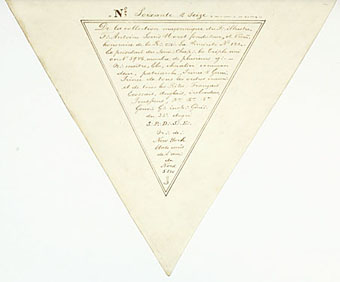
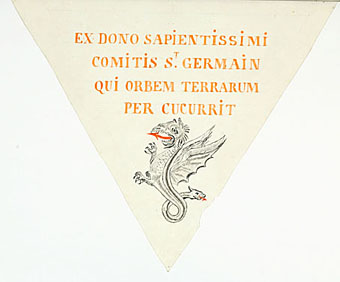
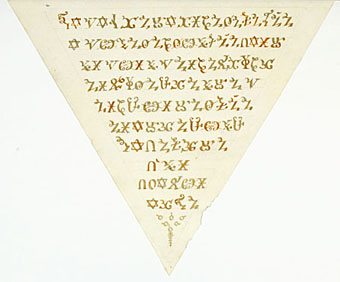
Triangular buildings aren’t so very unusual, triangular books, on the other hand, are less common. This example is from the Manly Palmer Hall collection of alchemical manuscripts at the Internet Archive, not only a triangular book but one where most of the pages are written in a symbolic alphabet. A reviewer supplies the following details (which may not be accurate so the usual caveats apply):

“No. Soixante & Seize” de la collection maconnique du F… Ex Dono Sapientissimi Comitis St. Germain Qui Orben Terrarum Per Cucurrit ca. 1775. Hogart MS 209.

This manuscript bought from Frank Hollings, a London antiquary, after 1933 (he apparently was unaware of the Hauser St. Germain manuscript) came from the occult library of Mme. Barbe, who had it from the bibliographer Stanislaus de Guaita, who in turn bought it at the auction of the library of Jules Favre. It is a copy made from one of the magical texts in the possession of St. Germain by the owner’s permission. A number of such copies were executed for the members of his Masonic lodge in Paris, and the following manuscript, as different in style as it is, may be one of the copies too. It is unclear in both cases whether the Comte St. Germain wrote the magical formulae or owned a copy of an ancient text. This manuscript was made for Antoine Louis Moret, a French emigre to America active in Masonry and in politics.

Does the 76 on the cover refer to the year the book was made, or does it have some other significance? One of the meanings assigned to the number 76 in the Sepher Sephiroth is “Secret, put away; a hiding place”, so the latter is a possibility. See the entire volume here.

alchemy2.jpg

alchemy3.jpg

alchemy4.jpg

Continue reading “A triangular book about alchemy”

The Winchester Mystery House

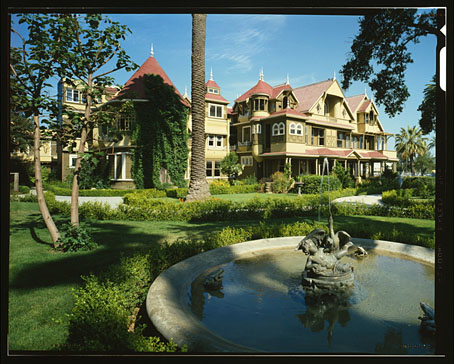
winchester1.jpg

Winchester House, 525 South Winchester Boulevard, San Jose, Santa Clara County, CA.

“One of the peculiar traits of Hill House is its design—”

“Crazy house at the carnival.”

“Precisely. Have you not wondered at our extreme difficulty in finding our way around? An ordinary house would not have had the four of us in such confusion for so long, and yet time after time we choose the wrong doors, the room we want eludes us. Even I have had my troubles.” He sighed and nodded. “I daresay,” he went on, “that old Hugh Crain expected that someday Hill House might become a showplace, like the Winchester House in California or the many octagon houses; he designed Hill House himself, remember, and, I have told you before, he was a strange man. Every angle”—and the doctor gestured toward the doorway—”every angle is slightly wrong. Hugh Crain must have detested other people and their sensible squared-away houses, because he made his house to suit his mind. Angles which you assume are the right angles you are accustomed to, and have every right to expect are true, are actually a fraction of a degree off in one direction or another. I am sure, for instance, that you believe that the stairs you are sitting on are level, because you are not prepared for stairs which are not level—”

They moved uneasily, and Theodora put out a quick hand to take hold of the balustrade, as though she felt she might be falling.

“—are actually on a very slight slant toward the central shaft; the doorways are all a very little bit off centre—that may be, by the way, the reason the doors swing shut unless they are held…”

The Haunting of Hill House (1959) by Shirley Jackson.

I re-read Shirley Jackson’s novel a few months ago but neglected at the time to follow-up the reference to the Winchester House. News this week that Sarah Winchester’s sprawling folly in San Jose is to finally allow overnight stays prompted some investigation. The most remarkable thing about the Winchester Mystery House is that it’s much more of an oddity than its fictional relation, if you overlook (so to speak) the fact that Shirley Jackson’s house is a home to malevolent spectres. Sarah Winchester was heir to the Winchester rifle fortune, and instituted a process of continual and completely uncoordinated house-building for thirty-seven years, believing that this would confound the ghosts of those killed by the weapons bearing her name. Among the house’s 160 rooms are extraneous chambers and closets, doors to nowhere, and stairways serving no purpose. The spirit-trapping decorations include repeated spider-web motifs, and a recurrence of the number 13; one room at least was originally a Séance Room. This blog post concerns a tour round the house as it is today, while the Library of Congress has a number of views of the place.

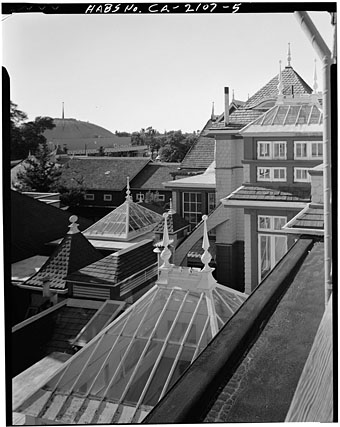
winchester2.jpg

View looking west from top floor.

It’s unfortunate that the house was built in California’s earthquake zone, the structure had reached seven stories until the 1906 earthquake forced the removal of the three topmost floors. I had to go looking for views of the pre-quake building, and happily there are a few preserved on old postcards. When Blue Öyster Cult chose Adolph Sutro’s Cliff House for the cover of their Imaginos album they certainly picked the more immediately photogenic building, but the Winchester Mystery House a few miles to the south has it beat when it comes to metaphysical cachet.

The Winchester Mystery House at Pinterest.

winchester4.jpg

winchester3.jpg

Previously on { feuilleton }
The Cliff House revisited
Adolph Sutro’s Gingerbread Palace